
Drafting & Negotiating Commercial Cleaning Contracts
Master commercial cleaning contracts with our guide. Learn to draft, negotiate, and manage agreements to prevent disputes and ensure quality service.
Dan Robin

I've seen a “simple” cleaning contract turn into a weekly headache because nobody agreed on what clean meant. The scope looked complete, the price was fine, and the first missed restroom turned into months of back-and-forth.
That's the pattern. Commercial cleaning contracts fail less because the cleaning crew is bad and more because the contract never became a working system. The market is large, recurring, and sensitive to service quality, so consistency matters when day-to-day execution is what clients judge.
The problem usually originates in the contract's framework.
A clause can sound reasonable in a conference room and still fall apart on the floor. If the scope, inspection process, and escalation path are too vague, supervisors spend their time arguing over intent instead of managing service.
What matters is turning the document into something operations can use. That means the contract has to match how the building is cleaned, who checks the work, how issues get logged, and what happens when the standard slips. Modern tools help here, but only if the agreement is specific enough to support them.
The Contract That Looked Great on Paper
The worst cleaning agreement I ever inherited had all the right words. It listed the building, sounded professional, and promised “full service.” Three months later, the client was mad, the vendor was defensive, and we were stuck trying to prove what “full service” had meant in the first place.
That's the trap. A contract can look tidy and still be operationally useless if it never defines what good looks like in the building, at the hour, and for the people living with the work. In a retention-sensitive market where service failures push customers away fast, vague terms are more than annoying, they're expensive IBISWorld.
The real problem is usually the frame
Most disputes don't start with bad intent. They start with fuzzy language, a stale checklist, and nobody wanting to ask the awkward question, “What exactly are we paying for here?”
A strong agreement doesn't just name tasks. It makes the work visible enough that both sides can tell when it's going right and when it's slipping. That's the difference between a paper contract and an operating contract.
Practical rule: if two people can read the same clause and picture two different outcomes, the clause isn't done yet.
The bigger the operation, the more this matters. Global contract cleaning revenue is already measured in the hundreds of billions of dollars, with one forecast putting the market at USD 417.71 billion in 2026 and USD 549.23 billion by 2031 (Mordor Intelligence). Another estimate projects USD 366.8 billion in 2023 growing to USD 688.5 billion by 2033 at a 6.5% CAGR (Mordor Intelligence). At that scale, nobody should still be buying “cleaning” as if it were a handshake favor.
The best contracts don't win on clever wording. They win because everyone can live with them on a Tuesday night when the building is busy and something gets missed.
Before You Write a Single Word
The strongest commercial cleaning agreements start before anyone opens a document. They start with a walk-through, a notebook, and the discipline to stop guessing based on square footage alone. That shortcut is tempting, but it usually hides the underlying cost drivers.
Walk the space like an operator, not a tourist
Don't ask first, “What's the rate per square foot?” Ask, “Where does the dirt land, who touches it, and what gets missed when the building is busy?” Restrooms, break areas, entry points, stairwells, and supply closets all age differently. A good scope reflects that reality instead of pretending every room needs the same attention.
That's why recent guidance pushes buyers to compare total cost of ownership, not just square-foot pricing. A low bid can get expensive once rework, complaint handling, and escalation time show up on your calendar, and a 60-90 day pilot can reveal the true shape of the relationship before you sign long-term Shinebook.
If you're building a pricing model for a new site, the post-construction cleaning calculator is a useful reminder that scope drives price, not the other way around.
Ask for outcomes, not just tasks
A task list says, “Clean restrooms nightly.” An outcome says, “Restrooms must meet a defined inspection standard by opening time.” That shift matters because it changes the conversation from activity to quality. The vendor isn't just proving they showed up. They're proving the space is acceptable when people arrive.
This is also where vendor questions tell you a lot. Ask how they hire, train, and keep people. Ask what they do when a crew lead calls out. Ask how they supervise. A bidder who asks smart questions about your site is usually more valuable than a bidder who just quotes fast.
Don't price the job before you understand the building.
If the proposal doesn't reflect how your space is used, the contract is already wrong.
Use this stage to decide what belongs in the scope and what doesn't. That separation saves you later when the building changes, the workload shifts, or someone tries to treat an extra task like it was always included.
The Anatomy of a Bulletproof Contract
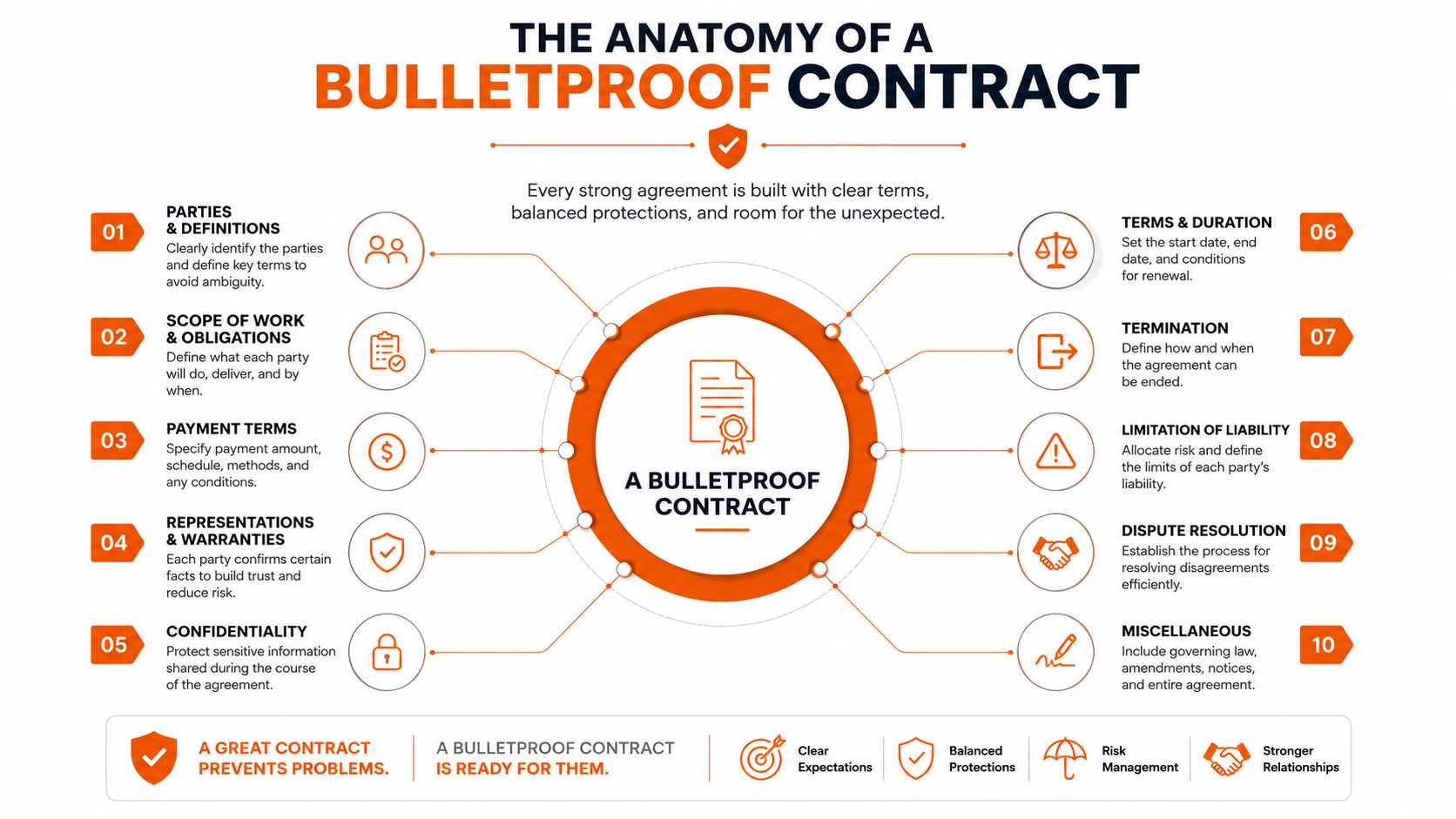
A cleaning contract should read like an operating manual, not a courtroom exhibit. The best ones make it easy for both sides to know what's expected, how success gets measured, and what happens when the work slips. That kind of clarity doesn't happen by accident.
Scope of work has to be painfully specific
The scope should name the area, the task, the frequency, and the standard. Not “common areas,” but which ones. Not “daily cleaning,” but which daily tasks and how they're judged. Industry guidance on commercial cleaning production rates makes the same point, a good estimate starts by timing task-level work and then rolling that into a site-wide labor model, because vague scopes create downstream disputes and value leakage (BSCAI).
SLAs and KPIs make the contract useful
Outcome-based agreements work better than task lists alone. Expert guidance recommends scheduled audits, photo evidence, client-led inspections, quarterly reviews, and KPIs such as inspection pass rate, response time, and completion rate (McCoy Maintenance). That's practical because it gives both sides something real to review instead of arguing from memory.
Sample language: “Service quality will be reviewed through scheduled inspections, documented photos, and agreed KPI reporting. Repeated misses trigger a corrective-action plan before escalation.”
Insurance, liability, and exit terms need plain language
The contract should say who carries what coverage, what proof is required, and what happens if the relationship fails. If you're in a market like Phoenix, a useful external reference is important advice for Phoenix property owners from South Mountain Window Cleaning, LLC, because the bonded-versus-insured distinction often gets muddled in service contracts.
The termination clause matters just as much. A clean exit keeps the relationship honest. If performance is weak, the client should have a path out. If the building changes materially, the vendor should have a fair path to renegotiate or leave.
For deeper internal alignment, I'd also keep the policy and procedure manual close at hand so the contract and internal rules don't drift apart.
From Paper to Practice Onboarding and Management
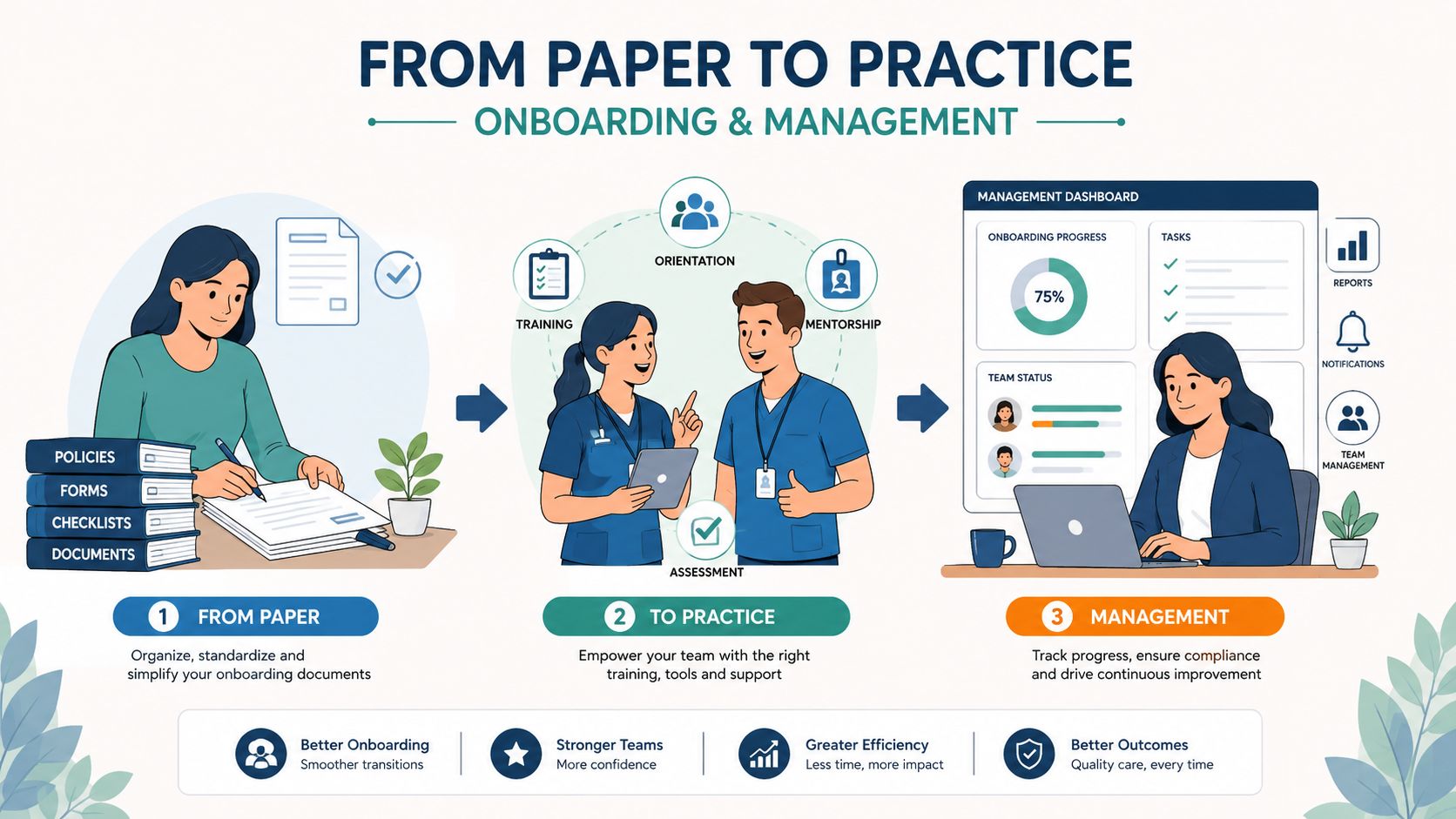
A signed contract is not the finish line. It is the first day the vendor has to prove they understand the building, the people, and the rhythm of the site. The smoothest transitions I have seen started the same way, with a kickoff walk and a very boring amount of clarity.
Kickoff should be a working meeting, not a meet-and-greet
Bring the supervisor, your main point of contact, and anyone who knows the site quirks. Walk the space together. Point out the high-traffic areas, the fragile spots, the locked rooms, and the items that look minor but trigger complaints fast. This keeps the “we never knew” problem from taking root later.
The practical move is to treat the kickoff like an operating session. Show the crew where the service boundaries are, where access gets tricky, where keys or codes live, and which rooms change use during the week. A good vendor will ask pointed questions here. A weak one will nod through the meeting and learn the site by making mistakes.
Communication needs one clear path
Set the reporting rhythm early. Decide where issues get reported, who acknowledges them, and how fast the vendor responds. The first 30 days usually determine whether the relationship feels calm or chaotic. If people start using texts for urgent problems and email for formal complaints, you have already built confusion into the workflow.
I like to keep feedback direct and small during onboarding. Fix the little misses fast. Say thank you when the crew gets something right. That sounds soft, but it is not. People clean better when they know someone is paying attention in a fair way.
Use the first month to prove the system
Frequent inspections in the early days tell you whether the scope matches reality. If something is off, adjust the process before bad habits harden. That early correction is cheaper than pretending everything is fine and then renegotiating out of frustration later.
The point is to make the contract usable on the floor. The legal language sets the terms, but the day-to-day routine decides whether the site gets the service it was promised. That usually means a simple checklist, a clear escalation path, and one place where photos, notes, and follow-up items live so no one is guessing from memory.
Good onboarding turns a vendor relationship into a predictable operating routine. Bad onboarding turns every issue into a surprise.
Keeping Things on Track When They Go Wrong
Even good contracts hit rough patches. Someone misses a spill, a supply room runs low, a scheduled task slips, and suddenly a minor issue feels bigger than it is. The trick is to respond without turning the contract into a weapon.
Start with correction, not escalation
For a first miss, a direct notice and a quick fix are usually enough. If the same issue keeps showing up, bring it back to the agreed KPI and look at the pattern. That keeps the conversation anchored in evidence instead of emotion.
The best contracts make remediation boring. They define the escalation ladder ahead of time, so neither side has to invent fairness in the middle of a bad week. That approach also helps protect the relationship. People are more willing to admit mistakes when the fix is clear.
Change orders need a real approval path
Many agreements fall apart on this point: Out-of-scope work shows up in occupied offices, healthcare sites, retail, and logistics all the time, but too many contracts still treat extra work like an afterthought. Fuzzy responsibility for add-ons is a common source of invoice and performance conflict, which is why the contract should say who can approve extra work and how it gets documented Facility Management Insights.
A practical change-order process usually answers three questions:
Who can approve: Name the role, not just “management.”
How it's recorded: Put the request, approval, and backup in one place.
How it's billed: Tie the work to a defined rate or written estimate before the crew starts.
That sounds basic, but it saves real arguments. A vendor should never be left guessing whether a site manager had the authority to authorize more work. And a client shouldn't have to sort out a surprise invoice after the fact.
The best move is to treat the contract like a shared rulebook. Use it to solve the problem, then return to the work.
The Modern Way to Manage It All
Cleaning contracts used to sit in email threads, spreadsheets, and one person's memory. A lot of sites still run that way, and the result is usually the same, slow follow-up, lost context, and a lot of time spent hunting for answers that should already be documented.
One place for the work, the proof, and the history
A unified work app changes the shape of the job. Instead of scattered messages, the team can post an issue, tag the right supervisor, attach a photo, and keep the record clean in one place. That matters because service management works better when the scope, the checklist, the contact list, and the follow-up all live together.
The bigger win is visibility. If response times and completion data sit beside the contract, the SLA stops being a line in a PDF and becomes part of daily management. That is a better way to run recurring work, especially when different sites, shifts, and supervisors all touch the same account.
The contract should tell the vendor what good looks like.
The system should make it easy to prove it.
Why this beats scattered communication
Text threads work until they do not. Emails work until someone forgets to copy the right person. A single work app gives you a live trail of what was reported, what was fixed, and what still needs attention. That record helps both sides stay steady when pressure rises, because nobody has to reconstruct the story from fragments.
If you are standardizing vendor communication, the vendor management systems article is a useful place to compare the moving parts. The main point is simpler than the software talk. A contract only works if the daily management is just as disciplined as the wording.
That is what makes the relationship easier. Less chasing. Fewer surprises. Better work.
If you are trying to turn a cleaning contract into something your team can run, start with a shared system and fewer loose ends. Pebb can help you keep the scope, communication, and follow-up in one place, so the contract stops living on paper and starts operating in the field.
