
Overcoming the Noise: A Saner Approach to Workplace Communication
End communication frustration. Explore real challenges in communication and discover calmer, more effective ways to connect your team. Boost productivity now.
Dan Robin
We have a million ways to talk to each other at work, but have we ever felt more disconnected? This isn't just a feeling; it's the core frustration of modern business. The biggest challenges in communication today aren’t about a lack of tools. They’re about the overwhelming noise and confusion those tools create.
Drowning in Talk, Starving for Connection
Let’s be honest. Does your workday feel like a calm, focused flow? Or is it more of a scavenger hunt across a dozen apps just to figure out what’s going on?
I’ve seen this story play out a hundred times. A project manager needs a simple status update. She checks a chat channel, then remembers an email thread from yesterday. She scans the project board, only to hear the real conversation happened in a completely different app. This isn't a bad day; this is just Tuesday.
We bought into a dream: more tools would mean more speed and better connection. But the reality is the exact opposite. We’ve accidentally built a digital Rube Goldberg machine of communication chaos.
The explosion of communication tools hasn’t brought clarity. It’s created more noise, more silos, and less genuine connection. The problem isn't the tools themselves, but the fragmentation they cause.
This constant app-switching isn't just annoying; it’s quietly killing our productivity and morale. Every time we jump from one platform to another, our brain pays a small tax. We lose focus. We waste time. Crucial details slip through the cracks. It's not just a feeling—a McKinsey study found the average employee spends 28% of their workweek just managing email and another 20% searching for internal information. That’s nearly half the week gone before we even start our real work.
More Channels, Less Clarity
Here’s the thing: the problem gets worse when you look beyond the office. The tools that work for headquarters are often useless for frontline teams in retail, healthcare, or logistics. They aren't sitting at desks all day. A company-wide email about a new policy is almost guaranteed to be missed by a nurse in the middle of a 12-hour shift or a warehouse associate on the floor.
This creates a dangerous divide—a two-tiered system where one part of the company feels connected and another feels ignored. This isn't just a remote work issue or a frontline problem; it's a universal drag on performance. Spotting the most common employee communication mistakes can help you see where these gaps are forming.
Ultimately, we're all swimming in a sea of pings, alerts, and updates, just hoping for a single, calm place where we can get meaningful work done together.
The Hidden Cost of a Disconnected Team
That constant, nagging feeling of juggling a dozen different apps isn't just an annoyance. It’s a quiet, relentless tax on your entire organization. Let’s be honest: poor communication is a financial black hole, and it’s probably much bigger than you think.
This isn’t some soft HR issue. It’s a hard-hitting operational failure. I see the fallout every day in the form of duplicated work, missed deadlines, and projects that go completely off the rails. Good people end up quitting, not because they hate the work, but because just doing the work has become an exhausting battle against digital friction.
From Annoyance to Bottom-Line Expense
So, what does this communication chaos actually cost you? The numbers are staggering. Poor communication is projected to cost businesses over $9,000 per employee every single year by 2026. For a team of just 50 people, that’s nearly half a million dollars vanishing into thin air. Money that could have funded a critical project or covered new salaries.
This isn't an abstract figure. It’s the sum of a thousand tiny failures. It's the cost of a developer rewriting code because the requirements were buried in a messy chat thread. It's the price of a marketing campaign that flops because the sales team never got the memo on the new messaging.
This is what that daily fragmentation looks like. Most teams are constantly bouncing between different tools just to stay on the same page.
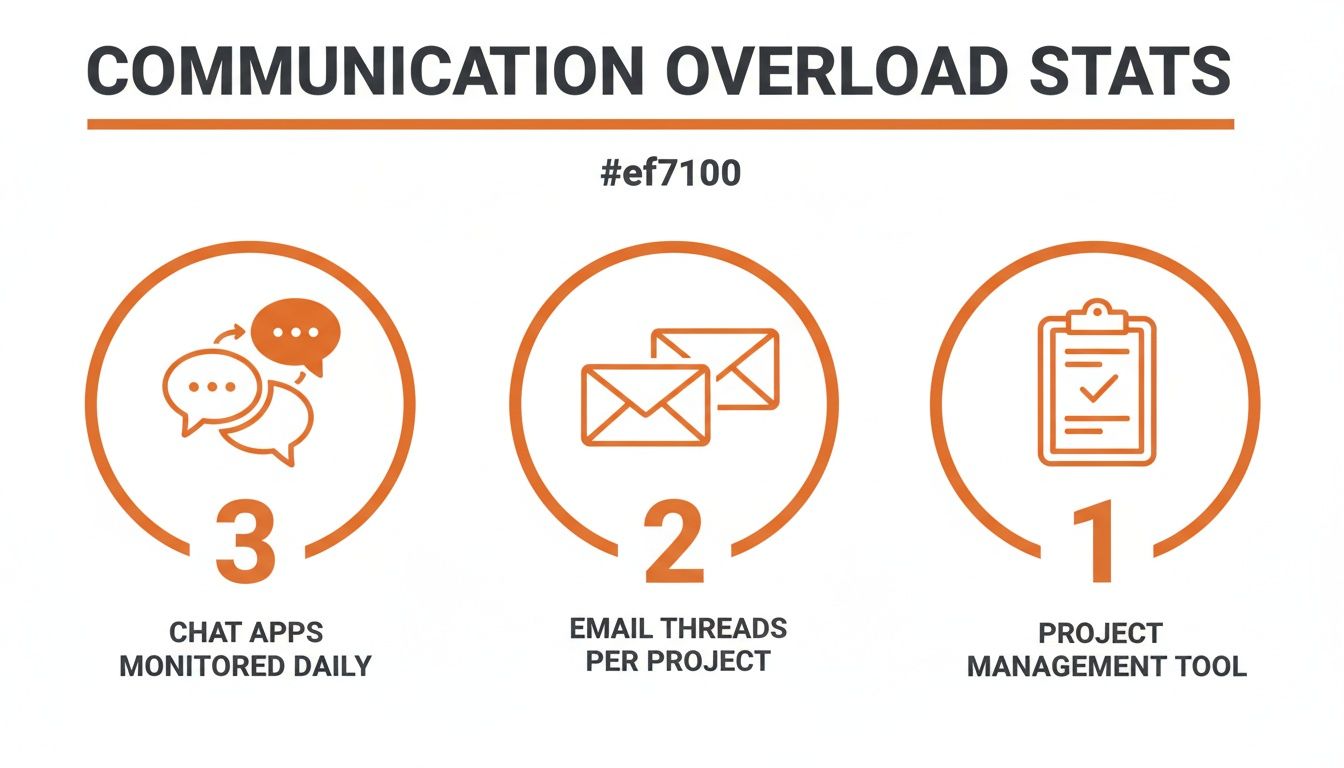
When every conversation is scattered across different platforms, just finding the right information can feel like a full-time job.
The Real-World Consequences
For frontline industries like healthcare or logistics, the stakes are even higher. A single missed message isn't just inefficient—it can be catastrophic. Think about a patient care update that never reaches the next nurse on shift. Or a last-minute delivery change that a driver never sees. These are critical system failures with serious consequences.
This chaos doesn't just tank productivity; it's a direct path to burnout. A staggering 86% of employees and executives point to a lack of collaboration as the main reason for workplace failures. On top of that, 28% of employees directly link poor communication to something as tangible as a delayed delivery. You can see more eye-opening communication stats to understand the full scope of the problem.
The real cost of poor communication isn't just the money. It's the lost trust, the wasted potential, and the slow erosion of a team's spirit.
Ultimately, these communication challenges tell a familiar story. For years, we’ve been adding more tools, thinking that more channels would automatically lead to more clarity. Instead, we’ve just built a maze.
The question isn’t whether this is a problem—we all feel it every day. The real question is, what are we going to do about it? Sticking with the status quo is like willingly paying a hidden tax that bleeds your company dry, one missed message at a time. It’s a cost no business can afford.
Your Tech Stack Is Part of the Problem
Let's be blunt about the communication challenges we've been discussing. The very tools we bought to fix them are often making things worse. We were sold a vision where a specialized app for every task would make us hyper-efficient. Instead, we’ve ended up with a jumbled mess that kills our focus.
It’s like trying to cook a gourmet meal, but your knives are in the garage, your spices are in the attic, and your pots are in the basement. You’d spend all your time running around looking for tools instead of actually cooking. That’s not just inefficient; it’s exhausting. And it's exactly what we're asking our teams to do every day.
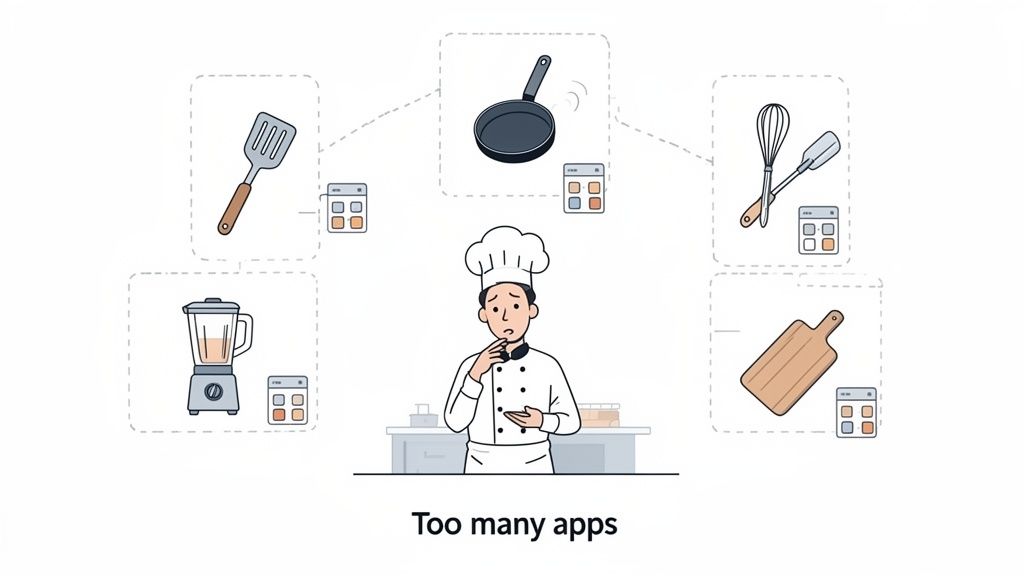
This constant app-switching is destructive. It forces our brains to pay a hefty cognitive tax every time we jump from a chat window to an email to a project board. This is context switching, and it’s a silent killer of deep work.
The True Cost of Context Switching
Every time you switch apps, your brain has to reorient itself. It needs to recall why you opened that app, what you were looking for, and what to do next. Each switch feels tiny, but they add up to hours of lost productivity and mental energy every week.
For managers, this has become a daily nightmare. They’re forced to play digital detective, piecing together scattered fragments from a dozen sources just to get a clear picture of what’s going on. This isn't leadership. It's painful administrative busywork.
The “best-of-breed” approach to software has accidentally created a communication disaster. We’ve optimized for individual features at the expense of a cohesive, calm workflow.
And this problem isn’t just for office workers. For frontline teams in retail, hospitality, or logistics, being chained to multiple platforms is impossible. A shift supervisor can’t check five different apps on their phone while managing a busy restaurant floor. It’s impractical and, frankly, unsafe.
The data confirms what we all feel. Research shows that employees using more than 10 apps report communication issues at a rate of 54%, compared to just 34% for those using fewer than five. This app overload is more than an annoyance; leaders spend over an hour each day just resolving collaboration hiccups, costing companies up to $16,491 per manager annually in lost efficiency.
App Overload Creates Digital Silos
When your team’s tools don't talk to each other, neither do your people. Each app becomes its own isolated island of information. Crucial conversations get trapped in one tool, key documents live in another, and project updates are posted somewhere else entirely.
This fragmentation fosters an environment where:
Information gets lost: A critical decision made in a chat is never documented in the project tool.
Onboarding is a mess: New hires are handed a list of 15 different logins with no clear map of where to find anything.
No one has a single source of truth: Everyone operates from their own version of reality, depending on which app they checked last.
The table below breaks down just how much this fragmentation costs your business—and what you gain by simplifying.
The Hidden Costs of a Fragmented Tech Stack
Challenge Area | Impact of Fragmented Tools (10+ Apps) | Benefit of a Unified Platform |
|---|---|---|
Productivity | Constant context switching drains focus and wastes hours each week. | One central hub for work eliminates the need to jump between apps. |
Information Access | Critical information is scattered, lost, or hard to find. | A single source of truth makes information instantly accessible to everyone. |
Employee Experience | Frustration and burnout from digital friction and tool fatigue. | A calmer, more streamlined workflow reduces stress and improves job satisfaction. |
Onboarding | New hires face a steep, confusing learning curve with too many tools. | Faster, simpler onboarding with one system to learn and master. |
Team Cohesion | Digital silos prevent cross-functional collaboration and alignment. | Centralized communication breaks down silos and connects the entire organization. |
A scattered tech stack creates a scattered team.
Solving these communication problems in the workplace requires more than just adding another tool to the pile. It calls for a fundamental shift in how we think about our digital workplace. Instead of chasing the "best" app for every little task, we need to find the best way for our people to work together in one place. It’s about choosing calm and clarity over chaos and complexity. The goal should be to find a digital home for your team, not a dozen digital apartments.
Connecting the Desk to the Frontline
One of the most persistent, and honestly, most damaging communication challenges I see happens in the space between a comfortable desk at HQ and the fast-paced reality of the frontline. It’s a gap that can swallow great ideas, crush morale, and quietly sabotage the entire customer experience. This isn't some abstract business theory; it's a daily, tangible failure.
I’m reminded of a retail chain we worked with. Their marketing team, full of brilliant people, put together a massive seasonal promotion. They spent weeks perfecting the creative, the messaging, the whole plan. But on launch day? A disaster. Why? Because the most critical details never made it to the store associates who were supposed to bring it to life.
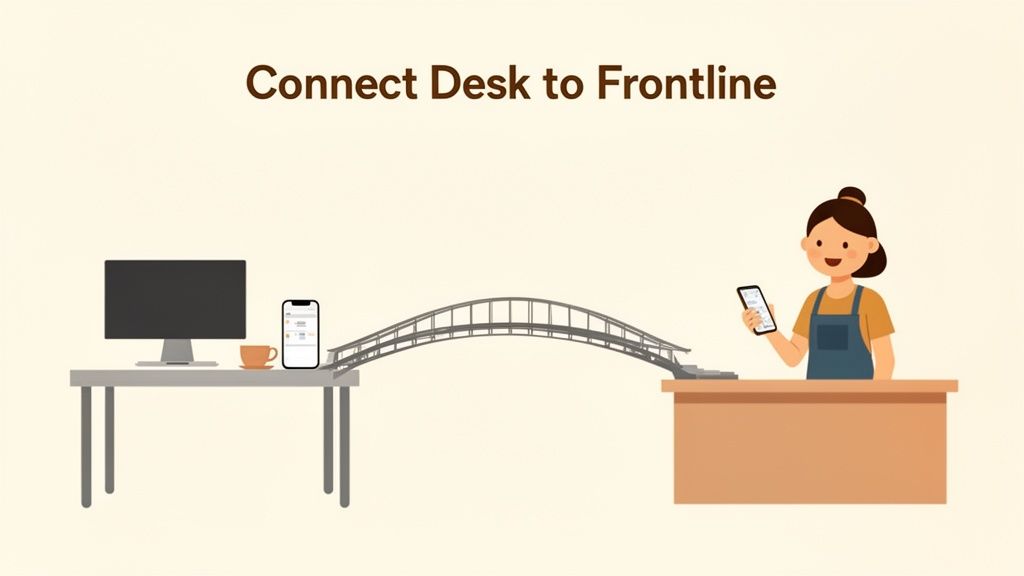
The plan was dutifully sent out via email and posted on the company’s ancient intranet. The problem is, frontline employees don’t live in their inboxes. They don’t have time to hunt down a clunky, desktop-only portal between helping customers and restocking shelves. The message was sent, but it was never truly received.
The Frontline Is a Different World
We have to get real about the environment of frontline work. These folks are mobile, on their feet, and working shifts that don't fit into a 9-to-5 box. For them, the communication tools that office teams take for granted are practically useless.
Email is a black hole. It’s a tool for desk workers, not for a nurse on a 12-hour hospital shift or a warehouse associate operating a forklift.
Intranets are ghost towns. They're often outdated, a nightmare to navigate on a phone, and feel completely disconnected from the daily rhythm of their work.
Meetings are a luxury. You can't just pull an entire retail team off the floor for a 30-minute Zoom call to walk through a new policy.
When we try to force office-centric tools onto a mobile workforce, we create a fundamental disconnect. The result is a company operating in two different worlds.
This isn't just a technology gap; it's a culture gap. When frontline teams are left out of the main conversation, they don’t just miss information—they feel like they don’t matter.
This feeling of being an afterthought has serious consequences. It leads to inconsistent customer service, as staff work with incomplete or outdated information. It tanks morale, as employees feel disconnected from the company's broader mission. In fact, over 70% of frontline workers report feeling that communication from headquarters isn't relevant to their actual jobs. That's a huge portion of the workforce feeling ignored.
Building a Bridge, Not Just Sending a Memo
So, how do we fix this? The answer isn't to send more emails or plead with people to log into the intranet. We have to meet them where they are, with tools designed for their reality. A purpose-built, mobile-first platform like Pebb is what finally builds that bridge.
Imagine a single app on every employee’s phone that becomes their central hub. A single source of truth that works for everyone, no matter their role or location. A news feed delivers important updates, a knowledge library puts procedures right in their pocket, and shift-based chats allow teams to coordinate in real time.
This isn't about adding another app. It's about replacing a broken system with one that actually works for the people who are the face of your brand. It’s about making everyone—from the CEO to the newest cashier—feel like they’re part of the same team. When that happens, you don't just solve a communication problem; you build a stronger, more connected company.
Finding a Calmer Way to Work Together
We’ve all felt it. The constant pings, the frantic search for that one file you know you saw last week, the nagging feeling you’re missing an important conversation happening somewhere else. It’s easy to write this off as just “the cost of doing business” in a modern company.
But what if it isn’t?
The answer isn't another app or a complicated new process. It's about taking a step back and intentionally choosing clarity over clutter. The way forward is to stop chasing conversations across a dozen channels and, instead, build a single, calmer place where work actually happens. This is a move away from the always-on, reactive scramble that burns people out. It’s about creating space for focused, deliberate work.
From a Messy Garage to a Clean Workshop
Imagine trying to build something in a cluttered garage. Tools are scattered everywhere, half-finished projects are piled in corners, and you spend more time looking for a screwdriver than actually using it. It’s stressful and inefficient. That’s what work feels like when your communication is a mess.
Now, picture a well-organized workshop. Every tool has its place. Your current project is laid out on a clean workbench. You can walk in, grab exactly what you need, and get down to business. That’s the feeling we should be aiming for.
This is where the idea of dedicated Spaces comes in. In a tool like Pebb, a Space is a central hub for a specific team, project, or topic. It’s not just another chat channel; it’s the digital workshop where everything related to that initiative lives together.
A Space is the dedicated workshop for your team. It’s where conversations, files, decisions, and tasks all live together, in perfect context.
It’s a simple concept, but the impact is huge. When a new person joins a project, you don't forward them a mountain of old emails. You just add them to the Space, and the entire history—the full context—is right there. The chaos becomes a clear, organized record of work.
More Than Just Organization
Getting everything into one place does more than just tidy things up; it fundamentally changes how your workday feels. That low-grade anxiety from digital noise—the fear of missing something important—starts to disappear. This isn't just about efficiency; it's about reclaiming your focus.
When conversations, files, and action items are all linked, work starts making sense again. A clear narrative emerges, and everyone is reading from the same page. This approach delivers a few profound benefits:
One Source of Truth: No more digging through emails or asking, "So, where did we land on that?" Everyone knows where to look.
Less Context Switching: By staying in one environment, you protect your focus and conserve mental energy.
Natural Accountability: With tasks tied to the conversations that spawned them, it’s always clear who owns what and when it’s due.
This isn't a one-size-fits-all mandate, either. A great system like Pebb allows you to tailor each Space to the team's needs. A marketing team's Space can be a hub for creative assets, while a logistics team's Space is all about shift planning.
Turning a List of Names into a Community
Finally, creating a calmer digital workplace has a powerful side effect: it helps turn a directory of employees into a community.
When you can easily find people, see their roles, and get a sense of what they're working on, the entire organization feels more connected and human. A searchable people directory isn't just a handy feature; it's a bridge between teams. It helps a new hire feel less like a name on a spreadsheet and more like a part of the team from day one. It lets a manager in one department quickly find the right expert in another.
The communication challenges we’re all facing run deep, but the solution doesn't have to be complicated. It starts with one human-centric idea: give your people a single, calm place to do their best work. Give them a workshop, not a messy garage. The efficiency, clarity, and sense of connection will follow.
Alright, let's talk about where the rubber meets the road. We've spent a lot of time exploring the tangled mess that communication can become, but fixing it doesn't mean staging a massive, company-wide intervention. It starts with one small, deliberate step.
Honestly, the thought of unwinding years of communication chaos is enough to make anyone’s head spin. But that’s only if you try to fix everything at once. The real path forward begins with just a single team.
Try a Quick Communication Check-Up
Pick one team. You don't need a fancy consulting firm, just a few honest questions:
What tools are we really using day-to-day?
Where does work get stuck? Is it hunting for a file, waiting on an approval, or just figuring out who’s responsible?
How much of our day is lost just trying to get on the same page?
This check-up isn't about pointing fingers. It's about seeing the hidden costs of confusion. Once you spot the patterns, you’re ready for the next move.
Start small. Choose one team or one high-stakes project and give them a dedicated, unified space. Pull all their conversations, files, and to-do lists into that one spot and watch what happens. The goal is to see for yourself how it cuts down on stress, brings a sense of calm, and helps people feel truly connected to their work and each other.
The most powerful solutions are often the simplest ones. Creating a single source of truth for one team is a small change that creates a ripple effect of clarity and calm across the organization.
The fundamentals of great teamwork are the same everywhere. To build stronger bonds, it’s crucial to know how to fix poor communication skills in any environment. As you build this muscle, you can even check out our guide on how to measure communication effectiveness to see your progress in black and white.
Here’s the bottom line: solving these communication problems is not only doable, but it's far less complicated than you might think. You don’t need another app; you need a better, more human way to work. That journey doesn’t start with a grand five-year plan. It starts with one team in one clear, simple space.
Ready to stop juggling apps and start building a calmer, more connected team? Pebb unifies all your communication, operations, and engagement into one simple app for both frontline and office teams. Start your journey toward clarity today.
