
The Truth About Instant Messaging in Business
Discover the real truth about instant messaging in business. We explore how to move beyond chaotic chats to build a calmer, more productive workplace.
Dan Robin
Instant messaging was supposed to save us from our inboxes. The promise was faster, easier collaboration. But let’s be honest about where we’ve ended up. For most of us, it’s a digital leash—a relentless stream of pings that shatters our focus and creates a culture of constant interruption.
The expectation of an immediate response isn't a feature. It's a bug in our work culture.
The Unspoken Cost Of Constant Connection
We were sold a direct line to our colleagues, a way to cut through the noise. What we got was a blinking green light that never, ever turns off. That’s not progress. It’s just a new kind of chaos.
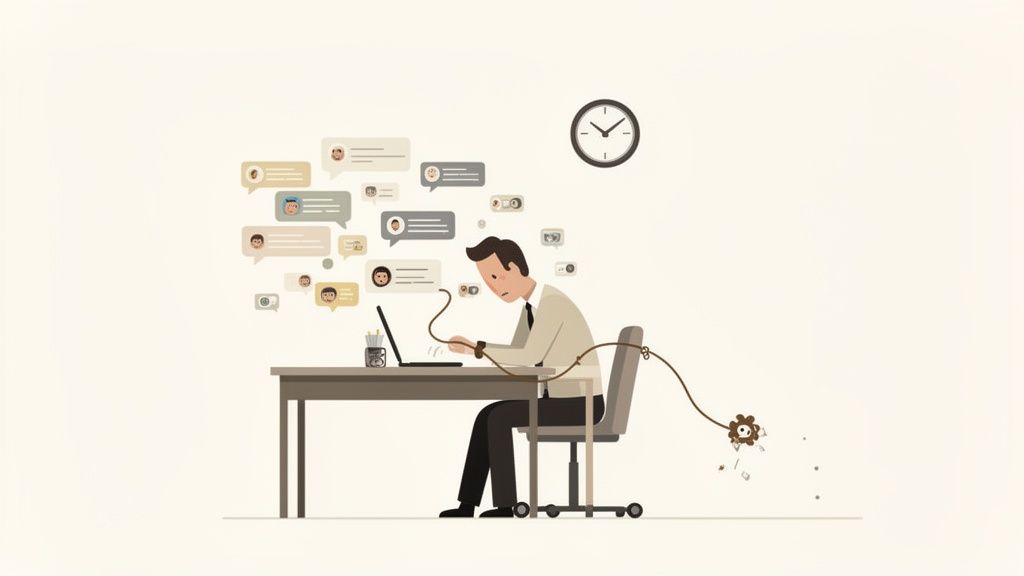
Every “quick question” that pings you on chat is the modern equivalent of a tap on the shoulder. It seems innocent, but it yanks you out of deep work, fractures your attention, and forces you to rebuild your train of thought. It’s a huge, hidden cost. We feel more connected than ever, yet somehow, less productive.
The Real Cost of "Always On"
This constant state of alert isn’t just annoying; it has a human cost. It leads straight to burnout, mental fatigue, and that nagging sense that you’re never truly off the clock. One of the biggest unspoken costs is the pervasive issue of employees feeling overwhelmed at work. It’s a slow erosion of our ability to think deeply and do creative work.
Here’s the thing: when every message feels urgent, nothing is. This isn’t a personal failure to manage our time. It’s a systemic problem we’ve accidentally built by adopting tools without setting rules.
It turns out that poor internal communication is one of the most expensive problems facing businesses today. Recent data shows the cost can top $30,000 per employee annually, with U.S. businesses losing over $2 trillion each year.
This isn’t just about lost productivity; it's about your people. The same data reveals that a staggering 63% of employees have thought about leaving their jobs because of bad communication. That number speaks volumes. You can find more insights in these communication statistics on Pumble.com.
Acknowledging the Problem We Created
It’s easy to blame the technology—the notifications, the endless channels. But the tool is just a mirror. It reflects our company’s communication culture. The expectation of an immediate response isn't baked into an app; it’s a bad habit we’ve allowed to take root.
This isn’t a call to abandon instant messaging. It’s a call to be honest about the mess we've made and to have a real conversation about finding a better way. It’s time to find a calmer, more intentional way to work together.
Moving Beyond Disorganized Chat
The problem with most instant messaging at work isn't the message itself—it's the mess. It’s the chaotic, real-time free-for-all that happens when chat is just another app, disconnected from everything else.
Let's think about this differently. Imagine a cluttered garage versus a well-organized workshop.
In the garage, tools are everywhere, projects are piled high, and you waste half your time just looking for a screwdriver. You’re constantly tripping over junk. That’s what most business chat feels like: disconnected threads, lost files, and conversations completely detached from the actual work.
From Chaos to Context
Now, picture the workshop. Every tool has its place. Projects are arranged on dedicated benches with all the necessary parts and plans right there. When you need to work on something, you walk over to its spot, and everything you need is within arm’s reach.
This is what instant messaging in business should feel like. A message shouldn't float in a random, endless stream. It should live inside a dedicated space for a project, right alongside the tasks, files, and key updates.
Imagine hashing out a new marketing campaign. Instead of a vague chat thread named "#marketing-stuff," the entire conversation happens right next to the campaign brief, the design mockups, and the task list. Every message has context. Every decision gets documented where it matters.
The real breakthrough happens when messaging stops being a source of distraction and becomes a tool for clarity. It’s not about talking more; it’s about understanding more.
When your team can see the project schedule while they discuss the schedule, the conversation is instantly more productive. No more switching apps, searching for files, or asking, "Wait, which version are we talking about?" The context is built-in.
The Power of a Dedicated Space
This approach fundamentally changes how work gets done. It shifts communication from being an interruption to being part of the workflow.
Decisions get recorded, tied to the specific project or task, creating a clear, searchable history. Focus is preserved because you enter a project's space mentally, leaving other distractions behind. And onboarding a new team member becomes a breeze; they can join a project space and see the entire history of conversations and decisions, getting up to speed in hours, not weeks.
We’ve all felt the pain of piecing together a project's history from scattered emails and chat logs. It’s a massive waste of mental energy. For anyone looking to break that cycle, our guide on how to stop work information getting lost in email and chat offers some practical first steps.
Ultimately, turning that messy garage into a functional workshop isn’t about buying more tools. It’s about creating a system—a space where focused work can happen naturally, and where communication actually supports the work instead of derailing it.
Connecting Your Entire Organization
For too long, we’ve treated our communication tools like they belong in the corner office. We give our desk-bound teams powerful software, but leave our frontline workers—the folks in the warehouse, on the retail floor, or in the hospital wing—to make do with paper notices and their personal chat apps.
This creates a dangerous divide. An information gap. We’ve accidentally built two different companies under the same roof. One part of the business moves at the speed of light while the other is left in the dark.
This isn't just inefficient; it's a failure of connection. Modern instant messaging in business has to be for everyone, especially for the people who aren’t sitting in front of a computer all day.
One Source of Truth for Everyone
Think about the real-world scenarios that play out every day. A retail associate needs to check stock in the backroom. A shift lead in a hospital has to send an urgent update about a patient. A logistics manager on the road needs to confirm a delivery with the warehouse team.
These aren't edge cases. This is the lifeblood of your business. When these teams are forced to use insecure consumer apps, you lose control over company data and create a mess. Whose phone number do you need? Is that message official? What happens when that employee leaves?
The goal isn’t just to pass messages back and forth. It’s to build a bridge between every single employee, ensuring each person feels seen, heard, and connected to the company's mission.
A single, unified platform becomes the one source of truth. It's where the new company policy is posted, where schedules are confirmed, and where a team member can get a quick, reliable answer without having to hunt someone down.
This comparison shows the difference between the chaotic chatter we're used to and the clarity of a unified, contextual approach.
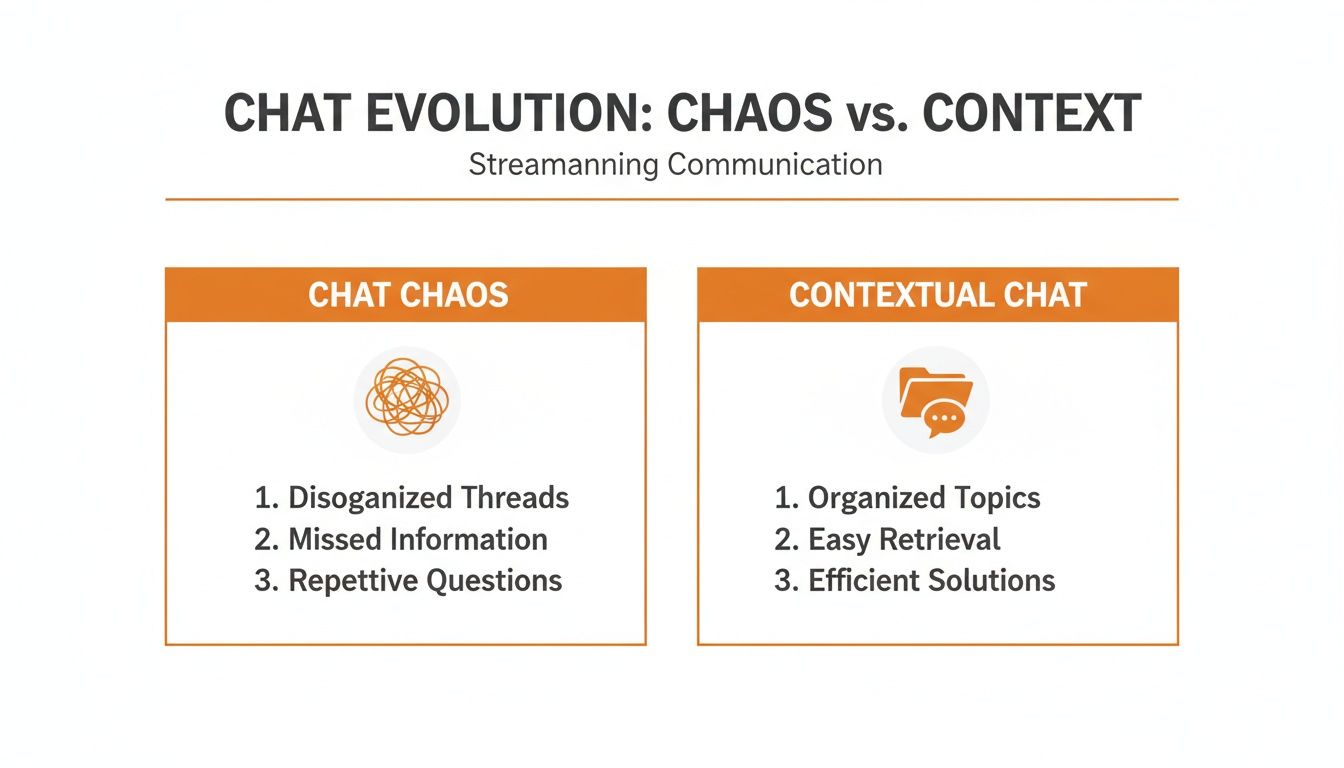
It’s a simple visual, but it captures the core idea: moving from tangled, disorganized threads to focused conversations that live right alongside the work.
More Than Just a Chat App
Let's be honest. Giving everyone a chat app isn't the solution. It can make things worse if it’s just another silo. The real value comes when communication is baked into an integrated system—a single digital home for your entire organization.
This means business-grade security and oversight that consumer apps like WhatsApp can’t provide. You control the data and maintain a professional boundary between work and personal life. It also means the tool does more than just chat. It handles shift scheduling, task management, and document sharing. The message about a shift change lives right next to the schedule itself.
When everyone is on the same platform, you can finally build a cohesive culture. The CEO can share an update that reaches the part-time cashier instantly. A win from the sales team can be celebrated by the logistics crew who made it happen.
The business case for this is clear. Faster communication leads to faster decisions and better-coordinated operations. For instance, companies that use text messaging with customers are 683% more likely to report digital marketing success, a principle that applies just as strongly to internal operations. You can discover more about the power of direct messaging on Emarsys.com.
When we choose to connect our entire organization, we’re doing more than improving efficiency. We’re saying that every person’s work matters. We’re saying that everyone, from the front line to the corner office, is part of the same team. That simple idea might be the most powerful tool we have.
Comparing Communication Tools For A Hybrid Workforce
Let's take a closer look at how different tools serve the needs of both office-based and frontline teams, highlighting the gaps left by traditional and consumer apps.
Feature | Consumer Chat Apps (e.g., WhatsApp) | Unified Work App (e.g., Pebb) | |
|---|---|---|---|
Reach | Effective for desk workers; poor for frontline staff. | High adoption but mixes personal/work and lacks oversight. | Reaches everyone on any device with a single company-wide app. |
Security & Compliance | Secure but vulnerable to phishing; difficult to manage. | No company control, data on personal devices, major risk. | Centralized control, enterprise-grade security, and compliance. |
Operational Integration | Disconnected from workflows and other business tools. | Completely separate from work systems like scheduling/tasks. | Integrates chat, tasks, schedules, and training in one place. |
Culture & Engagement | Formal, slow, and not ideal for building community. | Informal but unprofessional; creates communication silos. | Fosters a unified culture with company-wide announcements & recognition. |
User Experience (Frontline) | Clunky and impractical on mobile for on-the-go work. | Easy to use but not designed for business-specific needs. | Mobile-first design optimized for frontline tasks and speed. |
As you can see, while email and consumer apps have their place, they fall short in creating a truly connected and secure environment for the entire workforce. A unified app is built specifically to bridge that gap.
Establishing A Culture Of Calm Communication
Let's get one thing straight: a new tool won't fix a broken communication culture. It will just give you a faster way to continue the same bad habits. If your team is drowning in interruptions, a new app just becomes a more powerful firehose.
Tools don't create calm. Principles do.
To make instant messaging in business a true asset, you have to build a culture of calm, intentional communication first. It’s about setting shared agreements that help everyone work without burning out. It’s about turning down the noise so people can finally focus.
Make Asynchronous The Default
Here is the single most important rule: an instant message does not demand an instant reply. We have to break the spell that a blinking green "available" light means "interrupt me now." The real power of modern messaging isn’t just speed; it’s the freedom to leave a thoughtful message that someone can pick up when they are ready.
This is the heart of asynchronous work. It’s a simple but profound shift from "I need you now" to "I trust you'll get to this when you can." Fostering a truly calm environment means embracing practices centered on asynchronous communication, which dramatically lowers the pressure for instant responses and protects everyone's focus.
We’ve found that when you give people long stretches of uninterrupted time, they produce better work. The best ideas rarely come from a frantic chat thread; they come from quiet, focused thought.
This isn’t about ignoring your colleagues. It’s about respecting their time and attention as much as you respect your own. It's a mutual agreement that the most important work happens when we’re not constantly talking about the work.
Channels For Clarity, Not Chaos
A classic mistake is creating a few giant, all-purpose channels where everything gets dumped into the same feed. Before you know it, your "#general" channel is a messy pile of project updates, birthday announcements, and questions about the office coffee machine. It’s impossible to follow.
The solution is to be ruthless about creating dedicated channels for specific topics, projects, or teams. For example, every new project gets its own space (like #proj-q4-website-redesign). All conversations and files for that project live there, and only there. A dedicated space for each department (like #team-marketing) keeps their work contained. And fun, non-work channels (like #social-book-club) give people a place to connect without cluttering work conversations.
This structure creates what we call "contextual containers." When you jump into a channel, you know exactly what the conversation is about. Information becomes organized and searchable by default.
Respect The Status Indicators
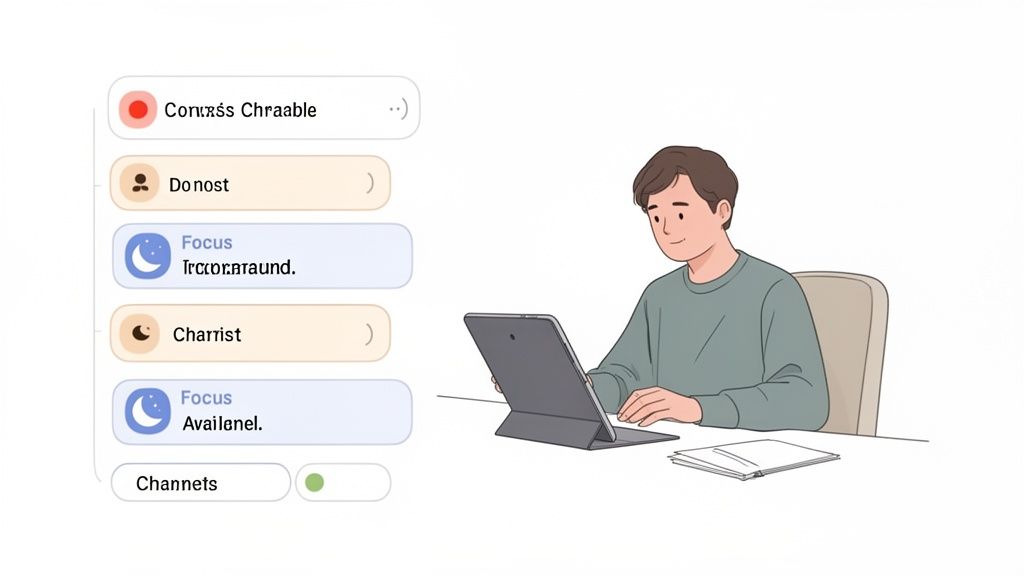
Finally, a calm culture runs on clear signals. Modern messaging tools have status indicators—"In a meeting," "Focusing," "Out for lunch." These aren't just cute icons; they are essential communication tools.
You have to teach your team to treat them like a closed office door. If a colleague's status says they're in focus mode, that's not an invitation to see if your message can break through. It’s a clear sign they’ve set aside time for deep work.
Respecting these boundaries is everything. It shows you trust your teammates to manage their own time. This isn't just a feature; it's a social contract. An agreement that we will protect each other’s focus because we know that’s where the best work comes from. It's a critical piece of the puzzle when you start to ask, how much communication is too much?
Building this kind of culture takes time. But by establishing these simple principles, you can transform your messaging tool from a source of anxiety into an engine for calm, focused collaboration.
How To Choose The Right Messaging Tool
Not all messaging platforms are created equal. Many are just features tacked onto other software—an afterthought to check a box. Others were built for casual chats between friends, not for the focused, professional work your business relies on.
Choosing a new tool isn't just about picking an app. It's a decision about the kind of company you want to be. Are you looking to add another distraction? Or do you want a tool that makes work simpler and brings your people together?
The market is flooded, but most options aren’t asking the right questions. We believe the evaluation should be simple and grounded in the reality of your day-to-day work. It comes down to a few critical questions that cut through the marketing noise.
Does It Unify or Divide?
This is the first and most important question. Does this tool bring all your communication into one place, or does it create another island? Many companies end up with a messy patchwork—one tool for office workers, another for frontline teams, and email for everything else.
This fragmentation is a hidden tax on your team’s time. Information gets lost, decisions are delayed, and a cultural divide forms. A true communication tool has to serve everyone, from the front line to the corner office, in a single, unified space. It needs to be the one place everyone knows to go for the truth.
A great tool doesn't just connect individuals; it connects the entire organization. It breaks down silos by design.
Is It Built For Your Entire Workforce?
Many messaging tools seem designed with only a desk-bound worker in mind. They assume everyone has a laptop and time to navigate complex software. But what about the nurse on her feet for a 12-hour shift, or the retail associate on the store floor?
Your communication tool has to work flawlessly for them, too. That means it must be mobile-first, incredibly simple to use, and directly relevant to their daily tasks. Can a manager post a schedule and have the team confirm shifts right from their phones? Can a new hire access training materials without ever touching a desktop computer?
If a tool doesn't serve the people doing the core work of your business, it’s not really a business tool. It’s just office software.
Is It More Than Just Chat?
This is where you see the difference between a simple chat app and a true work platform. Basic messaging is a commodity. What makes it indispensable is its connection to the actual work getting done.
Does the tool integrate with tasks, schedules, and file sharing? Can a conversation about a project happen right next to the project’s to-do list? When your team can discuss an issue and assign a task to resolve it in the very same window, you’re no longer just talking—you’re moving work forward.
A collection of separate apps—one for chat, another for tasks, another for schedules—only adds complexity. The goal should be to find one tool that simplifies work, not one that forces your team to juggle multiple apps. For those still using consumer apps, we've explored why WhatsApp isn't ideal for employee communication and what to look for instead.
Choosing the right tool is a deliberate act. It's a commitment to clarity over chaos, unity over division, and helping every single person in your organization do their best work. Don't settle for just another chat app. Demand a platform that understands what it truly means to work together.
Finding A Calmer Way To Work
We started this conversation by talking about noise. Let's end by focusing on the quiet confidence that comes from clarity.
For too long, the goal of business instant messaging was to make everything faster. A quicker question, a speedier reply. But speed without understanding is just chaos. What if, instead, we aimed to make everything clearer?
That’s a real shift in mindset. It means ditching the frantic, disorganized chatter that leads to burnout and swapping it for focused conversations that have context. It’s less about chasing the latest productivity hack and more about building a solid foundation for calm, intentional communication.
The Silent Engine Driving Collaboration
When communication is really working, you almost don't notice it. The constant pinging dies down. It’s replaced by a shared sense of purpose. It becomes a silent engine that powers teamwork, not a constant source of distraction. The right work just seems to happen.
This isn't some workplace fantasy. It's the result of making deliberate choices. It’s about picking a tool that unifies everyone—not just the folks at headquarters. It’s about building a single source of truth so the nurse on the night shift has the same access to vital information as the executive in the boardroom.
Clarity is the ultimate productivity tool. When people know exactly what needs to be done, who is responsible, and why it matters, the friction just melts away.
This is what happens when a discussion about a project is attached to the project file itself. It’s what happens when a question about a schedule is asked right next to that schedule. Context kills ambiguity, and with it, the need for a dozen follow-up pings.
The Real Goal of Instant Messaging in Business
The true purpose of instant messaging at work shouldn't be to keep everyone talking all the time. It should be to help everyone work better, together. That means protecting people's focus, not shattering it. It means building bridges between departments, not reinforcing silos.
Here’s what that looks like: fewer, better messages. Respect for focus time, where people trust they can disconnect to do deep work. And universal access, so every employee, no matter their role, feels connected and has the info they need.
Let’s be real. The old way isn't working. The relentless pressure to be "always on" is unsustainable. It's time to stop measuring our communication by its speed and start measuring it by its clarity.
Think of this as an invitation to see messaging not as another app, but as the cornerstone of a calmer, more focused, and more connected way of working. Because when your team is truly in sync, you’ll find that the best work happens in the quiet moments, not in the frantic exchange of messages.
Frequently Asked Questions
When teams start thinking about bringing instant messaging into their business, a few key questions always pop up. Let's dig into them, because the real win isn't just about new tech—it's about building a smarter communication culture.
How Do We Introduce Messaging Without Creating More Distractions?
This is the big one, and it's a totally fair concern. The secret isn't in the tool itself, but in the ground rules you set from the very beginning.
Make it clear that instant messaging is for asynchronous communication. In other words, an immediate response is never the expectation. A great way to reinforce this is by creating dedicated channels for specific projects or topics, which stops everything from getting dumped into one chaotic feed.
Also, encourage everyone to actually use their status updates. A simple "Heads down on the quarterly report" message lets the team know you need some uninterrupted time. It's all about teaching people how to use the tool respectfully.
Is Instant Messaging Secure Enough For Business?
Let's be direct: consumer apps like WhatsApp just don't cut it for professional use. They create huge security gaps and raise serious questions about who actually owns the data. Your company's private conversations have no business living on an employee's personal device, completely outside of your control.
Any true business-grade platform needs to offer end-to-end encryption and give you administrative control over who sees what. It also has to meet compliance standards like GDPR. Choosing a tool built specifically for work ensures your company's data stays your company's data. Period.
How Can We Get Frontline Teams To Adopt A New Tool?
For frontline workers, adoption boils down to two things: it has to be dead simple, and it has to make their job easier.
First, the tool must be mobile-first and ridiculously intuitive. If it requires a manual to figure out, you've already lost.
More importantly, it has to solve a real problem they face every day. If the app is just another place to chat, it's just another notification to ignore. But if that same app also gives them instant access to their schedules, important company-wide announcements, or safety documents, it becomes essential. It goes from being a "nice-to-have" to a "can't-work-without" part of their day.
Ready to build a calmer, more connected workplace? With Pebb, you can unify your entire team's communication, operations, and engagement in one simple, powerful app. See how Pebb can transform your business.
