
Break Management That Actually Works for Frontline Teams
Break management made practical for HR and frontline managers. Build policy, schedule coverage, track compliance, and improve culture without the chaos.
Dan Robin

On a Tuesday afternoon at a regional grocery distribution center, two pallet jacks went down, a manager covered the dock, and breaks slipped by thirty-five minutes. A new hire ate a granola bar at her station because nobody could release her. The schedule said everyone would get a break. The floor said otherwise.
That scene repeats in warehouses, hospital units, restaurants, and retail stores. Breaks sit between compliance, throughput, safety, and morale, yet most org charts don't give anyone clear ownership. When the system fails, workers get blamed for taking too long, supervisors get blamed for poor coverage, and HR gets the problem after the fact.
Good break management treats rest as an operating system. It gives the policy an owner, gives the schedule enough relief capacity, gives managers useful signals, and leaves a record that can survive a wage claim or inspection.
The Break Problem Nobody Wants to Own
The symptoms are easy to recognize. Lunches get skipped. Smoke breaks cluster around the same quiet window. Overtime appears at the end of a shift because people stayed late to finish work they couldn't complete while covering for others. The same two reliable employees keep filling every gap until reliability becomes resentment.
The organization often responds with one of two bad choices. The first is a strict policy that looks tidy on paper but ignores the dock, the medication round, or the lunch rush. The second is a flexible floor where supervisors make constant judgment calls and employees learn that breaks depend on how brave they feel about asking.
Neither choice fixes the structure.
A break isn't a personal favor from a supervisor. It's a planned transfer of responsibility. Someone steps away, someone else covers, and the operation keeps moving at a safe pace. If that transfer hasn't been designed, the employee usually absorbs the cost by delaying or skipping rest.
Operational rule: If a worker needs permission, luck, or personal sacrifice to take a scheduled break, the system isn't working.
Research has moved well beyond casual productivity advice. A 2019 scoping review identified 93 studies on experimental work-break research published over the previous thirty years, and a 2022 systematic review and meta-analysis expanded the evidence base to 83 observational and intervention studies (review literature on work breaks). The research connects rest timing and break length with recovery, well-being, and performance. It also reports that shorter, more frequent breaks can support recovery, while longer and more frequent short breaks were associated with greater resource restoration than infrequent short breaks.
A workable system has six parts:
Policy: The rule is clear enough to follow.
Law: The local requirements sit above the internal rule.
Scheduling: Coverage exists before the shift begins.
Monitoring: Managers can see misses, delays, and exceptions.
Measurement: The organization checks whether rest and operations improve.
Tools: Records and requests move through the same workflow people already use.
The rest is less about writing a better handbook and more about making the floor match the promise.
Building a Break Policy That People Actually Follow
Start with the policy's job. It should protect employees from prolonged work without rest, tell supervisors what coverage they must arrange, and give payroll a reliable record. If a rule can't change behavior during a busy shift, it belongs in a discussion document, not the operating policy.
Make the decisions in sequence. Define which short breaks are paid, which meal periods are unpaid, how break timing relates to shift length, and whether a break is required, voluntary, or subject to a lawful waiver. Don't add a waiver clause merely because it creates flexibility. A waiver can create more ambiguity during an audit if supervisors treat it as permission to make skipped meals normal.
The paid-versus-unpaid choice also has a floor-level effect. A paid short break may be easier to cover because it keeps the employee within the shift's planned workflow. A longer unpaid meal may create a larger handoff and a more noticeable coverage hole. Price both choices in terms of coverage drag, payroll handling, and the risk that people won't take what the policy promises.
Write for the person running the shift
A good policy answers the unpleasant question: What happens when work prevents a break on time? It should name who records the exception, who arranges the next available break, and how the employee reports a missed or shortened period. “Tell your manager” isn't enough if the manager is on the dock or inside a patient room.
Introduce the policy where people work. Translate it for non-native-language workers, post it near time clocks and break rooms, and explain it during onboarding with an actual shift example. A floor lead should be able to explain the rule in one sentence. A new hire should be able to follow it without asking a supervisor.
Use this break policy sample resource as a drafting reference, then reduce the final language until it fits on a page. A plain-language skeleton might read:
Employees receive the breaks and meal periods required by applicable law and this policy.
Supervisors schedule coverage before the shift starts.
Employees record breaks as required and report missed, late, or shortened breaks before leaving.
Supervisors arrange recovery time or escalate the exception.
Managers review patterns weekly. They don't punish employees for reporting a coverage failure.

That draft gives the legal review something concrete to improve instead of asking counsel to interpret a vague promise.
What the Law Quietly Expects From You
Break law is less uniform than most policy templates suggest. In the United States, federal law doesn't require lunch or coffee breaks. But when an employer offers short breaks of about 5 to 20 minutes, the U.S. Department of Labor says those breaks count as paid work time under the FLSA and must be included in hours worked for overtime purposes (U.S. Department of Labor break guidance).
That federal floor doesn't settle the question for every employee or location. State rules can add meal-period requirements, special protections for minors, lactation accommodations, or specific limits on waivers. California, Washington, New York, and Colorado each illustrate why a national policy needs local review rather than a single blanket sentence.
Section 4207 of the FLSA amendment, for example, matters for expressing milk. A manager who treats lactation time as an ordinary optional break may create a serious accommodation problem. Minor employees can also fall under different rules from adults, and a practice that seems harmless for one department can fail when applied to younger workers.
A practical comparison
The table below is a planning aid, not a substitute for jurisdiction-specific counsel. The federal position on short breaks and meal periods comes from the Department of Labor guidance linked above. EU and UK requirements should be checked against the applicable local implementation and worker category.
Jurisdiction | Short Break Rule | Meal Break Rule | Paid? | Key Waiver |
|---|---|---|---|---|
United States federal baseline | Offered short breaks of about 5 to 20 minutes are paid | Federal law doesn't require lunch or coffee breaks | Short breaks offered in this range count as paid time | State law and special categories may limit flexibility |
California | State rules may require rest periods depending on the workday | Meal-period requirements apply in covered situations | Payment depends on the applicable period and rule | Waivers and exceptions need careful state-specific review |
Washington | State rules can govern rest periods and scheduling | Meal-period requirements apply in covered situations | Follow the applicable state classification | Don't use a blanket waiver as a normal operating practice |
New York | State rules vary by industry and worker category | Meal-period requirements apply in covered situations | Confirm the applicable rule | Industry-specific exceptions need documentation |
Colorado | State rules establish rest and meal requirements in covered situations | Meal-period requirements apply in covered situations | Confirm the applicable period | Record exceptions and review local requirements |
EU baseline | The Working Time Directive sets a rest baseline | Local implementation controls details | Depends on national implementation | Check the relevant member-state rule |
UK baseline | The WTD-derived baseline includes a rest period for qualifying shifts | Local rules and employment terms add detail | Depends on the period and arrangement | Document exceptions and local arrangements |
A useful Pennsylvania break law guide can help managers see how state-level analysis differs from the federal baseline. Outside the US, the EU Working Time Directive includes a 20-minute rest requirement for qualifying work periods, and the UK has a WTD-derived 20-minute baseline for six-hour shifts. Some Canadian provinces and Australian awards use formulas tied to minutes per hour or shift structure.
The practical lesson is simple. Documentation beats intention. When breaks are combined with clock-in and clock-out records, the organization should be able to show what was scheduled, what was recorded, what changed, and who handled the exception. Compliance gaps usually surface during an inspection, wage claim, or injury investigation, not during a routine meeting.
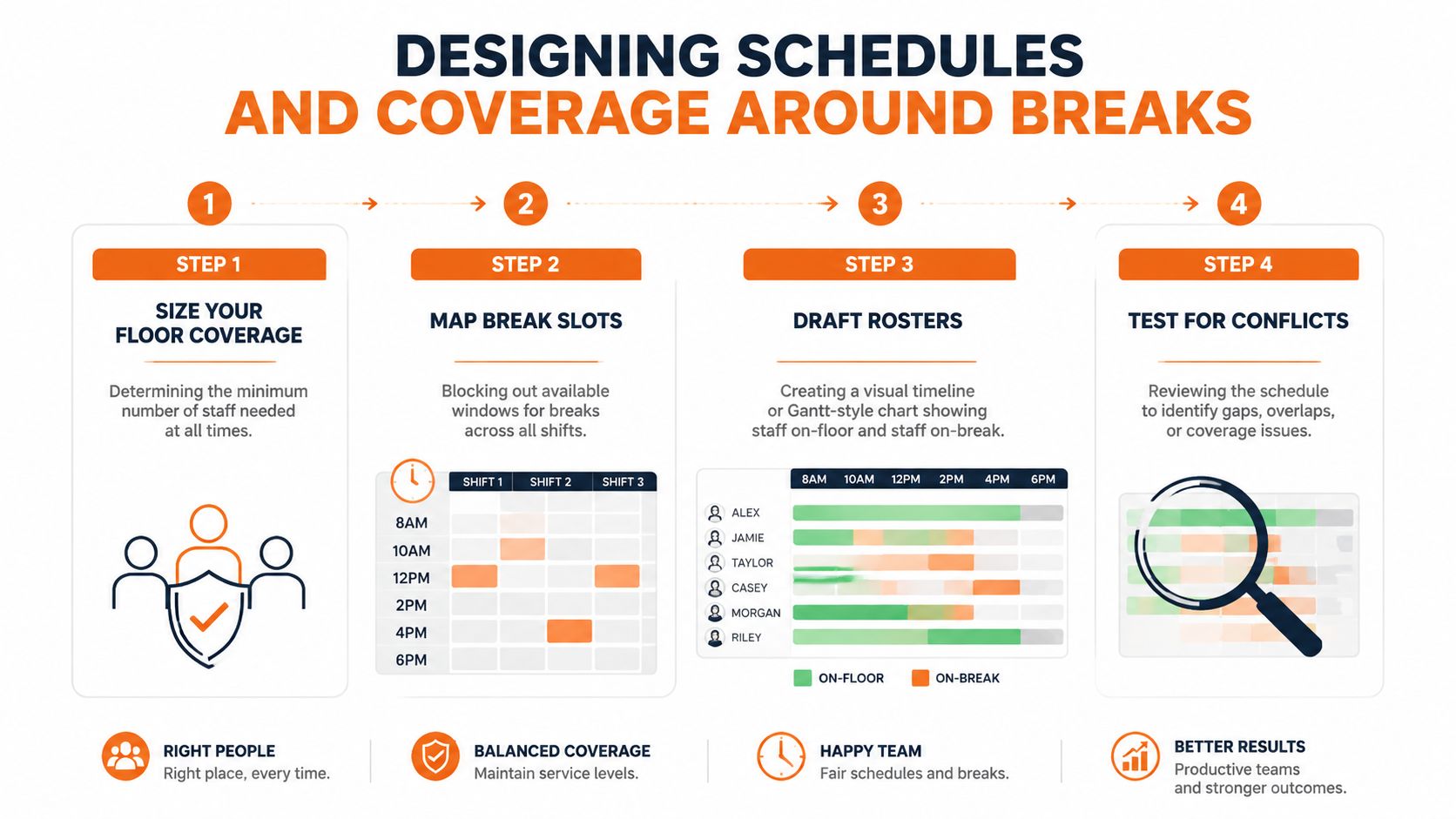
Designing Schedules and Coverage Around Breaks
Coverage is where break policies die. The schedule needs to answer a basic question before anyone clocks in: Who does the work while this person is away?
Start by counting concurrent staff by zone, not by total headcount. A hospital unit may need coverage at the medication station, the floor, and admissions at the same time. A warehouse may need separate relief for receiving, picking, and shipping. Subtract planned break and meal relief from each zone's staffing picture. The result is the true minimum floor, not the number printed at the top of the roster.
Three patterns that hold up
Wave breaks work for retail and hospitality. Stagger lunches in 15-minute increments, then protect the busiest windows by limiting how many people leave at once. The trade-off is visible. Throughput may slow during a wave, but the slowdown is planned instead of appearing as a string of surprise absences.
Zone relief suits warehouses and hospitals. Assign a floater, charge person, or cross-trained relief worker to rotate through defined zones. The relief role needs a route and a priority order. Otherwise, the loudest department wins and quieter teams wait.
Block breaks fit some 24/7 operations. One full team takes recovery time while another holds the floor, then the groups switch. This can simplify handoffs, but it creates a fairness problem if the same team is always last. Rotate the order and publish it.
Coverage test: A break slot isn't real until the schedule names both the person leaving and the person covering.
Build the roster around volume patterns, not habit. If receiving peaks early, don't copy the same break pattern used by a quiet afternoon shift. If a hospital's medication round creates a predictable constraint, mark that period before assigning breaks.
A simple worksheet can use four columns:
Zone: Where coverage is required.
Minimum floor: The fewest people who can safely remain.
Relief owner: Who covers each departure.
Exception path: What happens when volume makes the slot impossible.
Use a shift work schedule planning guide to review the roster alongside shift timing, then rebuild it whenever headcount or volume changes. Don't wait for quarter-end. A schedule that worked before a hiring gap or seasonal surge can become unsafe without changing a single policy line.
Monitoring, Coaching, and Enforcement as One Habit
Monitoring, coaching, and enforcement should live in one weekly rhythm. When they sit in separate notebooks, HR sees a policy violation, the supervisor sees a staffing problem, and the employee sees another rule that doesn't match the shift.
The loop can stay short. Pull the prior week's missed-break records, late returns, and waiver usage. Sort the results by team, shift, and manager before looking at individual names. A pattern attached to one shift often points to a late handoff or understaffed zone, not a careless employee.
Turn patterns into a small experiment
Use a 10-minute Monday huddle to review two patterns. Name the likely system cause, then commit to one test for the coming week. The test might move the first break earlier, assign a relief route, or require a handoff at a specific station before anyone leaves.
Don't use the meeting to read every exception aloud. Employees need a credible response to the problem, not a public ranking of who failed to take lunch. A manager who reports that the same zone missed breaks and then changes nothing teaches the team that reporting is pointless.
Enforcement comes last. Document repeated missed breaks, discuss them in a performance conversation when the employee's actions are part of the pattern, and reserve formal discipline for repeated behavior after the manager has checked coverage, instructions, and access. One late return shouldn't erase a record of an operation that routinely makes timely breaks impossible.
Manager habit: Review the pattern, fix the condition, then address the behavior that remains.
This approach also protects supervisors. They get a clear escalation path instead of having to choose between stopping production and accepting a miss. Employees get a consistent way to report problems. HR gets records that show whether the organization tried to correct the cause.
The goal isn't to make every break identical. Frontline work changes by shift. The goal is to make the response predictable when reality interrupts the plan.
Measuring Whether Your Break Program Is Working
A compliance rate can look healthy while workers are exhausted. A completed form proves that someone entered a record. It doesn't prove that the employee had a useful recovery period or that the operation carried the absence safely.
Track signals that managers can act on each week. Start with missed-break rate by team, average delay on return, voluntary overtime connected to skipped or delayed breaks, and employee-reported rest quality from a short pulse survey. Keep the survey plain. Ask whether workers could take breaks when scheduled and whether the break helped them return ready to work.
Read the signals together
A team with low recorded misses but poor rest-quality responses may be recording breaks accurately while taking them too late, too hurriedly, or in a space that doesn't support recovery. A team with frequent late returns may need better handoffs rather than stricter discipline. Voluntary overtime tied to skipped breaks can point to a coverage failure that payroll sees before operations does.
Review two lagging measures monthly: incident rates during the last hour of shifts and unplanned attrition among tenured frontline staff. These measures won't explain every cause, but they can show whether a persistent break problem is reaching safety and retention outcomes.
Metric Type | Examples | Cadence | Manager Action Triggered |
|---|---|---|---|
Leading | Missed breaks by team and shift | Weekly | Rebuild coverage or change break slots |
Leading | Average return delay | Weekly | Check handoffs, travel distance, and supervisor release |
Leading | Voluntary overtime tied to skipped breaks | Weekly | Investigate workload and staffing gaps |
Leading | Employee-reported rest quality | Weekly pulse | Improve timing, location, or break conditions |
Lagging | Incidents during the last hour of shifts | Monthly | Review fatigue-related operating conditions |
Lagging | Unplanned attrition among tenured frontline staff | Monthly | Compare break patterns with retention conversations |
A time-and-attendance platform can help connect schedules, clock events, and exception records. For teams comparing approaches, this overview of the HR Management 365 attendance solution is a useful reference point for evaluating how attendance data can support manager review.
Keep only metrics with an action attached. If nobody knows what to do when a number moves, remove it from the dashboard. The best break dashboard is small enough to use and specific enough to change next week's roster.
Picking the Right Tools to Run It All
Tooling should follow the work, not the other way around. Before comparing platforms, write down the daily jobs that currently fail: scheduling breaks beside shifts, warning a floor lead when coverage gets thin, recording clock-in and clock-out data, flagging missed or skipped breaks, and routing exceptions to the right manager.
Then test each platform against those jobs. A long feature list doesn't matter if a supervisor can't release someone from a phone during a lunch rush. The useful system makes the next action obvious.
Evaluate the workflow, not the brochure
A practical tool should surface compliance gaps while there is still time to correct them. Employees should be able to request or swap a break from mobile when the operation allows it. Break records should flow into payroll without manual re-entry, and HR should be able to retrieve an audit trail without assembling screenshots from several apps.
Pebb can place break rules inside the same communication layer used for shift updates, announcements, and recognition. Its clock-in feature lets managers review and track break time while employees record break time in minutes. Its shift scheduling feature includes an unpaid-break toggle, allowing managers to define part of a shift as unpaid break time and enter the break length in minutes.
That setup only works if the surrounding workflow is clear. A tool can't decide who covers a medication round or a loading bay. It can make the assignment visible, record what happened, and route an exception before it disappears into a text message.
For teams trying to cut admin with field workforce software, the same test applies. Look for a system that frontline staff will open, connects with payroll and scheduling, supports mobile use, and gives HR records that don't depend on manual exports.
Choose the smallest tool that handles the core workflow. More software won't rescue unclear ownership. But clear ownership, visible coverage, reliable records, and a tool people can use under pressure will give break management a chance to survive the lunch rush and the surprise inspection on the same day.
Pebb brings shift scheduling, clock-in and break records, employee communication, and operational updates into one mobile-friendly work app. Visit Pebb to see how your team can make break coverage visible, capture exceptions cleanly, and keep frontline managers out of spreadsheet chaos.
