
Arizona Final Paycheck Law a Clear Guide for Employers
Get a clear, human guide to the Arizona final paycheck law. Learn timelines for terminated vs. resigned employees, legal deductions, and how to stay compliant.
Dan Robin
It's late in the day, someone just left, and payroll suddenly feels like a fire drill.
I've seen this happen too many times. A manager is dealing with access removal, coverage gaps, keys, laptops, upset coworkers, and then someone asks the question that always comes a beat too late: when does the final check have to go out, and what exactly has to be in it?
That's where Arizona final paycheck law stops being an HR footnote and becomes an operational test. If your answer depends on who happens to be online, what your payroll admin remembers, or whether your commission spreadsheet is current, you don't have a process. You have luck. Luck is not a compliance strategy.
The Moment Every Manager Dreads
It usually starts with confusion, not malice.
A supervisor calls HR near the end of the day. An employee resigned on the spot. Or they were discharged after a rough meeting. Operations is trying to cover the schedule. IT is locking accounts. The owner wants to know whether the final paycheck can wait until the usual payroll run. Payroll wants to know if unused vacation is owed. Someone else asks if the company can deduct the missing tablet.
That pileup is normal. The mistake is treating it like an exception.
What makes this stressful
Final pay problems rarely come from one big failure. They come from several small ones stacked together:
No one confirms the separation type. Was this a resignation or a discharge?
Payroll gets notified too late. The legal deadline starts moving before the team does.
Variable pay gets ignored. Commissions, bonuses, and PTO are left for “later.”
Managers improvise deductions. They try to solve an equipment issue through payroll.
No one explains the math. The employee gets a number with no breakdown and assumes the worst.
I'm opinionated about this because I've watched businesses create avoidable disputes with people they were trying to part from cleanly. The employee may already be upset. If the last interaction is a late or confusing check, you've turned a departure into a grievance.
Pay mistakes at exit feel personal, even when they started as admin errors.
The better way to think about it
Arizona final paycheck law is not hard because the rules are mysterious. It's hard because exits are messy, and messy situations expose weak systems.
The fix is simple in concept, but it takes discipline. Treat final pay like a controlled handoff. The moment employment ends, one person owns the timeline, one person owns the wage calculation, and one person signs off on any deduction issue. No guessing. No side conversations. No “we'll sort it out on Monday.”
If that sounds strict, good. It should.
The Two Final Paycheck Timelines You Must Know
Arizona gives you two clocks. Which one applies depends on who ended the employment. This is the first fact every manager, HR lead, and payroll admin should memorize.
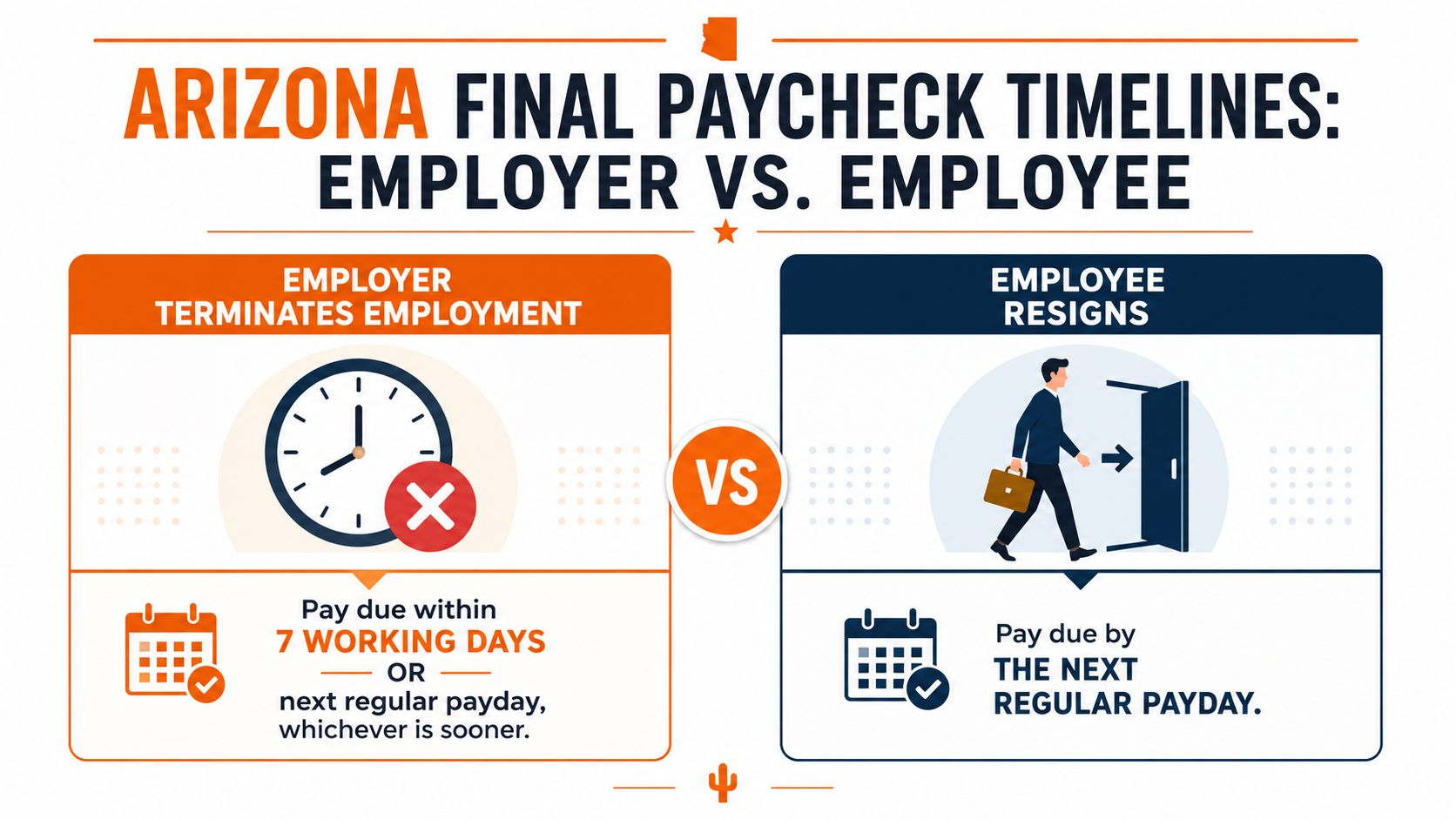
Under Arizona Revised Statutes § 23-353, a discharged employee must be paid wages due within 7 working days or by the end of the next regular pay period, whichever is sooner. An employee who quits must be paid by the regular payday for the pay period in which the termination occurred.
Burn this distinction into your process
If you terminate the employee, Arizona moves faster. You do not get to wait because your normal payroll process is more convenient. The law uses a fixed deadline tied to the separation and your payroll calendar.
If the employee resigns, the deadline is the regular payday for the pay period in which the resignation happened. That gives you more breathing room, but not much if your systems are sloppy.
Here's the clean comparison:
Separation type | Final pay deadline |
|---|---|
Employer-initiated discharge | Within 7 working days or by the end of the next regular pay period, whichever is sooner |
Employee resignation | By the regular payday for the pay period in which the termination occurred |
What this means in real operations
Most mistakes happen because managers think “final pay” follows internal habit instead of state law. It doesn't.
If you discharge someone, your payroll team may need an off-cycle run. If your system can't produce one quickly, fix that now. Don't wait until a termination happens and then discover your process is built for convenience, not compliance.
Practical rule: if your payroll platform can't handle a same-week final pay workflow, your offboarding process is incomplete.
Another point that gets missed: Arizona's statute doesn't leave payment method as a vague courtesy item. Final wages must be paid in immediately redeemable form, and violating the section is a petty offense, as the statute states. That matters because final pay is not something to delay with internal approvals, vague mailing plans, or informal promises that “it's coming.”
One decision that prevents a lot of errors
At the moment of separation, require a single field in your HR or payroll workflow: resignation or discharge.
Not “inactive.”
Not “terminated” as a catch-all.
Not a free-text note.
That single classification drives the legal deadline. If managers choose the wrong status, everything after that can be wrong too. This is exactly why Arizona final paycheck law belongs in your workflow settings, not buried in a handbook PDF.
Calculating Everything in the Final Paycheck
The last check is rarely just base wages for the final few days. That's the beginner version of this problem.
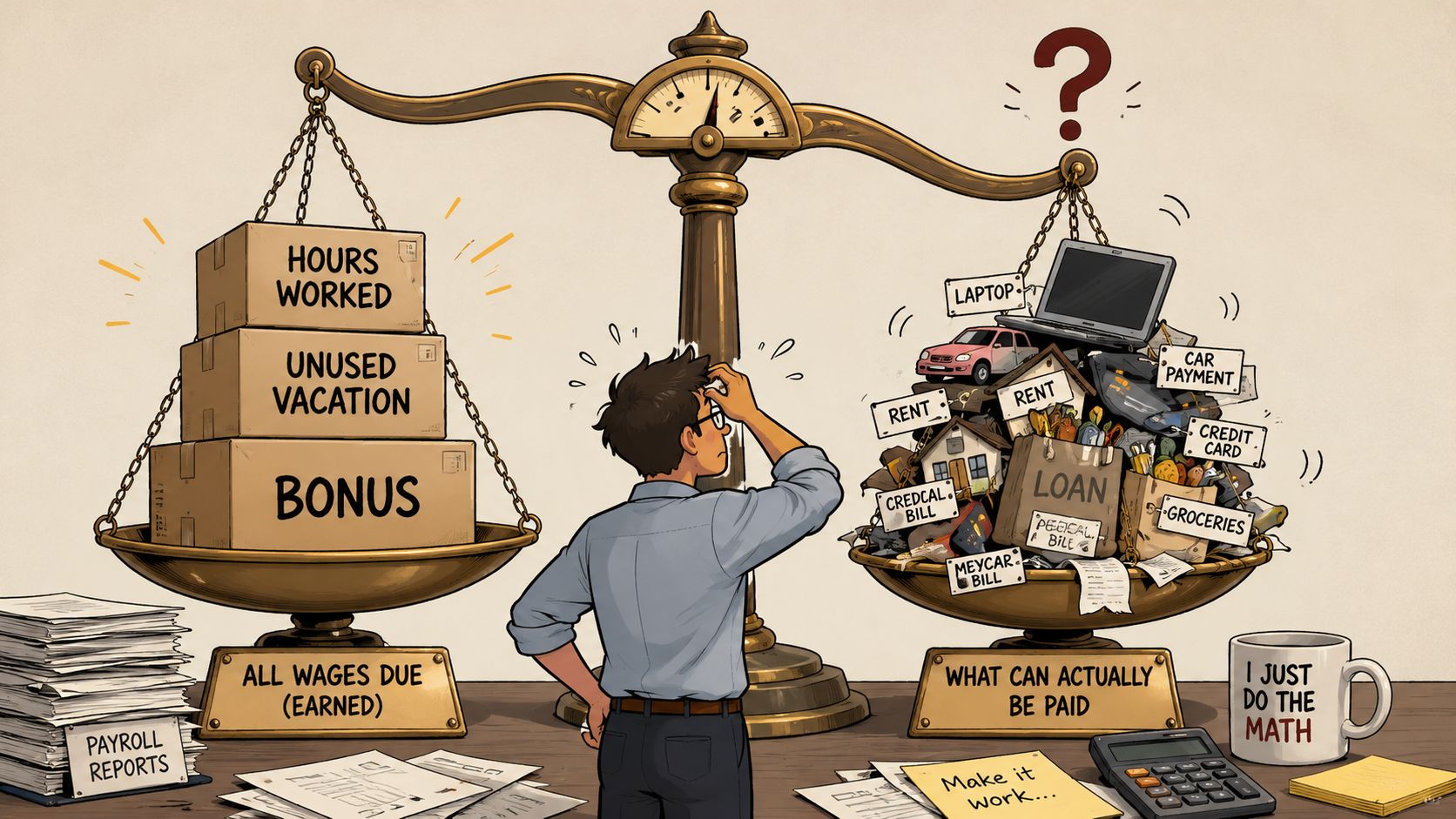
Arizona requires employers to include not only regular wages but also other earned compensation like commissions, bonuses, and accrued vacation pay if the company policy or agreement provides for it, as explained in Baker Donelson's Arizona wage guide. The trouble is the word earned. That's where people get into trouble.
The word that causes the most fights
If you pay hourly wages only, final pay is usually straightforward. If you pay commissions, bonuses, shift differentials, or PTO, you need written rules that answer one question clearly: when is it earned?
That answer should live in your commission plan, bonus plan, PTO policy, and offer letter language where relevant. If it doesn't, your payroll team is forced to make judgment calls after the person leaves. That's a bad time to discover your documentation is fuzzy.
A few common pressure points:
Commissions can be disputed when a sale is booked before departure but paid later.
Bonuses create problems when the plan doesn't say whether payout depends on being employed on the payment date.
Vacation or PTO often turns into an argument because the company assumed payout was discretionary, but its own policy reads like a promise.
Reimbursements get forgotten because they sit outside normal wage calculations.
Policy is where you win or lose
Arizona employers should stop treating policies as boilerplate. In final pay disputes, your written language often becomes the map.
If your PTO policy says accrued vacation is paid at separation, then payroll needs a reliable way to calculate it. If you need help tightening that math, a practical guide on how to calculate accrued vacation is worth bookmarking for your HR and payroll team.
And while you're checking payout amounts, don't overlook withholding setup. Final checks still run through payroll tax rules. If your team needs a clean refresher on federal and state payroll taxes, use that as part of your exit-pay review so nobody is improvising deductions or withholding treatment at the last minute.
If your pay plans are vague, employees hear one thing, managers promise another, and payroll gets stuck in the middle.
A clean review framework
Before you approve a final paycheck, review compensation in this order:
Base wages already worked
Confirm hours, salary through the final day, and any overtime already earned.Variable compensation
Pull the commission plan and bonus terms. Don't rely on memory. Read the actual language.PTO or vacation payout
Match the balance to the policy. If your policy creates eligibility, honor it consistently.Loose-end payments
Check pending reimbursements or other amounts your team may track outside payroll.
Arizona final paycheck law gets practical. It's not only about a deadline. It's about making sure the number on the check can be defended line by line.
What You Can and Cannot Legally Deduct
In this situation, employers get reckless.
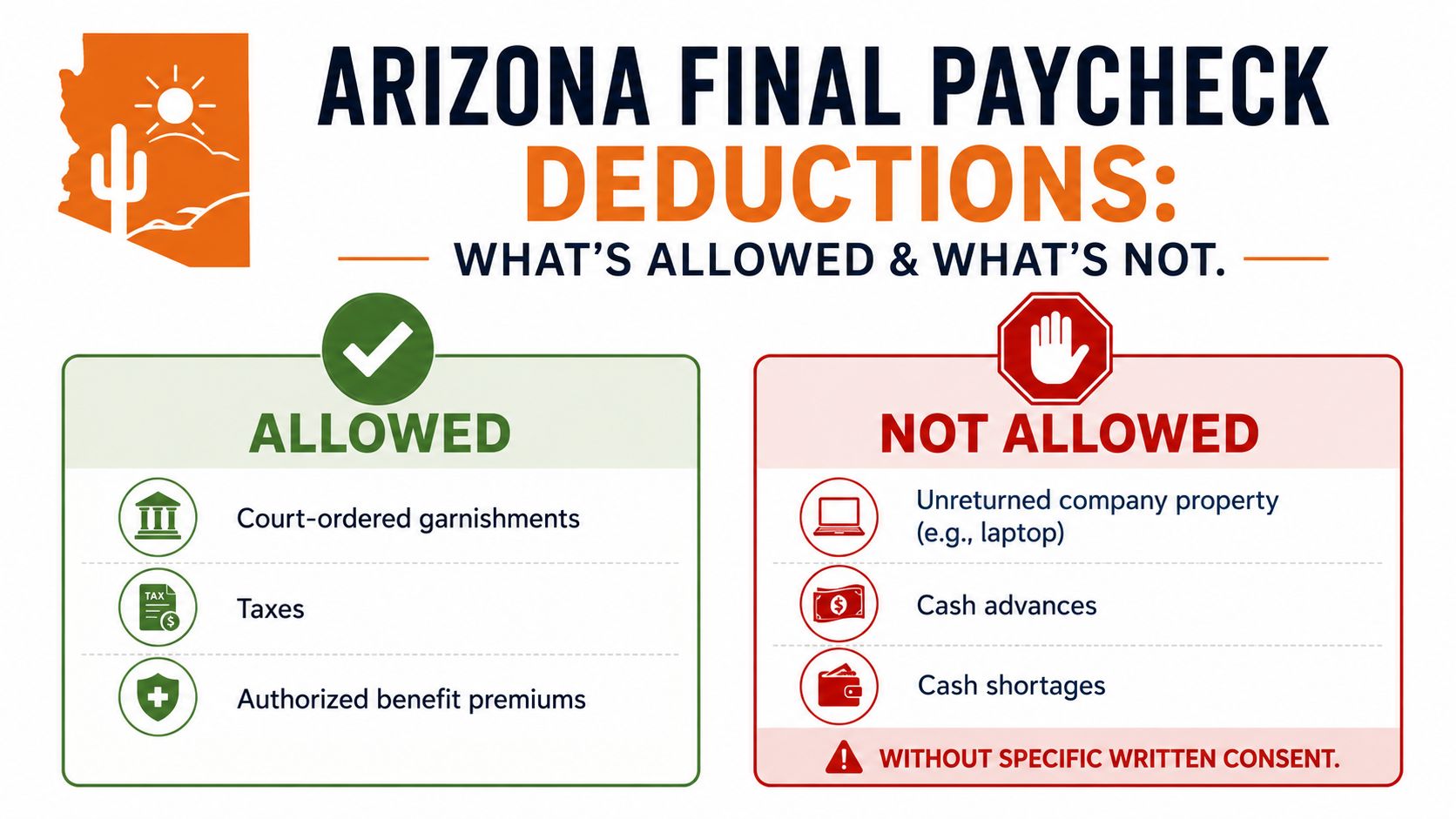
Someone leaves with a laptop. A drawer is short. There's an outstanding advance. A manager says, “Take it out of the final check.” That instinct may be understandable, but it's exactly how wage claims start.
Arizona law allows withholding wages only when there's a good-faith dispute, including counterclaims or set-offs. But that does not remove the duty to pay the undisputed balance, as explained in this Arizona employment law overview from JacksonWhite. A violation is classified as a petty offense under ARS 23-353, and problems can grow into civil disputes.
The rule most managers need to hear
An employee owing you money is not the same as you being allowed to hold their wages.
That distinction matters. You can't casually sweep a property dispute into payroll and call it settled. If part of the wage amount is disputed in good faith, handle that piece carefully and document why. But do not use the dispute as an excuse to sit on everything else.
A practical decision filter
Use this simple filter before any deduction touches a final check:
Is the deduction required by law?
Things like taxes and court-ordered items follow their own rules.Did the employee clearly authorize it in writing where required?
If the answer is fuzzy, stop.Is there a real good-faith dispute about wages due?
If yes, isolate that issue and pay the rest.Are you trying to solve a separate debt or property issue through payroll?
That's where employers usually overstep.
If your HR team needs a broader wage-and-hour review framework, PEO Metrics' compliance resources are useful for pressure-testing your process.
Don't turn payroll into your collections department.
The smartest operational move
Separate offboarding checklists from property recovery checklists.
Have one owner confirm wages. Have another owner chase equipment, cards, uniforms, or keys. They can coordinate, but they should not be the same step in the same box. Once those workflows get merged, somebody always decides to “wait on the check until the laptop comes back.” That's the exact move you want your process to prevent.
Your Offboarding and Final Pay Checklist
Good compliance does not come from smart people remembering things under pressure. It comes from a system that makes the right action the default.
If you want fewer errors under Arizona final paycheck law, build a repeatable offboarding process and make people follow it every time. Not when it's easy. Every time.
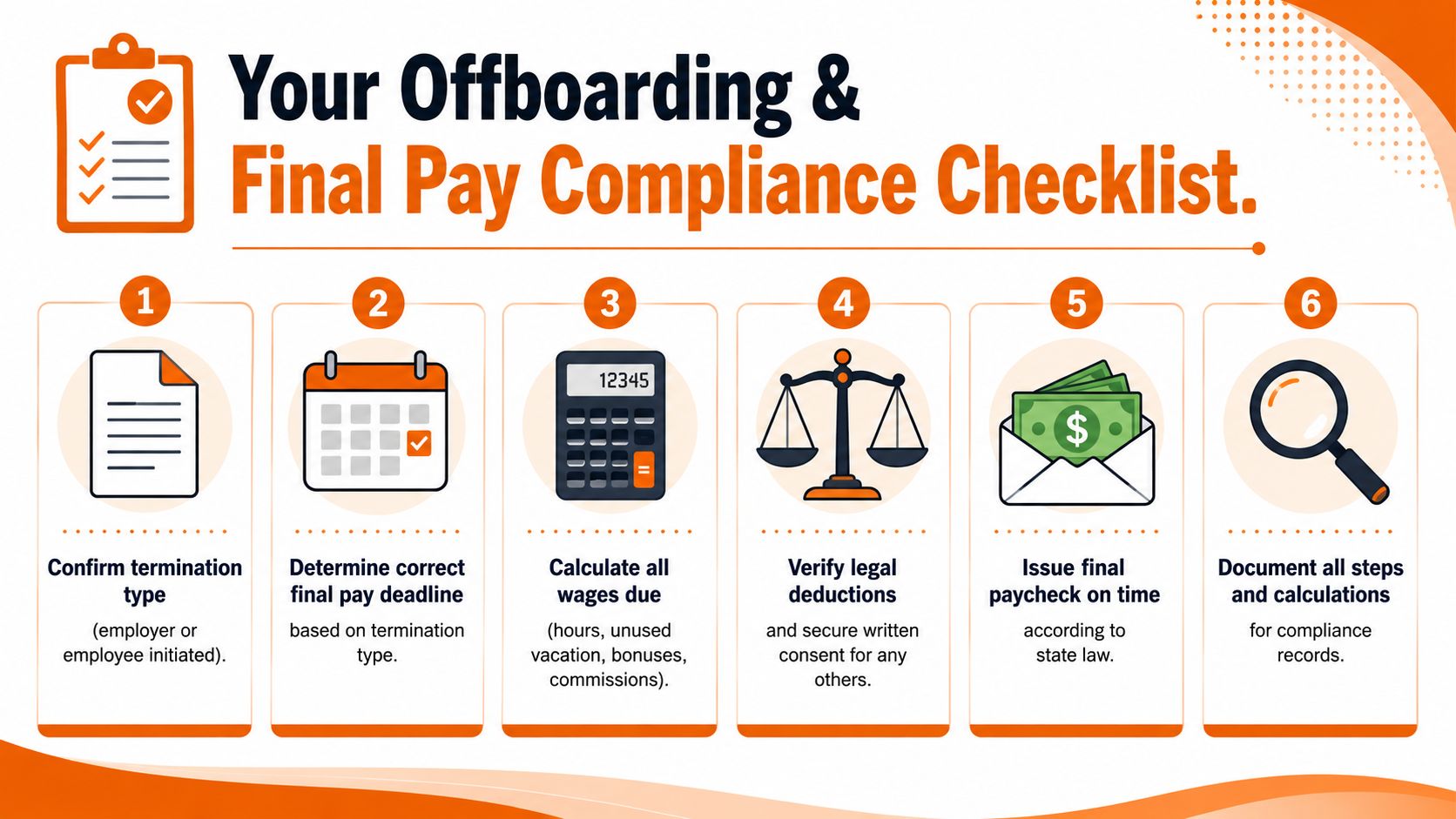
The checklist I'd put in every HR system
Lock in the separation type immediately
The first recorded fact should be whether the exit was employer-initiated or employee-initiated. If that field is wrong, your deadline can be wrong.Notify payroll the same day
Don't bury this in email. Use a standard form, workflow, or ticket that includes last day worked, separation date, manager name, and payout items.Pull all compensation sources
Review wages, variable pay, PTO or vacation balances, and any pending reimbursements. Don't assume one system contains everything.Review deductions separately
If there's a property issue, loan question, or set-off claim, route it for review before it touches payroll.Run the payment on the right schedule
If the legal timeline requires an off-cycle check, run one. Convenience is not a defense.Send a simple pay breakdown
A short written summary reduces disputes because people can see how the number was calculated.
System setup matters more than memory
You don't need a fancy process. You need a clear one.
A solid workflow should include a payroll trigger, a standard wage worksheet, a manager signoff, and a place where the supporting policy lives. For PTO questions, it helps to keep a reference on how to calculate PTO payout with the rest of your offboarding materials so managers and payroll are reading from the same page.
A short internal checklist can live wherever your team uses it. The point is accessibility. If your process is hidden in someone's desktop folder or stuck in the HR manager's head, it will fail at the worst moment.
Don't forget the long tail
Arizona's final pay obligations don't end when the check goes out. For compliance, employers must keep records of payees' names and last known addresses for 10 years after reporting unclaimed wages, according to Arizona final and unclaimed paycheck guidance. That long retention tail is one more reason to document exits carefully from day one.
Here's the operational takeaway:
Process area | What good looks like |
|---|---|
Trigger | Same-day separation notice to payroll |
Calculation | Written worksheet for wages, variable pay, and PTO |
Approval | Review of disputed items before payroll runs |
Delivery | Timely payment with a plain-language breakdown |
Recordkeeping | Stored payee details and support documents for the required retention period |
The companies that handle exits well are usually the ones that wrote the process down and made it boring.
That's a compliment.
Beyond the Check A Final Thought on Exits
A final paycheck is a compliance task. It's also a character test.
When someone leaves, they remember the ending. They remember whether the company was organized, respectful, and clear. They remember whether anyone explained what they were being paid and why. They also remember silence, delays, and shrugging.
That's why I don't see Arizona final paycheck law as just a rule set. I see it as one of the last moments where a company gets to prove it takes people seriously. You can be firm, protect the business, and still handle the exit cleanly. In fact, that's the standard.
A lot of businesses obsess over onboarding and ignore offboarding. That's backwards. Exits shape reputation too. If you want to close the loop well, your managers should know how to communicate, your payroll team should know the process, and your HR team should treat the departure as more than a form to complete. Even the way you run a thoughtful exit interview process can reduce confusion and bitterness because it gives people one last clear conversation instead of a messy handoff.
The goal isn't perfection. The goal is trust.
Pay people correctly. Pay them on time. Explain the math. Keep records. Don't turn a hard day into a preventable fight. That's not soft. That's disciplined.
If you want one place to keep offboarding checklists, policies, payroll handoff steps, manager instructions, and employee communication organized, Pebb is built for exactly that kind of operational clarity. It gives teams a shared space to store process docs, coordinate across HR and operations, and make sure the right people see the right steps at the right time.
