
Exit Interview Definition: Master Employee Feedback
Get a clear exit interview definition. Learn why they matter, what to ask, and how to use feedback from departing employees for real change.
Dan Robin
Most advice about exit interviews is too polite. It treats the process like a courtesy call on the way out. Ask a few questions, thank the employee for their time, file the notes, move on.
That’s why so many exit interviews produce nothing useful.
A better exit interview definition is simpler and more honest. It’s a structured conversation, or survey plus conversation, with a departing employee designed to tell you what your company usually fails to hear while people are still on payroll. Not to save the resignation. Usually that ship has sailed. To learn what broke, what held up, and what keeps repeating.
When exit interviews work, they expose the gap between the culture leaders describe and the one employees lived. When they fail, they become paperwork with a polite tone.
The Most Honest Conversation You'll Ever Have
Most companies underrate exit interviews because they’ve only seen bad ones. A rushed checklist. A manager asking questions nobody wants to answer truthfully. Notes that disappear into an HR folder no one opens again.
That’s the wrong frame.
An exit interview matters because it’s often the first time an employee feels safe enough to stop managing the message. An analysis of over 17,000 exit interviews found that 63% of former employees rated their experience more candidly than current staff, according to Breakroom’s overview of exit interview feedback. That lines up with what experienced HR teams already know. People still inside the company have reasons to stay careful. People leaving usually don’t.
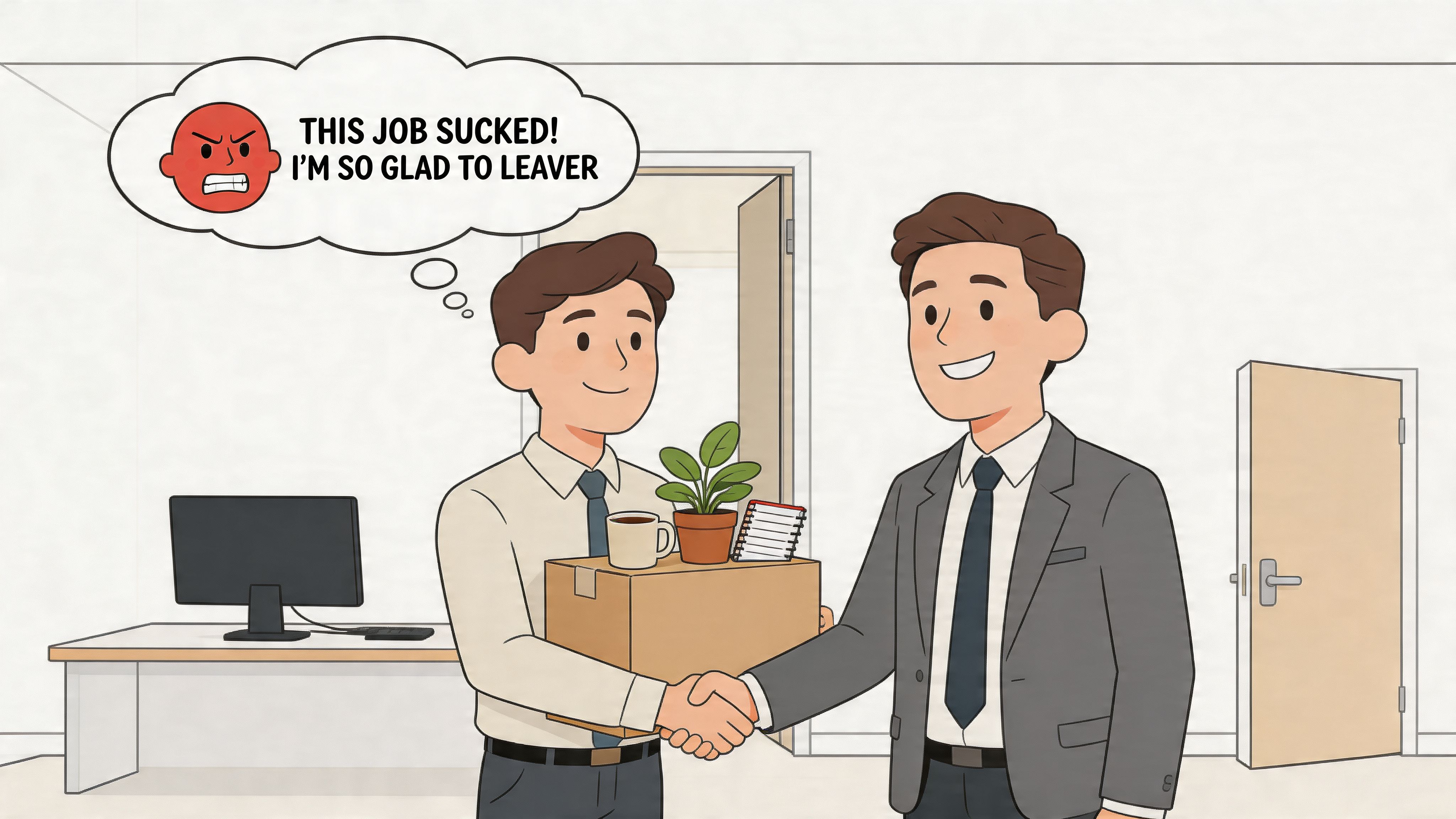
What the definition should really mean
A textbook definition says an exit interview is part of offboarding. Fine. Technically true. But too small.
In practice, an exit interview is a moment of truth. It gives you access to feedback on management, pay, workload, scheduling, culture, onboarding, and growth before memory softens and before the organization rewrites the story as “just a better opportunity.”
Exit interviews aren't valuable because people are leaving. They're valuable because people stop pretending.
The best ones don’t chase drama. They surface patterns. If three people from one team leave and all describe the same manager in different words, that’s not noise. If new hires keep mentioning confusion in their first months, your onboarding issue is bigger than one resignation.
The gift most companies waste
The employee is leaving anyway. You can either collect a vague goodbye or a clean read on reality.
That’s the practical definition I use. An exit interview isn’t a closing ritual. It’s one of the few chances you get to hear the unvarnished version of how work felt.
Why Most Companies Get Exit Interviews Wrong
The usual mistakes are predictable. The direct manager runs the meeting. The questions are generic. The tone is defensive. Someone asks, “So was compensation the main issue?” which is a nice way of telling the employee what answer you’d prefer.
Then leadership says exit interviews aren’t very useful.
They would be useful if the process didn’t train people to stay guarded.
The common failure points
Here’s where companies miss the mark:
They pick the wrong interviewer. If the manager might be part of the problem, the employee won’t speak freely to that manager.
They ask questions that are too broad. “Why are you leaving?” sounds open, but it often gets a rehearsed answer.
They treat one interview like a verdict. One angry comment can distract you. A pattern across many departures should get your attention.
They collect feedback and never act on it. Employees notice when companies ask for honesty and do nothing with it.
Practical rule: If you can't explain who reviews exit feedback, how themes are tracked, and what happens next, you don't have an exit interview process. You have a form.
There’s also a cost problem. Every sloppy exit process sits next to a larger retention problem. Gartner analysis puts the average cost of each voluntary employee exit at $18,591, excluding lost productivity and knowledge transfer, as summarized by People Element’s review of turnover and exit interview data. Once you look at it that way, a weak exit interview isn’t harmless. It’s expensive.
Performative listening does real damage
Employees can tell the difference between listening and theater.
If you ask for feedback at the end but ignore the same issues quarter after quarter, the process starts to work against you. Word gets around. People decide honesty isn’t worth it. Managers assume departures are random. Leaders keep funding the wrong fixes.
A good exit interview program won’t stop every resignation. It will stop you from being surprised by the same resignation ten times.
Designing an Interview That Actually Works
A workable process is boring in the best way. It’s consistent, calm, and easy to repeat. No theatrics. No improvising your way through sensitive conversations.
The strongest setup is a two-part approach. Wikipedia’s overview of exit interviews notes that exit interviews are most effective during the separation stage, with a common practice of sending a survey one week before departure and offering an optional 30-minute HR interview. That combination works because the survey gives you comparable data, while the conversation gives you context.
Who should lead it
Use a neutral party. Usually that means HR, employee relations, or another trained interviewer who isn’t in the employee’s reporting line.
That separation matters. Employees are more willing to talk about favoritism, poor communication, scheduling friction, or trust issues when the person asking the questions doesn’t control their workload or references.
A few practical rules help:
Keep the interviewer neutral. Not the direct manager, not the skip-level leader trying to defend the team.
Set expectations early. Explain how feedback will be documented, who will see themes, and what confidentiality limits apply.
Leave room for silence. People often say the real thing a few beats after the first answer.
When and how to run it
The timing is simple. Ask after the resignation is formal, but before the employee has mentally checked out completely. That’s why the final week often works well.
Format depends on the role, the setting, and the level of trust. There isn’t one perfect option. There are trade-offs.
Format | Potential for Candor | Scalability | Best For |
|---|---|---|---|
Face-to-face interview | High when trust exists and the interviewer is neutral | Low | Senior roles, sensitive departures, complex team issues |
Video call | Moderate to high | Moderate | Remote teams, distributed knowledge work, employees who want conversation without being on-site |
Structured digital survey | Moderate on its own, stronger when followed by conversation | High | Large teams, frontline workforces, shift-based roles, trend analysis |
What matters is matching the method to the workforce's circumstances. If someone works on rotating shifts, a scheduled sit-down may be the least practical option. If the departure involves a complex manager issue, a live conversation is usually more revealing than form fields alone.
For teams that already use regular listening practices, it also helps to align offboarding questions with broader sentiment tracking. A good example is using themes similar to those in a job satisfaction survey framework, so you can compare what current employees say with what departing employees finally admit.
A structured process makes people more honest because they don't have to guess whether the company is serious.
What good design feels like
It feels clean. The employee knows why they’re there. The interviewer knows what to ask. The company knows what it will do with the answers.
That’s the whole job.
The Right Questions to Ask And What to Avoid
An exit interview rises or falls on the quality of its questions. Most bad interviews don’t fail because the employee refused to talk. They fail because the company asked shallow questions and got shallow answers back.
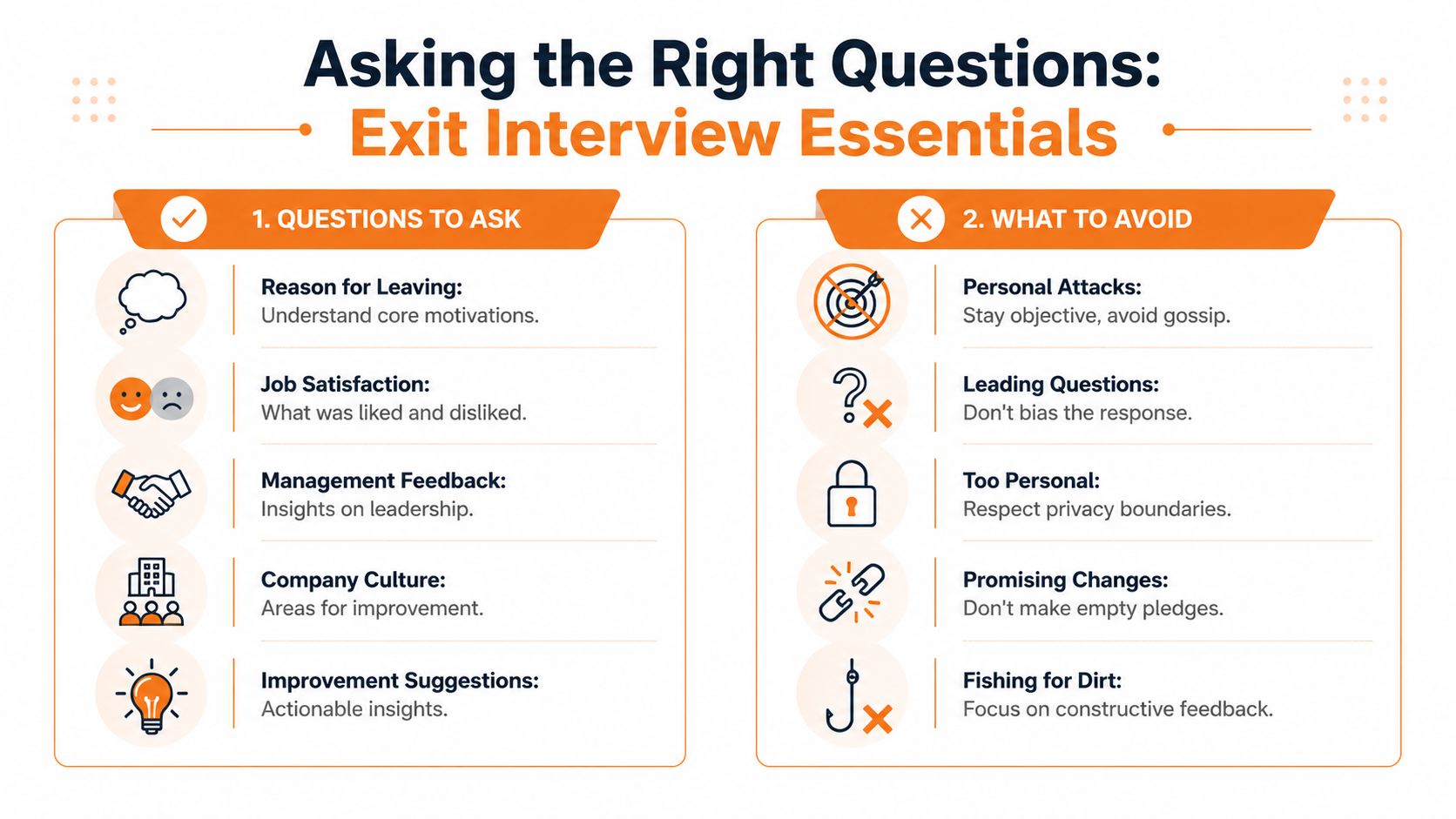
The cleanest framework comes from categorizing feedback across five domains: reasons for departure, employee satisfaction, management relationship quality, career advancement perception, and likelihood-to-recommend scores, as outlined in AIHR’s guide to exit interview data analysis. Those categories keep the conversation useful without turning it into a fishing expedition.
Questions worth asking
You don’t need a script that sounds robotic. You need questions that open doors.
Start with the story. Ask, “What led you to start considering a change?” That gets you a timeline, not just a headline.
Ask about the work itself. “When did the role feel like a good fit, and when did it stop feeling that way?” This helps separate job design issues from outside opportunity.
Get specific about management. “What helped or hindered your relationship with your manager?” That tends to produce clearer answers than “Did you like your manager?”
Probe growth. “What could we have done to better support your development?” Employees often reveal stalled progression, weak feedback, or lack of path clarity here.
Test advocacy. “Would you recommend this workplace to someone you respect? Why or why not?” This often cuts through politeness fast.
If you want broader ideas on building good listening habits before people resign, this guide to employee feedback examples and tips is a useful companion.
Questions to avoid
Some questions create more heat than insight.
Skip leading questions. “Was it mainly pay?” narrows the answer before the employee starts.
Don’t ask for gossip. You’re not there to collect rumors about coworkers.
Avoid personal intrusion. If the employee doesn’t want to discuss health, family, or private matters, leave it alone.
Don’t promise change in the room. Listen first. Analyze later. False reassurance damages trust.
Ask for examples, not accusations. Examples can be examined. Accusations without context usually can't.
The best questions are plain, open, and grounded in work people did.
Adapting for Frontline and Distributed Teams
The old model assumes everyone has a desk, a calendar, and time for a formal conversation in a quiet room. That’s not how a lot of work happens.
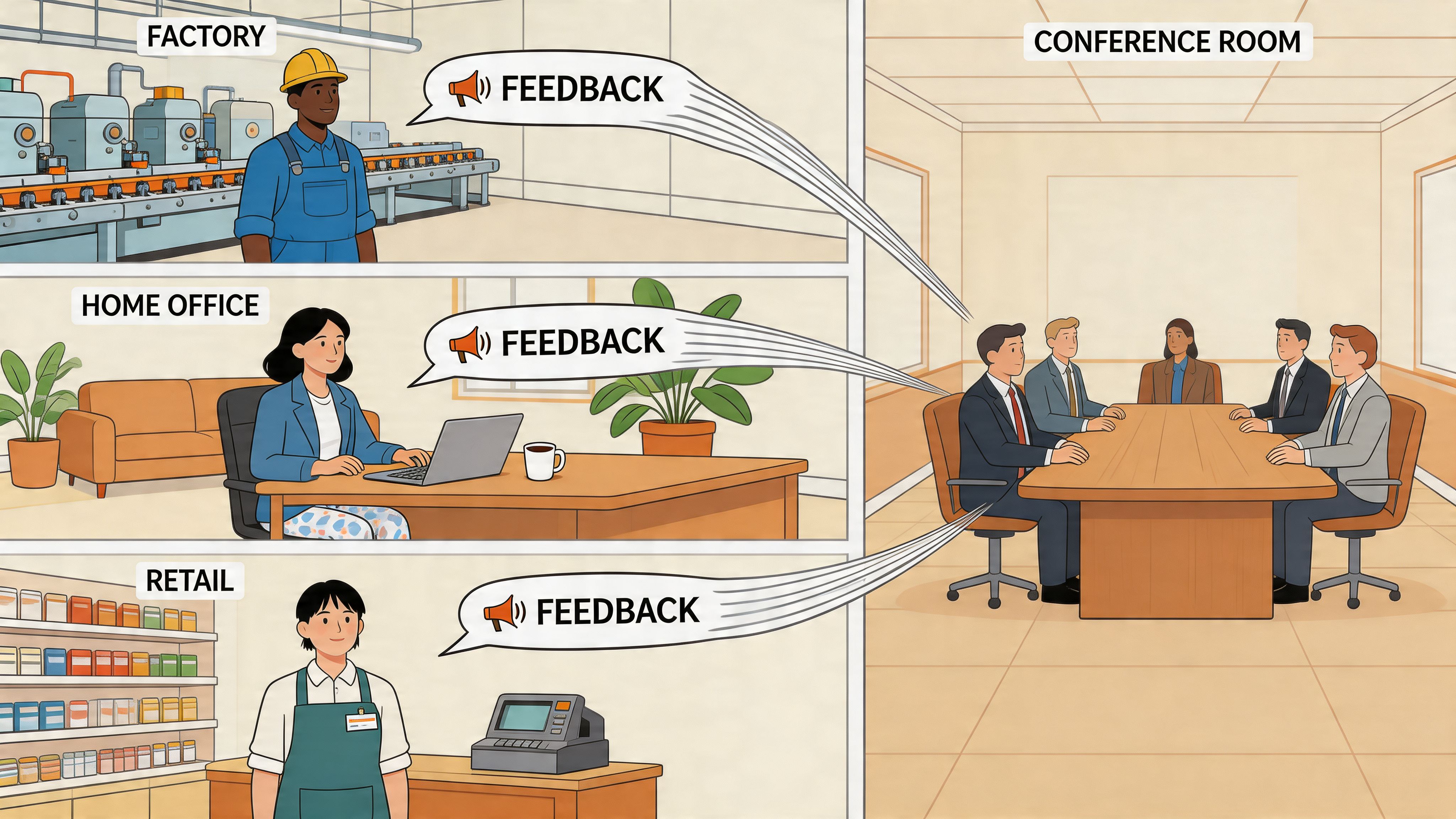
In retail, hospitality, healthcare, and logistics, offboarding often gets squeezed between shifts, handovers, and payroll tasks. Talenta’s discussion of exit interviews points out that exit interviews in frontline industries are rarely adapted for shift work and remote locations, which leads to poor participation and unreliable data. That mismatch is the actual problem. Not employee unwillingness.
What works better in the field
For frontline teams, the process has to meet people where they are. That usually means mobile-first, asynchronous, and short enough to complete without blocking the workday.
A practical setup looks like this:
A simple phone-friendly survey employees can complete on their own time
Optional follow-up by HR when an answer needs context
Clear routing of responses so location, shift, manager group, or tenure patterns can be reviewed without exposing private details too broadly
Seldom does frontline turnover arise from a single, clear cause. Scheduling, staffing pressure, local leadership, safety concerns, and commute realities can all pile up. If your exit interview process only works for office staff, your data will skew toward the people who are easiest to reach, not the people whose feedback you most need.
Why traditional formality backfires
A long, formal interview can feel heavy for hourly employees who just want to finish well and move on. Shorter tools often produce more usable input because they respect the context. That’s not lowering the bar. It’s designing for practical realities.
If you want honest feedback from distributed teams, convenience is part of trust.
From Conversation to Actionable Insight
Raw exit notes are messy. One person talks about pay. Another talks about a manager. Someone else says the underlying issue was scheduling, but only after twenty minutes of conversation. If you stop at note-taking, you’ll mistake anecdotes for insight.
The useful move is to combine structured responses with narrative context, then review them in groups. Not one departure at a time. Cohorts. Teams. locations. Time periods. That’s where patterns stop looking personal and start looking operational.
How to read the signal
A practical review process usually does three things:
Code the feedback by theme. Put comments into consistent categories such as manager relationship, workload, growth, onboarding, or scheduling.
Compare themes across groups. Look by department, site, role type, tenure stage, or manager.
Pair the “what” with the “why.” Survey selections tell you what people chose. Interview notes explain why they chose it.
One complaint is a story. Repeated complaints in the same category are a management issue, a design issue, or both.
This is also where discipline matters. Don’t overreact to the most dramatic interview. Don’t dismiss the quiet, repeated one-line comments either. “No clear path.” “Schedule changed too often.” “Manager hard to approach.” Those small phrases can tell you more than a long emotional download.
What action actually looks like
Good analysis ends with ownership. Someone needs to brief leadership, someone needs to decide what changes, and someone needs to report back on whether the pattern moves. If that handoff never happens, the process is incomplete.
Exit interviews become valuable when they influence manager coaching, onboarding redesign, staffing decisions, communication habits, or policy changes. Until then, they’re just archived disappointment.
Legal Guardrails and Ethical Considerations
An exit interview should feel humane, but it still needs rules.
For global teams, compliance matters. eLeaP’s overview of exit interview risk and compliance notes that in EU markets, explicit consent is required for processing exit data under GDPR, and mishandling feedback can increase legal exposure, with some reports linking 20-30% of turnover-related suits to unaddressed feedback. If you operate across regions, you can’t treat privacy, access, and documentation as afterthoughts.

The basics that keep you out of trouble
Get clear consent. Employees should know what data you’re collecting and how it will be used.
Limit access. Not every manager needs raw comments.
Escalate serious allegations. Harassment, discrimination, retaliation, and safety claims belong in a formal response path, not buried in summary notes.
If a departing employee raises concerns related to termination fairness, contract issues, or dismissal rights, it helps to understand the broader legal context around wrongful dismissal. Even when the issue sits outside the exit interview itself, HR should know when a routine conversation has crossed into legal territory.
Ethics matter just as much as compliance. Don’t ask for trust you haven’t earned. Explain the limits of confidentiality candidly.
The Last Conversation Is the Start of the Next One
A good exit interview definition isn’t about endings. It’s about memory, pattern recognition, and whether a company is mature enough to hear something uncomfortable without turning away from it.
Done well, the last conversation helps the next employee have a better first year. It helps a manager see a blind spot. It helps leaders confront the culture they have, not the one they wrote on a slide. Even the tone of departure matters, which is why small details like thoughtful farewell wishes to an employee say something about whether the organization knows how to part with respect.
Companies that learn from exits don’t treat them as admin. They treat them as evidence.
If you want one place to gather employee feedback, communication, operations, and engagement across office and frontline teams, Pebb is worth a look. It gives teams a mobile-first way to stay connected, organize work, and spot patterns early, so feedback from exits doesn’t sit in scattered files while the same problems keep repeating.
