
How to Calculate Accrued Vacation Accurately
Tired of messy spreadsheets? Learn how to calculate accrued vacation with simple formulas for any pay schedule. Get templates and tips for total accuracy.
Dan Robin

Most vacation disputes don't start with someone trying to game the system. They start with a pay stub, a balance in an app, or a manager saying, “That's what payroll has.”
An employee thinks they've earned enough time for a family trip. The system says otherwise. The gap might be small. A few hours. But people don't experience that as a rounding issue. They experience it as a fairness issue.
If you need to calculate accrued vacation, that's the part worth remembering. This isn't just arithmetic. It's one of those quiet operational details that tells employees whether your company is careful with their time or casual with it.
The Hidden Cost of a Simple Vacation Request
The most familiar version of this problem is painfully ordinary. An employee asks for a few days off. They've been watching their balance. They're pretty sure they've got enough. Then they check the pay stub and see 34.8 hours when they expected 40.
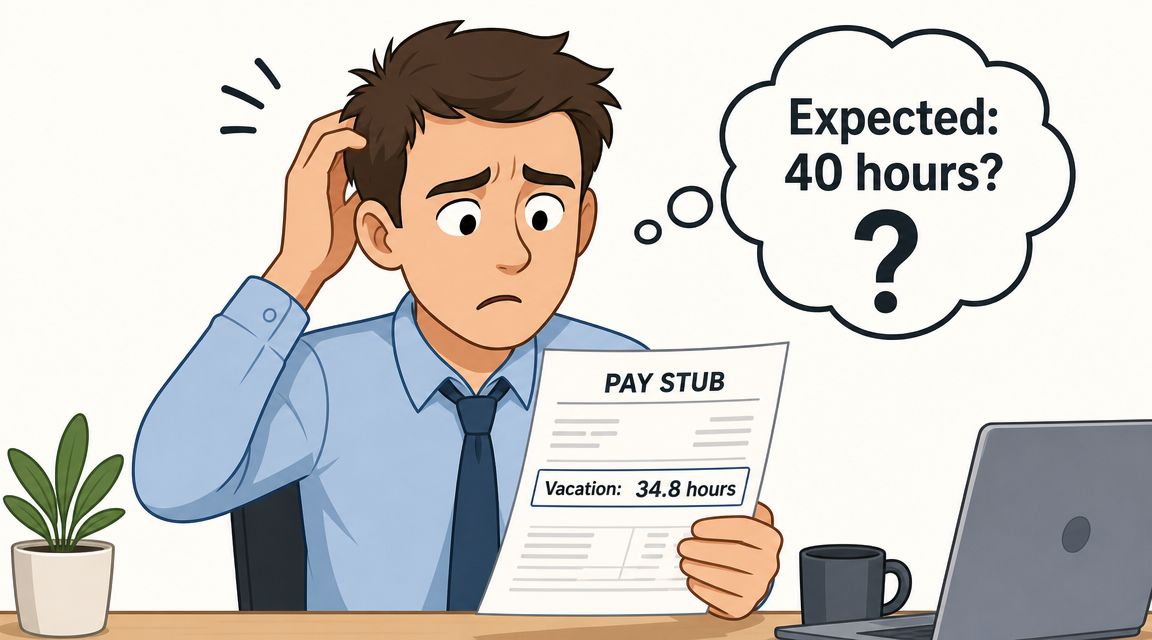
That conversation rarely stays about the number itself. It turns into other questions fast. Was the policy explained clearly? Did a manager approve something they shouldn't have? Is payroll using one rule while HR uses another? Is part-time time tracked differently? Once that doubt starts, every future request feels heavier.
Small balance errors create big trust problems
I've seen companies treat PTO tracking like a back-office nuisance. A spreadsheet lives with one person. A policy sits in a handbook no one reads. Payroll uses one denominator. HR uses another. Managers fill in the gaps with whatever seems reasonable.
That works right up until someone notices.
Practical rule: If an employee can't understand how their balance was calculated, the system is already failing.
The damage isn't dramatic. It's slower than that. Employees stop trusting the posted balance. Managers stop answering confidently. HR spends time explaining corrections instead of preventing them. A routine vacation request turns into a thread of screenshots, manual math, and awkward apologies.
Good enough stops being good enough
Vacation accrual has the same problem as margin math. It looks simple until small inconsistencies stack up across real operations. That's why I like practical resources that focus on the cost of tiny errors, such as this guide to protecting export margins. Different topic, same lesson. Small calculation mistakes don't stay small once they hit real workflows.
A sloppy accrual setup creates friction in a few predictable places:
Employee planning breaks down: People can't book time off confidently when they don't trust the balance.
Manager approvals get messy: Supervisors end up making judgment calls instead of following a clear system.
Payroll cleanup expands: Corrections near year-end or termination are harder than getting the logic right upfront.
Culture takes a hit: Employees remember when their pay or time off feels uncertain.
Vacation time is personal. When the balance feels wrong, employees don't hear “formula issue.” They hear “your time doesn't count the way you thought it did.”
That's why I never frame this as a narrow payroll problem. It's an operating discipline problem. And if you want consistency, you need to start with the accrual method itself.
The Three Foundational Ways to Accrue Vacation
Most companies end up using one of three approaches. None of them is universally correct. Each one reflects a different trade-off between simplicity, precision, and administrative effort.
Annual lump sum
This is the cleanest method to explain. The company grants the full vacation amount at the start of a year or another defined point, such as a work anniversary. Employees can see the balance immediately, and managers don't have to translate accrual math every pay cycle.
The appeal is obvious. It's easy to communicate. It also works fine in stable environments where schedules don't vary much and policy exceptions are rare.
The downside is just as obvious. It's blunt. If someone joins mid-cycle, leaves early, or uses time faster than policy intended, you need proration rules and clear repayment or adjustment rules. Without that, annual lump sum can feel simple on paper and messy in practice.
Accrual per pay period
This is the workhorse. Employees earn vacation each payroll cycle, and the rhythm matches how most organizations already process compensation. It's easier to manage than true hourly accrual, but more controlled than front-loading everything at once.
This method works especially well for salaried teams and hourly teams with fairly regular schedules. It gives people a predictable earning pattern without requiring constant recalculation from fluctuating daily hours.
The weak spot is operational discipline. If payroll is biweekly and someone sets the rate using a monthly assumption, balances drift. Paychex gives a clear warning on this point. A well-designed workflow starts by converting the annual entitlement into a common unit. For example, 15 days per year becomes 120 hours, which yields 4.62 hours per biweekly pay period. It also notes that denominator mismatch causes balances to drift when companies calculate with the wrong cadence, as explained in this Paychex overview of PTO accrual.
Hourly accrual
If your workforce includes part-time staff, variable schedules, seasonal workers, or shift-based roles, hourly accrual is usually the most defensible option. People earn time based on hours worked, which feels fair because it tracks actual labor more closely.
ADP shows the common foundation many teams use. The annual-hours method often uses 2,080 working hours per year as the denominator. In one example, 96 hours of annual PTO divided by 2,080 hours equals 0.046 hours per hour worked. ADP also shows a similar example of 0.038 accrual for an employee working 40 hours per week, yielding about 1.5 PTO hours per week, in its PTO accrual guide.
That sounds technical, but the point is simple. The same policy can be expressed per hour, per week, per pay period, or per month. Once the annual entitlement and work hours are defined, the math is equivalent.
Choosing Your Vacation Accrual Method
Method | Best For | Pros | Cons |
|---|---|---|---|
Annual Lump Sum | Stable teams with simple policies | Easy to explain, easy for employees to see what they have | Needs careful proration and exit handling |
Accrual Per Pay Period | Salaried teams and regular payroll operations | Predictable, aligns with payroll cadence, easier to administer | Errors appear when the denominator doesn't match payroll frequency |
Hourly Accrual | Part-time, variable-hour, seasonal, shift-based teams | Most precise, feels fair across uneven schedules | Harder to maintain manually |
Pick the method that matches how people actually work, not the one that looks neatest in the handbook.
That decision matters more than most companies admit. If the work pattern is irregular, the accrual method has to reflect that reality or the rest of the system will spend all year correcting for it.
Putting the Formulas to Work with Real Examples
Policies sound tidy until you put them into payroll. Then the actual work starts. The easiest way to calculate accrued vacation accurately is to convert the annual entitlement into one common unit first, usually hours, and work from there.
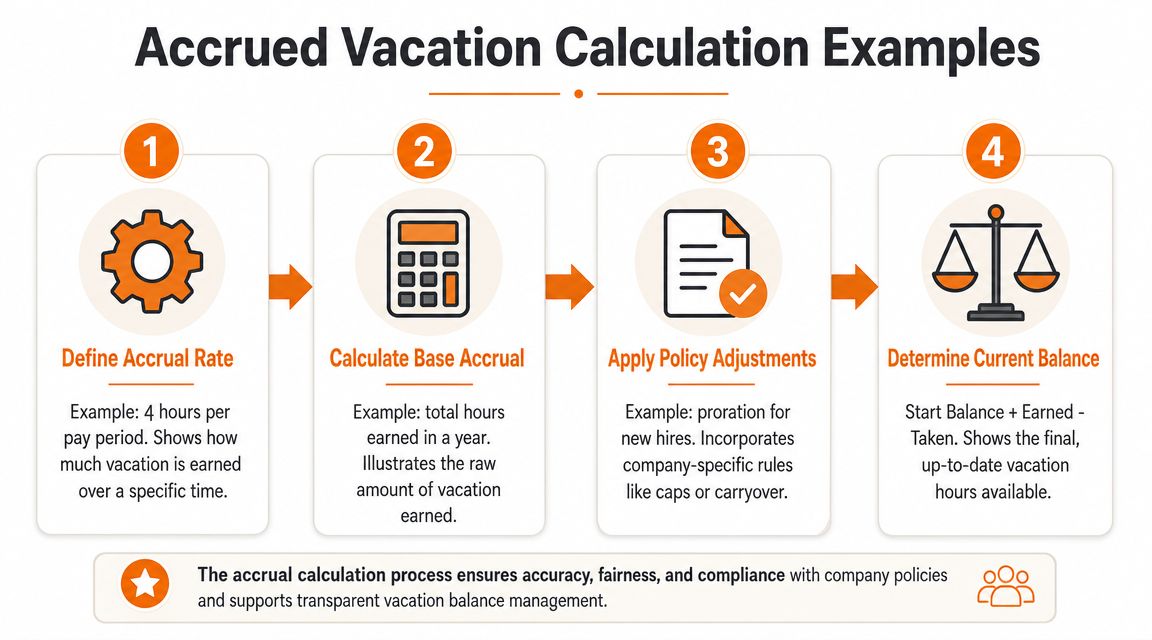
Start by normalizing the entitlement
Say your policy grants 15 days per year. If you assume 8 hours per day, that becomes 120 hours. From there, you can divide by the actual policy denominator.
Paychex lays out the practical conversions clearly. 120 hours per year yields 4.62 hours per biweekly pay period, 5.00 hours per semimonthly period, or 2.31 hours per week in its explanation of how to calculate PTO accrual.
That's the part many teams skip. They know the annual amount, but they don't convert it carefully into the same unit the payroll system uses.
Example one with pay period accrual
A biweekly payroll is common, so let's use that first.
Convert annual leave to hours.
15 days = 120 hoursDivide by the number of biweekly pay periods.
Result: 4.62 hours per biweekly pay periodSubtract any vacation already used.
The remaining balance is the accrued amount still available.
This method works because it matches the payroll cycle. If someone tries to use a monthly shortcut for a biweekly payroll, small under- or over-accruals start creeping in.
Watch for this: the formula can be mathematically correct and still be operationally wrong if it uses the wrong payroll cadence.
Example two with weekly accrual
Some teams prefer to express the same policy weekly because it's easier for managers to understand. The annual amount doesn't change. Only the unit changes.
For the same 120 hours per year, weekly accrual comes out to about 2.3 hours per week when you divide by 52. That's useful for schedules and manager conversations, especially in businesses that think in weeks rather than pay periods.
A policy written per week and a policy written per pay period can both be accurate. Problems start when one is written one way and tracked another.
Example three with hourly accrual
Hourly accrual is the cleanest way to handle fluctuating schedules. Using the annual-hours method, 96 hours of annual PTO divided by 2,080 working hours gives 0.046 hours per hour worked, as shown in the ADP example already discussed earlier.
Here's how that works in practice. If an employee works more hours in one period, they earn more PTO in that period. If their schedule drops, accrual drops too. That's often the fairest method for part-time or seasonal workers because the balance follows actual hours instead of assumed full-time patterns.
Example four with annual lump sum
Annual lump sum barely needs a formula once the award is issued. The employee starts with the full granted amount, and each approved vacation request reduces the balance. The math is simple. The policy design is not.
You still need to decide how to handle mid-year hires, early departures, and whether the grant happens on January 1 or on each employee anniversary. Those choices matter more than people expect.
A simple formula is helpful. A clean rule set is what keeps that formula from turning into a dispute.
Navigating the Messy Middle of Vacation Policies
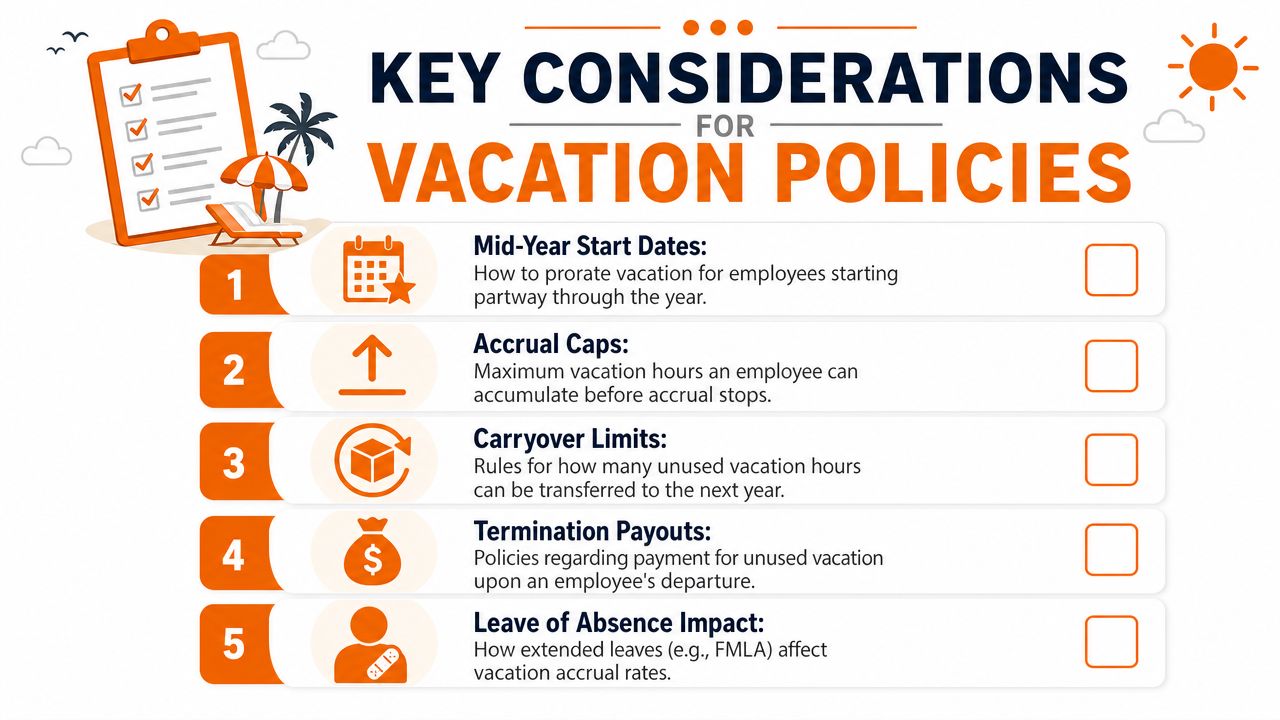
The formulas are the easy part. The hard part is applying them to real people with uneven schedules, mid-year start dates, leave periods, and exits that don't happen on neat boundaries.
That's where companies get into trouble. They use a perfectly decent accrual formula, then bolt on policy decisions that don't fit the workforce.
Non-standard schedules need a different mindset
A major gap in most guidance is what to do with part-time, variable-hour, seasonal, or irregular schedules. QuickBooks notes that many explainers assume a stable full-time pattern and leave HR teams with little help for fluctuating real-world scenarios in its discussion of accrued PTO for different work patterns.
That gap matters. In retail, hospitality, healthcare, logistics, and other frontline environments, the tidy full-time example often has nothing to do with how people work.
When schedules vary, a few questions become unavoidable:
What counts as accrual-eligible time: Is PTO earned on all paid hours, only worked hours, or something else?
What happens when hours change mid-year: Does the employee keep the same rate, or does the rate adjust?
How do compressed schedules fit: If someone works longer shifts on fewer days, is the policy written in days or hours?
How are holidays treated: Are paid holidays part of the accrual base or excluded?
If the handbook doesn't answer those questions, managers will answer them ad hoc. That's when consistency disappears.
Mid-year starts and proration
New hires almost never start on the exact day your policy wishes they would. So you need a proration rule. A simple one. One you can explain in a sentence.
The mistake I see most often is mixing methods. A company says vacation accrues per pay period, then prorates new hires with a monthly shortcut, then applies balances in hours. That creates avoidable confusion. Keep the proration method in the same unit and cadence as the policy itself.
A fair proration rule usually has these traits:
It uses the same unit as the policy
It's written once and applied consistently
It's visible to employees before they ask
Caps, carryover, and negative balances
Policies fail when they hide the rules that matter most. Employees want to know how much they can bank, what rolls into the next year, and whether accrual stops at a cap.
Those aren't side notes. They are part of the actual balance.
A vacation balance is never just earned minus taken. It's earned, minus taken, plus or minus every policy rule sitting behind the scenes.
Negative balances need similar care. Some employers allow them for emergencies or manager-approved cases. That can be humane. It can also become uneven fast if managers apply it differently across teams. If you allow negative balances, define when, who approves them, and what happens at separation.
Termination payout and final checks
Accuracy ceases to be merely a beneficial feature. Stanford's guidance makes the operational point plainly. Administrators need to calculate vacation accrual so it can be included in the employee's final check, as noted in Stanford's explanation of vacation accrual and termination pay.
That single fact changes the stakes. An incorrect balance isn't just a bad employee experience. It can affect final pay.
This is also why I recommend pairing accrual policy reviews with payout process reviews. If your termination checklist and your accrual logic were built by different people at different times, check them together. They often contradict each other.
For teams dealing with exits, rehires, and payout questions, a practical reference like this guide to calculate PTO payout can help frame the workflow before payroll is under deadline.
The policies that actually hold up
The strongest vacation policies aren't the most generous or the most restrictive. They're the clearest.
They answer ordinary questions without forcing HR to interpret the rule fresh each time. They fit variable schedules. They specify carryover and caps. They say what happens when someone starts mid-year, goes on leave, or leaves the company. And they use hours when days would create ambiguity.
That kind of precision doesn't feel flashy. It feels fair. Employees notice the difference.
From Spreadsheets to Systems Why Automation Wins
Most PTO spreadsheets begin as a reasonable stopgap. One tab for balances. One tab for requests. A few formulas. Maybe some color coding if someone's feeling organized.
Then life happens. Managers approve time off in chat. Someone changes a schedule. A carryover rule gets updated but not documented. A formula gets dragged one row too far. One person understands the sheet, and everyone else hopes they never leave.
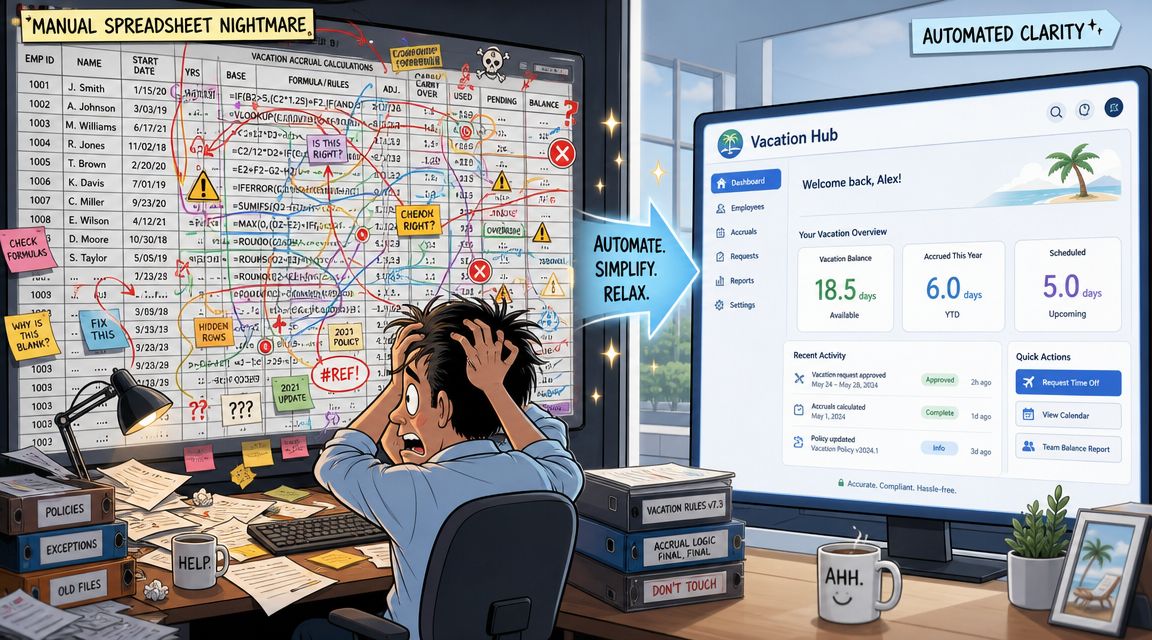
Spreadsheets are useful, until they become the policy
I'm not anti-spreadsheet. A simple Google Sheet or Excel file is fine when you're testing a policy, checking a one-off discrepancy, or cleaning up a transition from a legacy setup.
But spreadsheets break down in predictable ways:
Version drift: Different managers keep different files.
Manual overrides: One-off exceptions never make it back into the master logic.
Poor visibility: Employees can't see balances without asking someone.
Audit pain: You can't always tell who changed what and why.
That last one matters more than people think. If you need to explain a balance months later, “the formula must have changed” isn't an answer.
What automation does better
A proper timekeeping or PTO system doesn't just speed things up. It enforces consistency. The accrual rule lives in one place. The payroll cadence matches the formula. Requests, approvals, and balances connect to the same record.
That reduces the kind of tiny mismatches that create larger trust problems. It also gives employees direct visibility, which cuts down on avoidable HR questions.
If you're comparing tools or validating your current setup, a practical reference like a vacation hours calculator helps pressure-test the underlying logic before you automate it. And if you want one system that also connects communication, scheduling, and time-off tracking, Pebb is one example of a platform that includes PTO tracking alongside day-to-day team operations.
One hard truth: if your accrual logic only works when one careful person babysits it, you don't have a system. You have a dependency.
What works in practice
What works is boring. One source of truth. Clear rules. A visible balance. Fewer manual interventions. A setup that handles regular employees and edge cases without turning every exception into a custom project.
What doesn't work is trying to patch a weak process with better explanations.
If employees keep asking why the number changed, the issue usually isn't communication. It's the calculation underneath.
Accrued Vacation Is More Than a Number
A vacation balance looks like a number on a screen. But employees read more into it than that. They read whether the company keeps its word. Whether policies are clear. Whether time off is treated as earned time or as a favor that can be reinterpreted later.
That's why it's worth taking the work seriously. When you calculate accrued vacation accurately, you reduce disputes, yes. But you also remove a low-grade source of friction that people carry around longer than managers expect.
The standard isn't whether HR can explain the math after the fact. It's whether employees can trust the balance before they ask. That's the difference between a policy that exists and a policy that feels fair.
Good vacation tracking does something subtle but important. It lets people plan their lives without second-guessing the company's numbers. It lets managers approve requests without improvising. It lets payroll run without cleanup at the worst possible moment.
That may sound small. It isn't.
The companies that get this right rarely talk about it much. Their people just know where they stand. That's usually the sign the system is doing its job.
If you want a calmer way to manage time off alongside scheduling, communication, and day-to-day operations, take a look at Pebb. It gives teams one place to track PTO, handle requests, and keep employees aligned without relying on scattered spreadsheets and side conversations.
