
Author: Ron Daniel
Ultimate Guide to Leadership Transition Communication
Practical playbook for leadership transition communication: stakeholder mapping, clear messaging, channel strategy and feedback to reduce uncertainty.
Have you ever walked into the office on a Monday morning only to find the atmosphere thick with whispers and uncertainty? I remember one such day vividly - it was the start of a new CEO's tenure. Coffee machine chatter turned into speculation about layoffs or sweeping changes. Productivity took a nosedive, and I caught a few colleagues quietly updating their LinkedIn profiles. It’s incredible how quickly uncertainty can ripple through a team when leadership changes aren’t handled well.
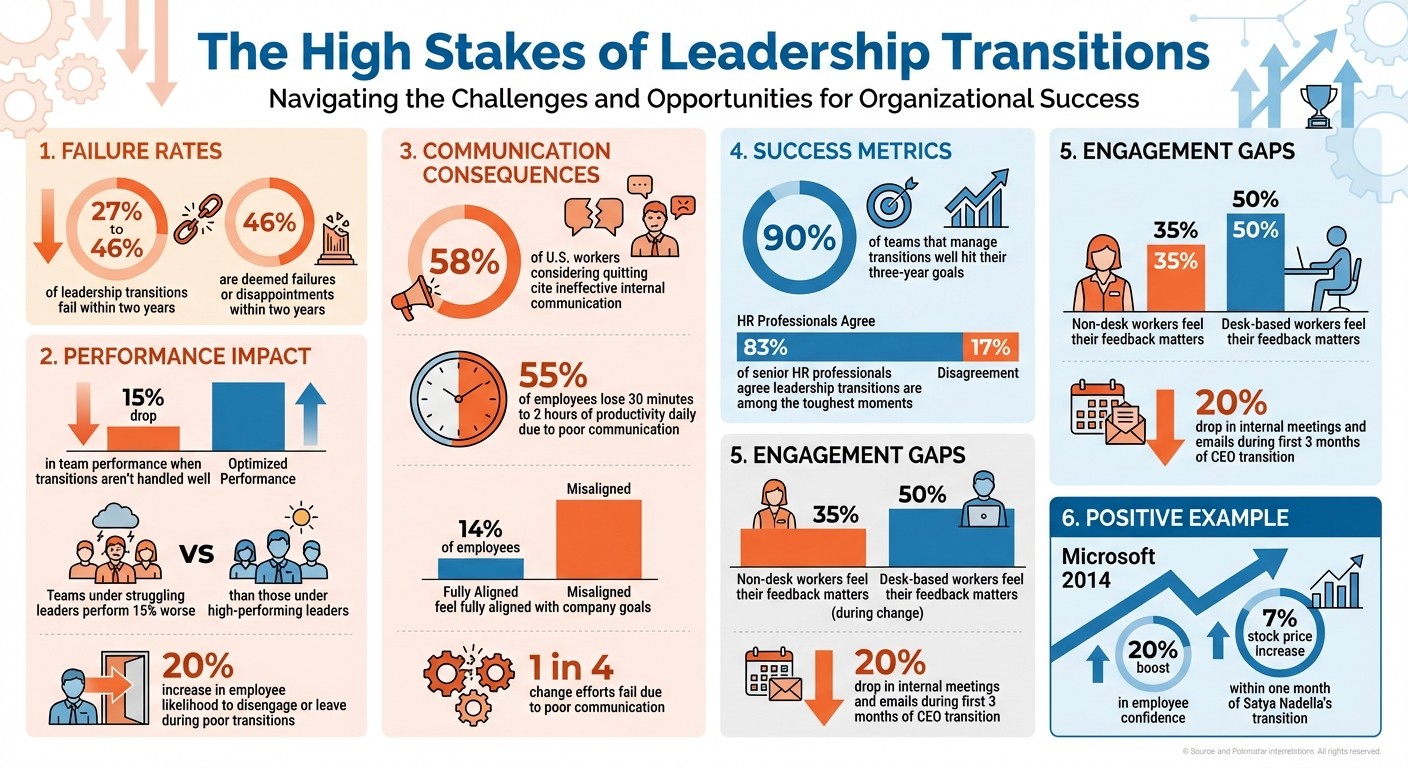
Here’s the kicker: studies show that 27% to 46% of leadership transitions fail within two years. That’s not just a statistic - it’s a reminder of how much is at stake. Poor communication during these moments doesn’t just create anxiety; it can lead to disengagement, turnover, and even a 15% drop in team performance. But when done right? Leadership transitions can set the stage for growth and alignment, as we’ve seen firsthand at Pebb.
At Pebb, we’ve spent years helping teams navigate these tricky waters. From mapping out stakeholder needs to creating centralized communication hubs, we’ve learned what works (and what doesn’t). In this guide, I’ll share the practical steps we use to turn potential chaos into clarity. Whether you’re preparing for a leadership change or in the thick of it, this is your playbook for keeping teams informed, engaged, and ready for what’s next. Let’s dive in.
Leadership Transition Statistics and Impact on Team Performance
Building Your Leadership Transition Communication Plan
Let’s face it - when leadership transitions fail, it’s rarely because the incoming leader lacks talent. The real issue? Companies often treat these transitions as isolated events rather than carefully planned processes. And the numbers don’t lie: with failure rates ranging from 27% to 46%, it’s clear why having a structured approach is so important.
Think of your communication plan as a GPS for the team. Without it, everyone’s wandering aimlessly. With it, you’re giving them clear directions, reassuring checkpoints, and a shared destination they can visualize. At Pebb, we’ve seen how the right plan can turn potential chaos into a seamless handoff. Our platform acts as the central hub, housing everything from stakeholder updates to real-time Q&A sessions. But before diving into tools, the first step is figuring out two key things: who needs to hear what, and when they need to hear it. This foundation sets the stage for a communication plan that truly works.
Mapping Stakeholders and Their Communication Needs
Here’s the thing: a one-size-fits-all message doesn’t cut it. Your frontline employees might be wondering, “Will I still have a job?” while board members are more concerned with, “What does this mean for our strategic goals?” If you send the same generic update to everyone, you’ll miss the mark entirely.
At Pebb, we use our platform to segment communications, ensuring every stakeholder gets the right message at the right time. Start by grouping stakeholders into priority levels. High-priority groups should hear from you within the first two weeks, while secondary groups can follow within 30 to 60 days. This isn’t about playing favorites - it’s about being intentional. Your internal team deserves to hear the news before it hits social media, and key clients should get a personal call before reading about it online.
A framework we swear by is the "Know, Feel, Do" model. For each group, define three things:
What they need to know (facts and updates)
How you want them to feel (emotional response)
What you want them to do (specific actions)
Here’s a quick example:
Stakeholder Group | Communication Goal (Know, Feel, Do) | Recommended Channel |
|---|---|---|
Frontline Employees | Know the timeline; Feel secure; Do stay focused | Town Halls / Manager Huddles / Pebb News Feed |
Key Partners/Clients | Know continuity plans; Feel confident; Do maintain partnership | Personal Phone Calls / Emails |
Investors/Donors | Know the vision; Feel optimistic; Do continue funding | Formal Letters / Press Releases |
One lesson we’ve learned? Don’t overlook middle managers. They’re the ones fielding daily “What does this mean for me?” questions from their teams. Equip them with toolkits, FAQs, and talking points so they can confidently lead through the change. Our knowledge library is perfect for centralizing these resources, giving managers instant access to what they need.
Another must-have? A "Briefing Book" for the incoming leader. This isn’t just a nice touch - it’s essential. Include institutional knowledge, organizational charts, key stakeholder insights, and summaries of ongoing projects. When the new leader steps in, they should feel informed, not overwhelmed. At Pebb, we make this part of our centralized repository, so everything they need is at their fingertips.
With stakeholders and their needs mapped out, the next step is setting clear goals and timelines for your communication strategy.
Defining Goals and Creating a Timeline
Here’s a surprising stat: stakeholders usually expect a new CEO to outline a strategic vision within the first 8 months, not the first 100 days. Yet companies often rush this process, creating unnecessary pressure and unrealistic expectations.
A strong communication plan unfolds in four phases:
Pre-departure planning: Notify the board and form a transition committee.
Departure announcement: Inform staff first, then external stakeholders.
Progress updates: Keep everyone in the loop about the search process.
New executive introduction: Officially welcome the new leader and share their vision.
Here’s how this timeline could look in practice:
Transition Stage | Key Communication Actions | Primary Responsibility |
|---|---|---|
Pre-Departure | Notify the board; form transition committee; draft talking points | Departing CEO & Board Chair |
Announcement | Inform staff first; send stakeholder letters; issue press release | Board Chair & HR |
Progress Updates | Share search updates; profile the "ideal candidate"; highlight milestones | Search Committee |
Introduction | Host a welcome event; distribute biography; share "100-Day" vision | New CEO & Board |
Here’s a pro tip: create a "stop-doing" list. When Alan Lafley became CEO of Procter & Gamble in 2000, he ended nearly $200 million in experimental projects to focus on core businesses. The result? A 70% increase in profits and a 30% boost in revenue over five years.
"Be clear on what you won't do - what needs to stop.... Most human beings and most companies don't like to make choices, and they particularly don't like to make a few choices they really have to live with." - Alan Lafley, former CEO, Procter & Gamble
At Pebb, we streamline these processes with tools like calendar events for town halls, AMA sessions, and team check-ins. Updates go straight to the news feed, so there’s one clear version of the truth - no conflicting email threads. And when it’s time to gather feedback? Launch a quick digital form right on the platform. These surveys help you track employee sentiment and ensure everyone stays informed throughout the transition.
The takeaway? A solid communication plan isn’t about flooding inboxes with updates. It’s about delivering the right message to the right people at the right time. Nail this, and you’ll already be ahead of the nearly half of transitions that fall apart.
Writing Clear Leadership Transition Messages
Let’s be honest - crafting a clear and effective leadership transition message can feel like walking a tightrope. Too much jargon? You lose people. Too vague? You create confusion. And trust me, I’ve seen it happen more times than I can count.
Here’s a sobering stat: nearly 46% of leadership transitions are considered failures or disappointments two years down the line. Why? Poor communication. When we at Pebb work with teams, it becomes crystal clear that the difference between a smooth transition and a chaotic one often boils down to how honest, clear, and empathetic those first messages are. So, once your plan is in place, it’s time to tackle the human side of this equation.
Being Honest and Addressing Employee Concerns
Let’s face it - when employees hear the words "leadership change", it’s like their internal alarm bells start ringing. And it’s not just drama; it’s a real psychological response. People immediately wonder: Will my role change? Is my job safe? Is the company in trouble?
That’s why sugarcoating or dodging the hard questions doesn’t work. Actually, it does the opposite - it erodes trust. Studies show that 83% of senior HR professionals agree that leadership transitions are some of the toughest moments in a manager’s career. And if it’s that stressful for leaders, imagine how the rest of the team feels.
Here’s what we’ve learned at Pebb: don’t shy away from the tough stuff. If people are worried about job security, address it head-on. For example, say something like, "I know some of you might be wondering what this means for your role. Here’s what we know right now..." And if the previous leader left under less-than-ideal circumstances, don’t rewrite history. Acknowledging both the wins and the challenges of the past shows respect for your team’s intelligence.
One pro tip? Use inclusive language like "we" and "our" instead of distancing phrases like "the board decided" or "leadership has chosen." When you own the narrative, you gain credibility. Remember, 1 in 4 change efforts fail due to poor communication. Don’t let your team become part of that statistic.
What to Include in Leadership Announcements
So, what makes a leadership message land? It’s all about hitting the right notes. Here’s what we always include to keep things clear and build trust:
The "What" and "Why": Start with the facts. Be upfront about what’s happening and why. Whether it’s a planned retirement, a strategic shift, or an unexpected departure, transparency is key. If you can’t share everything just yet, say so: "We’re still working through some specifics, but here’s what we know today..."
The Leader’s Story: Humanize the new leader. Share their background, their qualifications, and - most importantly - their "why." At Pebb, we often use video intros or written profiles to help employees see the person behind the title. Skip the resume dump and focus on their story - why they’re excited to lead and what drives them.
Acknowledgment of the Past: If someone is stepping down, honor their contributions. A simple nod to their achievements - like, "We’re grateful for [Name]’s leadership over the past [X] years, especially their work on [specific achievement]" - can go a long way in maintaining trust.
Vision and Continuity: Paint a clear picture of what’s ahead, but also ground your team in what’s staying the same. Reinforce your mission, values, and commitments to customers. During uncertain times, these constants can be incredibly reassuring.
Actionable Next Steps: Lay out a clear timeline. When does the new leader start? What happens in the interim? If there’s no permanent replacement yet, explain the interim plan. Ambiguity only fuels anxiety.
Two-Way Communication: Don’t make it a one-and-done announcement. Invite feedback through AMA sessions, town halls, or even private groups. At Pebb, we’ve set up private groups where employees can ask questions, and we respond within 48 hours. It’s a simple way to show people they’re heard.
Here’s a quick breakdown of how each piece of the message serves a purpose:
Message Element | Purpose |
|---|---|
The "Why" | Explains the business reasons to establish logic-based trust |
The "Who" | Shares the leader’s story to build an emotional connection |
The "Where" | Paints a picture of the future to inspire the team |
The "How" | Outlines next steps and expectations for the first 90–100 days |
At Pebb, we make sure everything is centralized on our news feed - one source of truth for everyone. We also encourage managers to hold team huddles to answer questions in real time. The more touchpoints you create, the better your message will resonate.
Choosing the Right Communication Channels
Your message is ready to go, but now comes the hard part: making sure it actually reaches everyone. Here's the thing - 58% of U.S. workers thinking about quitting say ineffective internal communication is a big reason why. That’s not just a communication hiccup - it’s a full-blown retention issue.
One of the biggest traps companies fall into is assuming a single channel works for everyone. Sure, your desk-based employees might live in their inboxes, but what about your frontline staff? Many of them don’t even have company email. And the numbers back this up: only 35% of non-desk workers feel their feedback matters during organizational change, compared to 50% of desk-based workers. That’s not just an engagement gap - it’s a channel gap.
So, what’s the solution? Start by auditing your communication channels. Are you reaching everyone, especially your non-desk teams? If not, it’s time to rethink your strategy. Mobile-first tools like SMS, employee apps, or even digital signage can bridge that gap. The goal is simple: make sure every employee, regardless of their role or location, gets the updates they need when they need them.
Using Pebb to Centralize Your Communication
At Pebb, we’ve made it our mission to simplify communication by putting everything in one place. Whether it’s news feeds, work chats, group updates, files, or digital forms, Pebb keeps everyone connected. Let’s say you’re announcing a leadership change. With Pebb, you can post the announcement on the news feed, pin it to the top, and ensure that everyone - from the folks at their desks to those on the warehouse floor - gets the same message at the same time.
Our news feed acts as the go-to hub for updates. You can share a video introduction from the new leader, lay out the transition timeline, and even create a dedicated group for employees to ask questions. One of my favorite features? Some of our clients have implemented a 48-hour response rule - every question posted gets answered within two days. It’s a small but powerful way to show your team that their voices matter during uncertain times.
And for those on the go, Pebb is built with frontline workers in mind. Whether it’s retail staff, drivers, or field technicians, they can access updates straight from their phones. It’s available on any device, making it ridiculously easy to stay connected. Plus, at just $4 per user per month for our Premium plan (or free for teams of up to 15 employees), it’s one of the most affordable ways to ensure no one is left in the dark.
When to Use Digital Tools vs. Face-to-Face Meetings
Let’s be honest - digital tools are great for speed and reach, but there are times when only a face-to-face meeting will do. Here’s the rule of thumb: use digital channels for efficiency, but lean on in-person interactions for sensitive or emotional topics. For example, if you’re announcing a planned retirement with a clear succession plan, a well-crafted digital message followed by a town hall Q&A can work wonders. But if the transition is happening under more challenging circumstances - say, a leader was let go - start with face-to-face meetings. These moments allow you to address emotions, answer tough questions, and build trust.
Think of it this way: digital tools are like a megaphone, while face-to-face meetings are the handshake. When employees are worried about their roles or the company’s future, a Slack message or email won’t cut it. They need to see their manager, hear their tone, and ask questions in real time. That’s where site visits, team huddles, and one-on-one check-ins come in. Once those conversations happen, you can reinforce the message digitally to keep it top of mind.
At Pebb, we recommend a hybrid approach. Start with face-to-face meetings for major announcements, then follow up with digital updates for reinforcement. For instance, after a town hall, post a summary on the news feed with key takeaways and a link to the recording. That way, employees who missed the meeting - or want to revisit it - can access the information anytime.
Here’s a quick guide to choosing the right channel for the right situation:
Channel Type | Best Used For | Target Audience |
|---|---|---|
Face-to-Face / Huddles | Empathy, sensitive news, building trust | Direct reports, local teams |
Employee Apps / SMS | Urgent updates, reaching deskless staff | Frontline, field workers, drivers |
Town Halls / AMAs | Two-way dialogue, vision casting | Entire organization |
Intranet / Central Hub | Policy details, FAQs, timelines | Desk-based staff, HR/Admin |
The key is balance. Use tools like Pebb to ensure consistency and reach, but never underestimate the power of a face-to-face moment to build trust and connection. Together, they create a communication strategy that’s both effective and human.
Rolling Out Your Communication Plan
Your plan is ready, and now it’s time to put it into action. This is the moment where everything can either come together beautifully or fall apart. What makes the difference? It all boils down to whether your leadership and HR teams are fully aligned and if you're genuinely listening to employees throughout the transition.
Here’s a stat that might make you pause: 46% of leadership transitions are deemed failures or disappointments within two years. And it’s rarely because the plan itself was flawed. Instead, it’s often due to inconsistent execution, muddled messaging, or employees feeling unheard. Let’s make sure your team avoids these pitfalls and delivers a unified, clear message.
Aligning Leadership and HR Teams
Before you roll out the plan company-wide, it’s critical to get leadership and HR on the same page. Mixed messages can erode trust faster than you can imagine. Picture this: one manager tells employees the transition is about “strategic growth,” while another describes it as “restructuring.” Confusion spreads, anxiety rises, and employees start filling in the blanks with worst-case scenarios.
So, how do you avoid this? By creating a centralized toolkit that ensures everyone is speaking the same language. At Pebb, we’ve seen this approach work wonders. Back in September 2025, a multi-state organization rolled out a new safety management system. They developed leader toolkits and implemented a monthly alignment strategy across their state-operating companies. This ensured consistent messaging across 20 workstreams, from engineering to HR, and eliminated confusion.
Another key step is holding a briefing session for all people managers. Whether it’s a live meeting, webinar, or recorded video, this is your chance to walk them through the toolkit, clarify their role in the communication process, and address their questions. I remember a scientific organization that nailed this in 2025. They briefed 95 leaders on a digital transformation process, provided a toolkit with core messages, and hosted working sessions across four divisions to anticipate employee concerns. The result? Over 100 employees stepped up to join “solution teams” and drive the two-year implementation.
It’s also smart to establish a transition committee before making any public announcements. This small group - comprising board members, HR professionals, and executives - can manage the messaging and behind-the-scenes planning. Their job is to keep the narrative consistent and focused.
And here’s a pro tip from JRG Partners:
"The CEO - not the HR executive - should formally communicate the departure to the company. This signals that the transition has full C-suite support." - JRG Partners
When the CEO takes the lead on the initial announcement, it sends a clear message that the transition is backed by the entire executive team. After the CEO sets the tone, HR and other leaders can reinforce the message using the toolkit.
Tracking Employee Reactions and Gathering Feedback
Once your leadership and HR teams are aligned and the rollout is underway, the next priority is real-time feedback. You need to know how employees are reacting so you can adjust on the fly. Without this, you’re essentially flying blind.
Start with pulse surveys - short, five-question check-ins to gauge how employees are feeling. Are they clear on the timeline? Do they understand the reasoning behind the change? Are they worried about their roles? These quick surveys provide a snapshot of what’s working and where you might need to tweak your approach.
At Pebb, we’ve built tools specifically for moments like these. For example, you can create private groups where employees can ask tough questions without fear of judgment. Pair that with our news feed, where updates and FAQs can be pinned for easy access, and you’ve got a centralized hub for communication. A simple rule - like ensuring every posted question gets answered within 48 hours - can go a long way in showing employees that their voices matter.
But don’t rely solely on digital feedback. Host "Ask Me Anything" (AMA) sessions during town halls or team meetings. These give employees a chance to hear directly from leadership and ask questions in real time. I’ve seen this approach work firsthand. In June 2025, a newly appointed division president at a global medical manufacturing company visited manufacturing floors within days of starting. By meeting with employees and patients impacted by their technology, the leader built immediate trust and demonstrated a commitment to understanding the business from the ground up.
Here’s why this matters: when leaders struggle through a transition, their direct reports perform 15% worse than those under high-performing leaders. That’s not just a leadership issue - it’s a team issue. By actively tracking feedback and responding quickly, you can prevent disengagement before it spreads.
Use Pebb’s analytics to monitor engagement metrics like post views, question response rates, and form completion rates. If you notice certain teams or locations lagging in engagement, that’s your cue to dig deeper. Maybe they need a follow-up meeting, or maybe the messaging didn’t resonate. Either way, these insights help you course-correct.
The key is to keep your leadership and HR teams aligned, equip them with the right tools, and establish feedback loops that keep you connected to your employees. With a consistent message and a listening-first approach, you can transform a challenging transition into an opportunity to build trust and strengthen your organization.
Solving Common Leadership Transition Problems
Leadership transitions can be tricky. They often come with a predictable set of hurdles: employees resisting change, communication channels getting clogged, and an overall sense of uncertainty that can throw even the best-laid plans off course. The good news? These challenges don’t have to derail your efforts if you tackle them head-on with the right strategies.
Let me walk you through two of the most common issues - employee resistance and communication overload - and share how we’ve approached them at Pebb.
Managing Employee Pushback
Joyce Kaduki, a respected leadership coach, once said:
"People talk about welcoming change but don't welcome it in real life... No one likes change - except the architect of the change."
And she’s absolutely right. When a new leader steps in, it’s not just about the new strategies or initiatives they bring. Employees start to wonder about their own roles, their teams, and what the future might look like for them. It’s a deeply personal reaction.
Here’s a stat that caught my attention: during the first three months of a CEO transition, internal meetings and emails often drop by about 20% because employees aren’t sure what to say or who to trust. That silence? It’s a breeding ground for uncertainty - and it needs to be addressed quickly.
At Pebb, we’ve found that creating safe spaces for employees to voice their concerns is a game-changer. For instance:
Private groups: These allow employees to ask the tough questions without fear of judgment.
Live "Ask Me Anything" sessions: Hosting these during town halls or team meetings helps build transparency and trust.
I’m reminded of Satya Nadella’s transition at Microsoft in 2014. His team planned a series of communications, including town halls and manager briefings, that boosted employee confidence by 20% and even led to a 7% jump in Microsoft’s stock price within just a month. It’s proof that open, consistent communication works.
Another critical piece? Empowering middle managers. Employees are far more likely to embrace change when they hear about it directly from their immediate supervisor rather than through a generic company-wide email. And here’s why it matters: when a leader struggles during a transition, their direct reports tend to perform about 15% worse than those under a strong leader. Addressing resistance early isn’t just about leadership - it’s about protecting team performance across the board.
Now, while managing resistance is crucial, there’s another pitfall to avoid: overwhelming employees with too much information.
Preventing Communication Overload
Here’s the thing: too many updates can backfire. Research shows that most employees can only handle one or two major organizational changes per year. If you’re bombarding them with constant updates, you’re not keeping them informed - you’re overwhelming them.
This is where Pebb has been a lifesaver for us. Instead of scattering updates across emails, Slack, and random meetings, we set up a dedicated transition hub using Pebb’s news feed, groups, and knowledge library. Here’s how it works:
Pin important announcements: The most critical updates stay at the top, so employees don’t have to dig for them.
Host a searchable knowledge library: Employees can quickly find answers to their questions without needing to ask around.
Segment information by department or location: This ensures people only see what’s relevant to them, cutting down on unnecessary noise.
Another tip? Use an editorial calendar to plan your communication themes for the first 90 days. For example:
Month 1: Focus on "listening and learning."
Month 2: Highlight "strategic priorities."
Month 3: Dive into "execution."
This pacing helps avoid the dreaded "information dump" that leaves everyone scratching their heads.
And don’t forget to check how your messages are landing. Pebb’s digital forms have been a fantastic tool for us to gauge employee sentiment. Are people feeling overwhelmed? Do they understand the transition timeline? If engagement starts to dip, it’s a clear sign to slow down and recalibrate. Responding to questions within 48 hours also goes a long way in showing employees that you’re listening without overloading their inboxes.
Measuring Results and Improving Future Transitions
Let’s face it - when it comes to leadership transitions, there’s no room for guesswork. The stakes are high, and the numbers don’t lie: 46% of leadership transitions are labeled as failures or disappointments within two years of a new leader stepping in. That’s nearly half! The difference between success and failure often boils down to whether you’re tracking the right metrics and learning from them.
At Pebb, we’ve learned that measuring the success of each transition isn’t just about ticking off tasks. It’s about uncovering what truly drives team performance and making adjustments that matter.
Which Metrics to Monitor
If you want to measure success effectively, focus on metrics that reveal how employees are experiencing the transition. For instance:
Digital engagement: Track how many employees read announcements, react, comment, or click through links. These actions show whether your message is resonating or getting lost in the noise.
Participation rates: Keep an eye on pulse survey responses and Q&A attendance. A sudden drop might signal that employees don’t feel safe voicing their opinions or doubt their input matters.
Here’s a stat that should grab your attention: poor communication causes 55% of employees to lose 30 minutes to two hours of productivity daily. And when a leader struggles to adapt, their team’s performance can dip by 15%, with employees becoming 20% more likely to disengage or leave. That’s why we recommend conducting simple organizational scans before and after transitions. Ask questions like:
What do you love about your job?
What’s your biggest challenge right now?
What changes would you like to see?
These straightforward surveys provide a baseline for spotting trends and addressing issues early.
Using Pebb Analytics to Track Communication Performance
Here’s where Pebb steps in to make life easier. Instead of juggling data from emails, chats, and spreadsheets, our analytics dashboard gives you a complete view of how your transition communications are performing - all in one place.
We analyze engagement metrics to fine-tune future transition plans. For example, if critical updates aren’t getting the engagement you expected, it’s a clear signal to tweak your strategy. Our analytics take it a step further, helping identify recurring questions and emerging concerns in real time. After major announcements, we send out quick digital forms to gauge whether employees understand and align with the new direction. Why? Because only 14% of employees feel fully aligned with their company’s goals.
One approach that’s been a game changer for us is conducting quarterly reviews of our communication data. During these reviews, we look at:
Which communication channels are underperforming
Which teams seem disconnected from central updates
Whether we’re meeting our 48-hour response time standard
This regular check-in helps us stay proactive, adjusting our methods before small issues turn into big problems.
The real magic of Pebb’s analytics isn’t just in gathering data - it’s in turning that data into actionable insights. For instance, if frontline employees are missing updates, we pivot to push notifications or SMS reminders. If engagement drops in a specific department, we equip the manager with targeted talking points to address concerns directly.
And here’s the best part: all this data builds a roadmap for the next leadership transition. By documenting what worked and what didn’t - whether it’s which communication channels performed best or which messages sparked the most questions - you’re creating a playbook that makes each transition smoother than the last. These insights aren’t just useful for the current transition; they become a strategic advantage for the future.
Conclusion
Leadership transitions can feel like navigating uncharted waters, but with clear communication, thoughtful strategies, and the right tools, they don’t have to spiral into chaos. Instead, they can be seamless handoffs that set the stage for success.
Throughout this guide, we’ve walked through the essentials: identifying key stakeholders, crafting honest and timely messages, picking the best communication channels, and measuring what really drives results. Here’s the kicker: 90% of teams that nail leadership transitions hit their three-year goals. On the flip side, poor management during these periods can lead to a 15% dip in performance and a 20% spike in attrition rates. Those are numbers no organization wants to face - and the good news is, they’re avoidable.
At Pebb, we’ve seen how centralizing communication can completely change the game during transitions. Our news feed, group chats, and analytics dashboard help cut through the noise of scattered updates. When everyone’s on the same page, trust builds faster, and confusion fades into the background. Whether it’s a quick team update or a major announcement, tools like Pebb ensure no one’s left in the dark.
"Communication plays a critical role in CEO transitions for the outgoing leader, the incoming leader, the incumbent leadership team, and the overall organization, with material impacts on engagement and performance."
– IMD
Here’s the thing: leadership transitions might be tough, but they’re also a chance to bring your team closer together. With a solid communication plan and tools like Pebb - starting at just $4 per user for our Premium plan or even free for up to 15 employees - you can turn a stressful time into an opportunity to strengthen your organization. Keep your team informed, engaged, and ready to embrace the future.
FAQs
What’s the best way to communicate a leadership transition effectively?
Leadership transitions can feel like walking a tightrope - one misstep, and things can spiral into confusion or disengagement. That’s why clear, intentional communication isn’t just helpful - it’s essential. To keep everything running smoothly, I’ve found it’s best to break the process into four stages: planning, announcing the departure, sharing updates, and introducing the new leader. Each phase needs its own tone, audience, and timing to hit the right notes.
First, map out your stakeholders. Think about everyone involved - frontline employees, managers, investors - and ask yourself: What do they need to know, and when do they need to know it? Transparency is non-negotiable here. Highlight the opportunities a new leader brings, address concerns directly, and make sure the conversation flows both ways. People need to feel heard, not just talked at.
Here’s where Pebb steps in to make life a whole lot easier. Imagine being able to handle the entire transition from one platform. With tools like news-feed announcements, live Q&A video calls, and dedicated groups for department updates, Pebb keeps everyone informed without the chaos of juggling multiple apps. And at just $4 per user for our premium plan, it’s an affordable, all-in-one solution. Whether your team is on the factory floor or in the C-suite, Pebb ensures everyone stays in the loop during these pivotal moments.
Why are middle managers crucial during a leadership transition?
Middle managers play a crucial role when a company undergoes a leadership transition. They’re the ones who take the big-picture vision of a new leader and break it down into manageable steps for their teams. At the same time, they act as a bridge, keeping communication flowing between senior leadership and frontline employees. Whether it’s answering questions, reinforcing messages, or gathering feedback, these managers are the steady hands ensuring the transition doesn’t veer off course.
Since middle managers already juggle the needs of their teams with the expectations of leadership, they’re in a prime position to uphold stability and morale during times of change. With the right tools - like Pebb’s all-in-one communication platform - they can do this even more effectively. Pebb makes it simple to share updates, host virtual town halls, and collect real-time feedback, turning middle managers into confident, well-equipped ambassadors. The result? A transition that feels organized and seamless, rather than chaotic or overwhelming.
Why is it important to communicate through multiple channels during a leadership transition?
Using different communication channels is like speaking everyone's language, ensuring messages are clear and timely - whether someone’s at their desk, in the field, or working remotely. This approach minimizes confusion, keeps the message consistent, and ensures no one feels left out, especially during pivotal moments like a leadership transition.
Here’s the thing - people absorb information in their own ways. Some thrive on email updates, others prefer scrolling through a news feed, and many rely on chat apps for quick updates. By mixing up your communication methods, you’re doing more than just informing your team - you’re engaging them and building trust when it matters most. Tools like Pebb make this process seamless, offering a centralized hub for messages, updates, and collaboration, so everyone stays in the loop without missing a step.
