
A Guide to Workplace Skill Development That Actually Works
Discover a calmer, more effective approach to workplace skill development. Build a confident, future-ready team by focusing on what truly matters.
Dan Robin
Most companies are sitting on a goldmine of untapped potential. Not in some new market or breakthrough technology, but in the people they already have. We spend so much time chasing the next big thing, we often forget the simplest truth: the best way to build a better company is to build better people.
Workplace skill development isn't a program you launch. It isn't a line item in the HR budget. It's a philosophy. It’s the quiet, daily commitment to helping your team get a little bit sharper, a little bit smarter, and a little more capable than they were the day before.
The Quiet Disconnect in Our Teams
Let's be honest. Most of us want to get better at our jobs. We want to feel like we’re mastering our craft. But a lot of the time, we feel stuck. We see the company’s ambitious goals on a slide deck, but we can't see our own path forward.
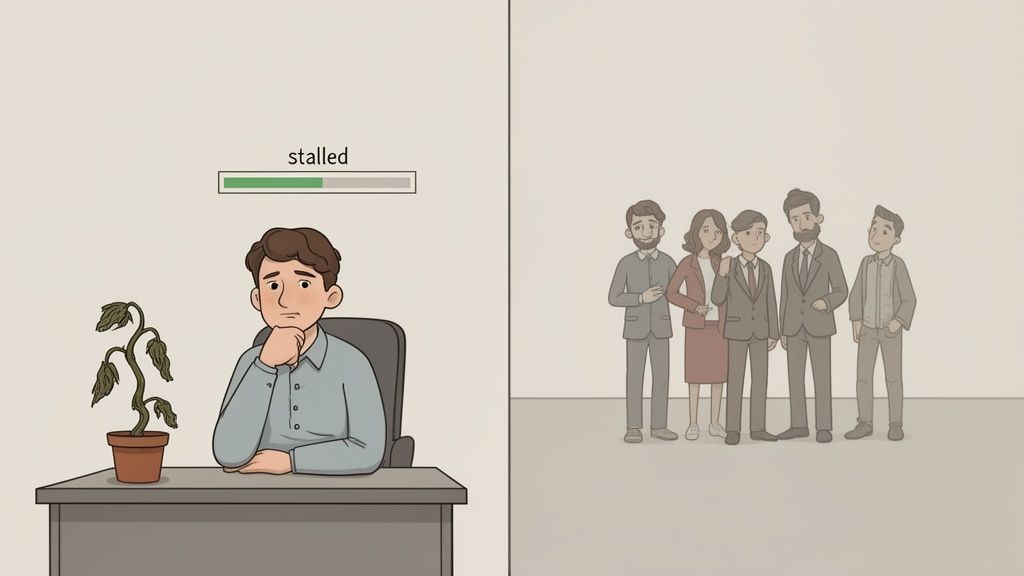
This feeling isn’t a mystery. It’s the gap between a company's vision and an employee's reality. We see where the business wants to go, but we have no idea how our own skills fit into that journey.
The problem is rarely a lack of expensive software or fancy off-sites. It’s usually much simpler. It’s the manager who’s too busy to have a real conversation about your career. It’s the fear that asking for help makes you look incompetent. It's a culture that talks about growth but only rewards immediate output.
The Real Cost of Stalled Growth
When people feel stuck, they don’t just stop growing—they start looking for the door. This isn't just a hunch; the data tells the same story.
A recent ADP 'People at Work' report found something startling. Only 24% of workers around the globe feel they have the skills they need for the next step in their careers. And just 17% feel their employers are actually investing in the right skills to help them get there. You can dig into the full findings about this employee skills gap.
This is more than an HR statistic. It’s the sound of potential walking away. It’s why great people leave for a competitor who simply promises them a clear path forward.
When we talk about workplace skill development, we're not just discussing a business strategy. We’re talking about a fundamental human need to learn and master new things. Ignoring it is like trying to run a marathon without training. Sooner or later, you just burn out.
Reframing the Conversation
So how do we fix this? The answer isn't buried in a complex learning management system or a mandatory annual workshop.
It starts by changing the conversation. We have to stop treating skill development like a box to check and start seeing it for what it is: a core part of the daily work. It’s about creating an environment where curiosity is rewarded, asking for help is normal, and learning is a shared responsibility, not a top-down directive.
This shift begins with small, consistent actions. It's about building trust. It's about encouraging open communication. It's about making it safe for people to admit they don’t have all the answers. Before we can build skills, we have to build a foundation of psychological safety. That’s the real work.
Why Traditional Training Programs Fall Short
We’ve all been there. The mandatory, all-day workshop in a windowless room, fueled by stale coffee and forced enthusiasm. Someone clicks through a hundred slides, we do an awkward "team-building" exercise, and by Monday, it’s like it never happened.
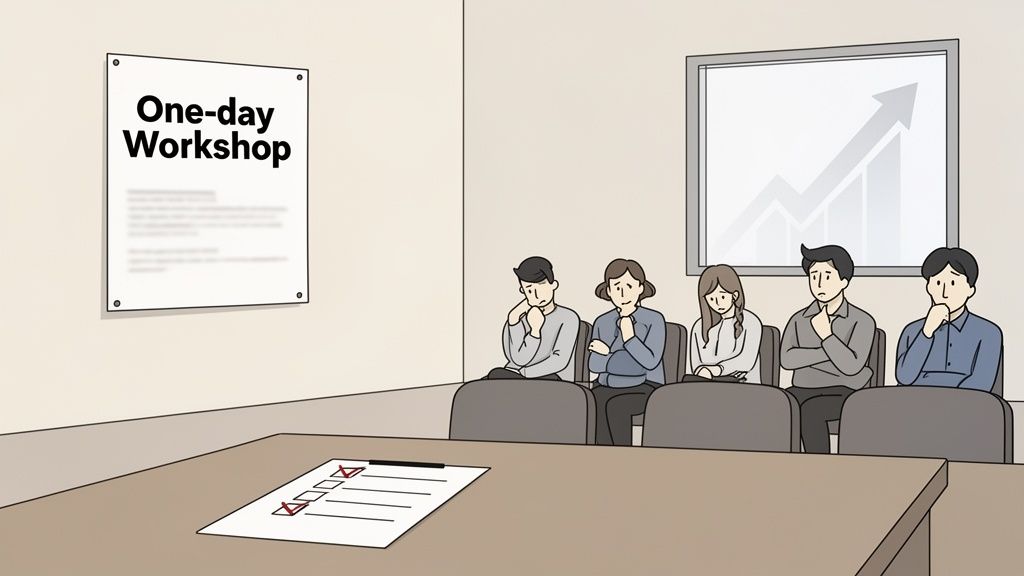
This is the old model of workplace skill development. It’s an event. Something we schedule, attend, and tick off a list. But let’s be honest—it rarely works.
The problem isn't the intention. The desire to help employees improve is the right one. The problem is the method. For too long, we’ve treated learning like a software update—a one-time installation that’s supposed to magically fix everything.
The Myth of Event-Based Learning
Real, lasting skills aren't built in a single day. You can’t learn to be a better leader between 9 a.m. and 5 p.m. on a Tuesday. You can't truly master a complex process by listening to a lecture.
These one-off events have a few fatal flaws:
No Real-World Context: The training is often disconnected from the daily realities of the job. The hypothetical scenarios feel abstract, making the lessons nearly impossible to apply when you’re back at your desk facing actual problems.
The Forgetting Curve is Real: Without immediate and repeated use, we forget most of what we learn. Research has shown that within a single day, people can forget up to 70% of new information. That expensive workshop quickly becomes a binder gathering dust on a shelf.
Passive Participation: Too often, these sessions are a one-way street. We’re talked at, not engaged with. This approach fails to build the "muscle memory" that only comes from doing, failing, and trying again.
The result is a staggering amount of wasted time and money. Companies spend billions on training that produces little more than a certificate of completion. We’re checking a box, but we aren't creating genuine capability.
From Training Events to Integrated Practice
Here’s the thing: skills are built through practice, not presentations. They are developed in the flow of work, not in a conference room isolated from it.
Think about learning a new language. You wouldn't expect to become fluent after one eight-hour class. You’d practice a little every day. You'd have conversations, make mistakes, look things up, and slowly, over time, it would start to feel natural.
Workplace skill development is no different. It’s about creating an environment where learning is a continuous loop, not a one-time event.
The most effective approach to skill development is calm, consistent, and integrated. It’s about weaving small, continuous learning opportunities into the fabric of the workday.
This means shifting our focus from top-down mandates to peer-to-peer knowledge sharing. It means valuing small experiments and learning from what doesn't work. It means creating resources that are easy to find at the exact moment someone needs them.
Ultimately, the goal isn't to create a perfect training program. It’s to build a culture where people feel supported in their curiosity, where asking for help is a sign of strength, and where everyone is getting a little bit better, every single day. That's a quieter approach, but it’s the one that actually sticks.
Building a Culture of Continuous Learning
So, what’s the alternative to that one-day workshop everyone forgets by Tuesday? It’s not a bigger, shinier training platform. The real secret is a shift in mindset. A place where genuine workplace skill development actually happens isn't built on mandates; it's grown from a shared sense of curiosity.
It's about creating an environment where learning is just part of the daily rhythm of work. A shared responsibility, not another directive from HR. This kind of culture just feels different—it's calmer, more human, and a lot more effective.
The foundation isn't some complex system. It's a series of small, consistent actions that send one clear message: it’s safe to be a work in progress here.
Start with Leaders Learning in Public
Culture trickles down from the top. If leaders act like they have all the answers, everyone else will pretend they do, too. But something powerful happens when a leader openly says, "I'm not sure, let's find out," or shares an article they found genuinely helpful. The entire dynamic changes.
This isn’t weakness; it’s strength. It gives everyone else permission to be curious and even a little bit vulnerable. When leaders model what it looks like to learn, they make it obvious that growth is everyone's job, not just a box for junior staff to check.
True learning cultures are built on intellectual humility. It starts with leaders being the most curious people in the room, proving that asking questions is more valuable than having all the answers.
Make Knowledge Sharing Effortless
Sometimes the simplest tools are the best. Forget the clunky, expensive Learning Management System that no one uses. A vibrant learning culture can be built with tools you probably already have.
How about a dedicated chat channel where people can share interesting articles or ask for help without feeling like they’re interrupting someone? Or a simple, shared knowledge base where a team member can document a new process just once, saving everyone hours of repeat questions down the line.
These aren't massive projects. They are small, practical steps that remove friction and let knowledge flow. When information is easy to find and share, learning stops being a scheduled event and becomes a natural part of getting work done.
Connect Learning to Engagement
A culture of continuous learning isn't just about collecting new skills; it's about forging a deeper sense of purpose. When people see their company is truly invested in their growth, they become more invested in the company's success. This is a crucial link we explore in our guide to boosting employee engagement with effective training.
To make it all work, you can't just focus on individual training. It’s about building a robust learning and development strategy that connects personal growth to the company's larger goals. That alignment is what makes people feel valued and see a clear future for themselves.
The real goal is to create a place where people don't just work, but grow. It’s about building a team that is resilient, adaptable, and genuinely excited to figure out the next challenge together. That kind of energy doesn't come from a workshop; it comes from the culture you build every day.
Identifying the Skills That Truly Matter
It’s easy to get lost in the noise. Every year, a new list of “must-have” skills makes the rounds, and suddenly everyone scrambles to learn the latest software or a methodology packed with jargon. But chasing trends is a surefire way to burn out your team and waste time.
The real question isn’t "what's popular?" but "what's necessary?" What does your team actually need to do their best work and move the business forward? Answering this requires a calm, deliberate approach.
This isn’t about creating a massive, one-size-fits-all training catalog. It’s about being thoughtful and connecting every learning effort directly to your goals. We need to stop collecting skills like they’re merit badges and start building capabilities with a clear purpose.
Durable Skills vs. Perishable Skills
Think of it this way: the specific software we use today might be obsolete in three years. These are perishable skills. They’re important for doing the job right now, but their shelf life is short. Training someone on the latest version of a tool is necessary maintenance, not a long-term investment.
Then there are the durable skills. These are the human capabilities that never go out of style: clear communication, critical thinking, adaptability, and the ability to collaborate. These are the foundational skills that let people learn the next piece of software, solve the next unexpected problem, and lead the next big project.
Investing only in perishable skills is like constantly patching a leaky roof. Investing in durable skills is like strengthening the foundation of the entire house. One is a temporary fix; the other ensures long-term stability.
When you focus on durable skills, you’re building a more resilient, self-sufficient team. When someone can think critically, they don’t just follow a process—they find ways to improve it. That’s an infinitely more valuable asset.
From Business Goals to Human Skills
So, how do you figure out which skills really matter for your team? Start by looking at your business goals, not at industry trends.
Where is the company headed in the next one to two years? Are you trying to break into a new market, make customers happier, or simply run more efficiently? Once you know that, you can work backward.
Goal: Improve customer satisfaction by 15%.
What needs to happen? We need faster response times and better problem resolution.
What skills are needed? Empathetic communication, active listening, and creative problem-solving.
This simple exercise turns a vague business objective into a concrete plan for workplace skill development. It ensures every learning opportunity is directly tied to a meaningful outcome, making the value crystal clear to both the employee and the business.
This strategic approach is more critical than ever. The World Economic Forum found that 63% of leading global employers see skills gaps as the biggest barrier to business transformation. The report also highlights that analytical thinking is now the most sought-after core skill, with resilience, flexibility, and leadership close behind—a clear signal that the focus is shifting toward durable, human-centric abilities. You can explore the full report on future skills to see just how deep this trend runs.
Essential Skills for the Modern Workforce
To cut through the clutter, it helps to see how these durable and technical skills fit together. Here’s a look at the capabilities that consistently prove their worth.
Skill Category | Top Skills | Why It Matters Now |
|---|---|---|
Durable (Human-Centric) | Analytical Thinking, Creative Problem-Solving, Communication, Collaboration, Adaptability, Leadership | These skills are timeless. They help people navigate change, solve complex problems, and innovate, regardless of the tools they're using. |
Technical (High-Demand) | AI & Machine Learning, Data Analytics, Cloud Computing, Cybersecurity, Project Management Software | These are the tools of modern business. Proficiency here lets teams execute efficiently, secure data, and turn information into insights. |
The best development programs don't treat these as separate. Instead, they integrate them, teaching people not just how to use a new analytics tool, but how to think analytically with the data it provides.
This hierarchy shows how a strong learning culture is built from the top down, with support from peers and the right systems in place.
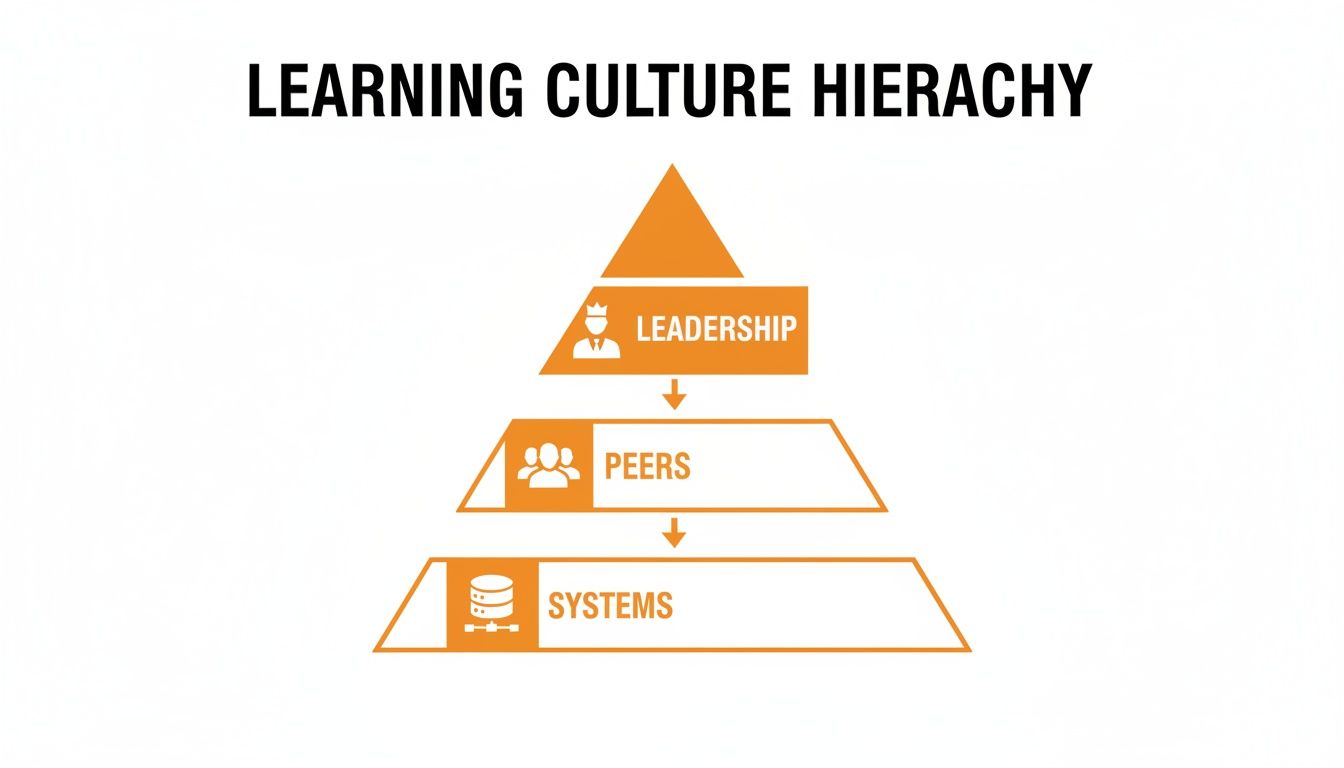
The key takeaway here is that without leadership buy-in and peer support, even the best tools won't create a genuine culture of growth.
Ultimately, identifying the right skills isn’t about predicting the future; it’s about preparing for it. By focusing on foundational, durable capabilities that align with your business, you’re not just training people for today’s job. You’re building a team that’s ready for whatever comes next.
Making Skill Development Accessible to Everyone
Let's be honest. In most companies, workplace skill development isn't a level playing field. Senior leaders get executive coaching, managers go to fancy retreats, and frontline employees get… well, maybe an annual compliance course if they’re lucky.
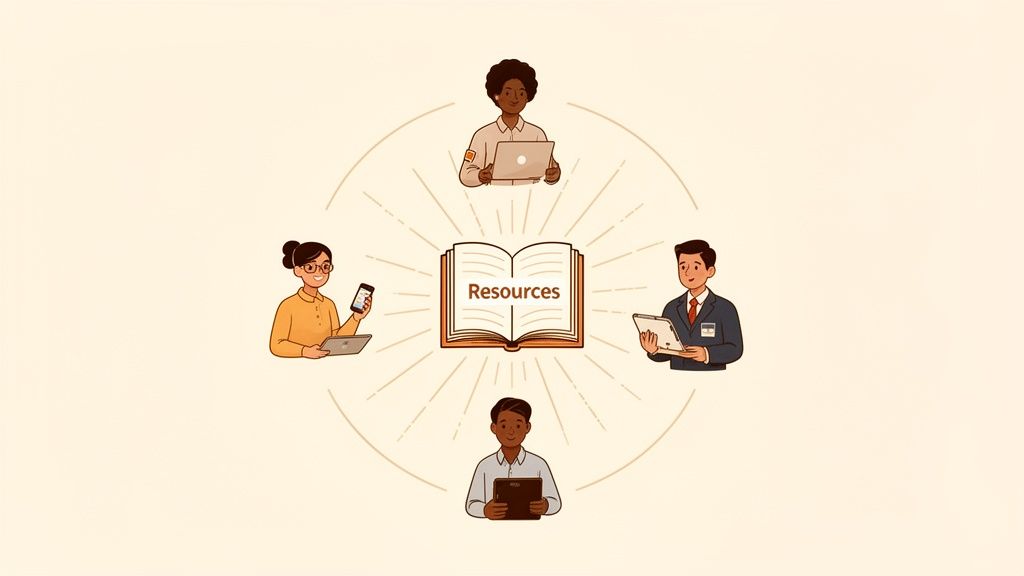
This isn’t just unfair; it’s a terrible strategy. The most resilient companies get it: your organization is only as strong as its most overlooked employee. When we reserve growth opportunities for a select few, we leave an incredible amount of potential on the table.
This isn't just a feeling; the data backs it up. PwC's research on the global workforce found that 72% of senior executives feel they have the resources they need to learn, while only 51% of non-managers feel the same. That's a huge gap. On the other side of the coin, their survey showed that companies with formal reskilling programs see a stunning 267% ROI and a 43% jump in internal mobility.
Leveling the Playing Field with Modern Tools
So, how do we close this gap? The answer isn't to send everyone to expensive conferences. It's to stop treating learning like a perk and start building systems that make it accessible to everyone, no matter their role.
The old model was built on scarcity. A trainer can only be in one room at a time. A coach can only work with one person. But today's tools have changed the game. We can now deliver high-quality knowledge directly into the flow of work for everyone.
The goal isn’t just to offer training. It's to democratize opportunity. When everyone has access to the tools and knowledge they need to grow, the entire organization gets smarter, faster, and more capable.
Think about what this looks like in the real world. A retail associate on the floor can pull up a quick video on their phone about handling a tricky customer return. A new hire in manufacturing can scan a QR code on a piece of equipment to get a step-by-step guide. This isn’t futuristic stuff; it’s practical.
From a Library to a Lifeline
This is where a simple, centralized knowledge base becomes so powerful. Instead of crucial information being locked away in different departments or buried in someone’s inbox, it becomes a shared resource for the entire company.
When you get it right, a knowledge library is more than a place to store documents. It’s a living part of your culture. It’s where your best people share what they know, creating a continuous cycle of learning and improvement. This is especially vital for getting new folks up to speed, a topic we explore in our guide on using knowledge libraries for employee onboarding.
By making these resources available on any device, at any time, you shift the power dynamic. You’re telling every employee, from the C-suite to the front line, "We trust you, we value your growth, and we’re here to help you." That’s a profoundly different message—one that builds a truly resilient company from the ground up.
Measuring What Actually Matters
So, you’ve started building a culture of learning. People are sharing articles, and teams are talking about new skills. That’s great. But how do you know if any of it is actually making a difference?
If your first instinct is to track course completion rates, I’d ask you to pause. That’s the old way of thinking—treating learning like a checklist. It tells you people showed up, but it tells you nothing about whether they learned anything useful.
Measuring the real impact of workplace skill development is less about spreadsheets and more about becoming a keen observer of your team. It's about looking for changes on the ground.
Look for Behavioral Change, Not Completion Rates
The true signs of progress aren’t in a dashboard. They show up in the daily rhythm of work.
Think about it. Are your people asking sharper questions in meetings? Are junior team members proposing solutions instead of just flagging problems? Is there less rework happening because a senior engineer took the time to mentor the team on a tricky concept?
These are the signals that matter. They are small, qualitative shifts that point to a bigger change: your team is getting more confident, more capable, and more collaborative.
The goal isn't to measure attendance; it's to measure impact. We should be looking for evidence that people are thinking differently and working better together, not just completing modules.
Connecting Skills to Business Outcomes
To see the big picture, you have to connect these subtle shifts to tangible business results. It’s not a perfect science, but you can absolutely draw a line from a skilled, confident team to a healthier bottom line.
Instead of getting bogged down in vanity metrics, start tracking indicators that tell a real story:
Internal Promotion Rate: Are you filling more senior roles from within? A rising internal promotion rate is a powerful signal that your people are growing into bigger responsibilities. It’s also far more cost-effective than hiring externally.
Problem-Solving Speed: How long does it take for teams to resolve complex customer issues or technical bugs? When knowledge flows freely and skills are sharp, teams solve problems faster and more independently, with far fewer escalations.
Employee Engagement: A team that feels the company is investing in them is a team that sticks around. Measuring engagement can feel abstract, but it's a critical gauge of whether your efforts are landing. If you need a starting point, our guide explains how to measure employee engagement in a meaningful way.
Measuring this way forces you to look at the whole system, not just a single program. It shifts the conversation from, "Did they finish the course?" to, "Is our team becoming more effective?"
That is a much more interesting question to answer. It gets you closer to understanding how a skilled and engaged team can transform a company from the inside out.
Frequently Asked Questions
When you start talking about real workplace skill development, practical questions come up. The theory is great, but people want to know how it works on a Tuesday morning. Let's tackle a few of the common ones.
What’s the Best First Step to Take?
The temptation is to make a big announcement or launch a massive new initiative. Don't. The best, calmest first step is to simply start a conversation.
Talk to your people. Ask a single team about their biggest frustrations. Run a simple poll asking what one skill would make their job easier tomorrow. The goal isn't to build a perfect, company-wide program overnight; it's to find a real pain point and start there. True skill development is built on genuine needs, not corporate assumptions.
How Do You Encourage Employees to Participate?
Let’s be honest: you can’t force people to be curious. Mandates often lead to compliance, not genuine engagement. Real participation comes from a much simpler place.
First, the learning has to be relevant. People will invest their time if they see a clear line between a new skill and their own growth. Show them what's in it for them—how this makes their current job better or prepares them for the next one.
Second, it has to be easy. You need to weave learning into the tools people already use. If they have to log into a separate, clunky system, you've already lost. Make it as easy as asking a question in a chat channel.
Finally, celebrate the effort. Publicly recognize people for sharing what they know or for trying something new, even if it doesn't work out perfectly. When learning feels like a valued part of the job, engagement follows naturally.
People don't resist learning; they resist learning things that feel irrelevant. Make it useful and easy, and you won't have to push anyone to participate.
What Is the Difference Between Upskilling and Reskilling?
These terms get thrown around, but they solve two different problems. Thinking about them clearly helps focus your efforts.
Upskilling is about making someone better at the job they already have. It’s adding depth. Think of a graphic designer learning new animation software. They’re still a designer, just a more capable one.
Reskilling, on the other hand, is about preparing someone for a completely different job. It’s adding breadth. This might be a customer service representative who is retrained to become a data analyst as the company’s needs shift. Both are vital for building a resilient team that can grow with the business.
For more common queries related to skill development, you might find answers in our frequently asked questions (FAQs).
Ready to make skill development a natural part of your daily work? Pebb brings communication, training, and engagement together in one simple place. See how we can help your team grow by visiting https://pebb.io.
