
How We Think About Measuring Employee Engagement
Tired of meaningless metrics? Learn how to measure employee engagement with a human-centered approach that drives real change, not just reports.
Dan Robin
We used to follow the script. You probably know it. Run a big annual survey, spend weeks crunching the numbers, then present a slick report that lands in a folder, never to be seen again.
It’s a ritual that feels productive but changes almost nothing. We’ve seen it time and again. This cycle of survey-analyze-forget leaves people feeling like their feedback disappears into a black hole. Frankly, it makes them cynical. And who can blame them?
That old way of doing things is broken. It's time to stop talking at our teams and start having a real conversation with them.
Moving Past the Old Playbook
The annual survey is flawed because it treats engagement as a yearly event, not the living, breathing thing it is. A single snapshot can't capture the day-to-day reality of your team's morale. It’s like trying to understand a film by looking at one still frame.
The numbers tell a sobering story. Globally, engagement is stuck. A recent Gallup report found only 23% of employees feel truly engaged. Meanwhile, a staggering 59% admit to "quiet quitting"—doing the bare minimum. This isn't just a morale problem; it's a productivity crisis, costing the global economy an estimated $8.9 trillion a year. You can dig into these employee engagement statistics yourself.
This guide is for anyone who’s ready to break that cycle. We’re going to walk through a calmer, more human way to understand employee engagement—one that respects your team's time and gives you insight you can actually use.
The goal isn't just to get a score. It's to build a high-trust environment where engagement is the natural outcome. Measuring it should feel less like a pop quiz and more like an ongoing dialogue.
To get there, we have to redefine what we're looking for. True engagement isn't a percentage. It's a mix of three critical, human elements:
Trust: Do people feel safe enough to voice their real opinions, take smart risks, and show up as themselves?
Purpose: Can they see the line connecting their daily work to the company's bigger mission?
Connection: Do they feel a sense of belonging with their immediate team and their manager?
When you shift your focus to these pillars, you escape the trap of the annual survey. You start paying attention to the small, everyday moments that actually shape your culture.
Define What Engagement Means for Your Team
Before you write a single survey question, stop. What does "engagement" actually look like at your company? It’s not a philosophical question. The answer is different for everyone.
For a software team, it might be the engineer who flags a bug at 4 PM on a Friday. In a hospital, it’s the nurse who takes an extra minute with a worried family. Here, it’s often the person who quietly points out a flaw in a plan, saving everyone from weeks of pain.
If you don't define these specific, observable behaviors first, you're just measuring noise. You’ll get data, sure, but it will be abstract percentages that don't point to any clear action. You have to know what you’re aiming for.
From Buzzwords to Business Outcomes
Let’s be honest. "Engagement" has become a squishy corporate buzzword. To measure it, you have to make it solid again. The best way is to tie it directly to the work your teams do and the results your business needs.
Don't start by asking, "What should our engagement score be?" That’s a dead end. Ask better questions:
What behaviors from our support team lead to happier customers?
How do our best product teams work together when they're building something new?
What does it look like when a salesperson feels a deep sense of ownership in their work?
This simple shift changes the game. You’re no longer chasing a vague feeling; you’re identifying the real-world actions that signal a healthy culture. This is how you draw a straight line between how your people feel and how the business performs.
As you start to pin down what engagement means for you, it can be helpful to look at some general approaches to measuring employee engagement. Just use it for context, not as a prescription.
The Danger of Measuring Without a 'Why'
I've seen it a hundred times. A company runs a survey, gets a mountain of data, and then… nothing. This is the fastest way to erode trust and create survey fatigue.
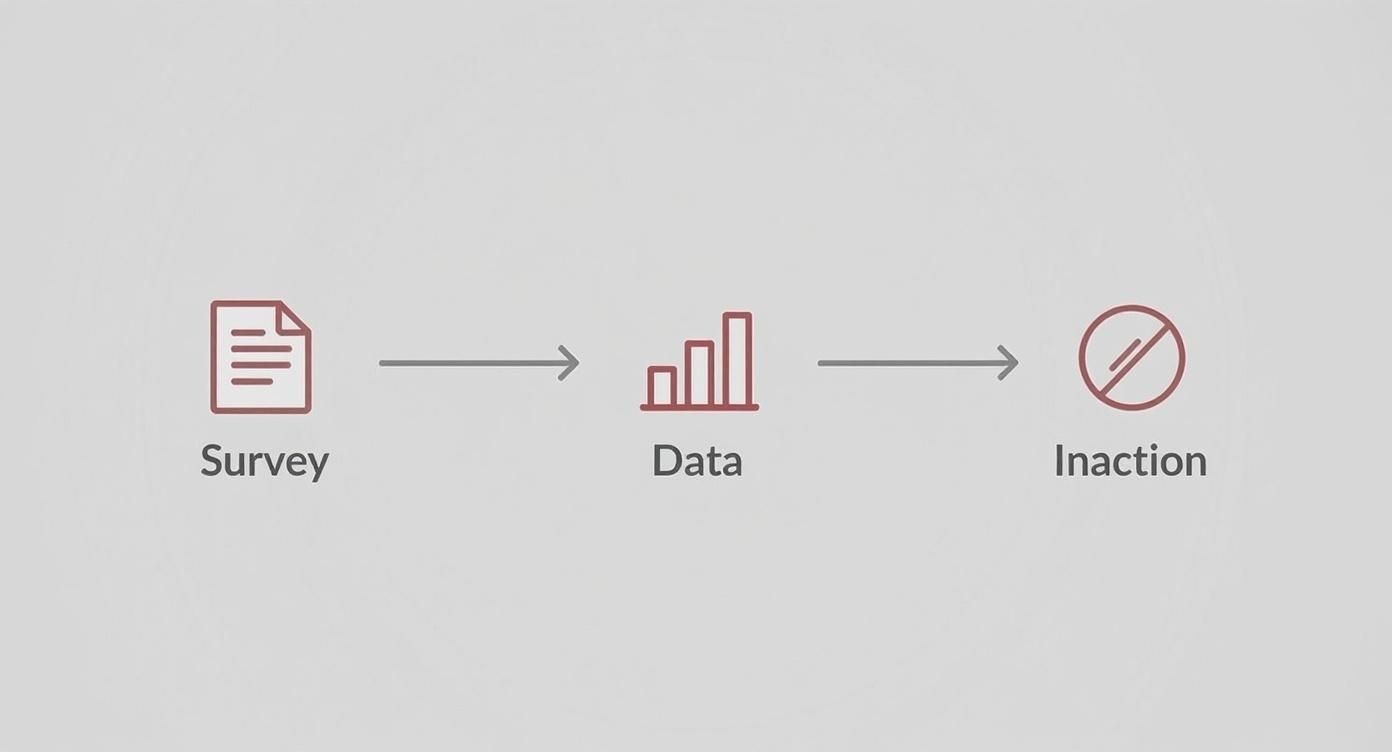
This simple graphic nails it. When you measure without a clear purpose, doing nothing becomes the default. The data doesn't point to any obvious next step.
This is why starting with your own definition is so critical. It gives your measurement a 'why.' The goal isn’t to get a number for the board; it's to see if your team is showing the behaviors you’ve all agreed matter for success.
Defining engagement for your company isn't an HR exercise. It's a leadership conversation about what a great team looks like in action. Get this right, and everything else becomes ten times more valuable.
So, take a step back. Before you shop for tools or browse question templates, get your leaders in a room. Have an honest conversation about the specific actions that define an engaged employee here.
Is it discretionary effort? Proactive problem-solving? People helping each other out? Write it down. Be specific. This definition is your true north. Without it, you’re just guessing.
Choose Your Tools Wisely
For decades, the standard method for measuring engagement has been the big, scary annual survey. It's a massive event that feels more like an audit than a genuine attempt to listen. By the time you’ve collected and analyzed the data, the results are already a relic.
We’ve lived through that cycle, and we’ve come to a simple conclusion: it’s broken. It’s time for a calmer, more consistent approach.
Think of it this way: would you check your car’s oil just once a year? Of course not. You monitor it regularly. The health of your team should be no different. This is where pulse surveys come in.

A pulse survey is a short, frequent check-in—a lightweight conversation, not an interrogation. It’s about asking fewer, better questions regularly to get a real-time feel for your team’s health.
The Problem with a Single Snapshot
The biggest flaw of the annual survey is that it gives you one static picture. It tells you how people felt during one week in October, but it misses the story of the other fifty-one weeks.
Employee sentiment ebbs and flows with project deadlines, leadership changes, and team dynamics. A consistent pulse captures these fluctuations, revealing trends you would otherwise miss.
We once saw this with a team that seemed fine on paper. Their annual survey scores were average. But a quarterly pulse showed a slow, steady dip in their feelings about workload and recognition. Two months later, a key person resigned, citing burnout. The annual survey missed it completely; the pulse saw it coming.
The annual survey tells you what happened. A pulse survey tells you what’s happening. One is history; the other is insight.
This shift in perspective is crucial. It moves you from being reactive to proactive. It lets you address small issues before they become big problems.
Pulse Surveys vs. Annual Surveys: A Practical Comparison
Let's break down the practical differences. This isn't just about frequency; it's a completely different philosophy.
Characteristic | Pulse Surveys (The Modern Way) | Annual Surveys (The Old Way) |
|---|---|---|
Frequency | Weekly, monthly, or quarterly | Once a year |
Length | 5-10 quick questions | 50+ questions, often taking 30 minutes |
Focus | Specific, timely topics (e.g., a recent change) | A comprehensive, broad-strokes overview |
Data Turnaround | Almost immediate | Weeks or even months to analyze |
Actionability | Leads to small, quick, team-level changes | Often results in large, slow corporate initiatives (or none at all) |
Employee Feeling | A light, normal part of the work rhythm | A dreaded, time-consuming obligation |
The table makes it clear. Pulse surveys provide timely, actionable data without the administrative headache or employee burnout.
Designing a Pulse Program People Don’t Hate
The key to a good pulse program is to make it effortless and valuable. If it becomes just another task, you’ll get fatigue and low-quality answers. Here’s how we think about it:
Keep it short. Seriously. No more than 10 questions. It should take less than five minutes. Respect their time. Always.
Be consistent, but not annoying. A quarterly pulse is a great start. Monthly can work for faster-paced environments. The goal is a predictable rhythm.
Ask about what matters now. Keep some core questions to track trends, but use the pulse to ask about timely topics. Did you just launch a new product? Ask how the team is feeling.
Close the loop. Fast. This is the most important part. Share high-level themes from the results within a week or two. Show people you heard them.
This approach transforms measurement into a collaborative dialogue. It builds trust because it shows you're listening continuously, not just when the calendar says to. As you build your program, it's helpful to learn more about the specific employee engagement metrics measuring what matters to ensure your questions are hitting the mark.
Choosing your tools isn't about picking the fanciest software. It's about choosing a philosophy. Do you want an outdated photograph, or a living view of your team's experience? For us, the choice is clear.
Ask Questions People Actually Want to Answer
Let’s be honest. The quality of your insights hangs entirely on the quality of your questions. If you ask dry, corporate-speak questions, you’ll get dry, unhelpful answers.
People can spot a generic, check-the-box survey from a mile away. They’ll respond with vague, non-committal clicks.
The goal isn't to gather data; it’s to start a dialogue. That means crafting questions that are clear, human, and get to the heart of what matters.
For instance, instead of, “On a scale of 1 to 5, rate your satisfaction with internal communication,” try something real. A better question is, “Do you have the information you need to do your job well?”
See the difference? One feels like an audit. The other feels like a conversation.
A Framework for Better Questions
Great questions are designed with intention. They usually focus on the core drivers that make work meaningful. We’ve found that the best questions tend to orbit a few key themes.
Autonomy & Impact: Do people feel trusted to own their work? Can they see how their effort connects to the bigger picture? A great question is, “Do you have the freedom you need to decide how to best do your work?”
Growth & Development: Are people learning? Do they see a path forward for themselves here? Avoid the generic “Are you satisfied with training?” and ask, “Do you feel like you’re growing professionally at this company?”
Belonging & Recognition: Do people feel psychologically safe? Do they feel seen and appreciated? A powerful question is simply, “Do you feel your unique contributions are valued here?”
Thinking in these categories helps you move beyond surface-level satisfaction and dig into the stuff that keeps people around. Our guide on crafting questions with an employee engagement survey builder can offer more examples.
The best survey questions don’t sound like they were written by a committee. They sound like they were written by a curious human who actually cares about the answer.
Here’s a simple test: Does this sound like something a real person would ask over coffee? This filter eliminates a surprising amount of corporate jargon. If it sounds stiff, rewrite it.
The Power of the Open-Ended Question
Scale-based questions are great for spotting trends. A dip in scores around “work-life balance” can tell you what the problem is, but it will never tell you why.
This is where open-ended questions earn their keep.
They are your single best tool for uncovering the stories and context behind the numbers. A simple, well-placed question like, “What is one thing we could do to make this a better place to work?” can yield more insight than 20 multiple-choice questions.
But here’s the catch: you have to actually read the answers. All of them. It takes time, yes, but this is where the gold is. It’s where you’ll find out about the frustrating process that’s slowing everyone down or the brilliant idea for a team ritual that would boost morale.
A Few of Our Favorite Questions
Over the years, we’ve collected a few questions that consistently deliver. They’re simple, direct, and get to the core of the employee experience.
"I would recommend this company as a great place to work." A classic for a reason. It's a strong indicator of pride and satisfaction. The real magic comes when you pair it with a follow-up: “What is the main reason for your score?”
"I know what is expected of me at work." This seems basic, but a lack of clarity is one of the biggest—and most hidden—sources of stress. When this score is low, you have a manager-level communication issue to solve.
"In the last seven days, I have received recognition or praise for doing good work." The specificity of “seven days” is key. It measures the recent, ongoing experience of feeling valued, not just a vague memory of an annual award.
The questions you ask signal what you care about. If you ask thoughtful, respectful questions, you send a clear message that you value thoughtful, respectful feedback.
Turn Raw Data into Real Conversations
Collecting feedback is the easy part. The meaningful work is turning a pile of numbers into honest conversations. A dashboard full of charts is just a vanity project if it doesn't spark a single change.

I’ve seen too many well-intentioned leaders get lost here. They chase percentage points and debate statistical significance, while the real stories buried in the data get ignored. The goal isn’t to hit a perfect score; it’s to find a starting point for dialogue.
Look for Patterns, Not Just Percentages
Your first instinct might be to fixate on the overall company score. Resist it. The most valuable insights are almost never at the 30,000-foot view. They’re hidden in the patterns that emerge when you slice the data.
Segmentation is your most powerful tool. Instead of just looking at the company as a whole, break the feedback down. Dig into the experience of:
Individual teams: How does the engineering team’s experience differ from the sales team’s?
Different locations: Is the vibe in the main office the same as in a satellite branch?
New hires vs. tenured staff: Are we delivering on the promises we made during onboarding?
When you look at the data this way, you stop seeing abstract numbers and start seeing distinct, human experiences. You might discover that while the company-wide score for "work-life balance" looks okay, it's a critical issue for one specific department. That’s an insight you can act on.
Put the Insights Where They Belong
Let's be honest. HR can't fix a team's engagement problem. Only that team's manager can. The purpose of this data is to arm managers with the information they need to lead productive conversations.
This is critical. Gallup’s research consistently shows that 70–80% of the variance in a team's engagement is tied directly to their manager. And when you see a global dip in manager engagement itself—from 30% down to just 27% in one year, as some recent employee engagement statistics show—it’s a massive red flag. Supporting our leaders is the most direct way to support our teams.
Your job is to translate the raw data into a simple story for them. Don't just email a spreadsheet. Share a few key themes—strengths and opportunities—and frame it with curiosity, not judgment.
The question you want a manager to walk away with isn't, "How do I fix this score?" It's, "I wonder why my team feels this way. I need to ask them."
That small shift from fixing to inquiring is everything. It moves ownership from HR to the team, which is where real, lasting change happens.
From Big Reports to Small Experiments
The final step is to turn these conversations into small, concrete actions. Forget massive, top-down initiatives. The most effective changes are almost always born from the team up.
Once a manager has talked through the feedback with their team, encourage them to identify one or two small things to try.
If communication is a pain point, maybe the team experiments with a 10-minute daily stand-up for a month.
If recognition feels low, maybe they create a Slack channel just for celebrating small wins.
These are small bets, not giant commitments. They are team-owned experiments to solve a team-identified problem. This approach is calmer, more sustainable, and far more likely to stick. It trusts the team to know its own dynamics best. For more ideas, check out our guide on how to make employees feel seen without another survey.
This entire process—from data to dialogue to small experiments—is how you build a culture of continuous improvement. It’s how you teach your organization to listen and adapt, one conversation at a time.
Beyond the Numbers: Turning Insights into Action
So, you have your data. Now what? That number is a snapshot of the past. It tells you where you’ve been, not where you're going. Honestly, measuring engagement is a waste of time if it doesn't lead to change. The real work starts after you get the results.
This is where so many companies drop the ball. They send out a company-wide email, make a vague promise to "address the feedback," and then... crickets. That silence is the quickest way to kill morale and prove your team's feedback doesn't matter.
Closing the feedback loop isn't an extra step; it's the most critical part of the process.
Show People You're Listening
The first move is simple: be transparent. Share the main findings—the good and the bad—with everyone. You don't need to get lost in every data point, but you have to be upfront about what you learned.
Simply acknowledging what you heard is a powerful way to build trust. It shows the survey wasn't just corporate theater. It signals you're ready to have an honest conversation.
From there, the ownership needs to spread. While leadership owns the big, systemic issues, the most impactful changes almost always happen within individual teams. Give your managers the tools and autonomy to review their team's results and work on one or two concrete actions together.
Ultimately, the goal is to foster a positive workplace culture where people want to show up and do their best work.
A Final Thought on Measuring
Let's circle back. For all the energy we put into scores and dashboards, the truest sign of engagement isn't a number. It’s a feeling.
You see it in the quality of the work. You feel it in the energy during a tough project. You know it when talented people choose to stay and build with you, even when they have other options.
Your measurement system should serve that reality, not the other way around. Think of it as a tool to help you listen better and a compass to point you toward the conversations that matter.
If you focus on creating a place built on trust, purpose, and connection, engagement will follow. The surveys are just there to help you check if you’re still on track.
Your Top Engagement Survey Questions, Answered
Over the years, we've heard every question in the book. Instead of the standard HR textbook answers, here’s what we’ve learned from being in the trenches.
How Often Should We Be Surveying Our Team?
My advice? Ditch the huge, once-a-year survey. A lighter, more consistent approach almost always delivers better results. For most companies, a quick pulse survey every quarter hits the sweet spot.
This rhythm keeps a finger on the pulse of the organization, letting you catch issues before they become problems. It also normalizes giving feedback, making it a regular part of how you operate, not a high-pressure annual event.
Is There a Single "Magic" Metric We Should Track?
Honestly, no. If anyone tells you there's one perfect number, be skeptical. Chasing a single score is a surefire way to miss the bigger picture. Instead, we focus on patterns across a few key areas that are vital for a healthy culture.
We've found the most telling insights often revolve around themes like:
Autonomy: Do people feel trusted to own their work?
Belonging: Is there a genuine sense of psychological safety within their team?
Growth: Can people see a real path forward for their career here?
That said, if I had to pick one question that acts as a powerful barometer, it would be: “I would recommend this company as a great place to work.” It's an excellent gut check, but the real gold is always in understanding the why behind that answer.
Do These Surveys Really Need to Be Anonymous?
Yes. 100%. Anonymity isn't just a "nice-to-have"—it's the bedrock of candid feedback.
The second people worry their name is attached to their answers, you'll start getting polite, filtered responses. You won't get the unvarnished truth you need to make meaningful changes. Always use a trusted third-party tool that guarantees confidentiality. The goal is to spot team-level trends, not to single anyone out. If you don't build that foundation of trust, the whole process is compromised.
Ready to stop guessing and start a real conversation with your team? Pebb brings communication, feedback, and culture together in one simple place. See how it works at https://pebb.io.
