
The Art of Internal Communication No One Talks About
Master strategic internal communications to align teams and boost results. Practical steps to cut noise and drive real, measurable impact.
Dan Robin
Let’s be honest. Most internal communication is just noise. The endless newsletters that go straight to trash, the all-hands meetings that feel like a hostage situation, the intranet that looks like a digital ghost town. We've all been there.
The problem isn't a lack of effort. It's that the entire approach is backward. Companies treat internal comms like a megaphone—a way to blast out whatever leadership is thinking this week. This "broadcast" model is broken. It treats employees like an audience, not participants. It talks at them, not with them.
This guide is about a different way. A calmer, smarter, more human approach to keeping everyone on the same page. It’s about building a company’s central nervous system, not just its mouthpiece.
Why Most Internal Communications Fail
We've seen it happen a hundred times. A company gets busy, and communication becomes a series of disconnected tactics. An email blast today, a town hall tomorrow. This isn't a strategy; it's just making noise.
And all that noise has a cost. When you bombard people with information, you train them to tune you out. A 2023 study by Grammarly and The Harris Poll found a scary trend: the amount of communication is rising, but its quality is plummeting. We mistake activity for progress.
This isn't just a feel-good problem. It's a financial one. Miscommunication costs U.S. businesses an estimated $1.2 trillion a year in lost productivity and high turnover. That’s a staggering number.
The real failure isn't that messages aren't being sent. It's that they aren't creating shared understanding. The goal is clarity, not volume.
From Broadcast to Connection
The alternative isn't about sending more emails or holding more meetings. It’s about being more intentional. It starts the moment you accept that your employees are your most important audience.
A classic mistake happens on day one. Poor onboarding leaves new hires feeling adrift. It’s worth checking out employee onboarding best practices to get this right from the start.
But the bigger shift is mental. Figuring out why your internal communication isn't working is the first real step. It’s about moving from top-down announcements to a system where every message has a purpose, every channel has a job, and every person feels connected to the larger mission. It’s not about talking more. It's about creating an environment where people actually want to listen.
The Real Goal of Strategic Communication
So, what’s the alternative to corporate noise? It's a quiet but powerful shift in thinking. We have to stop just ‘telling people things’ and start focusing on a new goal: creating shared context.
This is the heart of strategic internal communications. It’s not about writing the perfect email. It’s about making sure everyone, from the CEO to the person greeting customers, understands the why behind their work. They need to see the whole map, not just their little stretch of the road.
When people have context, something magical happens. They start making better decisions on their own. They don’t need constant check-ins because they understand the destination. Autonomy and clarity become the default.
Beyond Broadcasts Toward Business Impact
Let’s be honest for a second. A lot of internal comms feels like an administrative chore—another box to check. But when you treat it as a strategic function, the results are impossible to ignore. It stops being a cost center and becomes a driver of the business.
The data backs this up. Organizations that invest in internal communications perform significantly better. Compared to companies that don't, they are:
67% more likely to see market share growth.
69% more likely to improve their market reputation.
73% more likely to have higher employee satisfaction scores.
You can explore the full findings on communication investment and ROI here to see for yourself. This isn't just about making people feel good; it’s about aligning the whole company for success.
And yet, a huge gap remains. While 80% of leaders think their communication is great, only about half of their employees agree. That chasm is where strategy goes to die.
The following image shows what happens when communication breaks down. It leads straight to noise, disengagement, and a sense of being left in the dark.
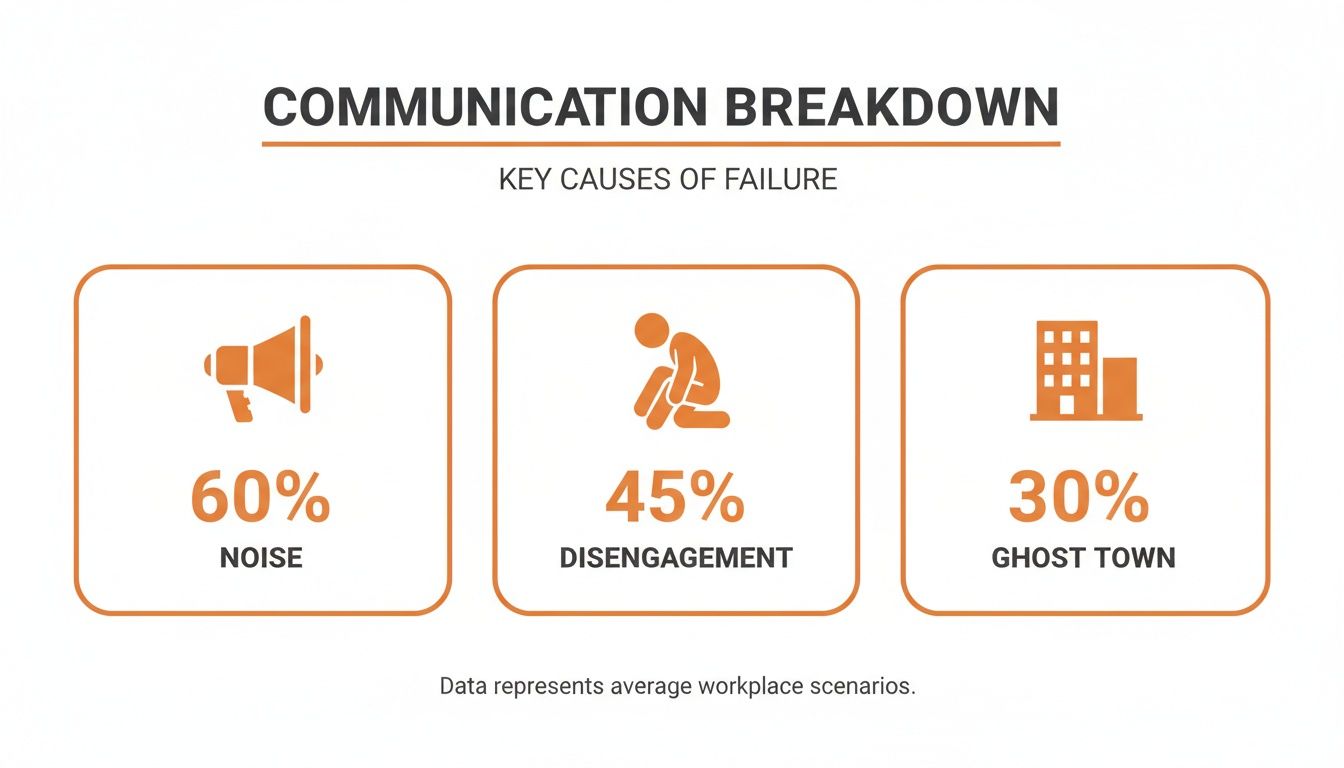
This isn’t just an inconvenience; it's a direct threat to alignment and morale. The real work is building bridges over these gaps, one clear message at a time.
Creating Context, Not Just Content
How do you actually do this? You start by asking different questions. Instead of, "What do we need to announce?" you ask, "What context do our teams need to succeed?"
Let’s take a simple example. A retail company is rolling out a new returns policy.
The Old Way (Broadcasting): A company-wide email goes out with a link to a 10-page PDF of the new rules. The result? Confusion, inconsistent execution, and angry customers.
The Strategic Way (Creating Context): It starts with a short video from the Head of Operations explaining why the policy is changing—maybe to compete better or improve customer loyalty. This is followed by a simple one-page guide and a dedicated channel for questions.
See the difference? The second approach respects people’s time and intelligence. It gives them the 'why,' which helps them handle weird situations and explain the change to customers with confidence. That is strategic internal communications in action.
The ultimate measure of your communication isn't whether people received the message, but whether they understood the mission behind it.
This shift doesn't require a bigger budget. It requires a different mindset. It's about being an editor, not just a publisher—cutting through the noise to deliver what’s essential. It’s about choosing clarity over volume, every time.
Building Your Communications Framework
A strategy without a system is just a wish. We’ve talked about the big ideas—shared context, clarity, and connection—but how do you make them real? You need a simple framework.
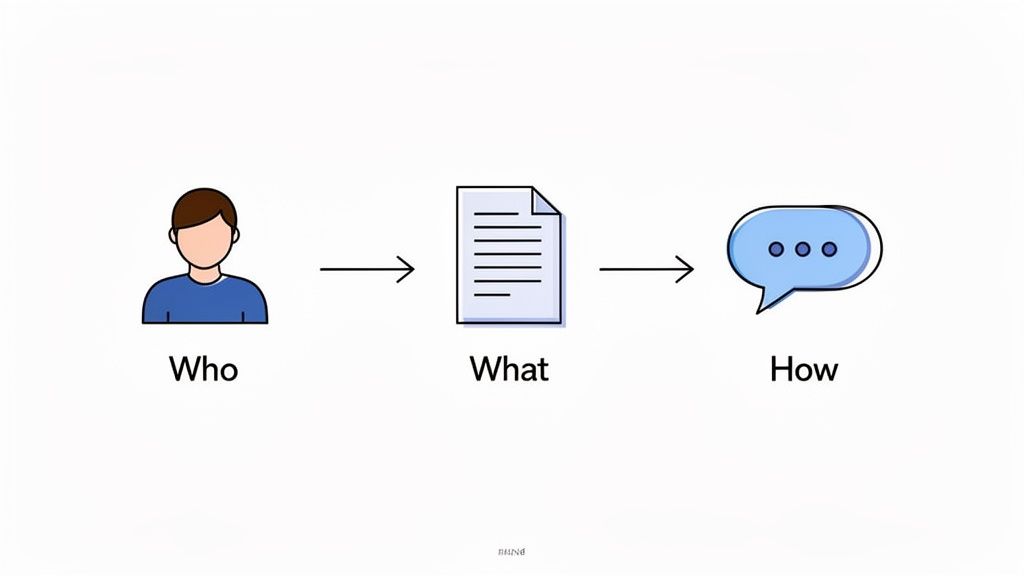
Forget the complicated playbooks. I've found that effective strategic internal communications boils down to answering three simple questions:
Who needs to know this?
What do they really need to know?
How can we tell them in the simplest, most respectful way?
That’s it. This isn’t about adding more work; it’s about being more intentional with the work you already do.
Start with Who, Not What
The biggest mistake I see is starting with the message. A new policy is written, and the impulse is to blast it to "All Staff." This is lazy. And it’s disrespectful of people’s time.
The better way is to always start with the audience. Who is this really for? Segmenting your audience isn’t a complex marketing exercise; it’s just common sense.
Think about the difference between your office teams and your frontline workers. An engineer has a different information diet than a retail associate on a busy sales floor. Pushing the same long email to both is a recipe for failure. The engineer might skim it, but the associate will never even see it.
Your job isn’t just to send information. It’s to deliver understanding. And understanding begins with knowing your audience.
A simple segmentation might look like this:
Leadership Team: Needs high-level strategic context and key data.
Desk-Based Teams: Need detailed project updates and access to documents.
Frontline Teams: Need urgent operational updates and quick visual guides on their phones.
Once you know who you're talking to, the next two questions get a lot easier.
Choose Less but Better Channels
Here’s the thing about communication channels: more is not better. A dozen noisy channels create confusion, not clarity. When people don't know where to look for information, they often end up looking nowhere.
This is about moving from noise to focus.
Element | Tactical Broadcast (The Old Way) | Strategic Communication (The Better Way) |
|---|---|---|
Focus | Sending information (output) | Creating understanding (outcome) |
Audience | "All Staff" default | Segmented and targeted |
Channels | More is more; overlapping and noisy | Fewer, with distinct purposes |
Goal | Announce and inform | Align, engage, and enable |
Success Metric | "Message sent" | Behavior change and feedback |
The goal is to have a few well-chosen channels, each with a clear purpose. This is the foundation of a calmer company. When people know where to find specific information, they feel more in control.
For instance, your channel setup might be:
Email: For official, company-wide announcements. Use it sparingly.
Team Chat (Slack/Teams): For quick, daily collaboration within a team.
A Unified Employee App (like Pebb): The central hub for everything else. News, documents, schedules, recognition. It's the single source of truth.
This 'less, but better' approach simplifies life for everyone. Of course, a framework is more than just tools; you also need to improve team communication at a cultural level.
Our guide on creating an internal communication plan template can give you a practical roadmap.
Ultimately, this is about making thoughtful choices. It's about deciding your team's attention is a precious resource. When you build a framework on that belief, you're not just communicating more strategically—you're building a healthier, more focused company.
The Unspoken Rules of Good Communication
Now for the part most guides skip. It’s not about frameworks or channels—those are just the plumbing. The real work, the stuff that makes a difference, is building a bedrock of trust. And that’s a human endeavor.
We’ve learned some of these lessons the hard way. The biggest one? Honesty is non-negotiable, especially when the news is bad. Too many leaders try to spin difficult announcements with corporate jargon and forced positivity. This doesn’t soften the blow; it insults everyone's intelligence and shatters trust.
Your team can handle the truth. What they can't handle is feeling like they're being misled or treated like children.
Consistency Over Perfection
Another hard lesson: consistency is more important than perfection. Your team doesn’t need a flawless, professionally designed update every few months. They need a predictable rhythm they can count on.
A simple, honest weekly update that arrives every Friday is a thousand times more valuable than a beautiful newsletter that shows up randomly. The rhythm builds trust. Chasing perfection just gets in the way.
We once fell into this trap, spending weeks crafting the "perfect" announcement. By the time we sent it, the rumor mill had already done its damage. The lesson was painful: good enough and on time beats perfect and late, every single time.
The Non-Negotiable Feedback Loop
Communication is not a monologue. If you're just broadcasting messages without a real way for people to respond, you’re missing the point. And I mean a real way—where you actually listen and act on what you hear.
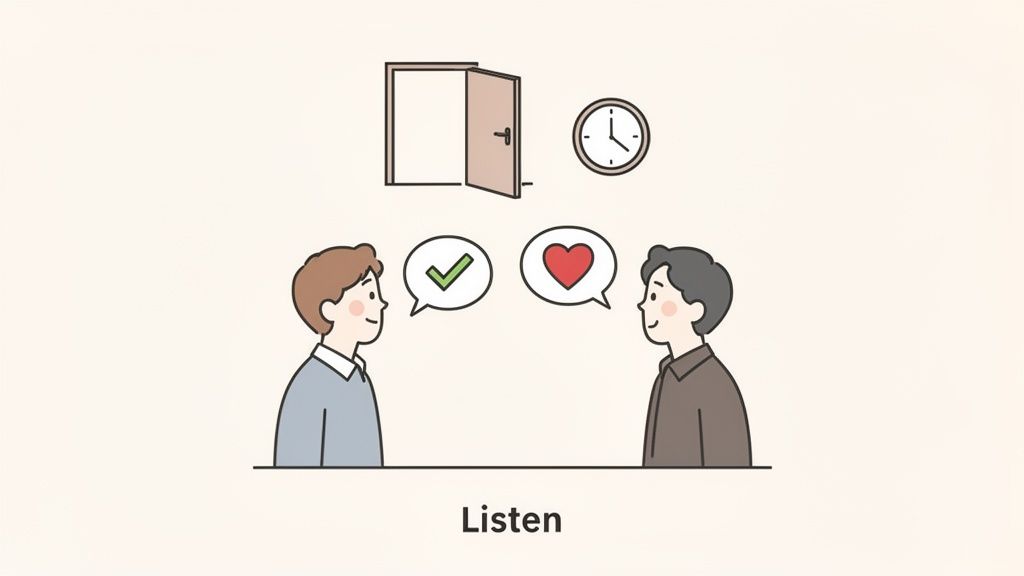
An annual survey is not a feedback loop. It's a checkbox. A real feedback loop is woven into your daily culture. It could be a dedicated channel for questions or regular "office hours" with leaders.
But be warned: asking for feedback and then ignoring it is worse than not asking at all. It signals that you don't actually care. When people see their suggestions lead to real changes—even small ones—they feel heard. That’s how you build a resilient culture.
Great communication isn’t about having all the answers. It’s about creating a safe space to ask the right questions and listen to the answers, no matter how uncomfortable.
Humility Builds Resilient Teams
At the end of the day, this all comes down to humility. Leaders who communicate with honesty and humility build engaged teams. They aren't afraid to admit when they don't know something. They own their mistakes. They speak like human beings.
Conversely, leaders who hide behind corporate jargon slowly chip away at trust. They create a culture of cynicism where people learn that what is said is rarely what is meant.
Think about the best boss you ever had. Did they speak in buzzwords? Or did they talk to you like a peer and genuinely listen to what was on your mind?
These aren't "soft skills." They are the foundation of effective communication. They are the unspoken rules that determine whether your messages land with impact or just add to the noise.
How to Measure What Actually Matters
"If you can’t measure it, you can’t improve it." We’ve all heard that. But for years, internal communicators have been stuck measuring the wrong things.
We obsessed over email open rates and intranet page views. Clicks and likes. These are vanity metrics. They look nice on a chart, but they tell you almost nothing. They only confirm a message was sent, not that it was understood or changed how anyone acts.
Let's stop making reports no one reads. It’s time to stop measuring activity and start measuring impact.
Moving Beyond Vanity Metrics
The real work of strategic internal communications is connecting people to the company’s goals. So, our metrics should reflect that. Instead of asking, "Did they open the email?" we should ask, "Do they understand the new strategy?"
This means focusing on metrics tied to business outcomes.
Employee Alignment: Do people know the company’s top three priorities? Track this with simple, recurring pulse surveys.
Initiative Adoption: What percentage of the team completed the training for the new software? This is a hard number.
Behavior Change: Are employees using the new safety protocols? Measure this through observation or system data.
Sentiment Shifts: How do people feel about the upcoming merger? Tracking sentiment gives you a real-time emotional barometer.
These are the numbers that tell a story. They reveal where there’s clarity and where there’s confusion. Our guide on how to measure the ROI of internal communication offers more ways to connect your work to the bottom line.
Using Data to See Around Corners
The tools for this are finally catching up. AI and better analytics have changed the game. It’s no longer about looking in the rearview mirror.
A recent survey found that 77% of internal communicators now use AI tools. And 72% say their role has become more strategic, as they move from just delivering messages to providing advice backed by data. You can learn more about these IC data trends and how they're reshaping the industry.
This shift is about gaining foresight, not just hindsight. It’s about using data to spot misalignment before it becomes a problem.
Imagine seeing a dip in sentiment in your engineering team two weeks before a product launch. That’s not just a data point; it’s an opportunity. It’s your cue to step in, ask questions, and provide the clarity they need.
This isn’t about surveillance. It’s about listening at scale. It’s about using technology to be more attuned to the human element of your organization. When done right, measurement is an act of empathy.
It All Comes Down to a Quiet Revolution
Let's get one thing straight. This isn't about launching another massive 'communications initiative.' Forget the big rollout and the mandatory training sessions. Those things are loud, expensive, and they rarely change a thing.
Instead, let's talk about starting a quiet revolution.
This is about making small, consistent changes that build on each other. It’s about deciding that clarity matters more than volume and that your team’s attention is a precious resource, not something to be strip-mined.
It Starts with Respect
When you peel it all back, strategic internal communications is just an act of respect.
It respects people’s time by not burying a critical update in a 2,000-word email. It respects their intelligence by sharing the honest ‘why’ behind a tough decision, not some sugar-coated spin. And it respects their need for context, trusting them to make smart choices when they have the full picture.
This shift in mindset is the most important part. Tools will change, but a culture built on respect lasts. It’s the difference between a team that complies and one that commits.
We think communication is about what we say, but its true power is in what it signals. A thoughtful, clear message doesn't just inform; it signals, "We value your time and your contribution."
Simpler Than You Think
Building a system like this isn't easy, but it’s simpler than we make it out to be. It doesn't require a monster budget. It starts with asking better questions before you hit "send."
Who is this really for?
What do they absolutely need to know?
What’s the most direct and helpful way to get this to them?
Answering those three questions honestly, every time, will put you light-years ahead of most companies. You’ll send fewer emails. You’ll hold fewer pointless meetings. The noise will die down.
When you get this right, you don’t just build a more informed company. You build a better one—calmer, more aligned, and far more effective. A place where people can finally focus on the work that matters.
That’s the quiet revolution. It’s not about doing more communication. It’s about creating more understanding. And it's worth the effort.
Frequently Asked Questions
Putting these ideas into practice is the hard part. Here are a few common questions we hear, with some straightforward answers.
How Do I Get Leadership to Care About This?
Let’s be honest. Most leaders are focused on customers and revenue, not internal newsletters. To get their attention, you have to speak their language. Stop talking about "engagement" and start talking about business impact.
Instead of saying, "We need a better platform to engage employees," try this: "Our frontline turnover is costing us $500,000 a year. A better communication system can help fix the operational issues driving people away."
Tie your request to a problem they already care about, like efficiency, safety, or retention. Bring them data, not just feelings. That’s how you get a seat at the table.
What’s the First, Smallest Step I Can Take?
Don't try to boil the ocean. Fix one broken thing.
Pick a single, high-impact communication channel that’s a mess. Maybe it’s the chaotic all-hands meeting or the weekly email blast that everyone ignores.
Focus all your energy on making that one thing better. Shorten the meeting by 30%. Replace the long email with three bullet points. A small, visible win builds incredible momentum and earns you the trust to tackle bigger projects.
How Do We Measure Success Without Getting Lost in Data?
This is the big question. The industry is still figuring it out. While 72% of communicators feel their role is more critical, there's a huge gap in proving it. One analysis found that only 29% of organizations effectively track the impact of their communication. You can read more about the industry's measurement challenges if you want to go deeper.
The key is to measure outcomes, not outputs. Forget open rates. Instead, ask: Did our safety reminders reduce on-site incidents? Did the new onboarding flow get new hires productive faster?
Pick one or two metrics that tie to a real business goal. Start there. Once you can show a clear connection between your work and a result the CFO cares about, the conversation gets a lot easier.
At Pebb, we built a single platform to help you cut through the noise and create alignment. It's the calm, central hub that connects your entire team—from the frontline to the back office—so everyone has the context they need to do their best work.
