
10 project management strategies we actually use
Discover project management strategies we actually rely on in 2025 to boost efficiency, collaboration, and results.
Dan Robin

Most articles on project management strategies are a mess. They’re filled with jargon and diagrams that have never seen a real deadline. They talk about 'leveraging synergy' and 'optimizing paradigms'—words that mean nothing when you’re staring down a launch date and your team is spread across three time zones.
We’ve been there. For years, we’ve built software, managed teams, and tried just about every method under the sun. Some worked. Many didn't. What we learned is that the best strategies aren’t rigid frameworks you follow blindly. They're toolkits you adapt to fit your team's reality. They're about creating clarity, calm, and making steady progress—not chasing certifications or performing elaborate ceremonies.
This isn't another textbook roundup. This is a practical guide to 10 strategies we've lived, tested, and found genuinely useful. We'll break down what each one is, why it matters, and the honest truth about where it shines versus where it falls flat. To see the bigger picture of how projects get done, it’s worth exploring the different sides of project management.
Think of this as a conversation, not a lecture. Our goal is to give you specific, actionable insights you can use immediately to help your team get things done without the chaos.
1. Agile Project Management
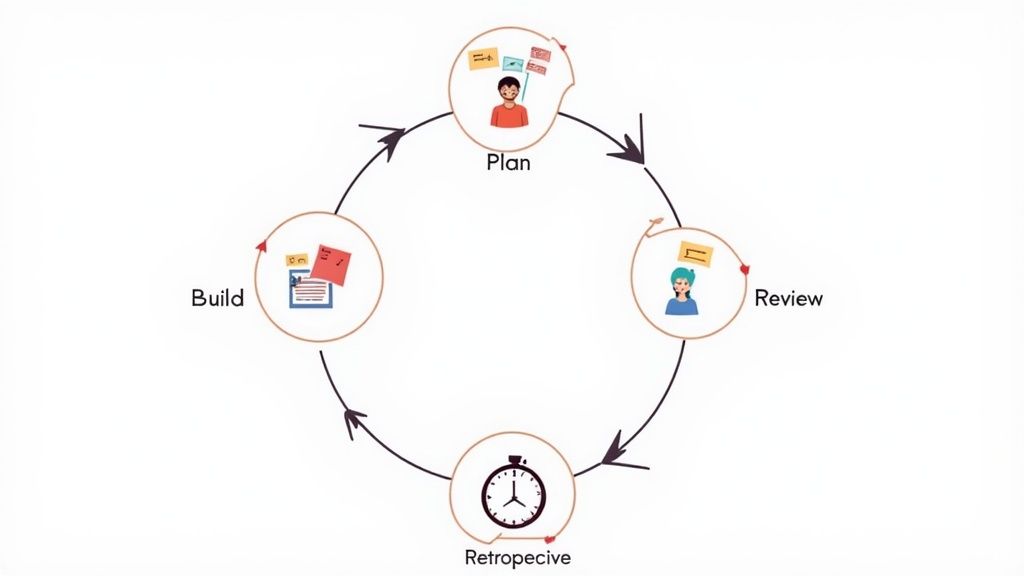
Agile isn't just a buzzword. It's a simple idea: break massive projects into small, manageable chunks called “sprints.” Instead of waiting months for a big reveal, your team delivers something of value in short, consistent cycles, typically lasting one to four weeks.
This method keeps you close to the ground. It allows for constant feedback and course correction. It’s a complete shift from the old "plan everything upfront" model, which often falls apart the moment reality hits. For anyone managing a team, this means you can launch new initiatives, gather real-world feedback, and adjust on the fly without derailing the entire project.
Why it works
Agile thrives in environments where requirements are evolving, which is the daily reality for most of us. Think about rolling out a new scheduling policy. Instead of a massive, one-time launch, you could use an Agile approach to release it to a single department, collect feedback, refine it, and then expand.
This continuous loop of feedback and improvement builds momentum and ensures the final product actually solves the right problems. It’s what lets companies like Spotify and Netflix innovate so quickly, and it's a powerful tool for any team focused on results.
Agile's strength lies in its humility. It assumes you don't have all the answers upfront and builds a process around learning and adapting.
How to get started
Define Your Sprints. Start with short, two-week sprints. This creates a quick rhythm of planning, doing, and reviewing that helps the team learn the process faster.
Hold Daily Stand-ups. Keep these meetings short, no more than 15 minutes. Each person answers three questions: What did I do yesterday? What will I do today? What's blocking my progress?
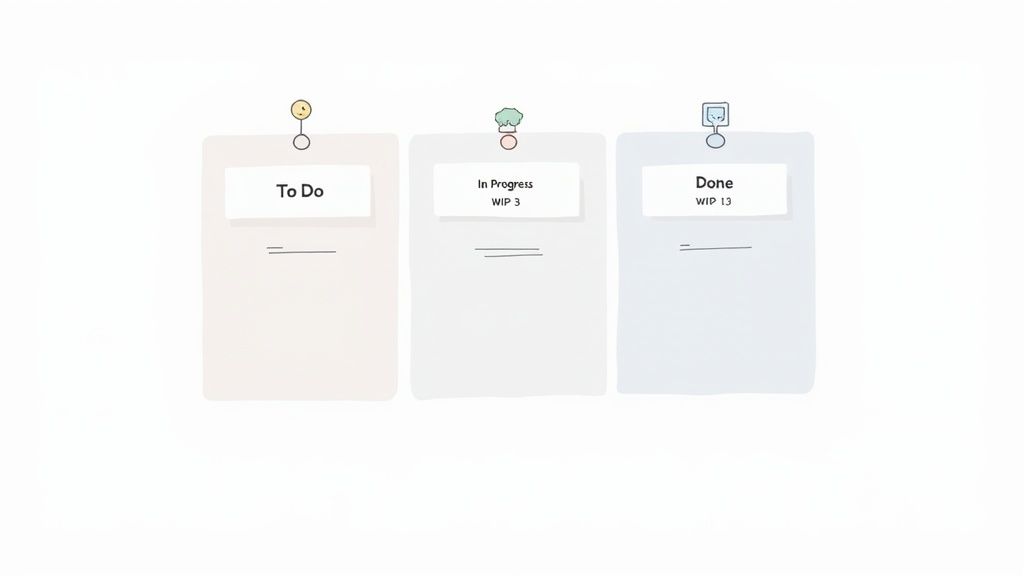
Use a Task Board. A simple visual board with columns for "To Do," "In Progress," and "Done" makes work visible and keeps everyone aligned.
Run Retrospectives. After each sprint, hold a meeting to discuss what went well, what didn’t, and what you’ll change for the next one. This commitment to continuous improvement is the engine of Agile.
2. Waterfall Project Management
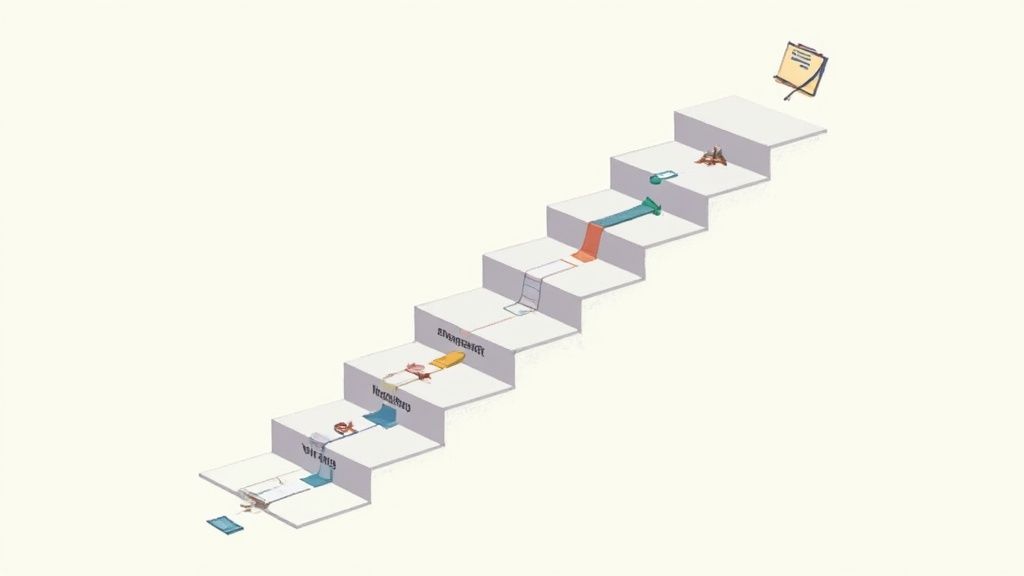
In a world obsessed with speed, the Waterfall method can feel a bit old-school. But let's be honest, sometimes you need a plan that doesn't change. Waterfall is a linear, sequential approach where each project phase must be fully completed before the next one can begin. Think of it like building a house: you can't put up the walls until the foundation is poured.
This method shines when the project requirements are crystal clear from the start and unlikely to change. It's one of the most structured project management strategies, involving a strict progression through stages like requirements, design, implementation, and testing. For projects like a new compliance protocol or a large-scale construction project, this predictability is a massive advantage.
Why it works
Waterfall’s strength is its discipline, especially for projects with fixed scopes and budgets. Consider a large-scale government project or developing a new medical device where regulatory requirements are non-negotiable. In these cases, you can't "sprint" your way through; you need meticulous planning.
This approach forces clarity upfront, which can save a lot of headaches later. It ensures everyone knows exactly what needs to be delivered and when, making it a reliable choice for high-stakes projects where mistakes are costly.
Waterfall isn't about being slow; it's about being deliberate. Its value comes from its insistence on getting one phase perfectly right before moving to the next.
How to get started
Gather All Requirements Upfront. This is the most critical step. Spend significant time with stakeholders to define and document every single project requirement before any work begins.
Create a Detailed Project Plan. Map out each phase, defining clear timelines, deliverables, and dependencies. This document becomes your roadmap.
Establish Clear Phase Gates. Set up formal review processes at the end of each phase. No work on the next phase should start until the previous one is officially signed off.
Implement Strict Change Control. Since Waterfall relies on a fixed plan, any changes must go through a formal process. This prevents scope creep and keeps the project on track.
3. Lean Project Management
If Agile is about speed, Lean is about one thing: ruthlessly eliminating waste. Born from Toyota's manufacturing process, the Lean method is focused on maximizing customer value by cutting out anything that doesn't contribute to it. This isn't about working harder; it's about working smarter.
For us, this means identifying and removing the "waste" in daily operations. Think of wasted time in inefficient meetings, excess steps in a process, or defects in a service that require rework. Lean helps you see these inefficiencies not as costs of doing business, but as opportunities for improvement.
Why it works
Lean is perfect for process-driven environments where efficiency is key. Its core principle is continuous improvement, or Kaizen. Instead of big, disruptive changes, you make small, incremental adjustments that compound over time. It helps the people closest to the work—your frontline staff—to identify problems and suggest fixes.
This creates a culture of ownership and efficiency. For example, a hospital might use Lean principles to redesign its patient discharge process, cutting down wait times. It’s a ground-up approach that builds a more resilient organization, one small improvement at a time.
Lean's genius is its simplicity. It asks one powerful question: 'Does this add value for the customer?' If the answer is no, it's waste.
How to get started
Map Your Value Stream. Visually map out every step of a current process. This exercise alone will immediately highlight redundant steps, delays, and other forms of waste.
Identify and Eliminate Waste. Focus on the "seven wastes" of Lean (e.g., waiting, overproduction, defects). Help your team spot them in their daily work.
Implement a "Pull" System. Instead of pushing work onto the next stage, create a system where work is "pulled" only when there's capacity. This prevents bottlenecks. A simple Kanban board is a great tool for this.
Foster a Kaizen Culture. Make continuous improvement a team habit. Hold regular, brief meetings to discuss small, actionable changes. Celebrate the small wins to build momentum.
4. Six Sigma Project Management
If you've ever heard the phrase "data-driven decision-making," Six Sigma is its ultimate expression. It's a highly disciplined, statistical strategy designed to eliminate defects and variations from any process. The goal is near-perfection: a process that produces only 3.4 defects per million opportunities.
Pioneered by Motorola, Six Sigma is less about managing a project's timeline and more about improving its output quality. It helps you systematically identify the root cause of recurring problems—whether it's order inaccuracies or inventory errors—and fix them for good. It transforms problem-solving from guesswork into a science.
Why it works
Six Sigma excels in environments where consistency and quality are non-negotiable, like manufacturing or logistics. Imagine running a distribution center where incorrect shipments are a constant headache. A Six Sigma approach would use data to find out why the errors happen. Is it a confusing interface? A flawed labeling system?
This method forces you to measure, analyze, and improve with precision. It moves teams away from "I think this is the problem" to "the data shows this is the problem," which is a powerful shift. It builds a culture of accountability grounded in facts, not opinions.
Six Sigma's real power isn't just in reducing defects. It's in changing the way a team thinks, making everyone an owner of quality.
How to get started
Start Small with DMAIC. Use the Define, Measure, Analyze, Improve, Control (DMAIC) framework. Pick one high-impact, recurring problem to define and measure its current performance.
Invest in Training. Six Sigma requires specific skills. Start by training a few key team leaders. Proper certification ensures the statistical tools are used correctly.
Ensure Executive Buy-In. This is not a grassroots-only effort. You need support from leadership to dedicate the time and resources required.
Establish Clear Metrics. Before you begin, define exactly what "success" looks like. Is it a 50% reduction in customer complaints? Make your target specific and measurable.
5. Kanban Project Management
If Agile is a sprint, Kanban is a continuous flow. It’s one of the simplest yet most powerful project management strategies because it’s entirely visual. Originating from Toyota, Kanban uses a board with columns and cards to show work as it moves from "To Do" to "In Progress" to "Done."
This method provides immediate clarity. You can see bottlenecks at a glance, understand where your team’s capacity is being spent, and stop new tasks from piling up before current ones are finished. It’s less about rigid deadlines and more about improving the workflow itself.
Why it works
Kanban's strength is its simplicity. There are no prescribed "sprints" or mandatory meetings. You can apply it to nearly any existing process, from IT support tickets to content creation.
Imagine an HR team managing employee onboarding. Each new hire is a card that moves through stages like "Paperwork Submitted," "IT Setup," and "First Week Check-in." If cards start piling up in the "IT Setup" column, you've instantly identified a bottleneck. That's the magic.
Kanban is about making the invisible work visible. When everyone can see the flow of tasks, the team naturally starts to optimize it.
How to get started
Visualize Your Workflow. Start with a simple three-column board: To Do, In Progress, Done. Map your actual steps and add columns as needed.
Set Work-in-Progress (WIP) Limits. This is crucial. Limit the number of cards allowed in the "In Progress" column. This forces the team to finish tasks before starting new ones, preventing burnout.
Use Cards for Everything. Each task, no matter how small, gets a card. Use colors to denote priority or task type.
Manage Flow. The goal is a steady movement of cards from left to right. Hold regular stand-ups around the board to discuss what’s moving and what’s stuck.
6. Scrum Project Management
If Agile is the philosophy, Scrum is the game plan. It’s a framework within the Agile family that gives teams a prescribed set of roles and events. Think of it as a lightweight, repeatable system for tackling complex work in short, focused bursts—the "sprints."
Scrum brings order to chaos by defining who does what and when. You have a Product Owner who represents the stakeholders, a Scrum Master who guides the team, and the Development Team that does the work. This structure provides a clear, predictable rhythm.
Why it works
Scrum thrives on transparency. The fixed sprint length (usually two weeks) creates a predictable cadence for delivering work, which is a game-changer for teams that need consistency. Imagine launching a new safety protocol. Instead of a vague timeline, you could run a two-week sprint focused on creating the training materials, then another sprint to gather feedback and refine it.
This rhythm builds trust and makes progress visible. Companies like Microsoft use Scrum not just for software but to manage complex initiatives. It provides a structured way to handle uncertainty.
Scrum doesn't solve your problems. It exposes them. Its real power is forcing difficult conversations early and often, so the team can actually fix what's broken.
How to get started
Establish Your Roles. Clearly define who will be the Product Owner (sets the priorities), the Scrum Master (facilitates the process), and the Development Team (executes the work).
Build Your Backlog. The Product Owner creates a prioritized list of everything the project needs. This "product backlog" is the single source of truth.
Plan Your First Sprint. Hold a planning meeting to select items from the top of the backlog that the team can realistically complete in the upcoming sprint.
Run the Ceremonies. Stick to the core Scrum events: daily stand-ups, sprint reviews (to show what you built), and sprint retrospectives (to improve your process). Using a tool for managing team tasks with Pebb keeps these events focused.
7. Critical Path Method (CPM)
When a project's deadline is non-negotiable, you need a strategy that puts the timeline first. The Critical Path Method (CPM) is that strategy. It’s a technique for mapping out a project and identifying the one sequence of tasks that dictates your finish date. In short, it shows you which steps have zero wiggle room.
CPM forces you to think through every task and its dependencies. You see exactly which delays will derail the entire project and which ones won't, allowing you to focus your attention where it matters most.
Why it works
CPM is the antidote to wishful thinking. In complex projects, it’s easy to miss how a small delay in one area creates a massive bottleneck elsewhere. CPM makes these dependencies impossible to ignore. It provides a clear, data-driven answer to the question, "If we want to finish on time, what must we absolutely get right?"
This clarity is invaluable for managing expectations and allocating resources. It helps teams understand not just their own tasks, but how their work impacts the entire project timeline.
CPM's real power is that it replaces anxiety with focus. Instead of worrying about a hundred tasks, you know you need to obsess over the ten that form the critical path.
How to get started
List All Activities. Break down the entire project into a comprehensive list of individual tasks. Be granular.
Identify Dependencies. For each task, determine which other tasks must be completed before it can begin. Effectively managing these workflow dependencies is the core of this method.
Estimate Task Durations. Assign a realistic time estimate to each activity. Use historical data or expert opinions.
Map the Critical Path. Lay out the sequence of dependent tasks that takes the longest to complete. This is your critical path. Any delay here directly impacts your project's finish date.
8. Program Evaluation and Review Technique (PERT)
When you’re facing a project with massive uncertainty, PERT is your statistical crystal ball. Developed by the U.S. Navy, this strategy is designed for projects where you’ve never gone before. Instead of a single, often-wrong time estimate, PERT uses three: an optimistic, a pessimistic, and a most likely guess.
This approach acknowledges a simple truth: things rarely go as planned. By calculating a weighted average, PERT gives you a more realistic timeline and highlights potential risks before they become disasters.
Why it works
PERT is perfect for high-stakes, innovative projects where there's no historical data. Think of a pharmaceutical company running clinical trials or a tech firm developing a first-of-its-kind product. These aren’t tasks you can time with a stopwatch.
Using PERT forces your team to consider the best- and worst-case scenarios, fostering a proactive mindset. It shifts the conversation from "When will this be done?" to "What's the probability we can finish by this date?" This is incredibly valuable for managing expectations when faced with the unknown.
PERT's genius is that it embraces uncertainty instead of ignoring it. It provides a framework for quantifying risk, turning 'I don't know' into a calculated range of possibilities.
How to get started
Break Down the Project. List every individual task required, just as you would with other methods.
Gather Three Estimates. For each task, ask experts for three time estimates: Optimistic (O), Most Likely (M), and Pessimistic (P).
Calculate Expected Time. Use the PERT formula to find the expected duration: (O + 4M + P) / 6. This gives more weight to the most likely scenario.
Map Out the Critical Path. Identify the longest sequence of dependent tasks that determines the total project duration. This is your critical path.
9. PRINCE2 (Projects In Controlled Environments)
If Agile is a speedboat, PRINCE2 is a cargo ship built to navigate any storm. It's a highly structured, process-based method that divides projects into manageable stages with crystal-clear governance.
PRINCE2 forces you to justify the project's existence at every turn through its focus on the business case. It's less about on-the-fly adaptation and more about meticulous planning, control, and documentation. For critical, high-risk initiatives like a new payroll system, this structured approach ensures nothing is left to chance.
Why it works
In an era of rapid change, the deliberate nature of PRINCE2 might seem old-fashioned, but its strength lies in managing complexity and risk. It excels in environments where the end goal is clearly defined, common in large infrastructure or government projects.
This method provides a common language that aligns everyone, from the executive sponsor down to the team member executing a task. It answers the questions "Who is responsible for what?" and "Is this project still worth doing?" at every stage, preventing runaway projects.
PRINCE2 doesn't leave success to chance. It builds a framework of control that guides a project from a simple idea to a valuable outcome.
How to get started
Define the Business Case. Before anything else, clearly document why the project is needed, its expected benefits, and the risks. This document is your North Star.
Establish the Project Board. Assign clear roles for the Executive (the ultimate decision-maker), Senior User (represents those who will use the product), and Senior Supplier (represents those building it).
Break the Project into Stages. Divide the work into distinct management stages. At the end of each stage, the project board must approve moving to the next one.
Maintain Key Documents. Keep diligent records, including a Project Initiation Document (PID), detailed stage plans, and a "lessons log" to capture what you learn.
10. Hybrid Project Management
Not every project fits neatly into one box. Sometimes, the rigid planning of Waterfall is perfect for one phase, while the adaptability of Agile is essential for another. Hybrid project management is the pragmatic approach of blending methods to create a custom-fit process. It’s not about choosing a side; it's about picking the right tools for the job.
This strategy acknowledges that most real-world projects are messy. You might have a fixed budget (perfect for Waterfall), but the actual product development requires rapid iteration (hello, Agile). You can use a structured approach for the core infrastructure deployment while using Agile sprints to refine user-facing features.
Why it works
Hybrid models offer the best of both worlds: structure and flexibility. It provides the predictability that leadership often requires while giving teams the freedom to adapt where it matters most. Think of a pharmaceutical company: the initial research phase benefits from an Agile, experimental approach. But once the formula is set, manufacturing must follow a strict, Waterfall-style plan.
This adaptability makes it one of the most practical strategies for complex initiatives. It allows you to apply rigor where requirements are clear and embrace uncertainty where they are not.
Hybrid isn't a compromise; it's a strategic choice. It's the recognition that no single method has all the answers, and the smartest approach is to build one that fits your reality.
How to get started
Assess Your Project. Analyze your project’s components. Identify which parts have fixed requirements (candidates for Waterfall) and which are more dynamic (candidates for Agile).
Define the Blend. Clearly document how the methods will interact. For instance, use a Waterfall approach for overall planning, then switch to two-week Agile sprints for implementation.
Establish Clear Handoffs. Create distinct checkpoints where the project transitions from one method to another. Ensure everyone understands the expectations.
Train Your Team. Don't assume everyone understands how to operate in a mixed environment. Provide clear training on both approaches and how they will work together.
Comparison of 10 Project Management Strategies
Method | Implementation complexity 🔄 | Resource requirements & speed ⚡ | Expected outcomes ⭐📊 | Ideal use cases | Key advantages 💡 |
|---|---|---|---|---|---|
Agile Project Management | Moderate — iterative setup; needs self-organizing teams 🔄 | Moderate — continuous stakeholder time and collaboration tools ⚡ | Frequent deliverables, high adaptability and customer value ⭐📊 | Software/product development, evolving requirements | Fast feedback; reduced rework; strong collaboration 💡 |
Waterfall Project Management | Low — linear phases with strict gates 🔄 | High upfront planning and documentation; predictable execution ⚡ | Predictable schedule/costs when requirements fixed ⭐📊 | Construction, regulated industries, fixed-scope projects | Clear milestones; easier budgeting; compliance-ready 💡 |
Lean Project Management | Moderate — cultural change and continuous improvement 🔄 | Low–Moderate — focuses on waste reduction; training needed ⚡ | Reduced waste, higher efficiency and quality ⭐📊 | Manufacturing, operations, process optimization | Cost reduction; faster delivery; employee engagement 💡 |
Six Sigma Project Management | High — structured, statistical methodologies 🔄 | High — training, data collection, certified specialists ⚡ | Significant defect reduction and measurable process improvement ⭐📊 | Manufacturing, quality-critical processes, process re-engineering | Data-driven decisions; measurable ROI; scalable improvements 💡 |
Kanban Project Management | Low — visual board, minimal ceremony 🔄 | Low — lightweight tools; requires discipline to maintain ⚡ | Improved flow, reduced WIP, faster throughput ⭐📊 | Support/maintenance teams, continuous delivery, Ops | Easy adoption; visual bottleneck detection; flexible workflow 💡 |
Scrum Project Management | Moderate — defined roles and ceremonies required 🔄 | Moderate — dedicated roles, sprint planning and review time ⚡ | Predictable cadence, team accountability, iterative value delivery ⭐📊 | Cross-functional software teams, complex product delivery | Clear roles; repeatable cadence; strong tooling and training 💡 |
Critical Path Method (CPM) | Moderate–High — dependency mapping and analysis 🔄 | Moderate — scheduling tools; accurate duration estimates needed ⚡ | Identifies critical activities, optimized schedule focus ⭐📊 | Large construction/infrastructure, complex schedules | Highlights bottlenecks; enables schedule compression; EVM support 💡 |
Program Evaluation and Review Technique (PERT) | High — probabilistic scheduling and analysis 🔄 | High — multiple estimates, simulations or statistical tools ⚡ | Probability-based timelines and better risk awareness ⭐📊 | R&D, pharma trials, high-uncertainty projects | Explicitly handles uncertainty; supports contingency planning 💡 |
PRINCE2 (Projects In Controlled Environments) | High — formal governance and stage-gates 🔄 | High — certification, documentation, governance overhead ⚡ | Strong control, compliance and accountability across projects ⭐📊 | Government, large enterprise programs, regulated sectors | Scalable governance; Clear roles; benefits-focused documentation 💡 |
Hybrid Project Management | High — combining methods requires careful tailoring 🔄 | Variable — depends on chosen mix; can be resource-intensive ⚡ | Balanced adaptability and control; tailored business outcomes ⭐📊 | Large enterprises, mixed-characteristic programs, transformation | Customizable approach; mitigates single-method weaknesses; flexible governance 💡 |
So, what’s the ‘right’ way?
You might be looking for a simple, final answer. A neat, tidy summary that says, “Use this one. It’s the best.”
Let’s be honest. That answer doesn’t exist.
The big secret, the one we learned through trial and a lot of error, is that there is no single ‘right’ way. The best approach isn’t about becoming a certified master in one specific methodology. It’s about being a pragmatist. It’s about finding the right tool for the job, even if that means borrowing a hammer from one toolbox and a screwdriver from another.
The mix-and-match reality
Think of these ten strategies not as competing ideologies, but as a buffet of ideas. The goal is to build a plate that works for your team, your project, and your culture. Maybe the visual clarity of a Kanban board is perfect for your team's daily tasks, but the structured check-ins from Scrum are what you need to stay aligned. That’s a great combination.
Perhaps a project requires the meticulous planning of Waterfall for its first phase. But once that foundation is built, the team needs the flexibility of Agile to iterate. This hybrid approach isn't a sign of indecision; it's a sign of intelligent, adaptive leadership. The work itself will always tell you what it needs. You just have to be willing to listen.
Starting small and staying human
The pressure to implement a perfect, company-wide system can be paralyzing. Don't fall into that trap. The best way to begin is to start small and focus on one specific problem.
Is communication chaotic? Try a daily stand-up.
Is work getting stuck? Map your workflow on a simple Kanban board.
Are you wasting time on non-essential tasks? Apply a Lean mindset and ask, "What here doesn't add direct value?"
Pick one thing. Try it for a few weeks. See if it helps. If it adds clarity and calms the chaos, keep it. If it just adds more meetings and bureaucracy, have the courage to throw it out and try something else. As you refine your processes, you'll also want to get better at spotting roadblocks. Exploring the top risk management software platforms can give you a structured way to handle uncertainty, no matter which method you choose.
Ultimately, the best project management strategies feel less like a system and more like a shared language. They create a calm, productive environment where people feel trusted and have the clarity they need to do their best work. The goal isn’t just to ship projects on time. It’s to build a sustainable way of working that doesn’t burn people out.
The ‘right’ way is whatever brings your team together and moves the work forward, one clear step at a time.
Tired of juggling different tools to make your project strategies work for your teams? Pebb brings communication, tasks, and resources into one simple app. It’s the calm, unified platform you need to put any of these strategies into practice without the extra complexity. See how Pebb can simplify your work.
