
What Is a Good Survey Response Rate: Insights for 2026
What is a good survey response rate? Move beyond basic numbers. Discover 2026 insights to boost employee feedback & get responses you can trust.
Dan Robin
You send the survey. You wait an hour, then two. You refresh the dashboard more times than you'd like to admit.
A few responses come in. Mostly from the same people who always answer everything. The thoughtful manager in Finance. The outspoken team lead in Ops. That one employee who treats every open text box like a sacred duty. Everyone else stays quiet.
If you've run enough surveys, you know this feeling. It's not just disappointment. It's doubt. Was the survey too long? Did the launch email get buried? Did people not care? Or worse, did they care and decide it wasn't worth saying anything?
That's usually the moment people ask, what is a good survey response rate?
It's a fair question. It's also the wrong one to obsess over.
A response rate matters, but only up to a point. What you're really trying to get is a clear signal. And clear signal comes from trust, timing, audience fit, and whether people believe anything will happen after they answer. I've seen teams waste weeks chasing a prettier number while ignoring the underlying issue: employees had learned that sharing feedback went nowhere.
Sometimes the problem is more basic. The invite never had a real chance. It landed in cluttered inboxes, got filtered, or looked like another forgettable internal blast. If email is your main survey channel, it's worth understanding how to stop email from going to spam in Gmail before you start diagnosing culture from silence.
A weak response rate can be a survey problem. More often, it's a relationship problem.
That Sinking Feeling After You Hit Send
The hardest part of survey work isn't writing the questions. It's facing what the silence might mean.
Organizations often blame mechanics first. They tweak the subject line, shorten a question, resend the invite, add another reminder. Those things can help. But they don't explain why people ignored a survey from their own employer in the first place.
Silence usually has a history
Employees don't respond in a vacuum. They respond in context.
If the last three surveys disappeared into a black hole, people remember. If leadership asked for candid input and then got defensive when the feedback came back sharp, people remember that too. If managers pushed completion without explaining why it mattered, employees learned the survey was about compliance, not listening.
Practical rule: Low participation is rarely a surprise if you've been paying attention between surveys.
When leaders ask me what counts as “good,” I usually push them to answer a different question first: why would your people trust this survey enough to spend time on it? If you don't have a strong answer, the rate you get is already telling you something useful.
A survey is not just a form
A lot of internal surveys are built like paperwork. Too many questions. Too much HR language. Not enough plain English. They feel like they were written for an executive readout, not for a tired nurse at the end of a shift or a warehouse supervisor checking a phone during a break.
That mismatch matters.
A survey asks for more than clicks. It asks for attention, honesty, and a little faith. It asks someone to believe that this time, saying what's true might lead to something better. If they don't believe that, no amount of polishing the form will fix it.
Here's the uncomfortable part. Sometimes a low response rate is the most honest feedback you get all quarter.
The Benchmarks Everyone Quotes and Why They Are Only Half the Story
The benchmark question sounds simple until two leaders compare numbers that were calculated differently.
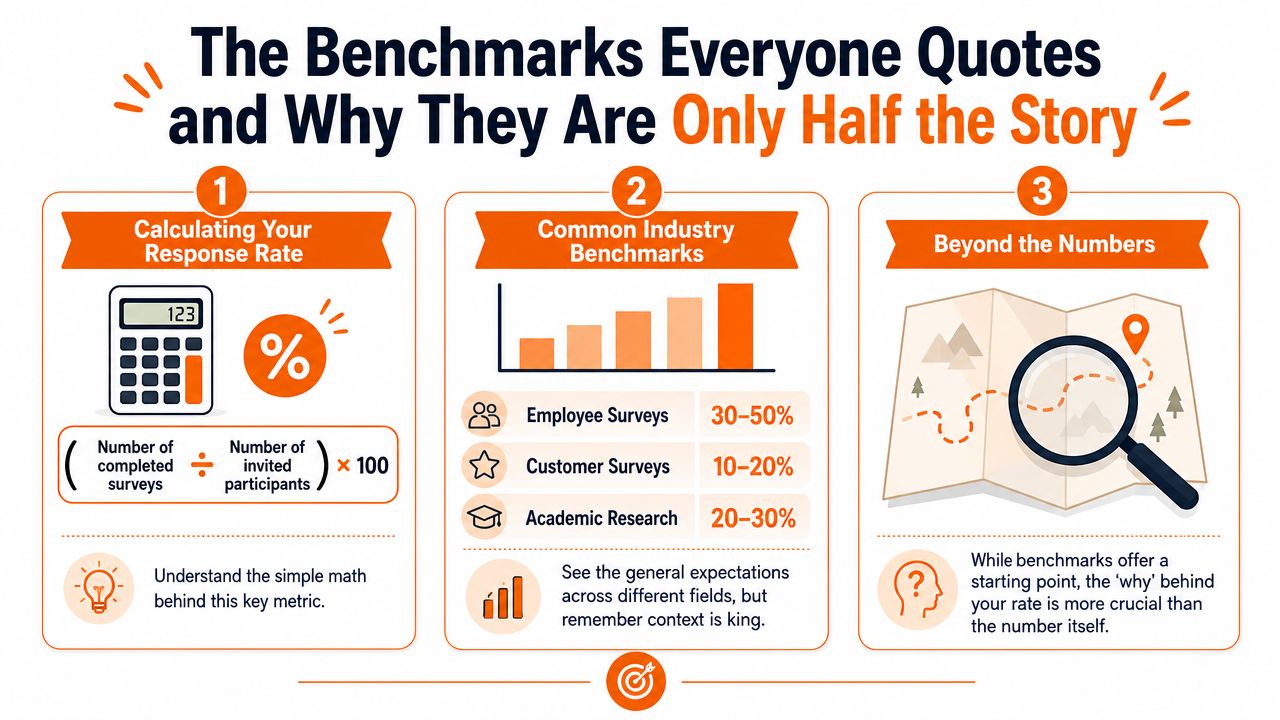
Some teams count everyone invited. Others remove bounced emails, partial responses, contractors, or people on leave. So before anyone declares a rate “good” or “bad,” make sure the math matches. Survey response rate usually means completed or usable surveys divided by the number of people invited or eligible to respond. If the denominator changes, the comparison stops being useful.
A visual helps here.
The benchmark people quote
The number people cite most often for online surveys is broad: a rate in the low double digits up through around a third is often treated as solid, and anything above that gets called excellent. SurveyMonkey uses a simple example. 300 completed surveys out of 1,000 invitations equals a 30% response rate (SurveyMonkey benchmark guidance).
That range is fine as a rough reference point.
It falls apart when teams treat it like a target that means the same thing in every workplace.
A 30% response rate from software engineers who sit in front of laptops all day is not the same as a 30% rate from field technicians, nurses, retail associates, or warehouse crews who have limited screen time and tighter schedules. One number can reflect indifference. The other can reflect a real operational lift and still leave blind spots in the groups you missed.
Why benchmarks can mislead
Older research standards often aimed much higher than business surveys do now. That does not make modern employee survey rates “bad.” It means the purpose is different.
Academic research usually cares a lot about sample rigor and representativeness. Internal employee surveys are often trying to answer a more practical question: do we have enough credible signal to act, and are we hearing from the parts of the organization that live a different reality than headquarters?
That distinction matters.
A benchmark can help you sanity-check the result. It cannot tell you whether the result is trustworthy.
Here is the test I use:
Situation | Better question than “Is the rate good?” |
|---|---|
Desk-based employee group | Did the rate match the ease of access, or did a convenient audience still ignore it? |
Frontline or shift-based workforce | Did employees have a realistic chance to respond during work, in their language, on a device they actually use? |
Small, targeted research sample | Are enough of the selected participants represented to support the decision? |
Broad internal census survey | Which teams, shifts, or locations are missing, and does that distort the story? |
This is why chasing a universal number is a fool's errand. A neat benchmark gives leaders comfort, but comfort is not the same as insight. I would rather see a lower rate with strong representation from hard-to-reach groups than a higher rate dominated by office staff who always answer everything.
The useful question is not “Did we hit the benchmark?” It is “Whose voice made it into the data, whose didn't, and what does that say about the organization?” Teams that want a better answer usually need a more disciplined approach to employee engagement measurement, not a prettier participation chart.
Your Response Rate Is a Mirror
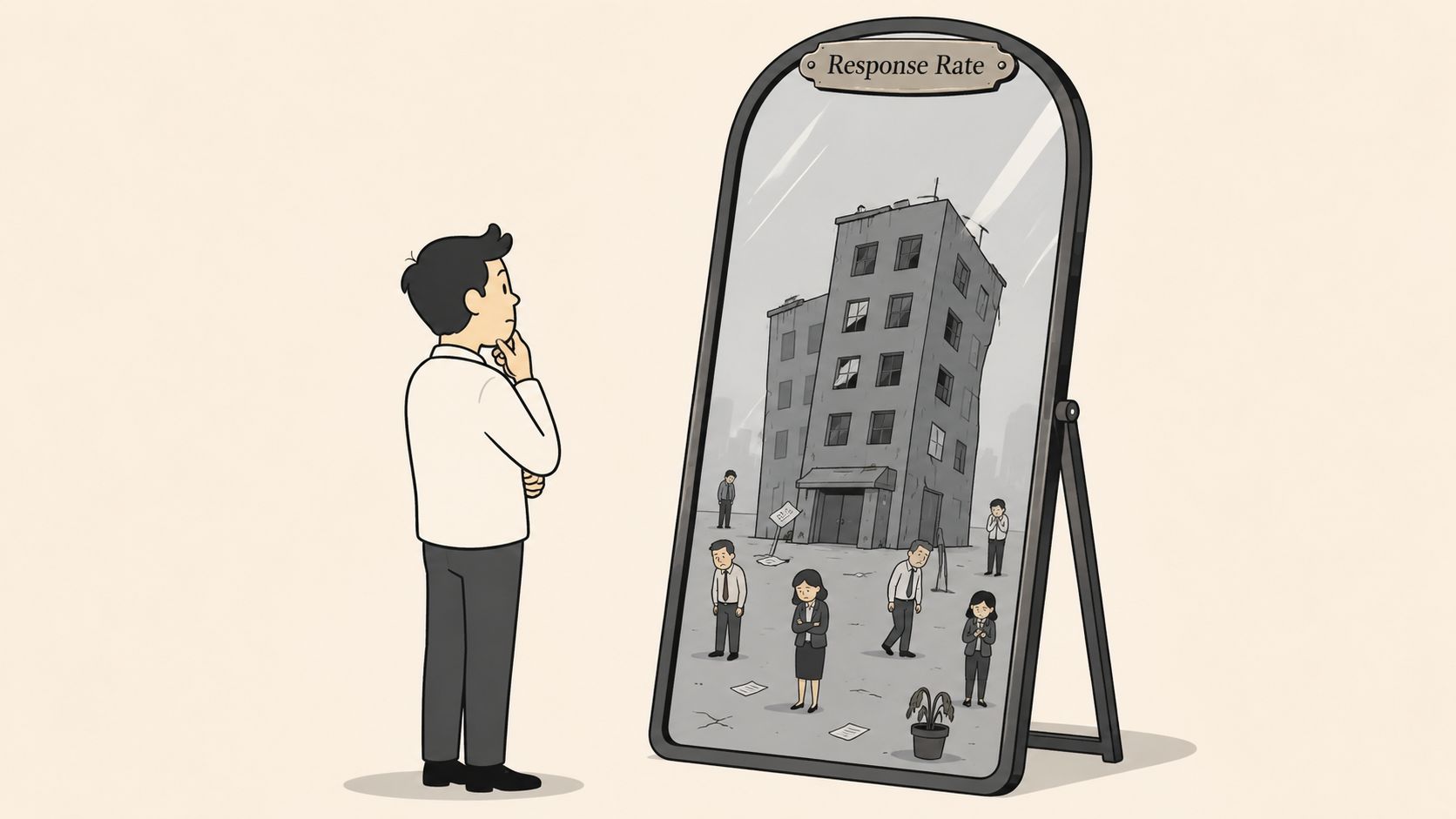
The response rate is often treated like a score. I think it works better as a mirror.
If the mirror shows something ugly, the answer isn't to polish the frame. The answer is to look at what's there.
Trust shows up before the first question
Employees usually decide whether to answer before they read the survey itself.
They ask themselves a few quiet questions. Is this anonymous enough to be worth it? Will anything change? Will my manager use this against me? Is this another exercise in looking busy? You won't see those questions on the form, but they shape the result more than almost anything written on it.
That's why low participation often points to a deeper problem than survey design. It can signal skepticism, fear, fatigue, or simple resignation. People don't stay silent for only one reason, but in healthy organizations, they're more willing to speak because they've seen evidence that speaking is safe and useful.
Survey fatigue is often self-inflicted
I've watched companies send pulse after pulse after pulse, then act confused when employees stop responding. They call it listening. Employees call it being nagged.
The pattern is easy to spot:
Too many asks: Teams request feedback constantly and treat access to employees like an unlimited resource.
No visible follow-through: Results go upward, but decisions never come back down.
Generic communication: Leaders say “your voice matters” without naming what will happen next.
That mix drains credibility fast.
If you ask for input more often than you act on it, people learn that the ritual matters more than the response.
The number is a symptom
A survey platform can help with delivery, reminders, and reporting. It cannot manufacture trust.
If response rates are weak, don't jump straight to incentives or reminder cadence. Start with the basics. Who is not responding? What have they learned from prior surveys? Do they have a practical way to answer during the workday? Have leaders earned the right to ask?
That's what I mean when I say the response rate is a mirror. It reflects your culture's listening habits. It reflects manager credibility. It reflects whether communication feels one-way or mutual.
You can improve the number. Sure. But if you do it without improving the conditions behind it, you're mostly making the mirror easier to ignore.
Employee Surveys vs Customer Surveys A Tale of Two Worlds
One of the fastest ways to confuse yourself is to borrow customer survey thinking and apply it directly to employees.
These are not the same relationship. Not even close.
Customers are passing through
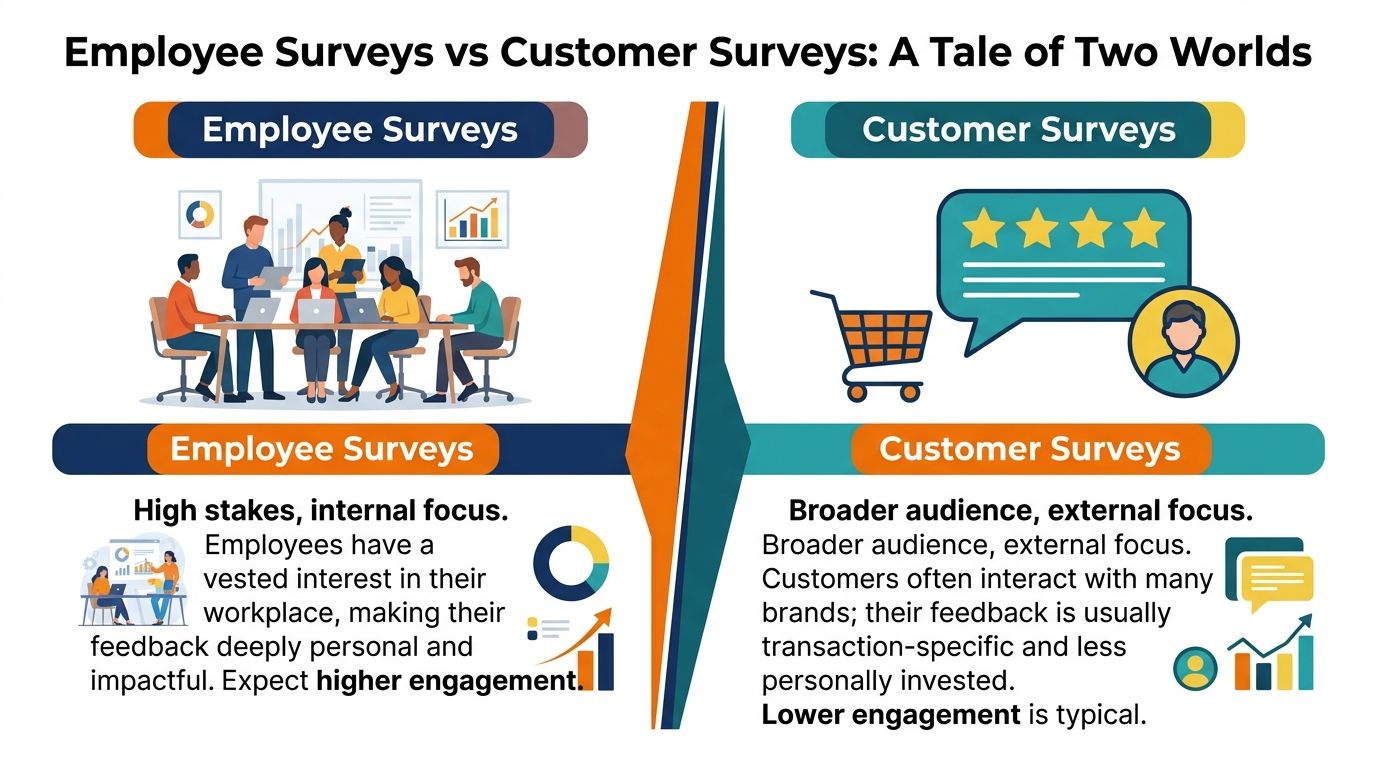
Customers interact with many brands. Your company is one of dozens in their inbox, one of many apps on their phone, one more purchase, one more service experience. Their feedback is often transactional. Useful, yes. Personal, usually less so.
That changes the meaning of participation. A low customer survey response rate doesn't automatically signal distrust or disengagement. It may merely mean your survey arrived at the wrong moment, or that the customer had no strong reason to spend time on it.
Employees live inside the system
Employees have a different stake. Their work shapes their pay, schedule, manager relationship, stress level, and daily routine. When you ask them for feedback, you're not asking about a transaction. You're asking about a lived environment.
That's why internal surveys carry more weight.
An employee ignoring a survey might be busy. It might also mean something sharper: they don't believe the process is safe, useful, or worth their energy. You can't read that the same way you'd read silence from a customer list.
Employee surveys measure more than opinion. They measure whether people think the organization is listening in good faith.
Not all employees are equally reachable
Even inside one company, “employee audience” is too broad to be useful.
An office team with laptops, steady calendar blocks, and easy access to email is one world. Frontline teams in retail, healthcare, hospitality, logistics, and field operations live in another. They may not sit at a desk. They may not check company email often. They may share devices, work rotating shifts, or have only a few practical windows to respond.
That means expectations and tactics should change by audience.
Audience | Survey reality |
|---|---|
Office-based staff | Easier digital access, but also more inbox clutter |
Frontline teams | Harder access, more timing and channel constraints |
Mixed workforce | One-size-fits-all distribution usually misses someone important |
The mistake I see most often is assuming fairness means sameness. It doesn't. Sending the same survey through the same channel to every employee may feel tidy, but it often underrepresents the people closest to operations. Those are usually the voices leaders need most.
How to Earn the Response
If you want a stronger response rate, stop looking for tricks. Use better habits.
The basics still do the heavy lifting. Respect people's time. Use the channel they use. Keep the survey easy to finish on a phone. Tell people why you're asking. Then prove you meant it after the survey closes.
Kantar notes that 80%+ of people are completing surveys on mobile devices in many markets, and it also points out that response rates vary widely by mode, with online surveys ranging from 2% to 30%, face-to-face at 30% to 60%, and better response tied to shorter, mobile-friendly surveys (Kantar on mobile-first survey behavior).
That should change how employee surveys are designed.
Start with the device people already have
If your survey still feels like a desktop task, you're making life harder than it needs to be.
People answer on phones. They answer between tasks, on breaks, while commuting, after a shift, or in the few spare minutes they can claim. So the survey has to load fast, read cleanly, and feel manageable on a small screen. Long matrix questions, clunky open text fields, and endless pages kill momentum.
A few practical rules help:
Make it short: If people can't grasp the finish line quickly, many won't start.
Use plain wording: Write like a person talking to another person.
Test it on mobile first: Not as an afterthought, as the default.
Distribution matters more than most teams admit
Email is fine for some audiences. It's weak for others.
For frontline teams, the better move is often to put the survey inside the place where work already happens. That might be a team communication app, a shift hub, or an internal mobile workspace employees open during the day. Tools like Pebb for job satisfaction surveys fit that pattern because they let teams share updates, coordinate work, and collect feedback in the same environment instead of hoping another email gets noticed.
That's not a pitch for one tool. It's a design principle. Meet people where they already are.
Explain the why before the ask
Most survey invitations are too thin. They say what to do, but not why it matters.
Employees deserve better than “please complete this survey by Friday.” Tell them what prompted the survey. Tell them how the feedback will be used. Name what leaders can influence and what they can't. If anonymity applies, explain it clearly and in normal language.
The reminder message matters too. If your team struggles with follow-up wording, it can help to borrow from outside internal comms. Good tips for cold outreach emails are surprisingly useful for survey reminders because they force brevity, clarity, and respect for the reader's attention.
Field note: People are more willing to answer when the invitation sounds like a real request, not an automated demand.
Close the loop or stop sending surveys
At this point, trust is either built or spent.
After the survey closes, share what you heard. Not the polished version that removes all friction. The authentic version. Name the patterns. Acknowledge the hard feedback. Tell people what will happen next, who owns it, and what won't be addressed right now.
Then come back later and show movement.
You don't need dramatic change to earn credibility. You need visible follow-through. Employees can handle imperfect action. What they won't keep tolerating is ceremonial listening.
Don't bribe your way past a trust problem
Incentives can increase participation. They can also muddy intent.
If the only reason people answer is the prize, you may get volume without honesty. The better incentive is usually simpler: make the survey easy, make the purpose clear, and show that feedback leads to decisions. That creates the kind of response quality many organizations desire.
The strongest survey programs don't treat participation as a marketing funnel. They treat it as something earned.
Forget the Rate Focus on the Conversation
You send the survey, watch the dashboard climb, and still feel uneasy. The total looks decent, but you know who answered fast, who stayed silent, and which parts of the business are barely in the sample. That is usually the moment the response-rate question shows up.
Leaders want a number because numbers feel clean. In practice, a survey works when the signal is believable enough to act on.
As noted earlier, published benchmarks can be useful reference points. They are not a finish line. Employee surveys happen inside real operating conditions: shift work, shared devices, language differences, manager credibility, recent change fatigue, and the simple fact that some teams have far less slack time than others.
What actually matters
A good response rate gives you usable truth from a broad enough slice of the organization to make decisions with confidence.
That may mean a lower overall rate with solid coverage across frontline, field, and office teams. It may also mean a high overall rate that hides a weak read because the same easy-to-reach group carried the survey. I have seen both. The second case looks better in a slide deck and performs worse in practice.
Start with signal quality. Ask whether the responses reflect the people who live the work, not just the people who sit near a laptop. Check who is missing. Check whether comments say something specific enough to act on. Check whether managers are willing to hear what comes back without sanding off the rough edges.
Question design matters here too. If you need a practical starting point, these employee engagement survey question examples can help you write prompts that people can answer clearly and leaders can use.
The strongest survey programs treat participation as a trust measure. Response rate still matters. It just matters as one signal among several.
A useful survey opens a conversation the organization has been avoiding, then gives leaders enough honesty to deal with it.
Pebb gives teams one place to communicate, coordinate work, and gather feedback across office and frontline environments. If you're trying to run employee surveys in a way that reaches people where they work, take a look at Pebb.
