
Finding a Real Alternative to Email
Email is failing modern teams. Discover a true alternative to email that unifies communication, boosts productivity, and ends inbox chaos for good.
Dan Robin
We’ve all felt it. The quiet dread of opening an inbox that’s become a Frankenstein's monster of urgent requests, FYIs, project updates, and stray HR announcements. We were promised a tool for simple communication. What we got was a digital junk drawer.
Let's be honest. Email was never designed to be the central nervous system for a modern company. We’ve stretched and twisted it into a role it was never meant for, and now we’re all paying the price in lost focus and frayed nerves. The search for an alternative to email isn't about finding a new toy; it’s about reclaiming our sanity.
The Hidden Costs of Living in Your Inbox
Your inbox is a crisis in slow motion.
It started innocently enough. A digital letter. A simple way to send a message. But over the years, we’ve burdened it with our to-do lists, our file cabinets, our project plans, and our company culture. It’s buckled under the weight.
A System Built for a Different World
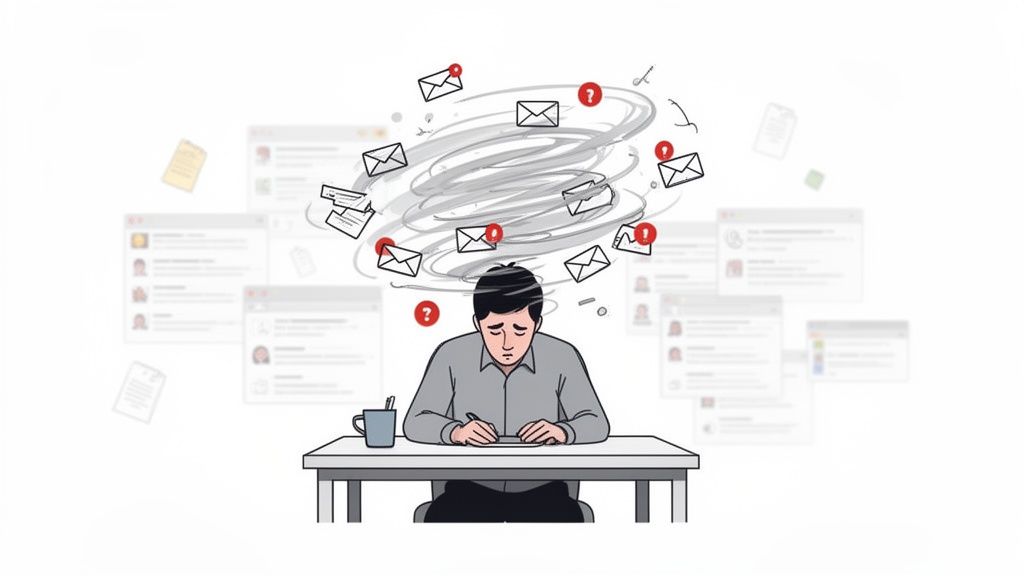
That constant hum of notifications isn't just a distraction. It's a focus-shattering machine. Every ping pulls you out of deep work, forcing a mental gear shift that drains your energy. We spend our days reacting to the newest unread message instead of doing the work that matters. The result? A low-grade, perpetual anxiety.
For teams spread across different locations or shifts—think retail, hospitality, or logistics—the problem is magnified. Critical information vanishes into endless reply-all threads. Attachments go missing. Frontline workers are either cut off from important updates or chained to a tool that was never built for them. It’s an exhausting and deeply inefficient way to run a business.
We’ve mistaken activity for achievement. The constant pressure of an overflowing inbox creates a cycle of reactive work, not proactive progress. It’s burning our teams out.
This digital chaos isn't just an operational headache. It fractures your culture. When communication is trapped in individual inboxes, it’s nearly impossible to build a shared sense of purpose. New hires feel lost from day one, and even veterans struggle to stay on the same page.
The Overwhelming Scale of the Problem
The sheer volume is staggering. A 2024 McKinsey study found that the average worker spends 28% of their week just managing email. That’s more than a full day, every week, spent just sorting and reacting. It’s clear this isn't about a few extra messages. We're dealing with a fundamentally broken system.
The search for an alternative to email isn't about finding a shiny new tool. It’s about finding a calmer, more effective way to work together. If you're weighing your options, you might be interested in our guide on employee communication apps vs. email.
What We Really Need Instead of Email
The search for an “email alternative” usually starts with the wrong question: "What tool can we use instead?"
Here’s the thing. The problem isn't email. The problem is that we’ve made email our default for everything. It's the classic case of using a screwdriver to hammer a nail. Sure, you might get it done, but it’s messy, frustrating, and you’ll probably hurt yourself. We need to stop looking for a better screwdriver and start picking the right tool for the job.
We’re asking a single, asynchronous tool to handle wildly different communication needs. As a result, it’s failing at all of them.
The Wrong Tool for Every Job
Think about what lands in your inbox. An urgent IT alert gets the same weight as a company-wide announcement about the holiday party. A deep project discussion with five attachments is buried under a simple request for a file. It’s a system that invites chaos.
Imagine a retail manager trying to spread the word about a flash sale. She blasts out an email. Half her team is with customers and won't see it for hours. The message is urgent and location-specific, but email treats it like any other note. By the time everyone reads it, the opportunity is gone.
The core issue isn't replacing email; it's recognizing that we have different kinds of conversations that demand different kinds of spaces.
Or what about an HR manager onboarding new hires? They send a massive welcome email packed with links, forms, and attachments. Within days, that critical information is scattered across dozens of individual inboxes, impossible to find. New employees are left confused, asking the same questions over and over because there’s no central, reliable place for answers.
This isn't a failure of people. It's a failure of the tool.
Shifting from Replacement to Rebuilding
A project team tracking deliverables over email is another perfect example. Feedback gets lost in reply-all chains. Version control is a nightmare. It’s nearly impossible to tell who is responsible for what. The conversation is about action and progress, but email is built for static, one-way messages.
Each of these scenarios—the urgent alert, the company announcement, the onboarding, the project—is a distinct communication job.
Urgent alerts need speed and immediacy.
Company announcements need broad reach and clarity.
Deep collaboration needs organization and context.
Onboarding needs a durable, single source of truth.
When you look at it this way, the solution becomes clearer. The goal isn't to find a single alternative to email that does everything. The goal is to build a smarter, more intentional communication system where each job has a dedicated home. This shift in mindset is the first, most important step toward a calmer, more organized, and genuinely more effective way to work.
Comparing Different Approaches to Communication
Once you decide to move internal work out of the inbox, the next question is obvious: where to? The market is flooded with tools, each promising a fix. But here’s the secret: picking an alternative to email by comparing feature lists is a mistake. It’s like buying a car based on the number of cupholders.
What matters is the philosophy each tool is built on—its opinion about how teams should work. Choosing a platform isn't about ticking boxes; it’s about finding a philosophy that fits your team. Most tool comparisons fall flat because they treat everything as interchangeable. They're not. Each one is a bet on a particular way of working.
Team Chat: The Philosophy of Now
Team chat apps like Slack or Microsoft Teams are built on one idea: immediacy. They operate on the principle that faster is better. For urgent, real-time problem-solving, they’re fantastic. When a server goes down or a customer has a critical issue, chat is brilliant.
But that strength is also its greatest weakness. The relentless stream of notifications creates a culture of constant interruption—a digital tap on the shoulder that never stops. Important information is ephemeral, buried within minutes under a flood of new messages and GIFs. Knowledge isn't built; it's exchanged and then lost.
Chat apps trade long-term clarity for short-term speed. They excel at talking but fail at remembering.
Using chat as your primary workspace is like trying to build a library in a hurricane. It’s loud, chaotic, and nothing stays put for long.
Project Management Tools: The Philosophy of the Task
Tools like Asana or Trello see work through a different lens. For them, the universe revolves around the task, the ticket, the deliverable. Communication is secondary—a comment on a card, a note on a deadline. This brings incredible order to complex projects, creating a clear path from A to B.
But work is more than a series of tasks. The most important conversations—creative debates, strategic shifts, human moments of connection—don't fit neatly on a project board. By organizing everything around a deliverable, these tools can accidentally silo the very conversations that lead to breakthroughs. The "why" gets lost in the "what." You end up with a great view of the project's skeleton, but you lose its soul.
This simple decision tree can help visualize when to use which tool.
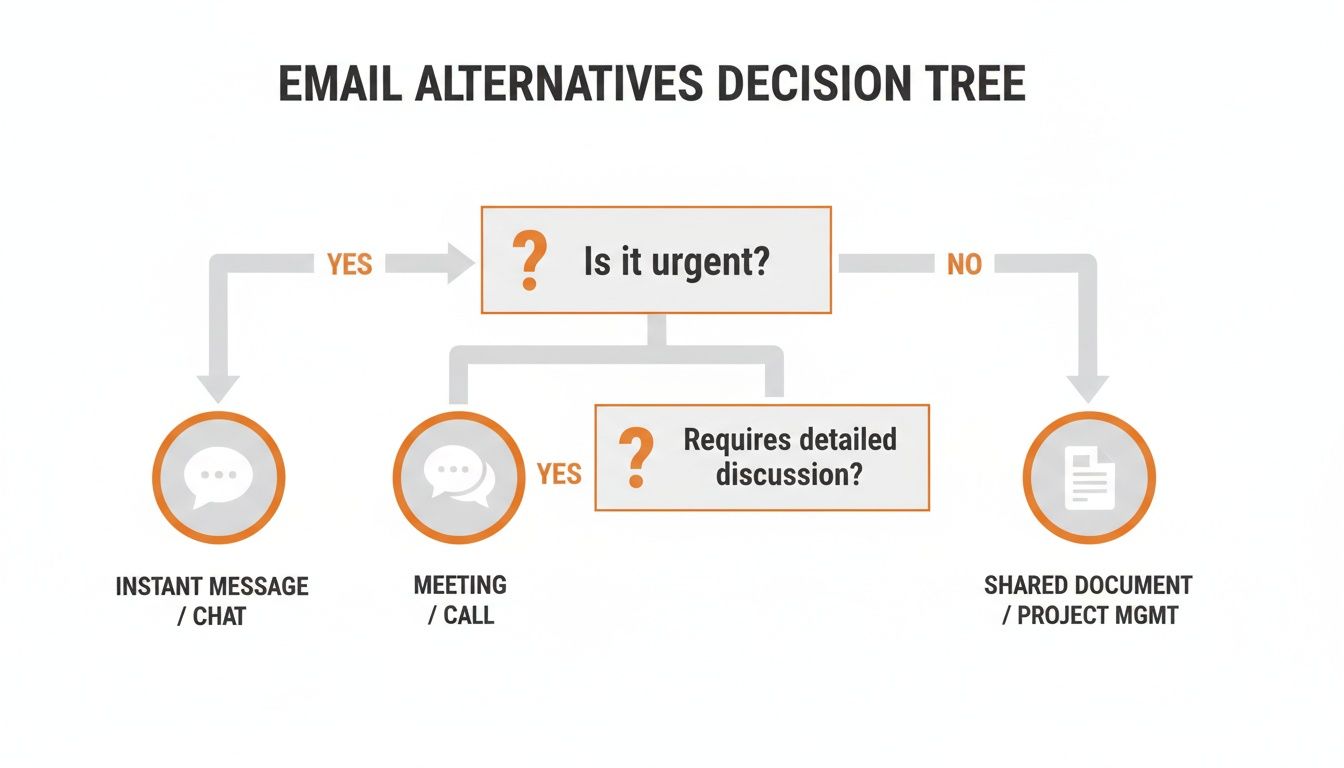
As the visual shows, urgent, quick discussions are perfect for chat, while more detailed, lasting conversations need a different kind of home.
The Corporate Intranet: The Philosophy of the Archive
Then you have the classic intranet, like SharePoint. These are built on a philosophy of top-down broadcasting. They are designed as a permanent, official archive—a digital filing cabinet for company policies, HR forms, and announcements. They are stable, structured, and a single source of truth.
But they are profoundly static. Intranets are where conversations go to die. They are a place for consumption, not collaboration. The experience is often clunky, forcing people to leave their daily flow of work just to find a document. They serve a purpose for storing official information, but they do little to foster a living, breathing culture.
All-in-One Platforms: The Philosophy of Unity
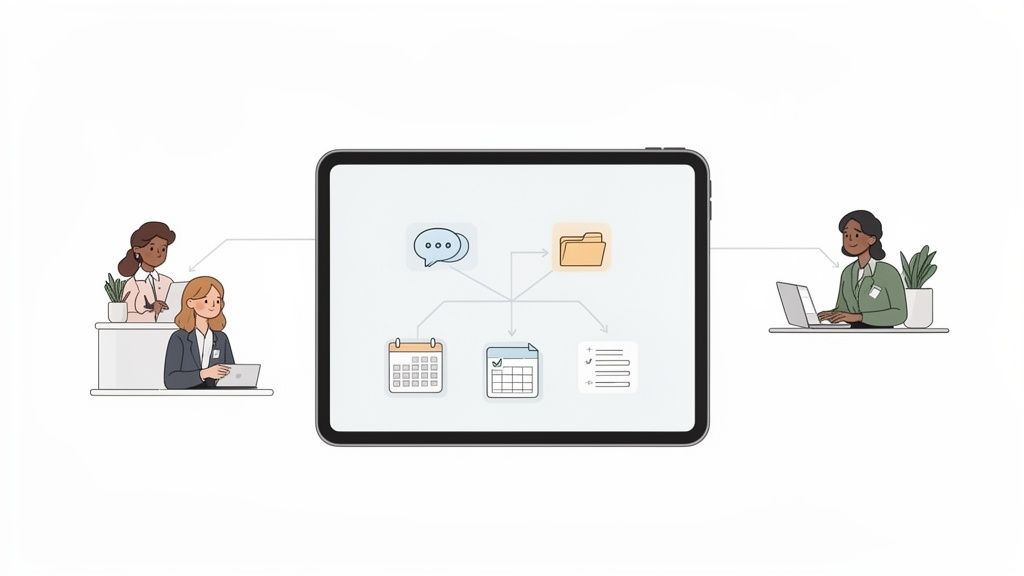
Finally, there are all-in-one work apps. Their philosophy is simple: the best way to work is to have your communication, tasks, and knowledge in one calm, organized place. This approach recognizes that conversations, projects, and documents aren't separate things; they are deeply intertwined.
An all-in-one platform provides dedicated spaces for different kinds of work without fragmenting focus. A policy update isn't just a document; it's a post that can be discussed, acknowledged, and easily found later. A project isn't just a list of tasks; it’s a space where the conversation, files, and to-dos all live together. We explore more of these ideas in our complete guide to the best alternatives to email for internal communication.
The challenge is execution. An app that tries to do everything can end up doing nothing well. But when done right, this unified approach doesn't just replace email; it creates a true digital headquarters for your team.
A Quick Comparison of Communication Tool Philosophies
Let's break down how these tools handle core communication jobs. This isn't about features—it's about their fundamental approach.
Communication Need | Team Chat (e.g., Slack) | Project Management (e.g., Asana) | Intranet (e.g., SharePoint) | All-in-One App (e.g., Pebb) |
|---|---|---|---|---|
Quick Questions | Excellent. Built for real-time chatter. | Poor. Questions get buried in task comments. | Non-existent. Not designed for interaction. | Good. Offers chat but keeps it organized. |
Project Discussions | Messy. Key decisions get lost in the scroll. | Good, but siloed within a specific task. | Poor. A one-way broadcast tool. | Excellent. Creates a dedicated, lasting space. |
Official Announcements | Ephemeral. Easily missed and hard to find. | Clunky. No central place for company news. | Excellent. Its core function is top-down sharing. | Good. Provides a central, visible place with discussion. |
Knowledge Sharing | Terrible. Information is disorganized and buried. | Inefficient. Knowledge is fragmented. | Good, but static. Functions as a library. | Excellent. Designed to build a searchable knowledge base. |
Ultimately, choosing an alternative to email is a cultural decision, not a technical one. It’s an opportunity to ask: what kind of company do we want to be? One that runs on urgency, obsesses over tasks, archives information, or one that brings its people and work together in one place?
Why a Single Source of Truth Matters
Let's be real. The biggest price you pay for a fragmented system isn't money. It's attention.
When your team has to jump from email for announcements, to a chat app for questions, to a task manager for their to-do list, you’re not just making them switch apps. You’re shattering their focus. You're breaking their train of thought. This constant shuffling is mentally draining. It forces people to waste precious energy piecing together a story that should have been in one place.
The search for a better alternative to email isn't about finding a faster messaging tool; it's about creating a calmer, more unified space to get work done.
Seeing Unity in Action
I saw this firsthand with a busy hospitality group. Their communication was chaos. Shift schedules landed in email, maintenance requests came as texts, and new cleaning protocols were buried in a shared drive nobody looked at. Managers spent their day chasing information. Staff felt disconnected and worked with outdated instructions. It was a perfect storm for mistakes.
When they moved to a single platform, the change was cultural. A new health policy was posted, acknowledged, and discussed, all in the same thread. When a manager updated a shift schedule, everyone on that team saw it instantly on their phones. No more confusion. No more missed shifts.
A single source of truth doesn’t mean cramming every feature into one app. It means having the right things together in one calm space to protect your team’s most valuable resource: their focus.
This isn’t about building some massive, all-powerful system. It’s about simplicity. It’s about creating a default place where the work and the conversation about the work can live together. Ultimately, it’s about giving people back their attention. A well-designed system makes it easy to find what you need and get back to what you were doing. This is why building a central knowledge hub is so crucial.
The Inevitable Shift to Unified Platforms
This isn't just a hunch; it's a clear trend. With global email volumes projected to hit 376.4 billion daily by 2025, according to a recent email industry report, businesses are realizing the inbox is too saturated to be a reliable hub. This is especially true as work shifts to mobile, where 75% of Gmail users now access their accounts. Fragmented tools just don’t work on a small screen; people expect a single, unified experience.
An all-in-one platform provides that single source of truth. It turns down the noise. It replaces the frantic search for information with a calm sense of clarity, ensuring everyone, from the main office to the front desk, is working from the same playbook. Choosing this path is a statement. It says you value your team’s time and mental energy more than the illusion of productivity that comes from a dozen buzzing apps.
How to Guide Your Team Away From Email
Let's be honest. Picking a new tool is the easy part. The hard part—where most of these initiatives fall apart—is getting your team to actually use it. This isn't a software rollout; it's a cultural shift.
You’ve spent years training people that everything important lives in their inbox. Now, you’re asking them to break a habit as ingrained as their morning coffee. You can't just send a memo and expect everyone to switch over. It takes patience, empathy, and a clear vision. This is about building new muscle memory, one small step at a time. A "big bang" launch is a surefire recipe for disaster.
Start Small and Prove the Value
The secret is to not try and replace email all at once. Instead, pick one specific, high-pain problem and solve it brilliantly with your new tool. Don’t start with a fuzzy goal like “let’s improve communication.” Get tangible.
For a restaurant group, that might be getting shift scheduling out of a nightmare of emails and texts. For a remote team, maybe it's creating a dedicated space for a single, high-stakes project. The goal is to create a small experiment where the new way is so obviously better than the old way that it speaks for itself. Once one team sees how much easier their work just got, they’ll start talking. That organic buzz is infinitely more powerful than any top-down mandate.
Find Your Champions and Listen to Them
In every company, there are people excited about finding better ways to work. These are your champions. They aren't always managers; often, they're the people on the ground who feel the pain of a broken system the most.
Find these people early. Bring them in, give them early access, and—this is the important part—genuinely listen to them. They’ll become your biggest advocates, your first adopters, and your most valuable source of truth.
Your champions are the human bridge between the old way and the new. Their enthusiasm is your most effective adoption tool.
When others see respected peers embracing the change, the conversation shifts from "Ugh, another tool" to "Hey, what's this thing everyone's using?" Let them lead the charge.
Create Clear Rules of the Road
Once you have momentum, you need to provide clarity. The biggest source of anxiety during a transition is uncertainty. Your team will be asking, “So… where do I post this?”
Head that off by creating a simple, one-page guide on “what goes where.” Think of it as your communication playbook.
Urgent Project Updates: Post in the dedicated project space.
Company-Wide Announcements: These now live in the company news feed.
External Client Communication: For now, this stays in email.
Quick Questions for Teammates: Use the direct chat feature.
This isn’t about creating rigid rules. It’s about reducing cognitive load. When you make the decision of where to communicate effortless, you make it easier for people to build the right habits. The journey away from email is a marathon, not a sprint. It’s about showing people a better way, not just telling them about it.
Imagining a Calmer Way to Work
Let’s step back from the features for a moment. This whole conversation about finding an alternative to email isn't just about efficiency. It's about building a saner way to work.
We're talking about giving our teams the gift of focus. Creating a work environment where knowledge isn't buried, conversations are clear, and that constant, nagging anxiety from a never-ending inbox finally goes quiet.
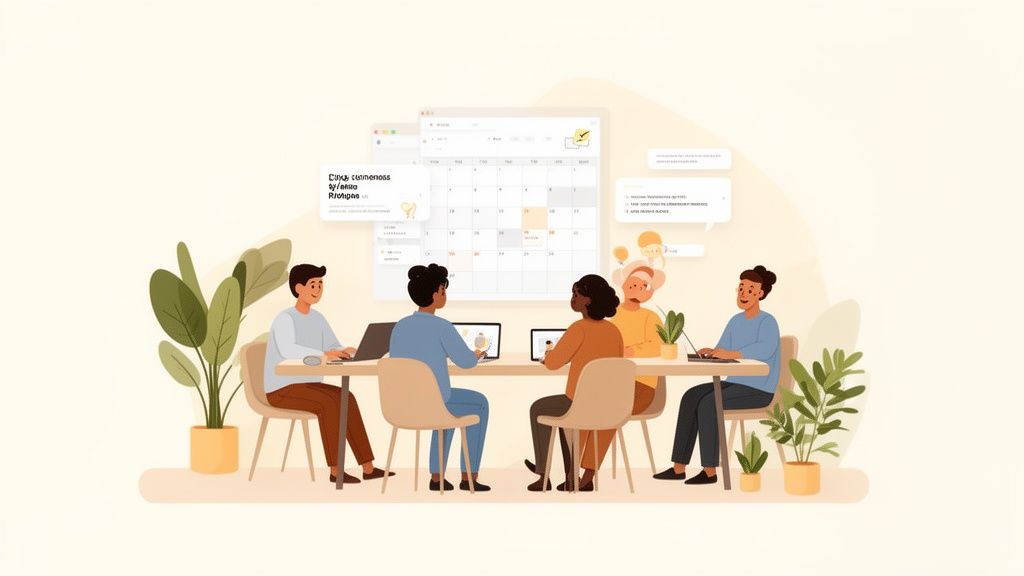
A Different Kind of Workplace
Imagine a workday where nobody has to dig through reply-all chains to get up to speed on a project. Picture a place where communication is deliberate and purposeful, not a knee-jerk reaction to the latest notification.
This is about creating a company where everyone, from the front desk to the C-suite, feels connected to the mission. They feel informed not because they got another mass email, but because they have a central hub where they can come together.
This isn't about buying another tool. It's about deciding what kind of company you want to build.
A company that values deep work over constant pings. A place that chooses clarity over chaos. An organization that treats its team's attention like the precious resource it is.
The tools we choose reflect the culture we're trying to build. So the real question isn't, "What can we use instead of email?" It's, "How do we want to work together?"
Answering that honestly is the first real step. It's how you start building a workplace that isn't just more productive, but is genuinely more human. A place where people can finally take a breath and do their best work.
Frequently Asked Questions
When we talk about pulling work out of the inbox, questions come up. It's a massive shift, so skepticism is healthy. Here are some of the most common things people ask.
Can We Really Replace Email Entirely?
Let's be realistic. For internal teamwork, absolutely. For talking to the outside world—customers, vendors, partners—email isn't going anywhere. It’s still the default.
The goal isn't to kill email. It's about being strategic. When you move all your internal chatter and collaboration into a dedicated space, the change is profound. Your inbox becomes a quieter, more organized place reserved for external conversations.
How Do We Get Less Tech-Savvy Employees On Board?
This is less about technology and more about people. The trick is to focus on simplicity and a clear benefit for them.
You need a tool that feels natural on a mobile phone, as easy as the social media apps they already use. Then, find one of their biggest daily frustrations and solve it first.
Don't run a massive training session on every feature. Just show them how the new tool makes one annoying part of their job disappear. Adoption will follow that feeling of relief.
Maybe it's getting shift schedules on their phone instead of finding a printed sheet in the breakroom. Or a simple button to request time off without digging up a paper form. Once they see the tool makes their life easier, you’ve answered the "what's in it for me?" question without saying a word.
Is an All-in-One Platform More Expensive Than Email?
A dedicated platform has a subscription cost, sure. But the real question is about the massive hidden costs of relying on "free" email. Think about the hours your team loses each week digging through old threads to find one piece of information. What about the lost productivity from constantly switching between five different apps?
When you factor in the expensive, time-sucking problems it solves, a unified platform delivers a much higher return. It's not a software expense; it's an investment in your team's sanity and focus.
Ready to create a calmer, more organized digital headquarters for your team? Pebb unifies communication, operations, and knowledge into one simple, all-in-one work app. See how it works.
