
Tracking time off shouldn't be a mess. So why is it?
Discover a calmer approach to tracking employee time off with streamlined approvals, accurate records, and simpler payroll. Click to learn more.
Dan Robin

We've all been there. A messy spreadsheet, a chain of forgotten emails, a sticky note on a monitor. The way we handle requests for a simple day off is often a well-intentioned disaster. It’s a system held together by good faith and a manager’s dwindling memory.
We tell ourselves it’s fine. It’s “good enough.”
But it’s not. That chaos isn't just an administrative headache; it’s a culture killer. It's the reason a simple request sits in an inbox for days, leaving someone unable to book a flight or just make plans. It’s why a manager, buried in work, accidentally approves time off for three key people in the same week, leaving the rest of the team to burn out.
This isn’t about busted formulas in a spreadsheet. It’s about the low-grade anxiety this mess creates for everyone. It slowly erodes trust and makes a simple, human need—rest—feel complicated and stressful. That’s a heavy price to pay for “good enough.”
The true cost of that spreadsheet
Let’s be honest with ourselves. Using a spreadsheet to track paid time off is like using a hammer to fix a watch. It’s the wrong tool for the job, and it does more harm than good.
The hidden costs pile up quietly. First, there’s the mountain of invisible work. Every single request kicks off the same time-sucking ritual for a manager: check the spreadsheet, cross-reference the schedule, reply to the email, and then—if they remember—update the original file. All that friction actually discourages people from taking the time off they've earned.

Then there's the fairness problem. A spreadsheet has no memory and zero sense of justice. It can't flag when one person’s requests are consistently denied while another’s sail through. It doesn’t notice when someone hasn't taken a single day off in eight months. These are the kinds of patterns that, left unchecked, breed serious resentment.
The system completely breaks down under pressure, especially during peak seasons like January, when 'use-it-or-lose-it' policies can cause a global surge in PTO requests by nearly 68%. For frontline teams, that kind of overload is a scheduling nightmare.
Here’s the thing. Manual systems are fundamentally broken.
They create ambiguity. Employees are never 100% sure what their balance is or if their request was even seen.
They cause blind spots. Managers can’t get a clear view of team availability, which leads directly to scheduling conflicts.
They undermine trust. Inconsistent approvals and frequent mistakes make the whole process feel arbitrary and unfair.
The cost of this chaos isn't just wasted hours. It’s lost productivity, frustrated people, and a damaged culture. It’s like managing any other critical business expense; just as you need to understand small business health insurance costs to stay financially healthy, you need a handle on time off to stay operationally healthy.
The goal isn’t just to replace a spreadsheet. It’s to find a calmer, more transparent way to operate. A way where taking time off is a simple, respected part of the job—not a source of endless confusion.
A time off policy that fits on one page
A good time off policy should fit on a single page. If it’s longer than that, it’s too complicated. And complexity is the enemy of trust.
Before you can track anything, you have to define the rules of the game in plain English. This isn’t about writing a dense legal document. It's about creating a simple guide that your team actually understands and feels is fair.
The first step is moving beyond the old, rigid buckets of "vacation" and "sick leave." Life is messy. A great policy anticipates that messiness before it turns into a one-off question that eats up a manager's afternoon.
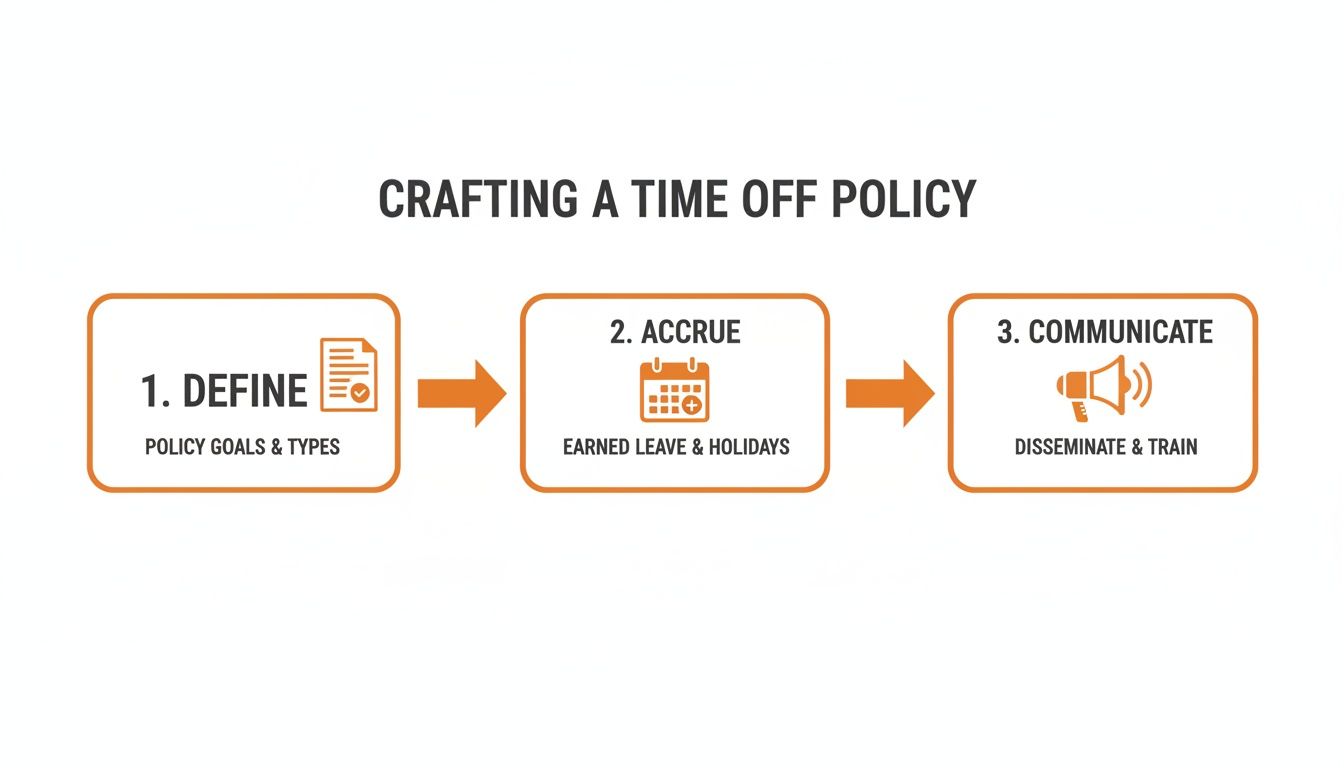
Think about all the reasons your team might need to be away from work. The more you can define upfront, the fewer gray areas you’ll have to navigate later. It’s a simple way to show you’ve thought about your team as people, not just names on a schedule. You might consider things like paid time off (PTO), sick leave, personal days for emergencies, floating holidays for cultural or personal days, and bereavement leave.
Defining these categories is an act of kindness. When the policy is straightforward, your team doesn't have to guess or feel awkward about asking for the time they’ve earned.
Next, you have to decide how people earn their time. You’ve basically got two choices. You can grant all the time upfront on January 1st, which is beautifully simple but carries the risk of someone using all their time and leaving in March. Or, you can have them accrue time with each pay period. This is more common and feels fair, especially in businesses with higher turnover, but it requires more tracking.
Then there’s the question of what happens at the end of the year. A "use-it-or-lose-it" policy, where time vanishes on December 31st, often just creates a mad dash for vacation. A much calmer approach is a carryover cap, letting people roll over a certain number of days. It respects the time they've earned while preventing a massive liability from building up on your books.
The best policy is one that feels generous but is also sustainable for the business. It strikes a balance.
This is even more critical for distributed teams. Paid time off is far from standard across the globe. Research from Moorepay shows a huge gap between countries like Yemen, with 46 total days off, and the U.S., which has no federal mandate. A clear, well-tracked policy is non-negotiable for fairness and compliance.
At the end of the day, a policy is just a document. What matters is how it feels. Does it make it easy for people to rest? Or does it create hurdles? The answer says more about your culture than any mission statement ever could.
A simple path from request to approval
Asking for a day off shouldn't be a bureaucratic nightmare. The process has to be dead simple for your team and even simpler for managers. For too long, we’ve relied on a chaotic mess of forgotten emails and hallway conversations that vanish into thin air.
So let’s design a process that actually respects everyone's time. This isn't just about speed; it's about removing the friction that breeds confusion and frustration.
It starts with one simple, powerful idea: put the team calendar on display.
This might sound counterintuitive, like you're inviting micromanagement. It’s the opposite. A shared, visible time-off calendar is about transparency. It empowers your team to coordinate among themselves. When someone sees that two colleagues are already out during a certain week, they often adjust their own plans without ever needing to involve a manager. It gives them the context they need to be good teammates.
We’ve found that a shared calendar quietly answers about 50% of the questions a manager would normally have to field.
This simple act of sharing information fosters a sense of collective ownership. It shifts the dynamic from "Can I have this day off?" to "How can we make this work for everyone?"
Next, keep the approval chain short. For most teams, a single point of approval—the direct manager—is all you need. Adding extra layers just creates bottlenecks. You have to trust your managers. The system’s job is simply to serve up the request with all the necessary context: who else is off, the employee's current balance, and any project deadlines. With that info, the decision is easy. An efficient employee time off app can route these requests instantly.
Finally, let automation handle the follow-up. Nobody should be left wondering about the status of their request. The moment it’s submitted, an automated notification should confirm it’s been received. When it's approved or denied, another one should close the loop. Immediately.
This isn’t just about efficiency; it’s about respect. It shows you value your team's time and understand their plans are hanging in the balance.
Ultimately, a truly great request flow feels almost invisible. It just works. And that’s the point—making sure your team can take their well-deserved rest without any of the stress.
Tying time off into the rest of your business
Tracking time off in a silo is a recipe for chaos. I’ve seen it happen countless times. An approved vacation is worthless if the shift schedule doesn't know about it. This is where most systems fall apart.
A tool for tracking time off has to connect with your scheduling, communication, and payroll systems. If it doesn’t, you haven’t bought a tool; you’ve created another chore. It’s like having a calendar that doesn't sync with your email.
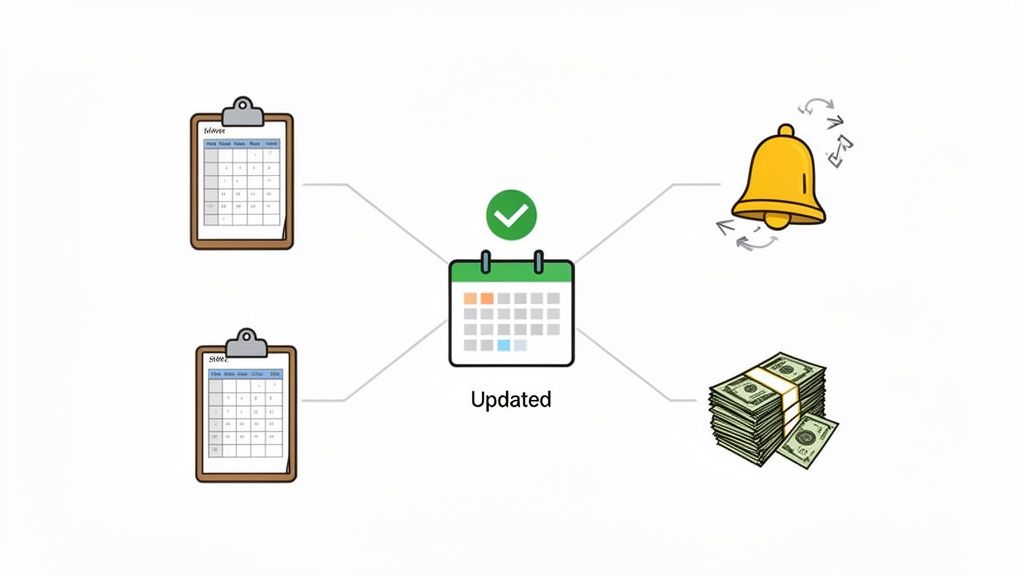
Here's how it should work. Imagine a retail manager approves a week off for someone. In a connected system, that one click—"Approve"—does all the heavy lifting. The schedule updates instantly, removing them from any shifts. The system flags the vacant shifts for coverage, often notifying qualified teammates automatically. And the approved PTO hours are sent straight to payroll.
This seamless flow transforms time off from a reactive chore into a proactive operational tool. You get a real-time view of who’s working, who’s not, and where you need coverage. It’s about making the system do the work, not the people.
For frontline teams in retail, hospitality, or healthcare, this integration is non-negotiable. Their work is the schedule. An error there can mean an understaffed floor during peak hours or a missed patient appointment. A disconnected system creates constant uncertainty. You can learn more about building smarter schedules in our guide to choosing an employee shift scheduling app.
When your time-off, scheduling, and communication tools all speak the same language, you eliminate the guesswork. Managers can approve requests with confidence.
Just as individuals need effective time management skills to organize their lives, organizations need connected systems to manage their collective time. Without that connection, you're constantly fighting fires instead of preventing them.
But here’s the thing that often gets missed: a connected system also sends a powerful cultural message. It tells your team that their time is respected. It shows that taking a vacation isn't a problem to be solved, but a normal, predictable part of work. That small change in technology leads to a big change in how people feel.
It’s not a system, it’s a signal
You can buy the fanciest time-off tracking tool on the market. But if your company culture silently screams that taking a vacation is a sign of weakness, your fancy tool is just expensive wallpaper.
A good system is only half the story. The other, much tougher half, is culture.
It’s about fighting the unspoken pressure to be "always on." Somehow, we’ve created a bizarre world where burnout is worn like a badge of honor. But burnout isn't a badge. It’s a business problem. It leads to sloppy mistakes, a cynical workforce, and your best people quietly looking for the exit.
The conversation about time off shouldn't be about policing your team. It should be about encouraging the rest they’ve earned and desperately need.
This idea of "leave shame" is a real thing. It’s that knot of guilt you feel before hitting "submit request." You start second-guessing: Is this a bad time? Will my manager hold this against me? The data backs this up. Workers in the U.S. often use just 48% of their allotted PTO. A FlexJobs poll found that a staggering 23% of workers skipped all of their paid time off because of overwhelming workloads and that "always-on" culture. You can dig into more of these trends over at Tesseon.com.
Culture starts at the top. If leaders are firing off emails at 10 PM or bragging about how they never take a vacation, their actions drown out any official policy.
So, how do you fix it?
Take your own vacations. And when you do, really unplug. Let your team see you disconnect.
Talk about time off positively. Frame rest not as an absence from work, but as a necessary part of doing great work.
Plan for absences. Work with your team to create a solid coverage plan before they leave. This eliminates the anxiety of coming back to a disaster.
The goal is to make taking a vacation feel as normal as charging your phone. You don’t feel guilty about plugging it in when the battery is low. Time off is the same thing for your people.
When you get this right, your tracking system changes. It stops being a tool for monitoring people and becomes a tool for enabling rest. It helps you spot who hasn't taken a break, giving you a chance to step in with a gentle nudge: "Hey, I noticed you haven't taken any time off this quarter. Let’s get a break on the calendar for you."
This is how you build a resilient team. It’s not about being soft; it’s about being smart.
Questions we hear all the time
Once you decide to fix how you track time off, a few questions always come up. Here are the most common ones we hear, along with some straightforward advice.
"How do we handle an unlimited PTO policy?"
"Unlimited" is a misleading word. It doesn't mean you stop tracking. In fact, it often requires more diligent tracking. The goal just shifts from policing a limited number of days to making sure people are actually taking enough time to rest.
How do you know if your unlimited policy is a genuine benefit or just a feel-good trap that discourages time off? Tracking gives you the answer. It shows you if leave is distributed fairly or if a few people are on a fast track to burnout. That data is a clear signal for a manager to step in and encourage a break. And practically, you still need to know who’s out next week to plan projects and cover shifts.
"What's the best way to switch from spreadsheets?"
Moving away from a spreadsheet doesn't have to be chaos. It’s all about communication and a phased rollout. Don't just rip the band-aid off.
Here’s a calmer way:
Finalize your policy first. Get your rules written down in plain English before you look at any software.
Import everything. You have to import all existing balances and—this is key—all future approved leave into the new system before you go live. If you miss this, you’re guaranteed to have scheduling conflicts on day one.
Run both systems in parallel for a bit. For a single pay period, use the new system alongside the old one. It’s a little extra work, but it’s the best way to catch any issues.
Explain the "why." Announce the change by focusing on how it helps the team. "This will make requests easier and get approvals faster." The simpler the tool, the less pushback you'll get.
"How does this help with compliance?"
An automated system creates a perfect, timestamped record of every request, approval, and balance adjustment. It’s your digital paper trail. It removes the "he said, she said" from any dispute.
Manual tracking is full of good intentions and human error. An automated system is built on consistency and fairness.
Local and state laws around sick leave can be incredibly specific. Getting those calculations wrong, even by accident, is a serious risk. Automation takes the guesswork out of compliance. It calculates accruals correctly, applies carryover rules consistently, and can generate an audit report in minutes. It's not just about saving time; it's about protecting your business.
Ready to move beyond spreadsheets and build a calmer, more connected team? Pebb unifies communication, scheduling, and time off tracking in one simple app for your entire team. See how it works.
