
Great Teamwork Is a Choice, Not an Accident
Discover practical tips for teamwork and collaboration to build a high-performing team and simplify work across remote or in-office setups.
Dan Robin
Let's be honest. Most conversations about teamwork and collaboration are a mess of buzzwords and wishful thinking. We're told to "leverage synergies" and "empower teams," then given another app that just adds to the noise. We all want great teamwork, but the path we're sold—more tools, more meetings, more notifications—usually leads to burnout, not breakthroughs.
This isn't about finding the perfect software. It's about deciding what kind of company you want to be. One that’s frantic, fragmented, and always on? Or one that’s calm, focused, and built on trust?
This is a guide about choosing the second path.
The Collaboration Paradox We All Live In
We talk a lot about teamwork and collaboration. We buy the latest tools, schedule endless meetings to discuss them, and write our values on the wall. But something still feels broken.
There’s this gap between the dream of effortless, synchronized work and the daily reality of digital chaos. We’ve all been there—jumping between ten different apps to move one project forward. Drowning in a sea of notifications that pull us out of deep thought.
This is the collaboration paradox. We have more ways to connect than ever, yet many of us feel more isolated and drained. More technology has not automatically led to better teamwork.
The Real Cost of Digital Friction
This isn’t just a feeling. The numbers tell a story. While everyone agrees collaboration is important, the way we're doing it is failing.
A staggering 21% of employees globally are actually engaged at work. The tools meant to help are often part of the problem. Employees using more than 10 apps report communication issues at a 54% rate—far higher than the 34% for those using five or fewer. It's no surprise a Deloitte study found only 9% of employees felt their company's collaboration tools were “very effective.” These workplace collaboration statistics show just how widespread the issue is.
The point isn't that technology is bad. It’s that our approach has been wrong. We got so focused on the digital connections that we forgot about the human ones. We added more channels but ended up with less clarity.
The goal isn’t to add more tools. It’s to remove the friction that prevents people from doing their best work, together. This is a human problem first, a tech problem second.
So, this guide isn't another fluffy list of "collaboration tips." It's a straight talk about what's broken and how to actually fix it. We'll explore why the difference between teamwork and collaboration is a bigger deal than you think. And we'll map out a path to a saner way of working that puts people, not platforms, back in charge.
Teamwork is the Goal, Collaboration is the Work
We use the words "teamwork" and "collaboration" like they're the same thing. They're not. This isn't just semantics; confusing the two is why so many efforts to work smarter fall flat.
It’s an easy mistake to make. Both involve people working together. But here's the secret: one is the destination, the other is the journey.
Teamwork is the what—the shared goal. Collaboration is the how—the messy, human process of getting there.
Imagine building a house. Teamwork is the blueprint. The architect, the electrician, the plumber—everyone agrees on the final vision. They all share one goal: build this house. It’s about alignment.
Collaboration is what happens on site. It's the plumber and electrician figuring out how to run pipes and wires through the same wall. It's the carpenter finding a problem with the framing and talking to the architect to solve it on the fly. Collaboration is the living, breathing interaction that gets the house built right.
The Problem With One Without The Other
You can have one without the other. That’s where things go wrong.
Teamwork without collaboration is just a group of people working in silos. The electrician wires the house, the plumber installs pipes, and everyone checks off their tasks. But when the walls go up, they realize the light switch is right where the sink should be. The project gets "done," but it's full of mistakes.
Collaboration without teamwork is just chaos. A flurry of meetings and brainstorms that go nowhere because nobody agreed on a blueprint. It's all activity, no progress.
This isn't a theory. A study from Queens University found that while nearly 75% of employers call teamwork "very important," 39% of employees say they don't collaborate enough. That’s the gap between the goal we want and the interactive muscle we’re failing to build.
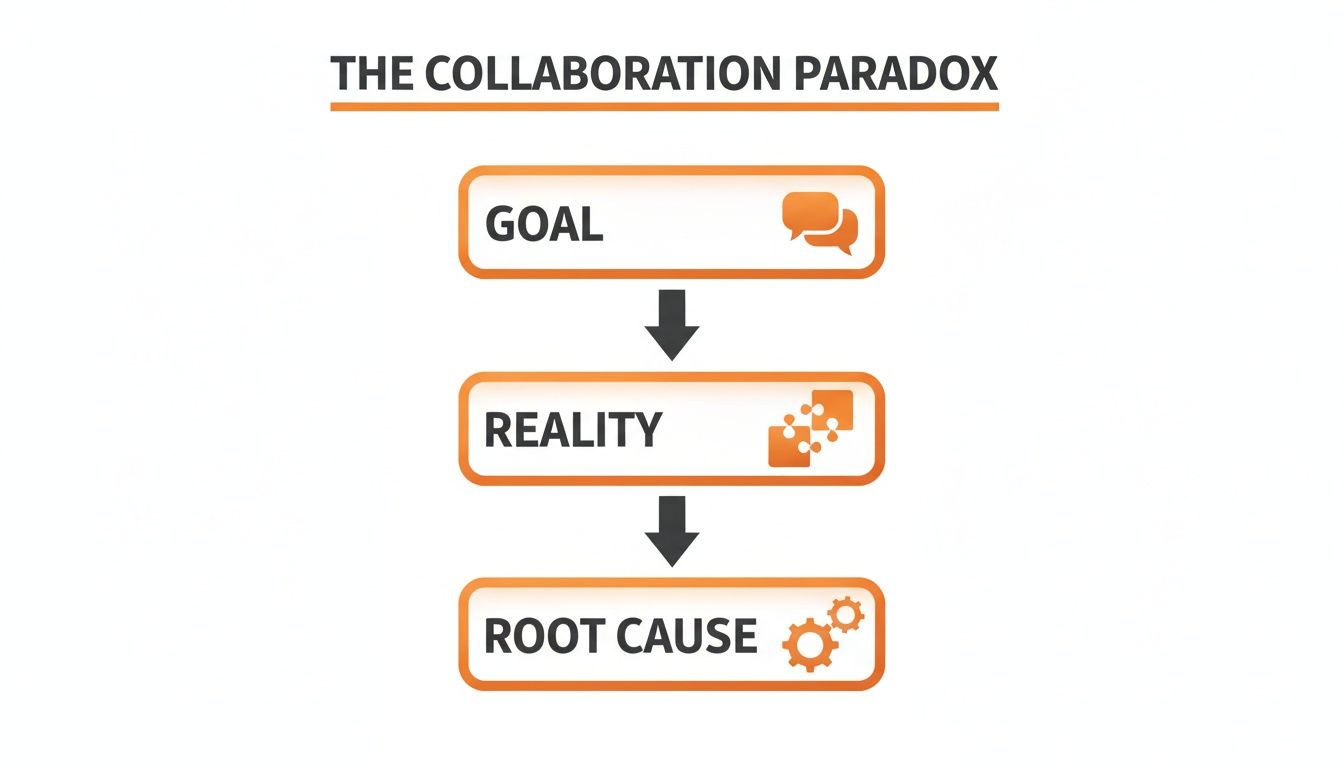
This "Collaboration Paradox" nails it. We want seamless interaction, but our reality is fragmented. The root cause? We're not building the right how to achieve our what.
Let’s break it down.
Teamwork vs. Collaboration At A Glance
Aspect | Teamwork (The Goal) | Collaboration (The Process) |
|---|---|---|
Focus | Achieving a defined, common goal. | Solving problems and creating new value together. |
Structure | Often hierarchical with clear, individual roles. | Typically flatter, more fluid, and interconnected. |
Process | Linear and task-oriented (do your part). | Iterative and dynamic (build on each other's work). |
Communication | Informational (updates, status reports). | Conversational (brainstorming, feedback, debate). |
Outcome | Efficient completion of a project. | Innovative solutions and stronger relationships. |
Seeing them side-by-side makes it clear. Teamwork is about efficiency and alignment. Collaboration is where the creative magic happens. You need both.
From Assigned Tasks To True Partnership
So, what's the point? It’s not just about handing out tasks and tracking them on a chart. That's just project management.
The best companies create an environment where the shared goal (teamwork) is so clear that it frees people to interact creatively and spontaneously (collaboration).
This requires trust. It means creating a space where people feel safe enough to share a half-baked idea, challenge an assumption, or ask for help. It's less about enforcing rigid workflows and more about finding a natural rhythm.
When you get this right, you don't just finish the project. You create something better than anyone could have on their own.
What Makes Modern Collaboration So Hard
We've spent a fortune on tools meant to bring us closer, but real connection at work feels harder than ever. If you feel this, you’re not alone. We were sold the dream of a seamless digital workplace. We got a digital maze instead.
The shift to remote work threw fuel on the fire, but it’s not the only culprit. The real problem is fragmentation. We don’t have one digital office; we have a dozen. There’s a chat app for pings, a project tool for updates, an intranet no one looks at, and an endless flood of email trying to tie it all together.
This creates a constant, low-grade digital noise. Async work was meant to give us focus time, but for many, it's become an "always-on" culture where work never really stops.
The Problem of Digital Exhaustion
All this friction is exhausting. Every time you switch apps, you pay a mental tax. That tax adds up. You lose your train of thought jumping from a chat to a project board, trying to piece together a conversation scattered across three different places.
You can't just lean over to a coworker anymore. Instead, you type out a message, send it into the void, and wait. That simple human interaction becomes a digital ticket in a queue. It’s not just inefficient—it’s isolating.
This isn't just venting; it's a diagnosis. You can't fix a problem you haven't named. And the problem is this: our tools have built more silos than they’ve torn down.
This fragmentation is especially tough on frontline workers—the people in your stores, on your factory floors, or in your hospitals. They're often the last to get important information because they aren’t tied to a desk. They get by with outdated breakroom posters or second-hand updates from a manager.
The Real Root Causes
The problem is deeper than too many apps. It's systemic. The time we spend on collaborative tasks has jumped by at least 50% over the past two decades. With remote work, that went into overdrive. Today, about a quarter of all paid work in the U.S. is done from home. The enterprise collaboration market is expected to hit $116 billion by 2033 as companies try to keep up.
But all that spending hasn't solved the core issues. Here are the real culprits:
Tool Silos: Our tech stack is a jumble of apps that don’t talk to each other. Information gets trapped, forcing people to play detective just to find what they need. If you're curious about the real price we pay, we've covered how to break down communication silos before.
Cultural Disconnects: Our work culture hasn't kept up. We still reward instant replies and the appearance of being busy, which undermines the trust and focus needed for real teamwork.
Frontline Exclusion: Let's face it, most collaboration software was built for desk workers. These tools fail to connect the entire organization, leaving a huge gap between HQ and the people who interact with your customers every day.
By naming these root causes, we can stop putting band-aids on symptoms like burnout and start talking about a real cure. The first step is admitting that our current approach is fundamentally broken.
Building a Culture of Intentional Collaboration
Great collaboration doesn't just happen. It isn't a happy accident that comes from a new chat tool or another meeting. It’s a system you have to design with purpose.
Most companies let collaboration happen by default. They end up with a mess of old habits and then try to slap a software band-aid on it. The result is the digital chaos we’ve all come to know.
But what if we stopped accepting that as normal? What if we built a framework for intentional collaboration? This is about creating an environment where the right way to work is also the easiest way. It’s about building a calmer, more focused, and fundamentally human workplace.
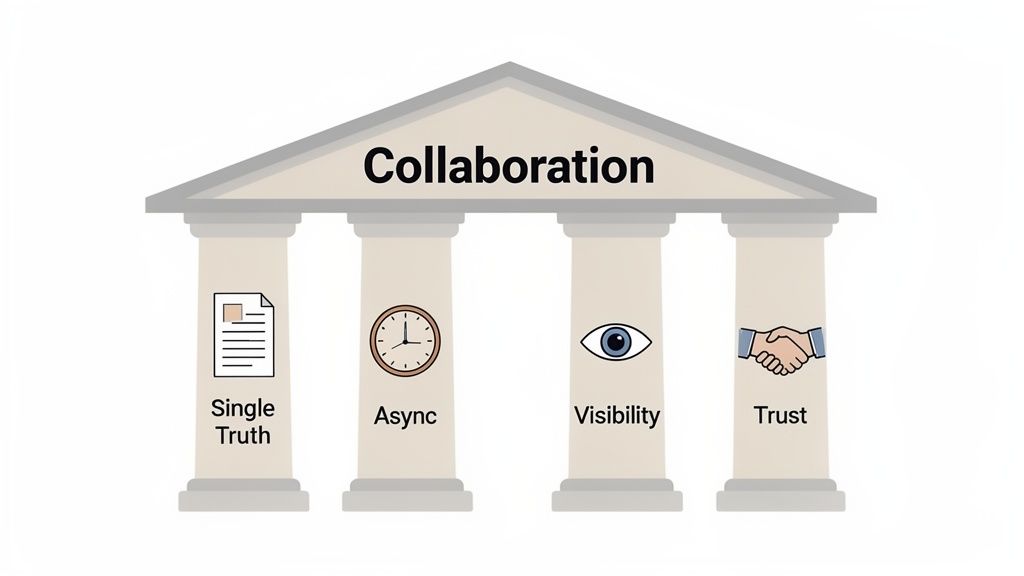
Through our work, we've found this kind of system rests on four simple, powerful pillars.
Pillar 1: A Single Source of Truth
I once worked with a retail chain where launching a simple promotion was chaos. HQ sent the announcement by email. Store managers passed the details to their teams through a jumble of text messages. The official marketing assets were buried on an old intranet no one could log into.
By Friday morning, half the stores had the wrong signs up. Nobody could agree on the discount code. It was a classic case of good intentions sunk by bad systems.
The problem wasn't a lack of effort; it was the lack of a single home for information. When knowledge is scattered, you create friction, doubt, and rework. A single source of truth isn't about one mega-app. It’s about one designated, accessible place where critical work happens and key information lives.
Pillar 2: Asynchronous by Default
The modern workplace is addicted to immediacy. That little green "online" dot creates a pressure to be available, to respond right now. This constant interruption demolishes deep work.
Asynchronous-by-default is the antidote. It’s a mindset that says, “We will protect each other’s focus.” It means most communication—updates, feedback, questions—doesn't demand an instant reply. You write things down with clarity, giving your colleagues space to respond thoughtfully when they're ready.
This doesn't mean no meetings. It means you make every meeting count. A real-time conversation becomes a deliberate choice for urgent or complex topics, not the default for everything. This approach respects time and attention, your team’s most precious resources. A great place to start is to build team habits for better collaboration.
Pillar 3: Genuine Visibility and Inclusion
Let’s be honest: in most companies, information flows downhill. Leadership makes decisions, and by the time the news reaches frontline employees, it’s often distorted, late, or irrelevant. This creates a gap between the people setting the strategy and the people doing the work.
Genuine visibility means everyone—from the CEO to the part-time cashier—can access the same core information and has a voice. It means a warehouse worker can share a brilliant idea for improving logistics and know it will be seen by the COO.
Inclusion isn't about inviting more people to meetings. It’s about building a system where their contribution is possible, valued, and visible, regardless of their role or location.
This is especially crucial for frontline teams. When they feel seen and heard, they become your best source of on-the-ground intelligence. They see the problems and opportunities that executives in a boardroom never will.
Pillar 4: Trust Over Surveillance
As work has become more distributed, a worrying trend has emerged: digital surveillance. Some companies use invasive software to track keystrokes or monitor employee activity, all in the name of "productivity."
This is a complete failure of trust. And it doesn't even work. A 2024 McKinsey study found that when employees feel they're being watched, their sense of psychological safety plummets, killing creativity and honest feedback.
The alternative is simple: trust your people. Hire great people, give them a clear goal, provide them with good tools, and then get out of their way. A culture of trust is built on transparency and autonomy. When people feel trusted, they take ownership. They solve problems without being asked and bring a level of care to their work you can't measure on a dashboard.
These four pillars aren't just ideas. They are design choices. You can choose to build a workplace that is fragmented and reactive, or you can build one that is unified, calm, and rooted in trust.
Putting It All Together in One Place
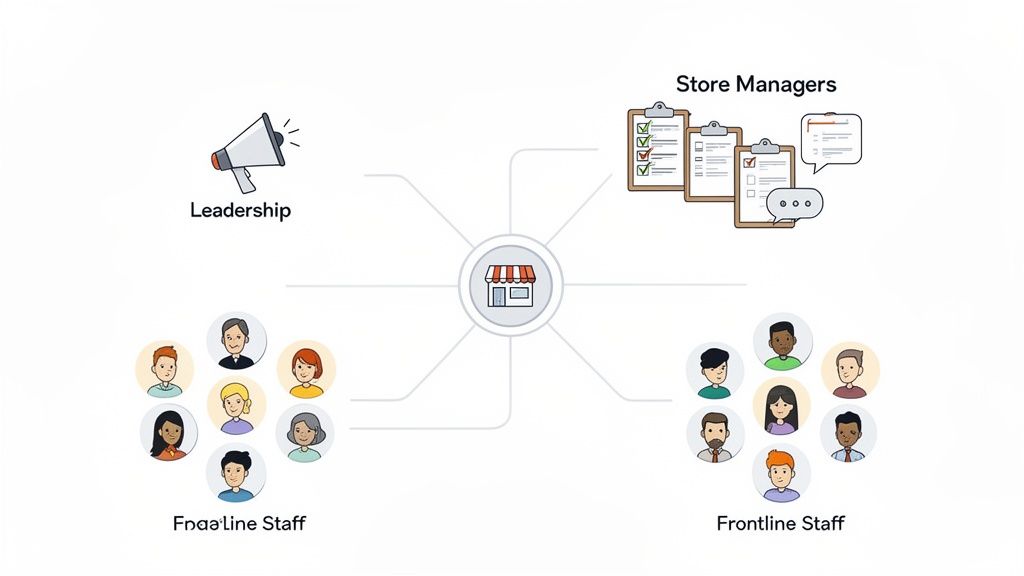
Theory is one thing, but daily work is another. We’ve covered the pillars of great teamwork and collaboration—a single source of truth, an async-first mindset, visibility, and trust. But what does that look like in practice?
Let’s walk through an example. Imagine a retail company, “Apex Apparel,” is launching a big in-store promotion. In the past, this was chaos. A storm of emails, texts, and outdated files left store teams confused.
This time, everything happens in one place.
The Launch Begins with Clarity
Instead of an email, the CEO kicks things off with a company-wide announcement in a dedicated “HQ Updates” feed. The message is short, clear, and includes a quick video explaining the why behind the promotion. It's a moment of connection that every employee can see.
This one post is the anchor for the entire campaign. It links directly to the official marketing guide and FAQs, which live in a central knowledge library. No more conflicting versions. Everyone is working from the same playbook from day one. If you want to dive deeper, we have some thoughts on how to build a central knowledge hub for your team.
This isn't about finding one tool that does everything. It's about creating one calm, organized space where everyone comes together.
Right away, regional managers create tasks for their store managers: "Review promo guide & confirm staff briefing by EOD Tuesday." The assignment is visible, trackable, and tied to the original announcement. No chasing down status updates.
From HQ to the Frontline
Now the plan moves to execution. Store managers get a notification. They open the task, read the guide, and post a message in their team’s private space: “Hey team, big promo coming up! Please review the attached one-pager before your shift tomorrow.”
And here’s where collaboration happens. A new sales associate asks a question: “Does the 30% discount apply to already marked-down items?” Instead of getting lost in a text chain, it’s visible to the entire store team. Within minutes, an experienced team member chimes in with the answer.
That small interaction solved a problem quickly, empowered a peer to help, and made that knowledge available to everyone else. To get your different tools working together, it's worth exploring the benefits of Unified Communications for Business.
Closing the Feedback Loop
As the promotion goes live, the process evolves. Frontline employees are encouraged to share what they're seeing.
An associate in Miami snaps a picture of a clever merchandising display and shares it in a "Best Practices" channel for other stores to see.
A stockroom employee in Seattle notices customers are repeatedly asking for a product that isn’t part of the sale. He flags it to the marketing team in real time.
This feedback isn't just chatter; it's invaluable data. Leadership can see what’s working, spot trends, and make smart adjustments. They’re no longer guessing what’s happening in their stores—they’re seeing it firsthand.
This entire lifecycle, from CEO announcement to frontline feedback, happened without a single messy email chain. It was calm, clear, and inclusive. That’s what it looks like when you put everything in one place. It’s not a tech solution; it’s just a better way to work.
This Is a Human Problem, Not a Tech Problem
After all this, it’s easy to fall into a trap. We start to believe the next flashy app is the magic bullet we’ve been missing. It never is.
We can have the most sophisticated technology in the world, but it’s worthless if we forget the people it's supposed to serve. The conversation about improving teamwork and collaboration shouldn’t start with a software demo. It has to start with your people.
Get the Tech Out of the Way
Let’s be honest. The point of technology should be to remove the friction that stifles human connection, not replace it. The best tools are the ones you barely notice. They fade into the background and let people do what they do best: talk, think, and create together.
Real collaboration doesn't come from a feature list. It grows from trust. It catches fire when a team rallies around a purpose they believe in. No software can fake that. A tool can either help those conditions flourish or crush them under the weight of complexity.
The true test of any collaboration tool isn't its number of features. It's how much simpler and more human it makes our work.
When we bombard teams with a dozen different apps, we aren't helping them—we’re just adding to the digital chaos. We create a work environment that shatters focus and makes real connection feel like a distant memory. Somewhere along the way, we got so obsessed with optimizing workflows that we forgot to optimize for human beings.
This isn’t about a relentless pursuit of efficiency. It’s about finding a calmer, more focused way to work. It’s about carving out a space where people feel seen, heard, and trusted.
Think about it. The most valuable interactions are rarely the scheduled ones. They're the spontaneous questions, the shared jokes, the "aha" moments that happen when two people are just figuring something out.
So, I’m not going to leave you with a seven-step plan. Instead, I’ll leave you with a simple question.
Is your current way of working making things simpler and more human, or is it just adding to the noise?
Frequently Asked Questions
We get asked a lot about how to make teamwork and collaboration better. People want a quick fix, but the real answers are usually simpler and more human.
Here are a few common questions, with some honest answers.
What Is The First Step To Improve Teamwork and Collaboration?
Stop buying things and start listening. Seriously. Before you look at new software, talk to your teams. Ask them: Where’s the friction? What’s making your job harder than it should be?
Often, the biggest hurdles are small. Maybe frontline staff can’t find company updates, or project info is buried across five different apps. You don't need a consultant to figure this out; you just need to ask the people doing the work. The first step isn’t a purchase order, it's a diagnosis. Once you know the real pain, you'll know where to focus.
How Do You Measure The ROI Of Better Collaboration?
Forget the complex ROI models. They rarely capture what matters. Instead, look for tangible signs that work is becoming calmer and clearer.
Are projects getting done with fewer last-minute fire drills? Is employee turnover dropping? Are you seeing more teams talking to each other naturally, without a manager forcing it? Check your engagement surveys. Are the scores for "feeling connected" and "feeling heard" going up?
The true return on investment isn't just a number. It’s less friction, higher morale, and a team that solves problems without constant hand-holding. That’s worth more than any spreadsheet can show.
Can One Tool Really Solve All Collaboration Problems?
Nope. And anyone who says their tool can is selling a fantasy. A tool, on its own, solves nothing. It's an enabler, not a silver bullet.
But here’s what a unified platform can do: It can fix the crippling problem of fragmentation. It cuts through the chaos of having too many apps. By bringing communication, tasks, and knowledge into one sane place, it creates the environment for great teamwork and collaboration to flourish.
But it only works if you're committed to a simpler, more transparent way of working. The tool is just the stage; your culture is the main event.
Ready to build a calmer, more connected workplace? Pebb unifies your team's communication, operations, and engagement in one simple app. See how it works at https://pebb.io.
