
The Quiet Revolution of a Good Internal Comms App
Discover how the internal communications mobile app streamlines updates, boosts collaboration, and replaces chaos with a central, efficient hub.
Dan Robin
Let's talk about the mess. The endless email chains, the chaotic group chats, the company intranet everyone forgot the password to. Most internal communication is a storm of digital noise, and it’s quietly killing your team's focus. Crucial updates get lost. Frontline workers feel like they’re the last to know anything.
It’s more than just an annoyance. It's a productivity drain. The answer isn't another app. It’s a better way to work.
A good internal communications mobile app is that better way. Think of it as a calm, dedicated space on your phone that brings every single employee together. One central hub for news, messages, and the tools people actually need to do their jobs.
Your Team Is Drowning. Throw Them a Lifeline, Not More Noise.
Let’s be honest. The way most companies talk to their people is broken. It’s an overwhelming mix of emails, notifications, and a clunky intranet that feels like a digital ghost town. We’ve seen this chaos up close, and it’s not a minor headache. It's a serious problem.
People spend more time digging for information than actually working. This isn't a small hiccup; it’s a silent productivity killer, draining energy and focus every single day. The answer isn't to throw another tool at the problem. It’s to find a saner approach.
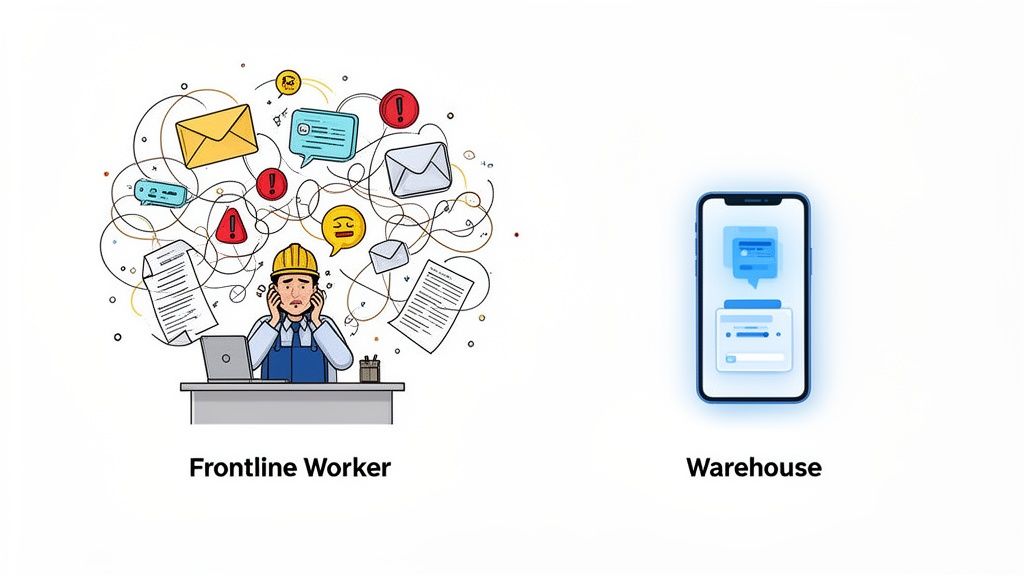
The Real Cost of Fragmented Communication
All that jumping between different apps comes with a price. A big one. It's not just the lost minutes; it’s the crushing loss of momentum. This scattered approach bleeds productivity. Some studies show employees lose up to 40% of their day context-switching or chasing down answers. Globally, that adds up to a staggering $1.5 trillion hit each year.
A dedicated internal communications app helps you win that time back. It's why a projected 85% of enterprises plan to consolidate their scattered platforms by 2026. You can dig deeper into how unified tools boost performance to understand the shift.
Here’s the thing: when your communication is fractured, your culture fractures with it. Without a single source of truth, you get:
Information Silos: Teams operate in bubbles, disconnected from what others are doing.
Message Overload: Important announcements get buried under a tidal wave of chatter.
Employee Disconnect: Your non-desk workers—the face of your company—feel like they’re the last to know.
A Calmer, More Organized Way Forward
So what happens when a company decides to fix this? It’s not about finding a silver bullet. It’s about building a digital space where everyone can connect, find clear information, and feel like part of the team, whether they’re at a desk or on the warehouse floor.
We believe the goal isn’t to add another app to the pile. It’s to replace five of them with one simple, organized place where work actually happens.
This is the promise of a dedicated internal communications mobile app. It’s a calm, central place designed to cut through the noise. It brings news, collaboration, and resources together in one spot—on the one device everyone already carries.
The rest of this guide will show you what this looks like in the real world. We'll get past the buzzwords and show you how a unified approach can truly change the way your team works.
What an Internal Communications App Actually Is
Let's clear something up. An internal communications mobile app isn't just another chat tool. We all have enough of those. Think of it as your company’s digital headquarters, built to live in your pocket.
It's a single space where everyone and everything comes together. It has the immediacy of a text, the organization of a news feed, and the power of a searchable library. If your company were a city, this app would be its central square, library, and town hall—all rolled into one. It’s where official announcements are made and you can actually find the right person without sending three emails.
More Than Just a Prettier Intranet
Let’s be honest: most company intranets are digital graveyards. Clunky, desktop-first relics that nobody wants to use. They feel like a chore.
A proper internal communications app is the opposite. It’s built for the 80% of the global workforce who aren't chained to a desk. It meets people where they already are: on their phones. This isn't a small detail; it's everything.
A retail associate can get a merchandising update on the store floor. A logistics driver can confirm a route change from their truck. A nurse can pull up a new protocol right from the patient’s wing.
The point isn’t to give people another place to log in. The point is to create a single source of truth that’s as easy to check as the weather.
Why Not Just Use WhatsApp or Email?
We see this all the time. Companies try to fix communication gaps with a patchwork of consumer apps—WhatsApp, Facebook Groups, endless email chains. It seems like a quick fix, but it almost always backfires.
Consumer apps are for casual chats, not professional work. They open up huge security risks, blur the lines between personal and professional life, and make finding important information nearly impossible. Many companies also juggle broader suites like Microsoft 365 vs Google Workspace, using communication features that weren’t truly built for their entire workforce.
A dedicated app is designed to solve the big problems that consumer tools create:
Security and Compliance: It keeps company information inside a secure, managed environment. In most industries, this is non-negotiable.
Structure and Clarity: It separates "must-know" announcements from "nice-to-know" chatter. Crucial messages don’t get buried under GIFs.
Accessibility for All: It gives every employee a professional platform. No one is left out because they don’t want to use their personal accounts for work.
Choosing a dedicated internal communications mobile app is a deliberate decision. It’s a signal to your team that you’re serious about communication and their experience. It’s not just a tool; it’s the foundation for a more connected company.
Connecting Everyone, From the Frontline to the C-Suite
Here’s a hard truth: a single, top-down message never lands the same way for everyone. An email from HQ about a new initiative doesn't resonate the same in a quiet marketing meeting as it does on a loud warehouse floor.
For too long, internal communication has been a one-way street, built for people at desks. This is where a dedicated internal communications mobile app flips the script. It's not just for pushing out information; it's about creating genuine connections that flow in every direction. The goal? Making sure the right information gets to the right people, in a format that actually helps them.
Bridging the Gap With Real-World Examples
This isn’t about abstract features—it’s about solving real problems. Think about a retail manager rolling out a new visual merchandising display across a dozen stores. Instead of a long email that gets buried, she can share a quick video and a visual guide directly to every associate's phone. They see it, get it, and can ask questions right away. No more guesswork.
Or consider a hospital that needs to communicate an urgent protocol change to its nursing staff. A targeted mobile notification is instant, trackable, and far more effective than a memo on a bulletin board. It’s about delivering critical information with confidence.
An app organizes these different needs into a simple, accessible hub.
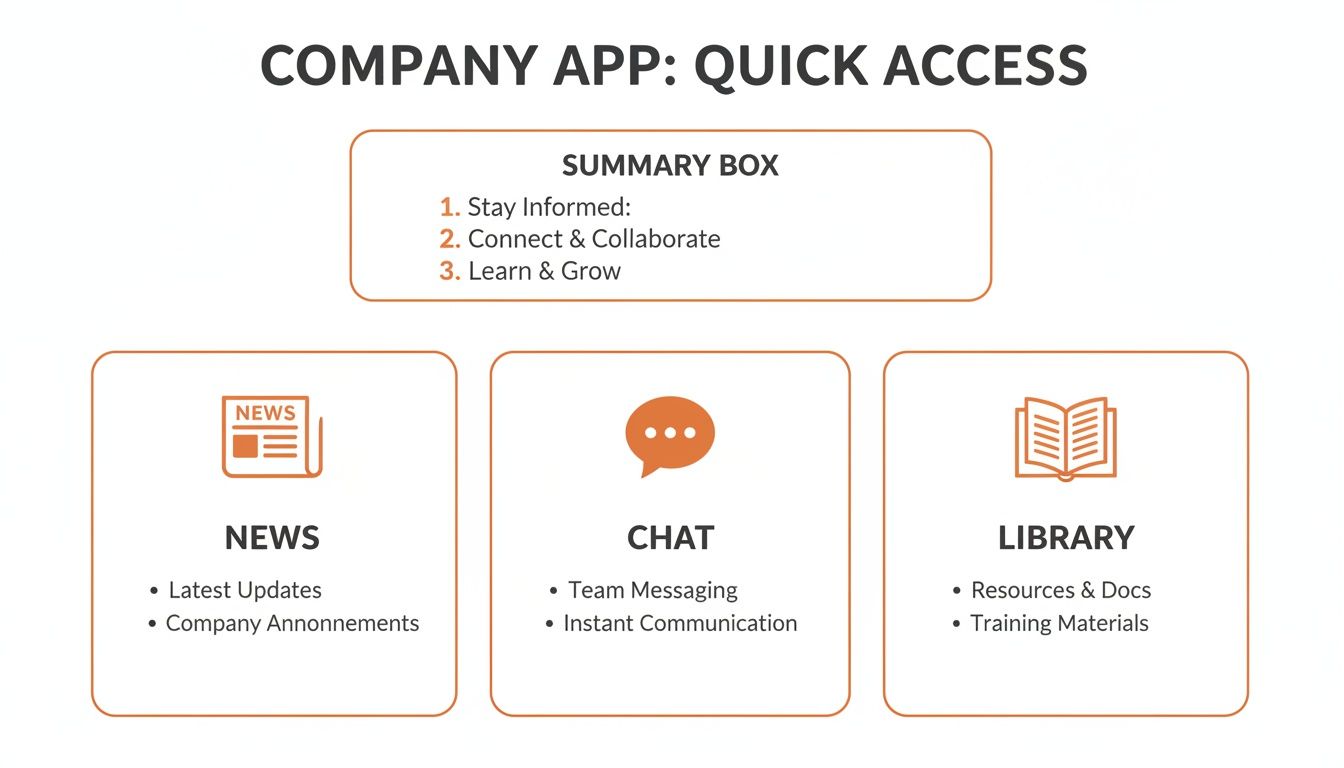
This structure means that whether an employee needs a quick answer from a teammate (Chat), an official company update (News), or a standard operating procedure (Library), it’s all a tap away.
A Single Source of Truth for a Scattered Workforce
Let's face it: your frontline workers are the backbone of your business, but they're often the most disconnected. Smartphones are now essential work tools. With 90% of employees already using them for information, a mobile-first strategy is just common sense. In industries like healthcare and retail, where deskless staff can be 70-80% of the team, this is non-negotiable.
An app brings everyone into the fold, enabling cross-functional chats, bottom-up feedback, and task management right from their pockets. This directly addresses the gap that leaves nearly 40% of workers feeling disconnected from their company’s mission.
Here’s how communication changes when you move from scattered tools to one unified platform.
Communication Before vs. After a Unified Mobile App
Communication Task | The Old Way (Email, Multiple Chats) | The New Way (Unified App) |
|---|---|---|
Urgent Announcements | Mass email with low open rates; messages get lost in personal chat apps. | Instant, targeted push notifications with read receipts. |
Sharing a New Policy | PDF attached to an email that’s hard to find later. | A permanent, searchable document in a central knowledge base. |
Asking a Quick Question | Trying to find the right person's number or email; delays are common. | A quick search in the employee directory and an instant message. |
Team Collaboration | Fragmented conversations across text messages, email threads, and different apps. | A dedicated, organized channel for the specific project or team. |
Celebrating Wins | Often only happens at the corporate level; frontline achievements go unseen. | Company-wide feed where anyone can post a shout-out with photos or videos. |
This shift isn't just about efficiency; it's about building a more inclusive culture.
The goal isn’t just to send messages. It’s to create a shared space where everyone, regardless of role or location, feels seen, heard, and valued.
This is where a unified app comes to life. A searchable people directory helps a new hire connect with a veteran employee in another state. Dedicated channels cut through the noise. A company-wide feed becomes a place to celebrate wins from every corner of the business, not just headquarters. You can learn more about the specific benefits of mobile apps for frontline employee communication in our glossary.
Connecting your entire team isn’t just a nice-to-have. It's a strategic move that builds a more resilient, informed, and cohesive organization.
Moving Beyond Chat to Run Your Operations
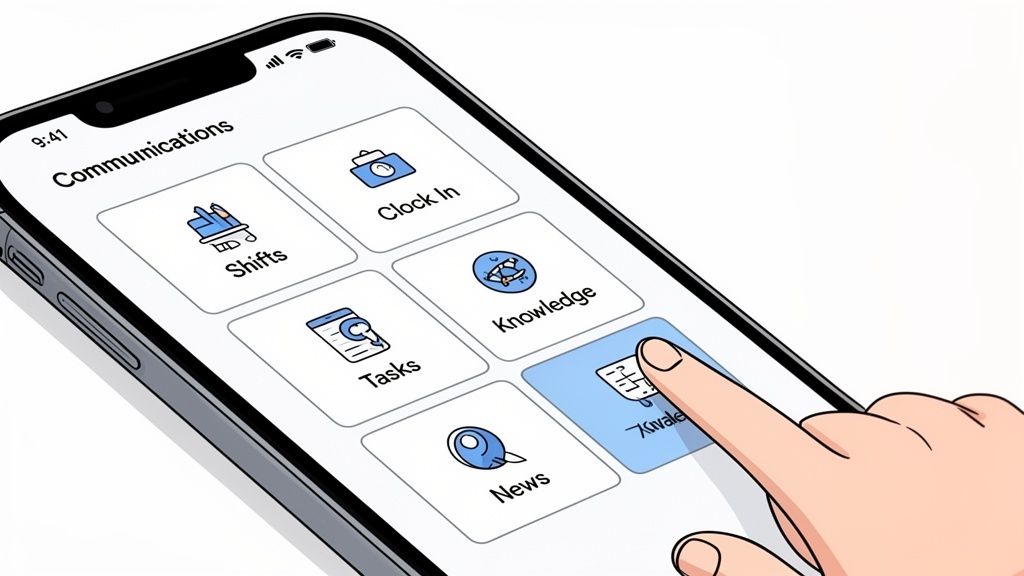
When you hear “communication app,” you probably think of chat. That makes sense. But honestly? That’s just scratching the surface. The real power of a true internal communications mobile app isn't just about talking; it's about doing.
The game changes when you weave operational tools right into the communication flow. It’s the difference between a simple messenger and a genuine work hub that lives in your team's pocket. This is about collapsing the stack of tools your team juggles every day. Not adding another app—replacing five of them.
From Conversation to Action
Picture the daily grind for a frontline team. A group chat about covering a shift can spiral into a messy trail of texts and calls. What if that chat could instantly become an action?
With an integrated system, a manager can adjust the schedule right there in the app, and the change is immediately visible to everyone. No more ambiguity. No more, "Did you see my text?" It's clear, official, and handled. This is where a communication tool evolves into an operational powerhouse. It stops being just a place to talk about work and becomes the place where work gets done.
The End of the Endless Search
Every company has that binder. Stuffed with outdated policies, safety procedures, and onboarding checklists. Or maybe it's a chaotic shared drive that’s impossible to navigate. A modern internal comms app ends that with a built-in, searchable knowledge library. Need the latest return policy? It’s right there, a quick search away on your phone.
This isn’t just about convenience; it’s about giving people what they need to do their jobs correctly and confidently. It's one of the biggest wins you can get.
No more asking a manager the same question for the tenth time. No more guessing. Just fast, accurate answers when they're needed. To see more on this, check out how asynchronous tools like a live feed and private clubs create seamless connection without constant interruptions.
A Unified Hub for Daily Operations
Let's pull back and look at the bigger picture. A really effective app combines multiple functions into one clean experience. This is where you move past basic messaging and start running your business more smoothly.
Here are a few core operational features that make all the difference:
Shift Management: Team members can see schedules, request swaps, and grab open shifts without leaving the app. This alone cuts down on a huge headache for managers.
Time Clocking: Clocking in and out from a personal device simplifies payroll and keeps time tracking accurate, especially for teams spread across multiple sites.
Task Management: A chat about a broken coffee machine can become an assigned task with a deadline. This closes the loop between spotting a problem and solving it.
PTO Requests: Employees can request time off and see approvals in the same place they get company news.
When all these functions live inside your communication app, you’re not just making things more efficient. You’re building a calmer, more organized team by putting the tools they need right in their hands.
How to Choose the Right App for Your People
The market for internal communication tools is a jungle. It’s packed with flashy feature lists and slick sales pitches, making it easy to get lost. So how do you pick the right tool for your people without getting overwhelmed?
It comes down to a few simple, human questions. Does this feel intuitive, or will everyone need a week of training? Can you roll it out this afternoon, or does it demand a six-month IT project? This is about cutting through the noise to find something your team will actually want to use.
Start with the Human Experience
Before you look at a feature list, think about the person you’re buying this for. Seriously. Picture a busy retail associate on the shop floor, a nurse moving between patient rooms, or a driver on their delivery route. What does their day really look like? They’re on their feet, busy, and only have a few moments to look at their phone. The app you choose has to respect that reality.
A great internal communications mobile app should feel as natural to use as the other apps they open every day. If it’s clunky, slow, or confusing, it will be ignored. Adoption isn’t about management mandates; it's about providing genuine value that makes their job easier.
Security and Trust Are Non-Negotiable
Let’s be honest. When you ask employees to download a company app, you’re asking for their trust. They need to know their data is safe and that company communication is happening in a secure, professional space—not bleeding into their personal messaging apps.
This is where enterprise-grade security is critical. You need a tool that offers:
Robust Data Encryption: To protect sensitive company and employee information.
Clear Roles and Permissions: To ensure the right people see the right information.
Compliance with Standards: Meeting regulations like GDPR isn’t an optional extra; it’s a fundamental requirement.
Without a solid security foundation, nothing else matters. It’s the bedrock of a connected company.
Look for Seamless Integrations
A new app shouldn't create more work; it should simplify it. The most useful tools don't live on an island—they connect smoothly with the systems you already rely on. Think about your core HR and payroll systems. The right app should plug into them, letting employees check pay stubs or request time off without logging into three different platforms.
The goal is to create one central hub, not another silo. An app that connects your existing tools quickly becomes indispensable.
This integrated approach is a big reason the global market for these apps is exploding. Valued at around $15 billion, it's projected to soar to $45 billion by 2033. This surge reflects a massive shift as businesses ditch fragmented tools for unified platforms. You can discover more about this market shift and see why it’s happening now.
Analytics That Actually Tell a Story
Finally, how will you know if your new tool is working? The answer isn’t just counting "active users." You need analytics that tell a story about engagement. Good analytics go beyond surface-level metrics. They help you understand what’s resonating. Which announcements get the most views? Are certain departments more engaged? Is that new safety protocol actually being read?
This isn’t about surveillance; it’s about insight. It helps you become a better communicator by showing you what your people care about. For more on what to look for, check out our guide on the top features every employee communication app should have.
Choosing the right app is less about technology and more about people. Find a tool that respects their time, protects their information, simplifies their work, and helps you understand them better. That’s the one they’ll use.
So, you’ve launched an internal communications app. What really changes? At first, it’s subtle. Then, it’s everything.
It’s the sound of silence where there used to be frantic phone calls. It’s opening an inbox that isn’t groaning under the weight of "reply all" chains. It’s seeing a new hire on the front line get up to speed and feel like part of the team from day one. Let’s be clear: this isn't just about new tech. It's a fundamental shift in your company culture.
More Than Just an App
Think about the relief a manager feels when a critical safety update is instantly seen and acknowledged by their entire team. Or the confidence you gain when everyone knows exactly where to find the latest, most accurate information—no more corporate games of telephone.
When information flows freely, trust builds with it. People stop guarding what they know and start sharing. Those invisible walls between departments begin to crumble because everyone can see how their work contributes to the bigger picture.
The goal isn't just to have a shiny new app. The real goal is to build a more connected, informed, and genuinely engaged team. The app is simply the vehicle that gets you there.
This is how a company evolves from a group of people working near each other into a unified team pulling in the same direction. It swaps confusion for clarity and anxiety for alignment. That's the quiet revolution. It doesn’t make a lot of noise, but its impact is massive.
As you think about your own team, ask yourself this: what could you accomplish if every single person was on the same page, moving in the same direction, all at once?
Common Questions About Internal Communication Apps
Thinking about overhauling how your team communicates is a big deal. It’s natural to have questions. Here are a few of the most common hurdles we see leaders grappling with when they consider a dedicated internal communications mobile app.
Will My Frontline Employees Actually Use This?
This is the most important question. A tool is only useful if people use it.
Here’s the reality: people will flock to a tool that genuinely makes their job easier. When an app becomes the single source of truth for things they need—like checking their schedule, accessing a pay stub, or getting an urgent safety alert—it becomes indispensable. It has to be the most convenient way to get vital information. Instead of forcing someone to log into a clunky desktop portal, a good mobile app feels as intuitive as the social media apps they use every day. Simple, fast, and in their pocket.
Isn't This Just Another Slack or Microsoft Teams?
Not at all. While tools like Slack and Microsoft Teams are fantastic for desk-based teams, they often create more noise than clarity for frontline workers. They can be too complex, too expensive for hundreds of employees, and frankly, they weren't built for the day-to-day reality of a busy retail store or warehouse.
A purpose-built internal communications app cuts through the clutter. It's designed for everyone, from the CEO down to the newest part-time hire. The focus is on a clean, simple interface that delivers critical information quickly and works seamlessly on a phone.
How Do We Measure Success With This App?
Success is more than just "daily active users." The real metrics are tied to your business operations.
Are new hires getting up to speed faster? Have you seen a drop in repetitive questions managers have to answer? Are your employee satisfaction and retention numbers climbing? Those are the indicators that matter. A solid app will give you straightforward analytics to see what content is resonating, but the true ROI is a calmer, more connected, and more efficient organization. That’s the real win.
Ready to replace the noise with a calmer, more connected way of working? At Pebb, we built the all-in-one app that brings your entire team together. See how it works.
