
Why Your Team Ignores Everything You Send (And How an App Fixes It)
Tired of disconnected teams? An employee engagement mobile app is the essential tool for unifying communication, culture, and operations. Here's why.
Dan Robin
Think of the last important message you sent to your entire team. An updated policy, a big company win, a change in schedule. How many people actually saw it? How many understood it? Be honest.
If you’re like most companies we talk to, the answer is a shrug. You send it out via email, post it on the intranet, or pin it to a corkboard, and then you hope. You hope people check their email. You hope they remember the intranet password. You hope they glance at the board on their way to the breakroom.
Hope isn't a strategy.
This isn’t about blaming your team. They’re busy. They’re overwhelmed. And for a huge part of your workforce—the people on the sales floor, in the warehouse, or out on the road—your current tools are basically invisible. They weren’t built for them.
And that’s the quiet crisis happening in most businesses. Not a lack of information, but a complete breakdown in connection.
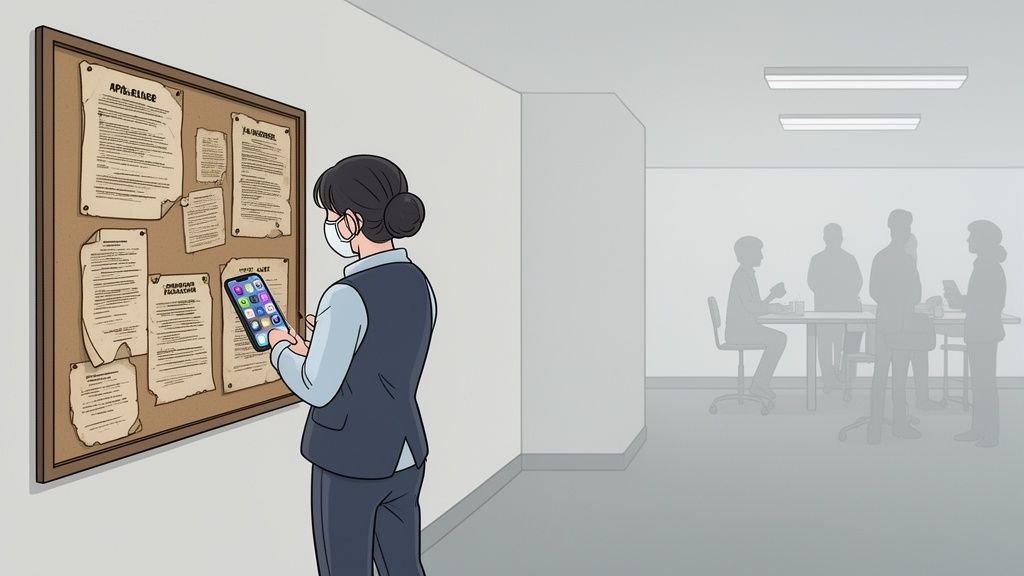
This is the problem an employee engagement mobile app is built to solve. Not with more features or notifications, but with a fundamentally better way to bring everyone together.
What is an employee engagement mobile app, really?
Let's cut through the corporate-speak. An employee engagement mobile app is a private, secure home for your company that lives on your team’s phones.
It’s not another piece of software you force people to use. It’s a single place where everything they need to do their job and feel connected actually lives. It’s where communication, tasks, schedules, and company culture finally click together.
Think of it less like a clunky intranet and more like a private social network designed for work. It’s built for conversation, not just corporate announcements.
The goal isn't to give management another megaphone. It’s to open up a two-way street where everyone has a voice—from the CEO to the newest hire on the frontline.
And this idea is catching on. Fast. The market for these tools is exploding, set to jump from $1.4 billion in 2023 to $4.3 billion by 2032. You can explore more on this market growth here. This isn’t just a trend; it's a signal that the old way of communicating is officially broken.
Here’s what this looks like in practice:
A town square. This is your main company feed. It’s where big news is shared, wins are celebrated, and everyone gets a sense of the bigger mission.
Dedicated rooms. These are focused spaces for specific teams, projects, or locations. The morning shift at one store can coordinate here. The marketing team can brainstorm in another. No more spamming the entire company.
A shared to-do list. Tasks aren’t separate from conversation. A manager can assign a task right in a chat, set a deadline, and see it through without switching apps.
A simple library. This is the one place for essential documents. Training manuals, HR policies, safety guides—all searchable and instantly available on a phone.
The whole idea is simple: give your team one place for everything they need. End the constant shuffle between WhatsApp, email, spreadsheets, and printed notices.
Let’s be honest. The old way of working is a mess. We’ve all tried to stitch together a dozen different tools that were never meant to work together. Our teams pay the price in confusion and lost time.
A modern employee engagement mobile app changes that. It’s the single place where an employee can check their shift, read a company update, finish a required training, and chat with a coworker. To see how these pieces fit together, you can explore a practical example like the lunabloomai app.
The difference is night and day.
From Disconnected Tools to One App
Area of Work | The Old Way | The New Way |
|---|---|---|
Communication | Key updates get lost in noisy WhatsApp groups, emails go unread by frontline staff, and official messages feel distant and cold. | All communication lives in one place. Dedicated channels and a central news feed ensure everyone gets the right message at the right time. |
Operations | Shift schedules are printed, daily tasks live on a whiteboard, and important files are buried in a shared drive nobody can find. | Schedules, tasks, and documents are instantly accessible in the app. A manager updates a shift, and the whole team knows immediately. |
Culture | Frontline and remote workers feel like outsiders. Recognition is rare, and there's no easy way for people to connect across departments. | A people directory helps everyone find and connect with colleagues. Celebrating wins in a central feed builds a real sense of community. |
This isn’t just about being more efficient. It’s about creating a calmer, more coherent work experience. It’s about giving your people a reliable center of gravity for their workday—one source of truth they can count on.
The Quiet ROI of a Connected Team
You won't see the benefits of a truly connected team in a flashy press release. They show up quietly, in the small, everyday moments that make a business healthier.
We’re not talking about a small bump in morale. We’re talking about real, measurable outcomes that come from giving your people a better way to communicate.
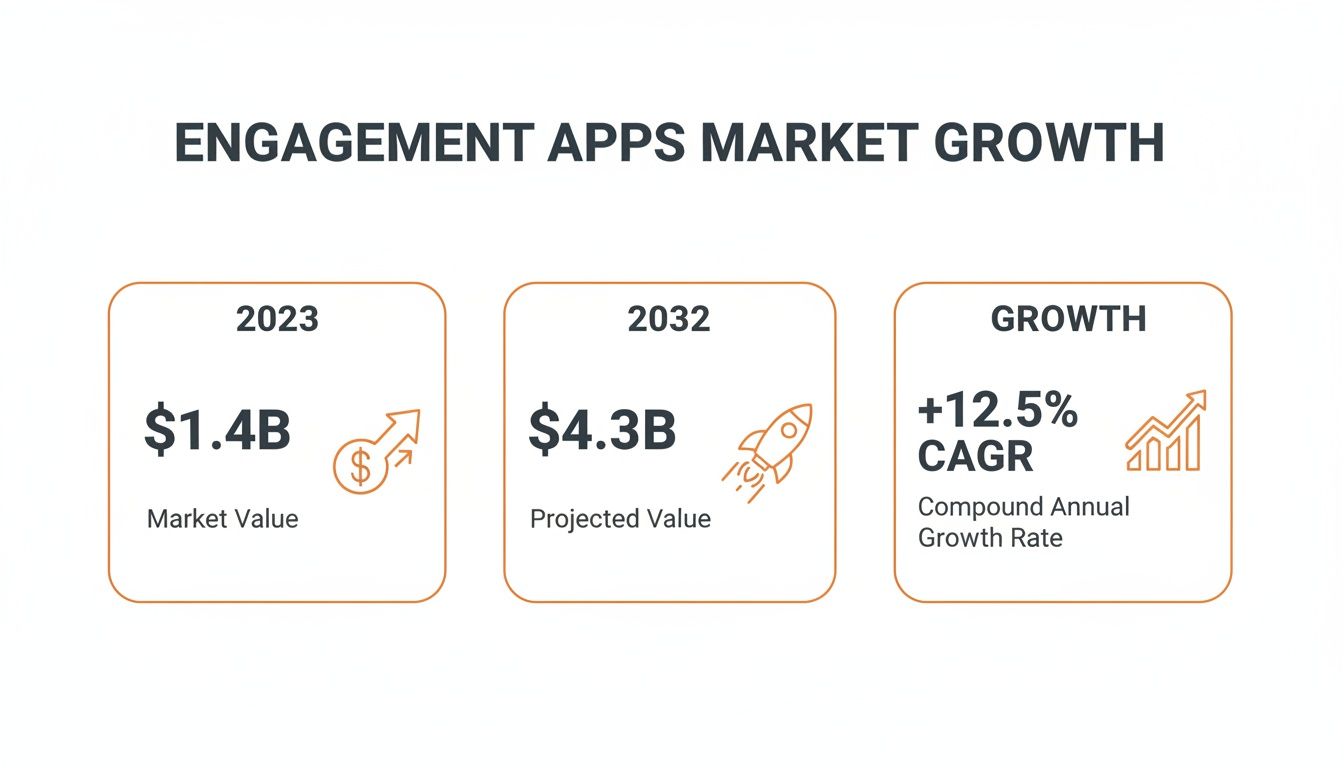
That kind of growth isn’t a fad. It’s a clear signal that companies are waking up to the real value these tools deliver.
Here’s where the return shows up.
First, you fix things that are obviously broken. Think of the hotel manager who spends an hour every morning frantically texting people to cover a sick call. Or the HR leader who sends a critical policy update via email and just hopes the frontline staff sees it.
These aren't minor headaches. They are daily drains on time and energy.
An employee engagement mobile app ends that friction. The manager posts an open shift and it’s claimed in minutes. The HR leader sees exactly who has read the announcement. These small wins add up.
When you make it easier for people to do their jobs, you're not just improving their day—you're improving the bottom line.
This is where the quiet ROI starts to get loud. A 2024 McKinsey study found that connected companies see a 20-25% increase in productivity. When people are informed, they work smarter. Then there’s absenteeism. Highly engaged teams see a staggering 41% drop in it. People who feel connected are more likely to show up. They feel like part of something. You can dig deeper into how to measure the ROI of internal communication in our guide.
But the biggest impact is on turnover. In industries like hospitality and healthcare, turnover is a constant, expensive battle. Hiring, onboarding, and training new staff is a massive financial drain.
Here’s the thing: people often don’t leave bad companies. They leave because of bad communication and feeling disconnected.
The data is clear. Top-quartile engaged teams achieve a 43% reduction in turnover. Think about what that number actually means for your business. It’s a huge saving in recruitment costs, training hours, and lost knowledge. You can read the full research about these findings here.
Investing in your people’s experience isn’t a soft perk. It’s one of the most direct investments you can make in the financial health of your company.
How to Choose an App That People Actually Use
Let’s be blunt: most employee engagement apps are terrible. They’re either clunky intranet software with a new coat of paint or glorified chat tools with a few features tacked on.
So, how do you find an app your team will actually open? The kind that becomes a natural part of their day, not another forgotten icon on their phone?
The secret isn’t a long feature list. It’s finding a tool that brings everything together in one simple, unified place.
Unify or Die
Think about how work actually happens. A conversation leads to a task. A question needs an answer from a document.
When these things live in different apps, you create friction. You force your team to constantly switch gears, bouncing between a chat app, a task manager, and a messy file-sharing system. This isn't just inefficient; it’s exhausting.
A great employee engagement mobile app erases that friction. It combines communication tools (chat, posts) with operational ones (tasks, schedules, documents). The idea is simple: work flows better when everything is in one place. You’re not just buying software; you’re buying back your team’s focus.
Spaces, Not Just Channels
A single, company-wide chat channel is a recipe for chaos. It quickly becomes a firehose of irrelevant information where important messages get buried instantly.
This is why dedicated ‘Spaces’ are essential. Think of them as digital rooms for specific teams, projects, or locations. The marketing team gets a Space for their campaigns. The downtown store gets its own Space for daily huddles. Inside each one, that group has everything it needs: its own chat, tasks, files, and schedule.
This structure keeps work organized and conversations relevant. It allows people to tune into what matters to them and ignore the noise.
The goal is to create a digital environment that mirrors how your company actually works—in focused, collaborative groups.
The Small Details That Matter
Beyond the big picture, a few details separate a good app from a great one. These are the things that decide whether the tool feels helpful or like a hassle.
A Clean Interface: If the app is ugly or confusing, people won’t use it. Period. It should feel as easy as the apps they use in their personal lives. Simplicity wins.
Powerful Search: Time is your team's most valuable asset. When someone needs to find an HR policy from last month, they need to find it in seconds. A reliable search function is non-negotiable.
A Real People Directory: This needs to be more than a list of names. A great directory helps people put a face to a name and understand roles, turning a big organization into a community.
Smart Admin Controls: You need control without creating a bureaucratic nightmare. The right app makes it easy to manage permissions so the right people see the right information.
Choosing the right tool isn’t about ticking boxes on a comparison sheet. It’s about finding a simple, unified platform your team will actually enjoy using. We've written more on the top 10 features every employee communication app should have if you want to dig deeper.
Where a Mobile App Changes Everything
The real power of an app isn't its feature list. It's how it shows up in the moments where the old ways of working fall apart.
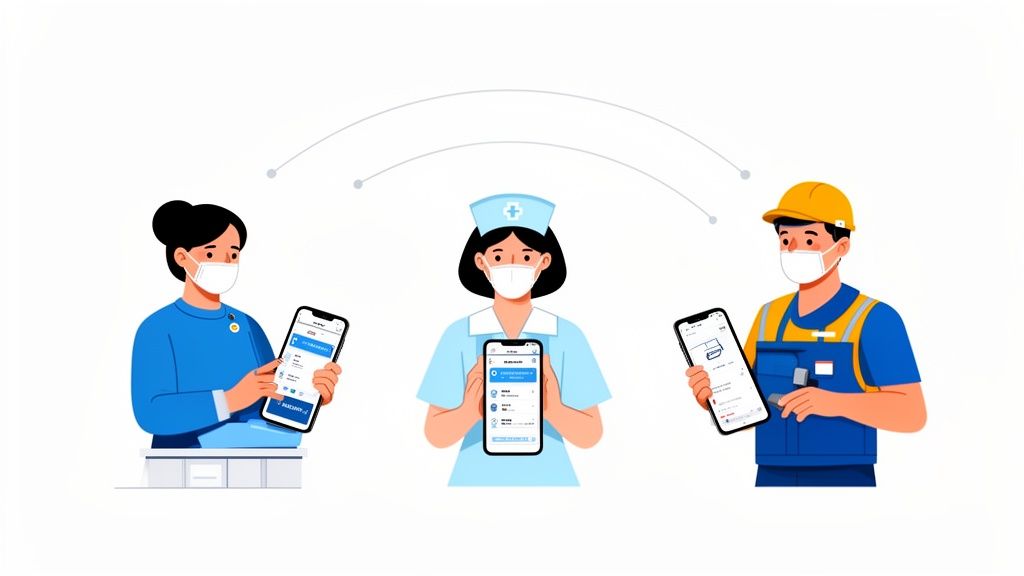
For a desk worker glued to a laptop, a mobile app might be a nice-to-have. But for everyone else? It’s a lifeline.
For the Frontline Team
Imagine a busy retail store on a Saturday. The manager gets a last-minute text: the morning cashier is sick. Before, this meant an hour of frantic phone calls, hoping someone would pick up.
With an employee engagement mobile app, the manager posts the open shift in the store's channel. A push notification goes out. Within minutes, someone who wants the extra hours claims it. Problem solved. No chaos.
This is critical when you consider that a staggering 52% of frontline workers are thinking about quitting over bad technology.
For the Distributed Company
Picture a fully remote company. The biggest threat isn't productivity; it's the slow drift into isolation. The company culture dissolves into a series of back-to-back video calls.
Here, the app is the digital glue. It’s the virtual watercooler where people share project wins, celebrate birthdays, and connect as humans. It’s how a new hire in another country can feel like part of a team, not just an email address. For more on this, check out our guide on the benefits of mobile apps for frontline employee communication.
An app can transform a disconnected group of individuals into a real culture. Distance doesn't have to mean disconnection.
For the Small Business Drowning in Chaos
If you've run a small business, you know the drill. Personal WhatsApp for team messages, messy spreadsheets for schedules, a dozen email chains for everything else. It’s exhausting.
An employee engagement app gives you your sanity back. All communication, schedules, and documents live in one clean place. You can post an update and know everyone saw it. It’s about graduating from amateur hour to a professional operation.
For the Enterprise Escaping Old Tech
Finally, think about a large company stuck with an ancient intranet nobody has used since 2015. It’s clunky, impossible to use on a phone, and completely out of touch.
For them, a modern mobile app is a breath of fresh air. It has the security and controls they need, but with a user experience people actually want to use. It’s how they can finally connect thousands of employees on a single platform.
In every case, the story is the same: the right tool solves a real, painful problem, making work simpler and more human.
It’s About People, Not Technology
We’ve talked a lot about features and benefits. But let’s end with the most important part.
Introducing an employee engagement mobile app isn't a tech project. It's a people project.
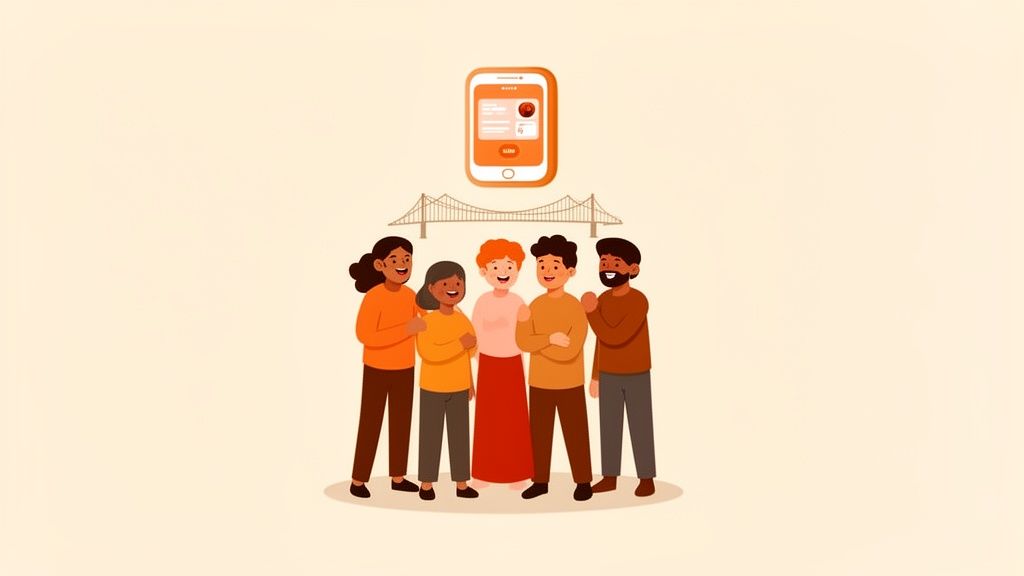
At its heart, launching an app like this is a statement. It’s a promise of transparency, clarity, and connection. It tells every single person that they matter. The app is just the vehicle.
We've all seen companies buy shiny, expensive software, hoping it will magically fix a broken culture. But a tool can't manufacture trust.
Here’s the truth: the app itself doesn't create engagement. It creates the space for engagement to happen. It tears down the barriers that keep people apart. It makes it easy for a manager to give a public shout-out and for the team to celebrate. It makes sure crucial updates get to everyone, not just those at a desk.
The technology is an invitation. It’s an open door to a new way of working. Your leaders and your team have to choose to walk through it.
This is where the human element is everything. The most successful launches we’ve seen are always led by people who get this. They don't just talk about features; they talk about what those features unlock for their team.
So take a step back and think about what you're really trying to build. A place where people just punch the clock? Or a community where everyone feels seen, supported, and connected to a purpose?
If it’s the latter, it’s time to stop patching broken systems. It’s time to build a real foundation.
It’s an invitation to build a culture that lasts, where technology serves your people—not the other way around.
So, what will you build?
Frequently Asked Questions
We get a lot of questions about making the switch. Most aren't about the tech, but about the real-world stuff: How do we get people to use it? And what does it cost?
Here are a few honest answers.
How do we get our team to actually use it?
This is the most important question, and it has nothing to do with features. Adoption comes down to solving a real, painful problem from day one.
Don't launch with a vague "let's connect!" message. Pinpoint the single biggest communication headache your frontline team has. Is it the chaotic scramble to swap shifts? Is it that crucial updates are buried in emails they never see?
Whatever that pain point is, make the app the only place to solve it. When your team sees the app as the fastest way to claim an open shift, they’ll jump on board. It stops being another corporate tool and becomes something that makes their day easier.
Your launch isn’t about the app. It’s about the job you’re helping your team do. Solve a real problem, and adoption will take care of itself.
What does an employee engagement app cost?
The honest answer? It varies. Pricing usually depends on how many employees you have and which tools you need. It might be a few dollars per user per month.
But that's the wrong question. Instead of asking what the app costs, ask what your current chaos is costing you.
How much time do your managers waste chasing down staff on personal apps? What's the price of one missed safety update? How much does it cost to replace an employee who leaves because they felt out of the loop?
When you look at it that way, a good employee engagement mobile app isn’t an expense. It's an investment in a calmer, more efficient operation. The cost of the app is tiny compared to the high price of disconnect.
Ready to build a calmer, more connected place to work? With Pebb, you can bring communication, operations, and engagement together in one simple app. See how Pebb can connect your people today.
