
10 Remote Employee Engagement Ideas We Actually Use
Tired of virtual pizza parties? Here are 10 real remote employee engagement ideas that build culture, not just fill calendars. Learn how to do it right.
Dan Robin
Most “engagement” initiatives feel like a chore. We’ve all been there. The forced Zoom happy hour. The awkward virtual trivia night. The well-intentioned survey that vanishes into a black hole. For years, companies treated remote work like a temporary bug to be patched with digital band-aids. But remote work was never the problem. Our old ideas about what it means to connect were.
True engagement isn't something you schedule. It’s the natural result of a calm, transparent, and respectful workplace. It’s a byproduct of trust, not a goal in itself. We learned this the hard way while building our own remote company. Engagement isn’t manufactured with an event; it's what happens when people feel seen, heard, and trusted to do their best work without someone looking over their shoulder.
So, this isn't another list of trendy tricks. It's a collection of fundamental shifts in how a company can operate. These are the remote employee engagement ideas that actually stick because they’re baked into the work itself, not sprinkled on top as an afterthought.
Inside, you'll find our approach to everything from peer recognition that feels genuine to building career paths that keep good people around. We’ll talk about fostering real connection through clear communication, supporting wellness without being intrusive, and using feedback to make meaningful change. This is a practical guide for people who want to build a truly engaged remote team, not just a busier one. Let's dig in.
1. Virtual Team Building Events and Social Spaces
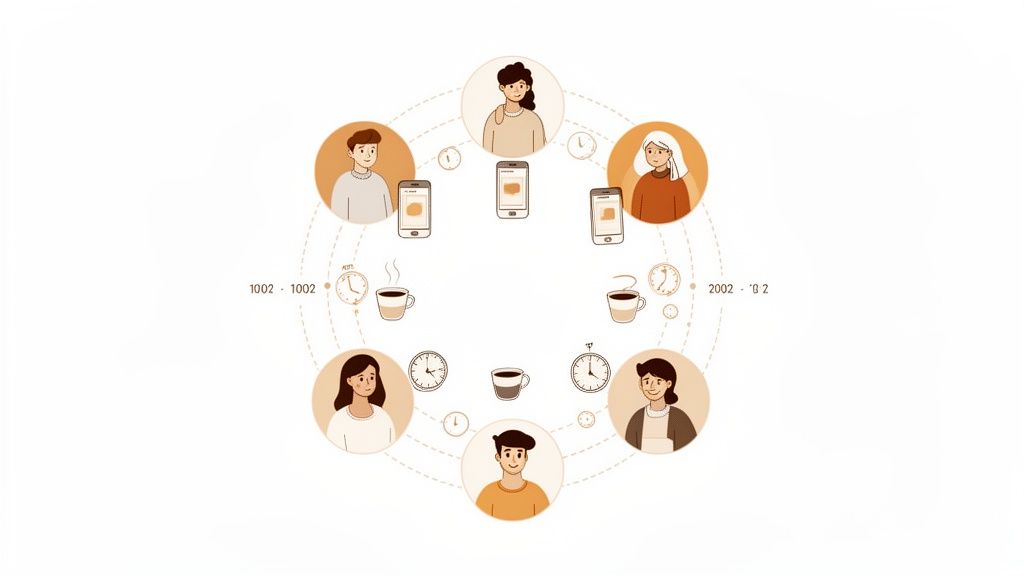
In an office, connection happens by accident. You bump into someone in the kitchen. You catch up by the coffee machine. When you go remote, those spontaneous moments disappear. Recreating them is a challenge, but it's far from impossible. This is where you have to be intentional about creating virtual social spaces.
The goal isn't to force fun; it's to create the opportunity for it. It's about carving out digital "breakrooms" where people can connect as people, not just as colleagues on a project. These non-work interactions build the trust and camaraderie that fuel better work later. Structured and unstructured social time is a powerful idea for remote employee engagement because it directly fights the isolation that can creep into a distributed team.
How to Make It Happen
Let's be honest: another mandatory Zoom happy hour sounds exhausting. The key is to offer variety and make participation optional and low-effort.
A simple start is to create dedicated channels for non-work chat. We use a feature called Spaces inside Pebb to set up channels completely separate from work. For example, we have a #pets Space for sharing photos of furry coworkers and a #good-reads Space for book recommendations. These interest-based groups give people a low-pressure way to connect over shared hobbies.
For more structured events, try mixing things up:
Virtual Coffee Roulette: Use an app to randomly pair two or three people for a 15-minute, non-work chat each week. No agenda. Just talk.
Team Celebrations: Spend the first 10 minutes of a team meeting celebrating personal and professional wins. Birthdays, work anniversaries, or major project milestones all count.
Asynchronous Games: Post a weekly riddle or a "two truths and a lie" prompt in a social channel. This lets people across time zones join in when it suits them.
2. Recognition and Peer Appreciation Programs
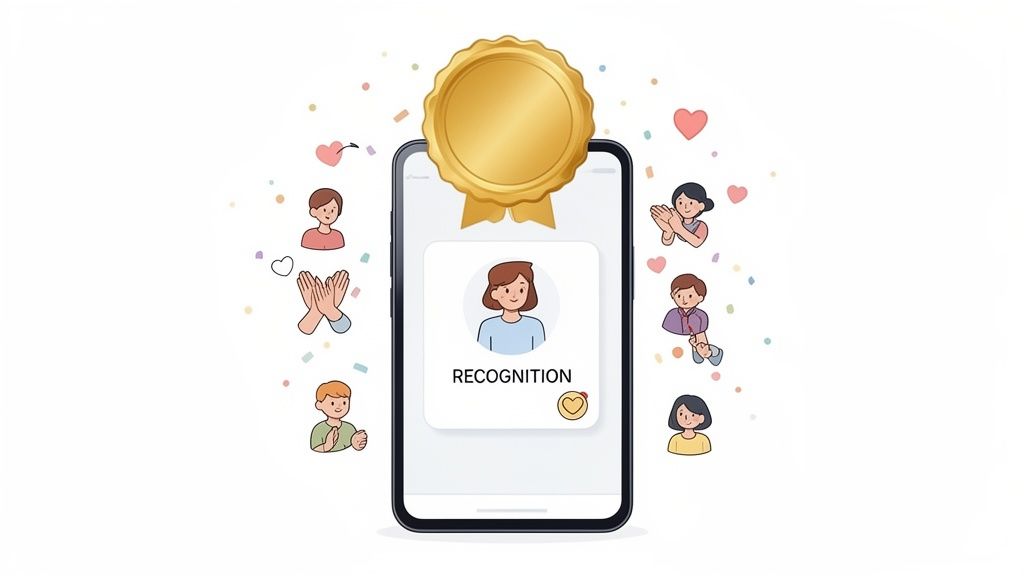
In a remote company, great work can happen in silence. Without the ambient awareness of an office, a colleague’s huge effort can go completely unnoticed. This is where a formal recognition program stops being a "nice-to-have" and becomes a critical tool for visibility and morale. It’s about building a system that makes gratitude a visible, everyday part of your culture.
The point is to make it easy for praise to flow in every direction—not just from the top down, but from peer to peer. When people feel seen and valued by their colleagues, it strengthens team bonds and fights the disconnect that's common in remote work. A good recognition program is one of the most effective remote employee engagement ideas because it creates a positive feedback loop that reinforces an individual's sense of contribution.
How to Make It Happen
A successful program isn't about grand, infrequent gestures. It’s about small, consistent moments of appreciation. The key is to embed recognition into the tools your team already uses.
We built recognition directly into Pebb’s main news feed. This creates a public "heartbeat" of praise that everyone can see. It makes giving a shout-out as simple as posting an update. For those who want more structure, dedicated platforms like Bonusly can also work well. For more inspiration, you can explore these 10 simple recognition program ideas for remote teams.
Here’s how to get a program started:
Tie Recognition to Values: Create specific hashtags for recognition that align with your company values (e.g., #CustomerObsession, #ThinkBig). This reinforces the behaviors you actually want to see.
Empower Everyone: Give every employee a monthly allowance of points to award to their peers. This democratizes recognition so it flows everywhere.
Celebrate the Wins: Dedicate a few minutes in company meetings to highlight top recognitions. This amplifies their impact.
Make It Mobile: For frontline or deskless workers, any system has to be mobile-first. Praise should be easy to give in the moment, from a phone.
3. Transparent Communication and Company Updates Hub
When you work remotely, you can't rely on office chatter to keep everyone in the loop. The casual hallway chat where a manager shares a small company win is gone. This information gap quickly leads to uncertainty and disconnect. A single source of truth for company news isn't just nice to have; it's the foundation of trust.
The point isn't just to broadcast announcements; it's to create a transparent, two-way street for information. This is your digital town hall, where everyone from an executive to a new hire can access the same official information at the same time. Having a central hub is a critical remote employee engagement idea because it kills the fear of being left out and shows you respect everyone enough to keep them informed.
How to Make It Happen
The key is to make your updates hub reliable and effortless to access. If people have to hunt through emails or chat threads, they won't. It needs to be the one place they know they can always turn to for official news.
We built our Heartbeat news feed in Pebb to solve this problem. It’s the company’s primary communication channel, a central feed where leadership posts updates. For permanent information, our Knowledge Library holds essential documents like company policies.
Here’s how to put this into practice:
Create a Central Channel: Dedicate one specific channel, like a
#company-newsfeed, exclusively for official updates. This stops crucial information from getting lost in project chatter.Use Rich Media: Don't just post text. A short video from a leader explaining a strategic shift feels far more personal than a formal memo.
Encourage Dialogue: Allow comments and reactions on announcements. This gives employees a voice and leadership a real-time pulse on how messages land. For more guidance, see how to make company-wide announcements in a remote setting.
Post a Monthly Summary: Create a recurring post or video that summarizes the month's key updates and wins. This helps people catch up on what they might have missed.
4. Professional Development and Learning Pathways
Investing in your team's growth is a powerful statement. It says you see a future for them at your company. When people feel stagnant, they start looking elsewhere. For remote teams, this feeling is amplified. Offering structured opportunities for development shows you're committed to their long-term success, which is one of the most effective remote employee engagement ideas you can have.
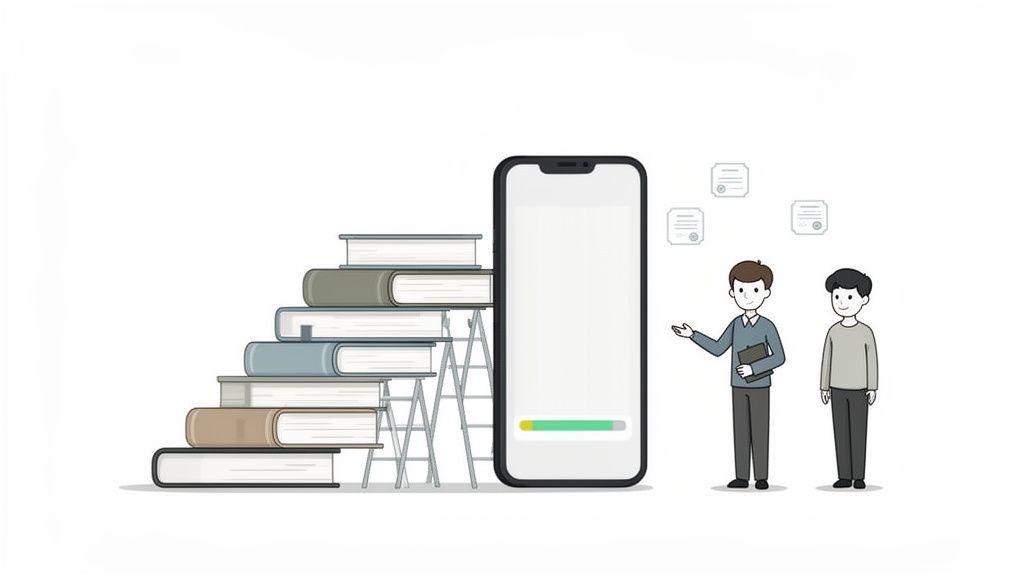
The goal is to make learning accessible and relevant. It’s about more than an annual training budget; it's about weaving skill-building into the flow of work. Think of it as creating a clear path forward for every employee, no matter where they are. This directly fights the "out of sight, out of mind" fear that can demotivate remote workers and proves that career advancement is a priority for everyone, not just those at headquarters.
How to Make It Happen
A dusty, unused learning portal doesn’t help anyone. The key is to embed learning into the tools your team already uses and celebrate their progress.
We suggest creating a dedicated Learning & Development Space right inside your main communication tool. This acts as a central hub for sharing resources and creating skill-specific study groups. For instance, a group for aspiring managers can work through a leadership curriculum together. This turns solitary learning into a collaborative activity.
For a more structured approach, try these ideas:
Establish Mentorship Pairs: Use a company directory to help employees find mentors outside their direct team. This cross-departmental connection fosters new skills and strengthens internal networks.
Share Microlearning Content: Post short, 5- to 15-minute videos or articles in the main news feed. This lets frontline workers learn on the go, during a break, or between tasks.
Celebrate Learning Milestones: When an employee completes a certification, celebrate it publicly. A shout-out in a recognition channel reinforces the value your company places on growth.
5. Manager-Led One-on-One Meetings and Check-Ins
For remote teams, the manager-employee relationship is the single most important driver of engagement. The one-on-one meeting is no longer a routine check-in; it's a foundational pillar of connection and trust. It’s the primary channel for understanding an employee's wellbeing, career goals, and sense of belonging.
These conversations are where company culture becomes an individual's daily reality. It’s the manager's chance to listen, unblock challenges, and connect on a human level. Neglecting this ritual is one of the fastest ways for a remote employee to feel isolated. That’s why prioritizing consistent, high-quality one-on-ones is one of the most impactful remote employee engagement ideas.
How to Make It Happen
The best one-on-ones feel less like a status report and more like a coaching session. They require intention. Success isn’t about having the meeting on the calendar, but about the quality of the conversation.
We encourage managers to use a shared agenda and our integrated Knowledge Library to keep continuous notes. This creates a running history of conversations and goals, so important topics don't fall through the cracks.
Here are a few ways to make your one-on-ones more effective:
Establish a Consistent Cadence: Schedule these meetings weekly or bi-weekly. This consistency makes them a reliable part of the work week.
Focus on the Person, Not Just the Project: Dedicate time to non-work topics. Ask open-ended questions like, "How are you, really?" This builds rapport.
Track Action Items: Use a tool like Pebb's task feature to capture action items that come out of the conversation. This ensures both parties are accountable.
Train Your Managers: Don't assume managers know how to run a great one-on-one. Provide training on active listening and giving constructive feedback. Create a dedicated Space where they can share best practices.
6. Inclusive Workplace Policies and Employee Resource Groups (ERGs)
Real engagement isn't about fun events. It's about feeling seen, valued, and safe to be your authentic self at work. For remote teams, where physical cues are absent, creating this sense of belonging requires deliberate effort. This is where Employee Resource Groups (ERGs) and transparent, inclusive policies become a fundamental part of your strategy.
The goal is to build an environment where diversity is actively included and celebrated. ERGs give employees with shared identities a way to connect, support one another, and be heard by leadership. Paired with clear, equitable policies, they are powerful remote employee engagement ideas because they prove your commitment to inclusion is more than just talk.
How to Make It Happen
Launching ERGs isn't just about creating new chat channels. Success depends on genuine support, resources, and executive buy-in. It's about empowering employees to build their own communities.
A good way to start is by surveying employees to see what groups they want. From there, create dedicated and private Spaces inside Pebb for each ERG, like a "Parents & Caregivers" group or a "Women in Tech" network. This gives them a secure home for conversations and resource sharing.
For a thriving ERG program, consider these steps:
Secure Executive Sponsorship: Assign a leader to champion each ERG. Their role is to provide a budget and advocate for the group's needs.
Document Policies Clearly: Your stance on DEI, flexible work, and parental leave shouldn't be a mystery. House these policies in a central Knowledge Library so they are transparent and accessible.
Host Regular Events: Encourage ERGs to host virtual meetups or guest speaker sessions. These events build community. For more ideas, check out these DEI activities for remote teams.
Celebrate Cultural Moments: Use company-wide channels to recognize cultural holidays, often led by the relevant ERGs. This promotes education and allyship.
7. Real-Time Feedback and Pulse Survey Programs
The annual employee survey is a relic. In a remote environment, waiting a year to check in with your team is like navigating with an outdated map. Small issues can become major problems by the time they surface. That's why real-time feedback and pulse surveys are essential remote employee engagement ideas.
The purpose isn't to constantly poll your team into survey fatigue. It’s about creating a consistent, low-friction channel for communication that flows both ways. It signals that their voice matters right now, not just once a year. This continuous listening allows leaders to spot trends, address frustrations before they fester, and show the team that their input leads to real change.
How to Make It Happen
The key to a good pulse program is making it quick, consistent, and actionable. If surveys are too long or the feedback disappears into a black hole, people will stop participating.
We use our own analytics inside Pebb to send out short, targeted pulse surveys. For instance, after a big project launch, we might send a two-question survey to the team asking about process effectiveness. Exploring other innovative employee survey solutions can also offer precise insights. The goal is to gather specific, timely data.
To get started with your own program:
Keep It Short and Sweet: Limit your surveys to 2-5 questions. This dramatically increases completion rates because it takes less than a minute.
Establish a Rhythm: Consistency is key. Send surveys at a predictable interval, whether it's a weekly one-question check-in or a bi-weekly survey on a specific theme.
Share the Results and Act: This is the most critical step. Share high-level findings with the team and communicate a clear action plan. When people see their suggestions leading to real improvements, they become more invested.
8. Flexible Work Arrangements and Work-Life Balance Policies
One of the biggest promises of remote work is freedom, but that promise is often lost in a culture of constant availability. True engagement isn't about being online 24/7. It's about trusting your team to deliver great work while living full lives. This is where explicit policies around flexibility become a powerful employee engagement idea.
The goal is to move from an assumption of flexibility to a documented reality. It's about giving employees the autonomy to manage their own time and energy without fearing they'll be seen as less committed. When you give people this trust, you’re not just improving their wellbeing; you’re showing them they are valued as whole people, which is a massive driver of loyalty.
How to Make It Happen
This isn't just about saying "we're flexible." It requires clear guardrails to make it work. Your policies must be visible, accessible, and consistently modeled by leaders.
First, document your approach. Create a clear "Work-Life Balance Policy" and put it in a central place like Pebb’s Knowledge Library. This document should set expectations around response times, like a 24-hour window for non-urgent messages, and define company-wide "no-meeting" blocks to protect deep work time.
Here’s how to put those policies into practice:
Normalize Time Off: Don't just track PTO; celebrate it. Encourage people to use their vacation and have leaders model this by completely disconnecting when they are away.
Use Status and Scheduling Tools: Encourage the team to use status features and do-not-disturb settings in Pebb to signal their availability. For shift-based teams, enabling shift trading gives frontline workers autonomy over their schedules.
Set Asynchronous-First Expectations: Shift the culture to value thoughtful, asynchronous communication over immediate responses. This respects different time zones and reduces the pressure to be constantly online.
9. Internal Mobility and Career Pathways Programs
One of the most powerful remote employee engagement ideas is showing your team they have a future with you, not just a present. When people can’t see a clear path forward, they start looking for one elsewhere. A structured internal mobility program solves this by making growth a visible and accessible part of your culture.
The goal isn't just to fill open roles; it's to invest in the people you already have. It communicates that you believe in their potential and are committed to helping them build a career, not just hold a job. This approach transforms employees into long-term partners. It proves that career growth doesn't require finding a new company.
How to Make It Happen
A successful internal mobility program is more than an internal job board. It requires a culture of development and transparency. The key is to make pathways clear and remove the friction that discourages internal applicants.
A great first step is creating a dedicated space for career development. You could launch a 'Careers' Space in Pebb to share new job openings, highlight career-pathing resources, and post success stories of internal promotions. This makes opportunities impossible to miss.
To build a robust program, focus on these steps:
Host Regular Career Conversations: Use one-on-one meetings to guide managers in discussing career goals, moving beyond simple performance reviews.
Showcase Success Stories: When someone is promoted or moves to a new role internally, celebrate it publicly. Share their story in a company-wide channel to inspire others.
Create Cross-Functional Projects: Offer people chances to work on short-term projects outside their core roles. This is a low-risk way to develop new skills.
Simplify the Application Process: Remove unnecessary barriers for internal candidates. Streamline the process to encourage them to apply without fear.
10. Wellness and Mental Health Support Programs
Supporting your team’s well-being goes far beyond health insurance. In a remote setting, the lines between work and home blur, making burnout a real threat. A genuine commitment to wellness means providing accessible resources that support the whole person. It’s about building a culture where mental health is prioritized and discussed openly.
The goal isn't just to check a box on a benefits list; it's to create a safety net. When people feel their employer genuinely cares about their well-being, they feel more secure and valued. This proactive approach is one of the most impactful remote employee engagement ideas because it addresses the root causes of disengagement, like stress and isolation. It shows you see your team as people first.
How to Make It Happen
Simply sending an email about an Employee Assistance Program (EAP) once a year is not enough. Effective wellness support needs to be visible, accessible, and part of your daily culture. The key is to normalize the conversation and make resources easy to find without stigma.
Start by centralizing your resources. We recommend creating a dedicated Wellness Space in Pebb where people can find everything from EAP contacts to meditation guides. It can become a community hub for sharing tips and supporting one another.
For a more comprehensive program, try these initiatives:
Normalize Mental Health Days: Explicitly include "mental health days" in your time-off policy and have leaders model this behavior. It signals that it's okay to recharge.
Offer Subscription-Based Tools: Partner with services like Headspace or Calm to provide free premium access for all employees. People can use these apps privately.
Run Wellness Challenges: Host a monthly step challenge or a "screen-free evening" prompt in your Wellness Space. Make it a fun, low-pressure way to focus on healthy habits together.
Train Your Managers: Equip managers to recognize early signs of burnout and have supportive, confidential conversations with their team members.
10 Remote Employee Engagement Ideas Compared
Initiative | Implementation Complexity 🔄 | Resource Requirements ⚡ | Expected Outcomes ⭐📊 | Ideal Use Cases 📊 | Key Advantages 💡 |
|---|---|---|---|---|---|
Virtual Team Building Events and Social Spaces | Low–Medium 🔄 — simple setup, needs ongoing facilitation | Low ⚡ — minimal budget, some coordinator time | ⭐⭐⭐ — boosts morale & belonging; participation varies 📊 | Distributed/frontline teams, onboarding, morale boosts | Builds cross‑team relationships, low cost, asynchronous options 💡 |
Recognition and Peer Appreciation Programs | Medium 🔄 — platform & governance required | Low–Medium ⚡ — platform fees + small rewards budget | ⭐⭐⭐⭐ — increases satisfaction & retention; reinforces behavior 📊 | All shift types; frontline visibility; value reinforcement | Real‑time visibility, high ROI, reinforces company values 💡 |
Transparent Communication & Company Updates Hub | Medium 🔄 — cadence, multi‑language, curation | Medium ⚡ — content production, translation resources | ⭐⭐⭐⭐ — improves trust, reduces misinformation; inclusion 📊 | Company‑wide announcements, compliance, distributed orgs | Reduces information gaps, searchable archive, leadership visibility 💡 |
Professional Development & Learning Pathways | Medium–High 🔄 — content curation + integrations | High ⚡ — content creation, subscriptions, admin time | ⭐⭐⭐⭐ — improves retention & skills long‑term; ROI slower 📊 | Upskilling frontline, succession planning, career growth | Builds internal talent pipeline, addresses equity, measurable growth 💡 |
Manager‑Led One‑on‑One Meetings & Check‑Ins | Low–Medium 🔄 — scheduling + manager training | Medium ⚡ — manager time, training resources | ⭐⭐⭐⭐⭐ — strong impact on engagement, retention, wellbeing 📊 | Ongoing performance, wellbeing checks, remote teams | Detects disengagement early, builds trust, aligns goals 💡 |
Inclusive Policies & Employee Resource Groups (ERGs) | Medium–High 🔄 — policy work + sponsorship | Medium–High ⚡ — budget, leadership time, facilitation | ⭐⭐⭐⭐ — increases belonging & retention for under‑represented groups 📊 | DEI initiatives, global orgs, retention of diverse talent | Drives inclusion, improves recruitment, peer support networks 💡 |
Real‑Time Feedback & Pulse Survey Programs | Medium 🔄 — survey design, cadence, action planning | Low–Medium ⚡ — tools + analytics time | ⭐⭐⭐⭐ — early warning signals; data‑driven improvements 📊 | Culture monitoring, crisis response, continuous improvement | Fast insights, trend tracking, targeted interventions 💡 |
Flexible Work Arrangements & Work‑Life Policies | Medium–High 🔄 — policy + cultural change | Medium ⚡ — systems, manager training, scheduling tools | ⭐⭐⭐⭐ — reduces burnout, improves retention & productivity 📊 | Roles needing autonomy, caregivers, shift workers | Increases retention, wellbeing, attracts diverse talent 💡 |
Internal Mobility & Career Pathways Programs | High 🔄 — systems, transparency, talent processes | High ⚡ — talent infra, training, coordination | ⭐⭐⭐⭐ — boosts retention, internal hiring, leadership bench 📊 | Growth‑oriented orgs, succession planning, frontline careering | Reduces hiring costs, builds leadership, promotes fairness 💡 |
Wellness & Mental Health Support Programs | Medium–High 🔄 — provider partnerships, privacy safeguards | High ⚡ — program costs, EAPs, confidentiality systems | ⭐⭐⭐⭐ — improves wellbeing, reduces absenteeism & burnout 📊 | High‑stress roles (healthcare, hospitality), burnout prevention | Prevents burnout, supports whole‑employee wellbeing, reduces costs 💡 |
Engagement Isn’t a Program. It's a Principle.
We’ve just walked through ten distinct areas. But if you see this list as a menu of programs to launch, you’ve already missed the point. You can't schedule your way to a great culture.
The real takeaway isn't about buying another tool. It’s about a fundamental shift in mindset. Engagement isn't a project with a start and end date. It's the natural outcome of a company that operates on principles of trust, transparency, and respect. It's the hum of a well-run machine, not the siren of an emergency.
If you treat people like adults, give them the information they need, and trust them to get the work done, they will be engaged. It's almost that simple. The ideas in this article aren't flashy "engagement hacks." They are simply the structures that bring those core principles to life. They are the plumbing that carries trust and information through the organization.
Where to Start? Don't Boil the Ocean.
Looking at this list can feel overwhelming. The temptation is to do everything at once. That approach almost always leads to burnout and lackluster results.
Instead, pick one. Just one.
Find the biggest crack in your foundation right now.
Is communication a black hole? Start with a transparent company updates hub.
Are your best people quietly leaving? Focus on creating real career pathways.
Does everyone seem exhausted? Double down on wellness support and flexible work policies.
The goal isn't to check off all ten boxes. It’s to make one meaningful, sustainable change. Do it well. Nurture it. Once it’s working, move on to the next crack. This is how you build something that lasts. These aren’t just remote employee engagement ideas; they are pillars for a healthy workplace. For more practical strategies, explore these additional employee engagement ideas for remote workers.
The Real Goal: A Calm Company
Ultimately, we aren't chasing a metric on an HR dashboard. We're building a place where people can do their best work without chaos. A calm company. A place where employees feel seen, heard, and valued—not because of a program, but because it's how the business operates every day.
When you get that right, engagement isn't something you have to manufacture. It's just what happens. People become proud of where they work, whether they’re at a home desk a thousand miles away or helping a customer on the frontline. The rest just follows.
Tired of juggling a dozen tools to keep your remote team connected? Pebb brings everything your team needs—communication, recognition, scheduling, and feedback—into one simple, calm platform. Stop chasing engagement and start building a better place to work at Pebb.
