
How We Talk When We’re Working
Learn to define communication process with practical steps and real-world examples to boost team clarity and connectivity.
Dan Robin
We’ve all been there. That sinking feeling when a project veers off course because of a simple miscommunication. An urgent update gets lost in an email thread nobody saw. A Slack message lands with the wrong tone, derailing a developer for half a day.
These aren't just isolated screw-ups. They’re symptoms of a bigger problem: we don’t really think about how we talk at work. We just open our mouths (or our keyboards) and hope the right message finds the right person at the right time.
It rarely does.
The biggest mistake we make is assuming communication just happens. It doesn’t. Clarity is a choice. It’s designed.
Let's be honest. Most guides on this topic are dry and academic. This isn't one of them. We’re not here to talk theory. We’re here to talk about untangling the messy wires of how teams actually talk to each other.
Why This Matters
Defining a communication process isn’t about making rules for the sake of rules. It’s about drawing a map so everyone knows how to get from point A to point B. When your team has a shared understanding of how, when, and where to share information, the guesswork disappears. So does the low-grade anxiety that drains so much of our energy.
This is what separates teams that click from those stuck in an endless loop of "circling back" and "just to clarify." It’s the foundation for a company where people feel heard, understood, and connected—no matter where they are.
What Is the Communication Process, Really?
Think of communication as a simple game of catch. One person has an idea—the ball—and throws it. Someone else, hopefully, catches it. Simple enough. But in the workplace, that ball gets dropped. A lot.
We rarely stop to examine the mechanics of the throw and catch until a project is on fire. But to get better, we have to. The communication process isn't just about a sender and a receiver. It’s a delicate loop, and it’s surprisingly easy to break.
This isn’t just theory; it’s the engine of our work. A 2023 study found that people spend a staggering 72% of their week communicating. With that much time on the line, getting it right is everything. You can dig deeper into how modern tools are shaping this in this report on workplace communication.
The Seven Parts of Every Conversation
Every single time we talk—a quick message, a formal announcement—the same seven parts are at play. This model has been around since 1949, and it holds up because it’s how humans connect.
Here’s a simple breakdown of each piece, with a real-world example.
Component | What It Really Is | A Workplace Example |
|---|---|---|
1. Sender | The person with the idea. | A manager needs to announce a new project. |
2. Encoding | Deciding how to say it. | The manager chooses encouraging, exciting words for the announcement. |
3. Message | The idea itself. | The actual words in the email, the slides, the tone of voice. |
4. Channel | The path it travels. | The manager sends a company-wide email and schedules a follow-up team meeting. |
5. Receiver | The person catching the idea. | The employees who read the email and attend the meeting. |
6. Decoding | Making sense of it. | An employee reads the email and interprets the manager's tone as a sign of an exciting, high-priority project. |
7. Feedback | The return throw. | Employees ask questions in the meeting. One replies to the email: "This looks great, excited to start!" |
When even one of these components is off, the whole thing starts to wobble.
What a Broken Process Looks Like
When the loop breaks, you don't just get a simple misunderstanding. You get chaos. The image below shows what happens when communication fails—it's not one mistake, but a web of confusion that leaves people feeling disconnected and lost.
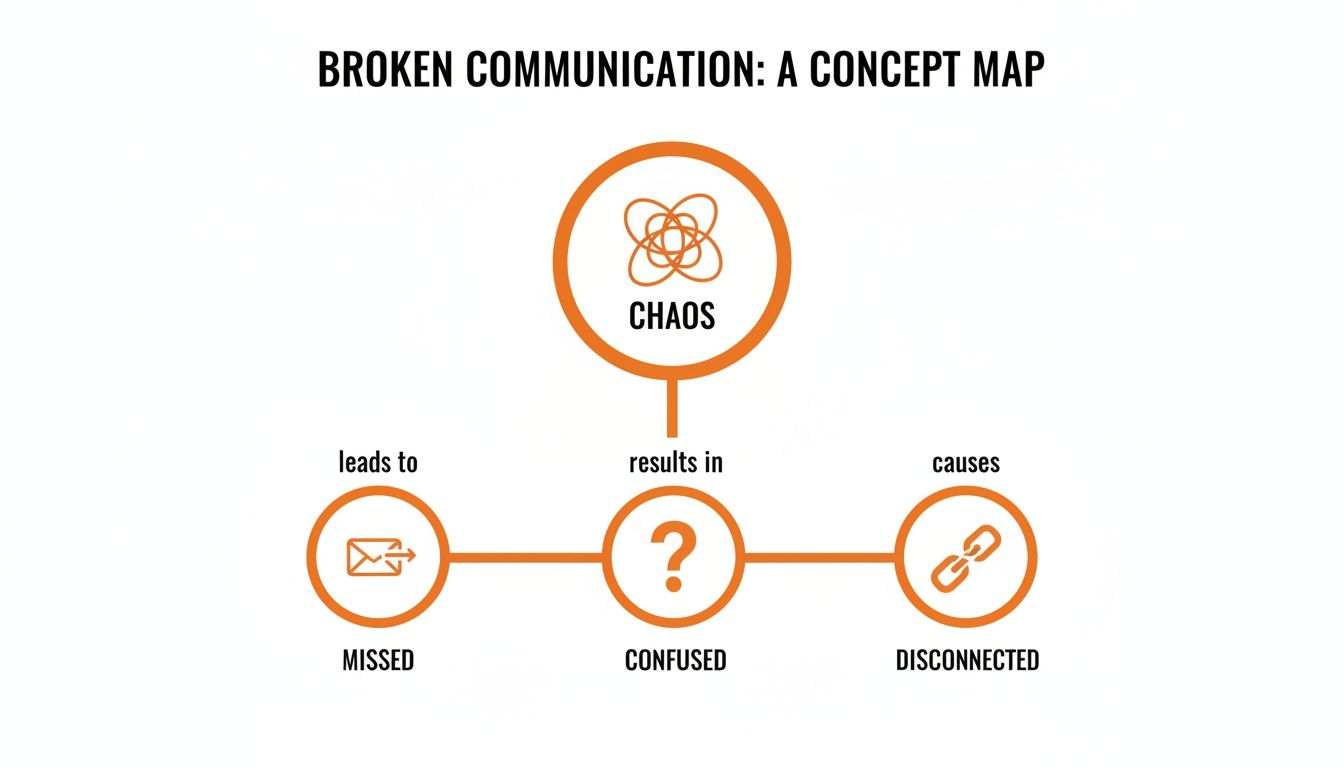
A wobbly process quickly leads to missed messages, confused teams, and that awful feeling that nobody is on the same page.
The Other Half of the Story
The throw is only half the story. The process isn't complete until the Receiver catches the message and decodes it—turning words and tone back into a thought in their own mind.
But here’s the part we all forget: Feedback. The return throw. It's the "Got it," the nod in a meeting, the question that confirms the message landed. Without it, the sender is just guessing. This is where unlocking the power of internal asynchronous communications becomes so important, as it helps keep feedback loops going without constant interruptions.
And then there's Noise. Anything that gets in the way. A spotty Wi-Fi connection. A confusing email subject. A bad mood that makes someone misread the tone of a message. Think of noise as a gust of wind that sends the ball off course. A good communicator learns to anticipate it.
Why Good People Have Bad Conversations
So if it’s just a game of catch, why are we so bad at it? We hire smart people. We have good intentions. Yet projects still derail over messy Slack threads and critical updates get buried in email.
Here’s the thing: modern work is loud. The "noise" we talked about isn't a minor distraction anymore; it's a constant roar. This digital noise turns well-meaning people into frustrated, disconnected teams.
Let's be honest. Bad conversations rarely happen because of bad people. They happen because of a broken process.
The Channel Overload Problem
We have more ways to talk than ever, yet we feel more disconnected. We use Slack for pings, email for "official" stuff, a project tool for updates, and shared docs for feedback. It’s exhausting.
This is channel overload. When an employee misses a crucial schedule change because it was in an email they rarely check, that’s not their fault. It’s a system failure. The sender chose the wrong channel.
A message sent through the wrong channel is the same as a message never sent.
This isn't just an annoyance; it’s expensive. Poor communication costs U.S. businesses $1.2 trillion annually. Research shows employees spend only 63% of their time on their actual jobs. The rest is spent just trying to get on the same page.
Misinterpretation and the Feedback Void
The noise isn't just about too many apps. It's about misinterpretation. A remote developer gets a one-line Slack message: "Need this done ASAP." Is that an urgent, drop-everything request, or just how their manager talks? Without context, the receiver is left guessing. This is a classic decoding error. It kills trust and momentum.
Worse is the feedback vacuum. You send an important update and hear… nothing. No "got it," no questions, no emoji. You’re left wondering if anyone even saw it. This is where small issues grow into major problems.
These breakdowns aren't just about lost money; they're about morale. When communication fails, people feel ignored and undervalued. To fix it, you have to get honest about the root causes and adopt better internal communication best practices. A key part of that is learning how to handle difficult conversations with grace. Fixing these problems starts with seeing them clearly.
A Calmer Way to Communicate
Let’s be honest. Fixing communication isn’t about buying another shiny tool. It’s definitely not about adding more meetings. The real fix is about being intentional. It’s about building a clear, calm process by design, not by default.
Most teams don't mean to create chaos; they just let their communication habits pile up into a tangled mess. It’s time to stop reacting and start building.
This means asking simple questions. When is a quick chat okay, and when does something need a formal email? What’s a fair response time? Where do we find company-wide news? Answering these questions creates a blueprint for how your team works together.
The goal is to eliminate the guesswork. When the process is clear, people stop wasting energy figuring out how to say something and can focus on what they need to say.
One Channel at a Time
So, where do you start? Get practical. Treat your communication channels like tools in a workshop. Each one has a specific job. You wouldn't use a hammer to saw a board. So why are we using instant chat for deep feedback that needs time to marinate?
Start by creating a simple "channel guide." This isn't some stuffy policy document. Think of it as a one-page agreement on how your team uses its tools.
Email is for: Formal announcements, talking to clients, and messages that need a paper trail. Expect a response within 24 hours.
Chat (like Slack or Teams) is for: Quick questions, working together in real-time, and casual team chat. Expect a response within a few hours, not instantly.
Video Calls are for: Solving complex problems, having sensitive talks, and team meetings where seeing each other matters.
A Unified Platform (like Pebb) is for: The official hub for updates, schedules, and critical news that everyone, especially frontline staff, needs to see.
Just defining your channels like this cuts through the noise. It sets expectations that respect everyone’s time and focus. For teams exploring how tech can help, tools like SupportGPT are worth a look.
Dedicated Spaces for Conversation
The other piece of the puzzle is creating dedicated spaces. A single, chaotic chat channel for everything from project updates to birthday wishes is a recipe for disaster. Important information gets buried. People tune out.
Instead, create specific channels for different topics: #project-alpha, #customer-feedback, #team-social. This simple step organizes conversations, making information easy to find. It also lets people mute channels that aren’t relevant, giving them back control over their attention.
When you define the communication process, you’re not just moving information. You’re building a system based on trust, clarity, and respect.
The data backs this up. An overwhelming 97% of workers say that communication directly impacts their daily tasks. Think about it: knowledge workers spend 88% of their week communicating, and nearly 70% feel they could get more done if the process were better.
Building this framework isn't a one-time project. It’s an ongoing effort. For a more structured approach, you might find our guide on creating an internal communication plan template helpful. It’s all about creating a calmer, more focused place where your team can do its best work.
The Power of Closing the Loop
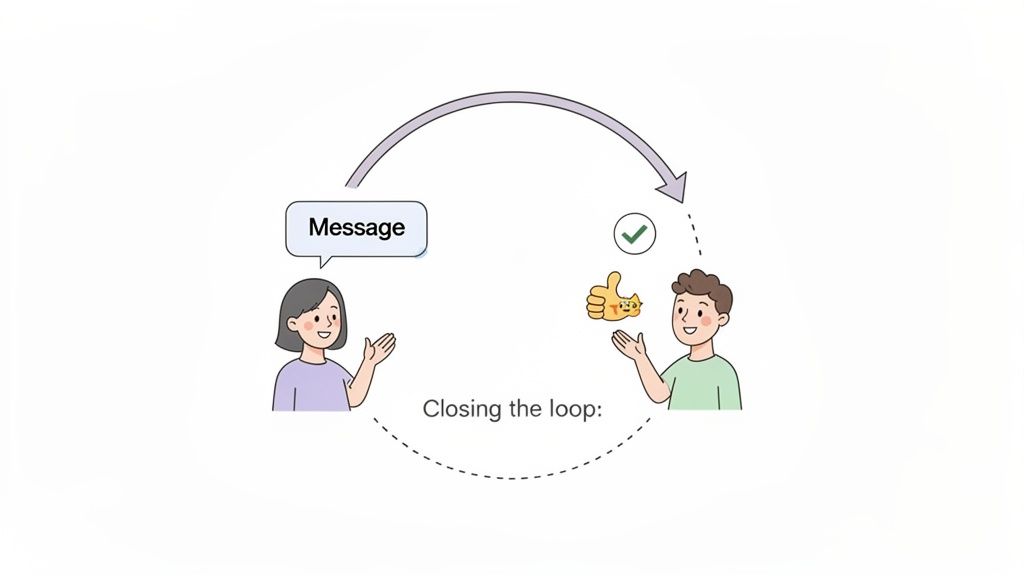
Here’s a secret about great communication: sending the message is only half the job. It’s not done until you know your message landed, and landed correctly. We call this “closing the loop,” and it might be the most overlooked—and most powerful—part of the whole process.
Think about it. The play isn't over when you throw the ball; it's over when it's caught. Without that confirmation, you're left wondering, “Did they see it? Do they get what I meant? Should I follow up?” This small uncertainty creates huge friction at work.
More Than "Did You Get That?"
Closing the loop isn't about nagging. It's about building a culture where confirming receipt is an automatic, effortless habit. It’s the difference between a team that’s in sync and one that’s just shouting into the void.
The good news? It doesn’t require more meetings or complicated software. Simple actions have the biggest impact.
Micro-Feedback: A quick thumbs-up emoji on a message says, “Got it.” A checkmark says, “Read it and I'm on it.” These tiny signals kill ambiguity in a second.
Asynchronous Check-ins: A quick comment on a project card or a reply in a thread confirms understanding without derailing anyone’s focus.
Structured Conversations: Of course, you still need the heavy hitters. One-on-ones and project debriefs are the ultimate feedback mechanism, creating space to ask questions and make sure everyone is truly on the same page.
A team that masters closing the loop prevents small misunderstandings from becoming major crises. It's preventative maintenance for teamwork.
Putting It Into Practice
Let’s make this real. A manager posts the new weekly schedule. Without a feedback loop, they spend the next day chasing people down and dealing with the chaos of those who missed it.
Now, imagine the team has a simple rule: react with a ✅ once you’ve confirmed your shifts. Within hours, the manager sees at a glance who's seen it and who needs a nudge. No frantic follow-ups. Just quiet alignment.
This is why communication has to be a dialogue, not a series of one-way announcements. When you truly define the communication process, you build these feedback loops in from the start. It stops being an extra step and just becomes how you work.
It’s Always About People
Here’s the truth. You can map out communication models, buy the slickest tools, and write the most precise guidelines. But every piece falls apart if you don't have a culture of trust.
Defining a communication process isn't really about the process. It's about people.
The real goal here is to create psychological safety. It's that quiet confidence an employee feels when they ask a "dumb" question. It’s the freedom to admit you made a mistake without fear, or to toss out a half-baked idea that might just be brilliant.
A well-designed communication process is the architecture for psychological safety. It builds the room where trust can grow.
A Practice, Not a Project
This feeling of safety is what lets a culture breathe. It connects people across shifts, time zones, and departments. It’s what makes a frontline worker and a software engineer feel like they’re on the same team—because they trust how information flows between them.
This isn’t a project you check off a list. Fine-tuning how your team connects is a continuous practice. It’s an ongoing commitment to listening, adapting, and caring about how people talk to one another.
We get so wrapped up in the mechanics—the sender, the receiver, the channel—that we forget what we’re trying to do. We're trying to help people feel seen, heard, and understood. We're building a place where they can do their best work without the friction that bad communication causes.
So as you build a better system, never lose sight of the people inside it. That’s the real work.
Frequently Asked Questions
What Is the Biggest Mistake Companies Make with Communication?
Honestly, the biggest mistake is assuming it will figure itself out. Most companies don't intentionally design how their teams should talk. It just... happens. Before you know it, you've got channel chaos, and everyone is frustrated.
The fix? Be deliberate. Decide which tool is for which purpose (e.g., chat for quick questions, email for formal announcements) and set clear expectations for everyone.
How Do You Measure if a Communication Process Is Working?
Look at the outcomes, not just the metrics. Are projects getting finished on time with fewer surprises? Are employee engagement scores improving?
The real proof is in the vibe. When it's working, you'll feel a calmer, more aligned atmosphere. People feel in the loop, not overwhelmed by noise.
Ready to stop the communication chaos for good? Pebb unifies your team's chat, operations, and engagement in one simple, powerful app. See how we help teams in 42+ countries connect and get work done at https://pebb.io.
