
Peer to Peer Communication: Building Stronger Teams
Discover how peer to peer communication transforms workplace culture. Learn practical strategies for building stronger team connections.
Dan Robin
The night shift discovers the policy change from a customer. The day team had agreed on it hours earlier, but nobody passed it along. A new hire asks three people how to handle a routine exception and gets three answers. Meanwhile, one experienced employee carries the fix in their head because the team never created a place to share it.
This is how peer to peer communication breaks down in real workplaces. Not with one dramatic failure, but through small gaps between shifts, locations, departments, and devices. The cost shows up as repeated questions, avoidable mistakes, frustrated employees, and managers pulled into decisions their teams should be able to handle together.
When peer connections work, the day team leaves a clear handoff. Frontline employees solve ordinary problems without waiting for approval. A new colleague learns from the people doing the work, not only from a training document written months ago. That kind of trust doesn't appear by accident, and practical guidance on how to create trust within your team is useful before anyone chooses a tool.
When Peer Communication Breaks Down
The hidden cost of disconnected teams
Peer-to-peer communication breaks down through small gaps between shifts, locations, departments, and devices. The results are repeated questions, avoidable mistakes, frustrated employees, and supervisors reconstructing events instead of improving the operation.
A warehouse supervisor may start the morning by piecing together a private text thread, a paper note near the loading desk, and one employee's memory. Similar gaps appear in healthcare, retail, hospitality, and field service. A nurse misses a change from another shift, a store associate hears about a promotion from a shopper, or a restaurant crew repeats a workaround because the next team cannot find it.
Practical rule: If the next shift has to ask what happened, your handoff is not a communication system yet.
People usually are communicating. The problem is that their messages sit in places that do not connect. More announcements rarely solve that gap. A top-down message records the official decision, while peer exchanges reveal questions, edge cases, and local knowledge. Employees need a reliable way to compare notes, correct misunderstandings, and surface issues before managers become the escalation point.
What good looks like in practice
A functioning peer network gives useful knowledge a path across shifts and locations. After solving a recurring problem, a team member posts a short update. Someone on another shift adds a missing detail. A supervisor notices the pattern, turns the answer into a shared reference, and keeps the work moving.
That process also makes operational improvement measurable. Track whether handoffs generate fewer repeated questions, whether supervisors receive fewer routine escalations, and whether teams resolve issues without waiting for approval. Engagement scores may show activity, but they cannot confirm that work is moving more reliably.
Peer communication does not replace clear policies, accountable managers, or documented procedures. It helps those systems work in practice by connecting the people who handle exceptions every day. Before choosing a tool, leaders should create trust within your team, set expectations for useful updates, and give important knowledge a dependable home beyond one person, shift, or private inbox.
What Peer-to-Peer Communication Means at Work
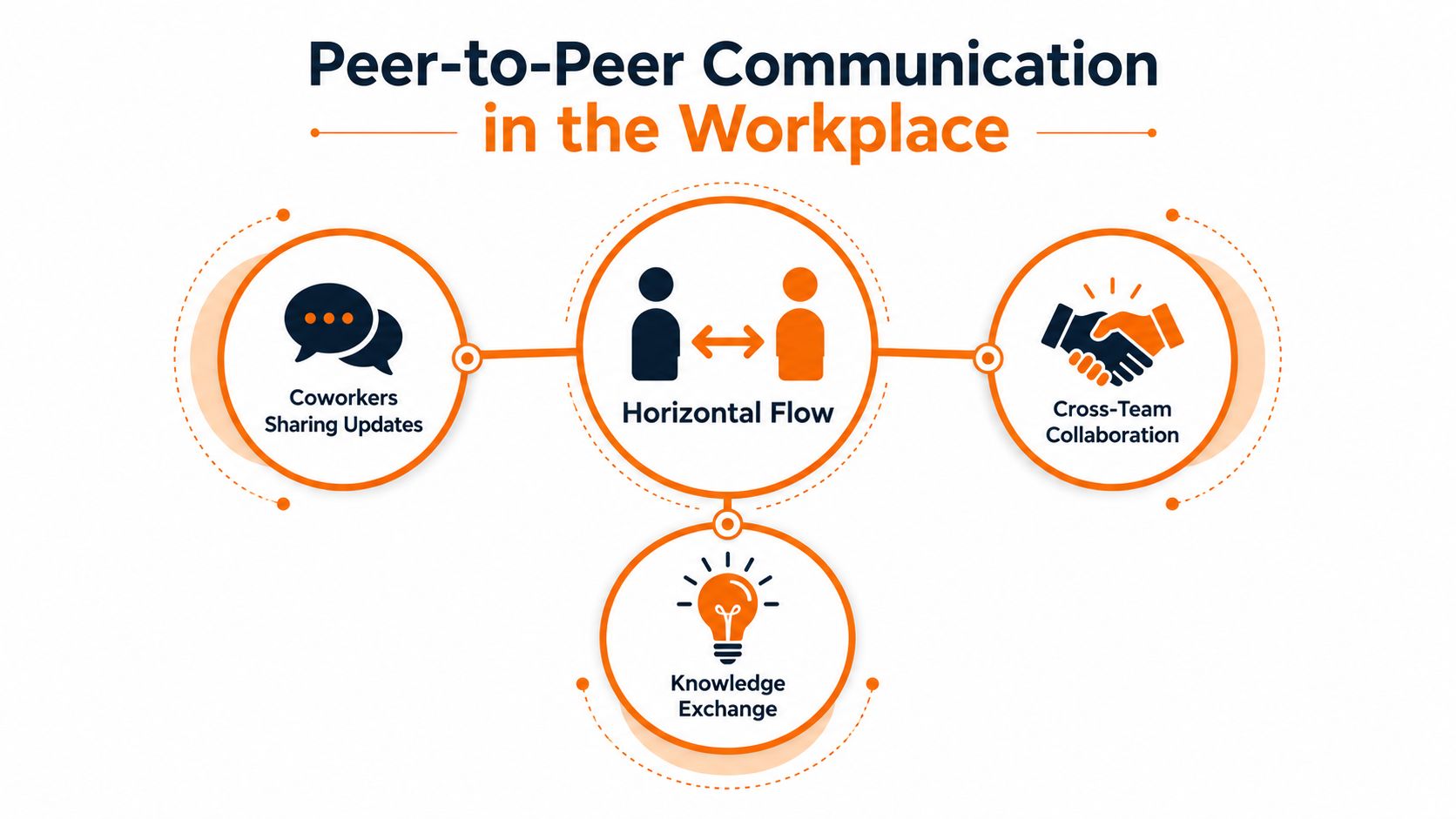
At a busy workplace, a shift worker may need an answer from a colleague at another location before a manager is available. Peer to peer communication creates that horizontal path. Colleagues at similar levels share updates, troubleshoot customer issues, explain processes, hand over work, and exchange local knowledge across shifts, sites, and frontline teams.
A leadership message delivers what changed. Peer conversations help teams understand what it means in practice. Both serve distinct operational needs. Top-down communication sets direction, while colleague-to-colleague discussion surfaces edge cases, clarifies instructions, and helps employees act with the context their situation requires.
Research on peer coworker relationships describes these relationships as ties between employees at the same hierarchical level, without formal authority over one another. Those ties support mentoring, information exchange, and social support. In daily operations, they let knowledge move through the organization when the org chart cannot provide every answer.
For a practical explanation of this horizontal flow, see this guide to horizontal communication in the workplace. The distinction matters most when teams work different schedules or serve customers from separate locations. A useful peer channel should make answers available beyond one person's inbox, shift, or site, while still giving teams a clear place to verify and retain them.
The network lesson
The technical history of peer-to-peer systems provides a useful comparison. Peer-to-peer communication became a major Internet model in the late 1990s and early 2000s, and Napster's 1999 release is widely credited with bringing the architecture to mainstream users. Napster reached more than 1,000,000 unique users by January 2000, more than 23,000,000 by November 2000, and more than 50,000,000 by February 2001. The history is documented in the peer-to-peer overview.
The workplace lesson is practical: direct connections need structure around them. Good peer communication gives employees a path to one another, while shared channels, searchable records, and clear expectations keep information findable, safe, and useful.
The Measurable Impact of Strong Peer Connections
Peer communication deserves more than a vague promise about better culture. The evidence points to a clearer outcome: when employees communicate with peers well and often, they're more likely to feel able to act.
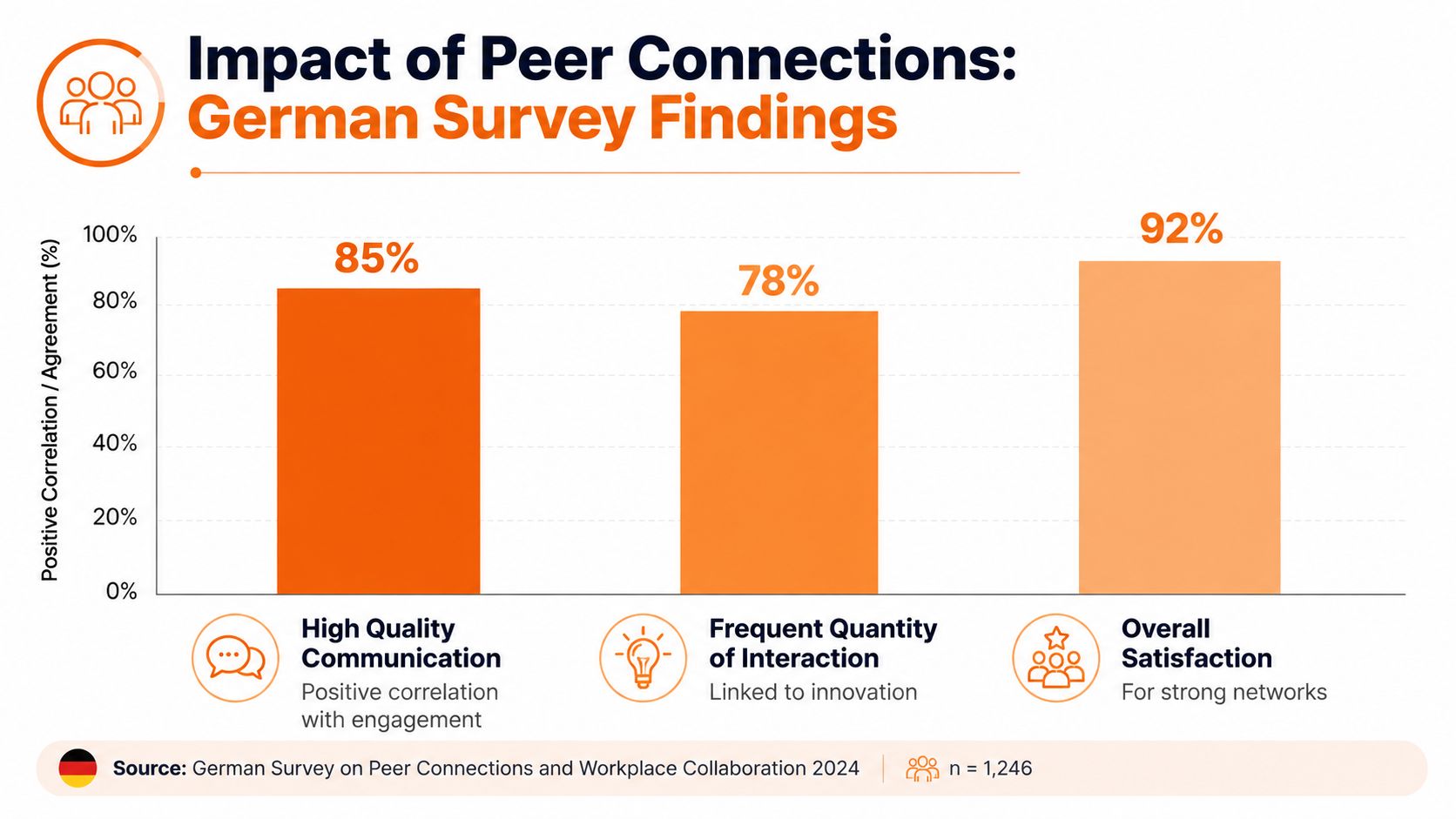
A representative employee survey in Germany found that the quality of peer-to-peer communication strongly supports individual agency and control. The quantity of peer communication also improved overall agency and control and every related dimension except competence, according to the study published in the Journal of Business Communication. That distinction matters. A team can have many messages and still lack useful communication, while high-quality exchanges help people feel integrated, autonomous, and capable of contributing.
From attitude to action
Peer communication can also move behavior. A quasi-experimental field study found that a peer communication program increased employees' pride in their company's environmental initiatives, their confidence discussing the company's environmental record with external stakeholders, and their awareness of and participation in employee environmental programs. The effects were significantly greater than those in the control groups, as reported in the field study on peer communication and environmental engagement.
That gives leaders a practical way to think about communication. The question isn't only whether employees liked the program. It's whether they understood the message, discussed it with peers, and acted on it.
In operations, the same logic applies to shift handoffs, safety practices, onboarding, and customer issues. Strong peer connections can help knowledge move faster and reduce unnecessary escalation. They can't fix a broken process, unclear authority, or poor staffing, but they can make useful knowledge available to the people who need it.
Measure the work, not just the mood
Engagement scores are too broad to explain whether peer communication is working. Track signals closer to the operation instead:
Handoff quality: Check whether the next shift can find decisions, unresolved issues, and ownership without chasing individuals.
Knowledge reuse: Look for recurring questions that become shared answers, guides, or task references.
Escalation patterns: Review which problems peers solve together and which still require manager intervention.
Cross-location participation: Compare whether employees in different sites or shifts can contribute to the same operational conversations.
Action after announcements: Check whether important initiatives produce questions, participation, and visible follow-through.
Research still has limited coverage of how to measure peer communication across frontline, hybrid, and multi-shift environments. That gap shouldn't stop teams from measuring. It should make leaders more careful about choosing operational indicators instead of claiming that every active channel creates better work.
Choosing the Right Channels for Peer Interaction
No single channel handles every peer exchange well. Chat is quick and convenient, but it encourages short answers and can bury context. Voice and video create room for nuance, while structured updates give shift-based teams a durable record.
Research on workplace communication openness found that face-to-face conversations were more open than instant messaging, and that American employees were generally more open than Chinese employees in face-to-face settings, particularly in peer-to-peer exchanges. The finding doesn't make in-person conversation practical for every team. It does show that channel choice affects candor, especially when the topic involves disagreement, feedback, or uncertainty.
Channel | Best For | Limitations | Example Use Case |
|---|---|---|---|
Instant messaging | Quick questions and time-sensitive coordination | Context gets buried and interruptions multiply | A retail associate checks whether a replacement item is approved |
Voice calls | Fast problem-solving and sensitive discussion | Decisions can disappear unless someone records them | A supervisor talks through a customer escalation with a peer |
Video calls | Complex issues where visual context matters | Scheduling is harder across shifts and locations | Distributed teams review a process or demonstrate a task |
Async updates | Shift handoffs, decisions, and searchable knowledge | Requires clear writing and consistent habits | The outgoing team posts open issues and next actions |
In-person conversation | Candid feedback, trust-building, and nuanced discussion | Not available to remote or non-overlapping shifts | Colleagues resolve a recurring workflow conflict |
News feeds and social posts | Shared awareness and culture | Informal posts can distract from operational updates | A team celebrates a milestone or shares a useful local tip |
A useful overview of communication channel types can help teams map channels to real work instead of selecting features first. The goal isn't to give employees every possible option. It's to make the right option obvious.
For teams coordinating travel, commutes, or rideshares, safety and continuity can also shape channel decisions. A specialized solution for commutes and rideshares illustrates why direct communication needs context, not just another message thread.
Keep the mix small
A frontline employee shouldn't have to remember whether the latest update is in email, a chat room, a scheduling app, or a shared drive. Choose one primary home for peer communication, then define when a call or face-to-face discussion is better.
A simple rule works well: use chat for the quick exchange, voice or video for the complicated conversation, and a shared update for the decision that others may need later. The channel should match the work.
Governance and Best Practices That Actually Work
Peer communication needs boundaries, but it doesn't need a bureaucratic maze. Leaders should decide what employees can share, where official information belongs, who can access sensitive material, and how a useful decision becomes easy to find later.
Start with channel structure. Create dedicated Spaces for teams, projects, locations, or recurring workflows. A shift team might have one area for daily handoffs, another for procedures, and a restricted area for sensitive personnel matters. The exact structure depends on the organization, but every space should answer one question clearly: what belongs here?

Four rules worth writing down
Security guidelines: Tell employees what information must stay private, how to handle sensitive files, and where confidential discussions belong. Use role-based permissions rather than trusting every participant with every document.
Channel structure: Separate operational updates from casual conversation. If people can't tell where to post a handoff or policy question, they'll choose whatever channel they already have open.
Community guidelines: Set expectations for respectful disagreement, useful replies, and correction of inaccurate information. Peer communication becomes safer when people know how to challenge an idea without attacking a person.
Analytics and monitoring: Track participation and activity trends without reading every conversation or turning the platform into a surveillance system. Leaders need visibility into adoption, not a transcript of private interactions.
Important updates also need a path out of chat. When a peer discussion produces a new procedure, add it to a knowledge library, task, or formal announcement. Chat is good for discovery and problem-solving. It's a poor permanent filing cabinet.
Onboard through real work
Don't introduce a peer platform with a tour of every feature. Give teams a real first task, such as posting the next shift handoff, finding a policy, or asking a question in the right Space. Supervisors should model the behavior by responding in the shared channel instead of moving every useful answer back into private messages.
Measure whether the system is becoming part of the work. Look at unanswered questions, repeated issues, participation across shifts, and whether employees can find recent decisions. Adoption isn't a login. It's the ability to complete work without rebuilding the same conversation every day.
Why Unified Platforms Solve the Fragmentation Problem
Disconnected tools create operational gaps one handoff at a time. Chat starts in one app, video calls move to another, policy updates remain in email, files sit in a shared drive, and shift schedules live elsewhere. Each tool may work independently, but employees must remember how the pieces connect.
Frontline teams carry the largest share of that burden. A warehouse worker, nurse, restaurant employee, or retail associate may need an answer from a phone while moving between tasks. If the message, file, task, and schedule are stored separately, finding context becomes part of the job.

One place, connected context
A unified platform connects the working parts of peer communication. Pebb combines one-to-one and group chat, voice and video calls, updates, tasks, file sharing, a knowledge library, Spaces, events, and shift-related workflows in one web and mobile app. Employees can move from a question to the relevant action without rebuilding the context elsewhere.
The advantage is shared context. Employees find conversations alongside the document, task, or update that explains what to do next. A unified communications platform also gives managers visibility into participation and activity trends while keeping private exchanges private. That connection matters across shifts, because the next team can locate the decision, source file, and assigned task in the same working environment.
A warehouse team can use a Space for shift handoffs, tasks, files, and schedule information. A hospital department can keep operational updates beside reference material while applying role-based access. A distributed technology team can move from chat to a call, then record the decision in a shared update. The implementation pattern stays practical: connect the conversation to the action it produces.
The rollout is a habit change
A platform does not reorganize communication on launch day. Leaders need to move one workflow at a time, explain the reason for the change, and stop treating side channels as the place for important decisions. If managers continue posting decisions in email, employees will keep the new system at arm's length.
Start with a problem employees already encounter. Make the next handoff easier. Put the current policy where each shift can find it. Let peers answer ordinary questions in public spaces, then attach useful answers to the relevant task or knowledge entry. Once the system supports daily work across locations and schedules, continued use has a practical reason behind it.
Common Mistakes Leaders Make with Peer Communication
Peer communication requires a clear reason to post, a known place to post, and confidence that someone will respond. A tool alone cannot create those conditions, especially when shifts do not overlap or locations rarely interact. Leaders need to connect peer discussion to work employees already perform, such as shift handoffs, troubleshooting, and updates that affect another team.
Social connection supports peer communication through practical exchanges. Coworkers pass along context, teach one another, identify weak points in a process, and show new employees how work is completed. Treating these exchanges as casual conversation hides their value and makes them harder to support.
A third mistake is adding channels whenever a problem appears. A new group chat may solve an immediate need, yet it also creates another place to check and another version of the truth. Across shifts and locations, fragmented channels make it harder to confirm which answer is current. Set a home for each recurring workflow before creating another space.
A busy channel isn't necessarily a useful channel. The test is whether people can find the answer and act on it.
Control creates its own risk
Some leaders worry that peer communication will spread misinformation or undermine authority. The concern is reasonable. Banning horizontal discussion pushes questions into private conversations, where leaders have less context and employees have fewer opportunities to correct one another.
Good governance gives peer communication a stronger foundation. Employees should know which messages are official, how to flag an uncertain answer, where sensitive information belongs, and when a peer discussion must become a formal decision. Clear boundaries make openness safer.
Leaders also misjudge adoption by counting logins or posts before the platform supports a complete workflow. Requiring contributions too early can produce empty replies and reluctant participation, especially among frontline employees who have not yet seen reliable responses. Start with a useful handoff or shared answer, then invite peers to improve it as trust develops.
Peer communication represents a basic form of trust. Leaders do not have to abandon standards or visibility. They do have to let employees coordinate, solve problems, and support one another in a dependable place.
Pebb brings peer chat, group conversations, voice and video calls, updates, tasks, files, knowledge, and shift coordination into one connected workplace app. Visit Pebb to give frontline and office teams a clearer way to stay aligned across locations and shifts.
