
10 Appreciation Day Ideas That Aren't a Pizza Party
Forget pizza parties. Discover 10 genuine appreciation day ideas for frontline and office teams that build culture, not just check a box.
Dan Robin
The pizza party is over. We’ve all been there. Another "Employee Appreciation Day" rolls around, and the default answer is a stack of lukewarm pizza boxes in the breakroom. It’s a gesture that says, "We had to do something, so here’s this." It feels hollow. A cheap substitute for genuine thanks.
Let's be honest: real appreciation isn't an event, it's a habit. It’s the small, consistent signals that show people their work matters. For teams spread across shifts, stores, and home offices, the old playbook is completely broken. You can’t just gather everyone in one room.
So, we stopped trying to invent one-off events and started building systems for real, ongoing recognition. It’s less about a single day and more about weaving appreciation into the daily workflow. This isn’t about spending more money. It’s about being more thoughtful. We’ve seen firsthand how a few smart appreciation day ideas can change the entire feel of a company, turning performative gestures into meaningful connections. To move past superficial gestures and truly make recognition count, delve into unique employee appreciation gift ideas that resonate deeply.
I'm skipping the generic advice here. Instead, I’ll show you ten specific ways to show your team you value them, whether they’re on the front lines or working from a home office. Let’s talk about what actually works.
1. Create a Public Space for Recognition
Most appreciation lives and dies in private emails or siloed team chats. Someone gets a quick "great job," and the moment vanishes. What if appreciation wasn't a fleeting comment but a permanent, visible part of your company's culture? That’s where a dedicated recognition space comes in. It’s a central, public hub where wins, big and small, are celebrated openly.
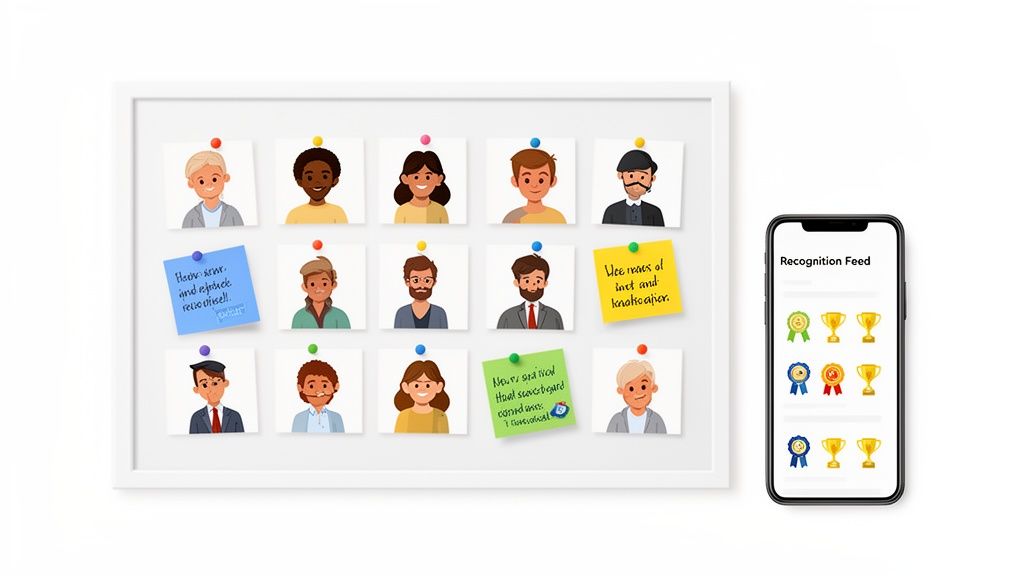
This idea goes beyond a simple "thank you." A healthcare system we know uses their Pebb Space for nurses to post shout-outs to colleagues who helped during a tough shift. It makes appreciation visible across different departments and schedules. A retail chain uses a dedicated "Manager Wins" Space for store leaders to share success stories, creating a sense of connection between locations. This turns isolated acts of praise into a living archive of your team's success.
How to make it work
Creating a space is just the first step. To make it a cornerstone of your culture, you need to be intentional.
First, set clear guidelines. Define what good recognition looks like. Tie it to company values like "Customer First" or "Own It." This prevents the space from becoming a feed of generic "thanks."
Second, leaders go first. When VPs and managers actively and thoughtfully recognize people in public, it signals that this is a core company practice, not just another HR thing.
Third, automate milestones. Don’t let work anniversaries or birthdays slip by. Set up automated posts to celebrate these moments. It often prompts a wave of well-wishes from colleagues.
Finally, amplify the good stuff. Create a weekly digest that highlights the best shout-outs. This gives great work a second wave of visibility. A good employee recognition platform can help formalize and scale these efforts.
2. Start a "Frontline Hero" Program
Generic appreciation often misses the mark for frontline teams. A "great job" email from corporate doesn't land when you're on a busy hospital floor or managing a hectic checkout line. A Frontline Hero program is built specifically for these workers. It celebrates the tangible contributions that keep the business running: exceptional customer interactions, commitment to safety, and pure operational hustle.
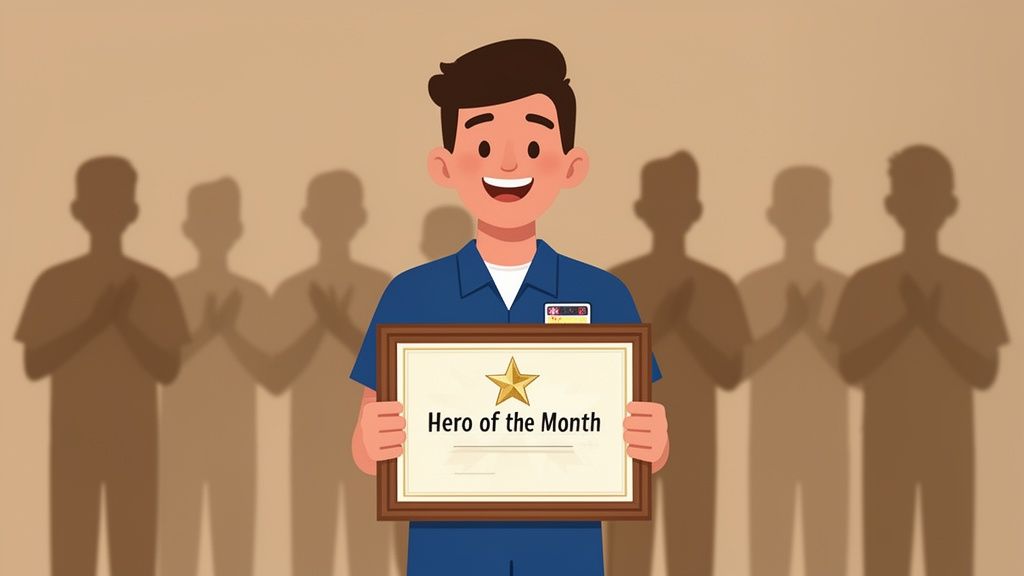
This isn't about giving out a gold star; it's about telling a story. A hospital system we admire uses this approach to feature nursing assistants who receive specific praise from patients. A logistics company celebrates drivers with outstanding safety records, connecting their diligence to the company’s success. These aren't just thank-yous; they are public acknowledgments of excellence in roles that are often behind the scenes. It makes heroes out of the people doing essential work.
How to make it work
A successful program needs more than a certificate. It needs structure, visibility, and authentic peer involvement.
Start by focusing on observable behaviors. Tie recognition to concrete actions, like hitting a safety milestone or earning a positive customer review by name.
Then, empower peer nominations. Managers see a lot, but coworkers on the floor see everything. Create a simple way for peers to highlight a colleague's great work. This makes recognition feel more genuine and less top-down.
When you announce a "Frontline Hero," share the specific story of what they did. Post it during shift briefings and in a dedicated Pebb Space so colleagues across all shifts can see it.
And finally, rotate the spotlight. Make sure the program includes people from different locations, departments, and shifts. This ensures recognition feels accessible to everyone, not just a select few.
3. Launch Cross-Functional Kudos
So often, appreciation gets trapped in team silos. The sales team celebrates a big win, but the operations team that made it possible never hears about it. But the most impactful work rarely happens in a vacuum. It’s the result of different departments and shifts working together. A cross-functional kudos day shifts the spotlight onto these collaborative wins.
This idea moves appreciation from individual performance to collective achievement. Imagine celebrating the night shift retail team for a flawless inventory hand-off that set the day shift up for a record sales day. At one logistics company, they created a shared Pebb Space to highlight moments when the warehouse team went above and beyond to support the delivery drivers. It turned a potentially tense relationship into a celebrated partnership.
How to make it work
Building a culture of collaboration requires more than just saying it's important. You have to actively recognize it.
First, create shared stages. Use a dedicated, cross-departmental Pebb Space as a "Collaboration Showcase." This gives teams like HR and Operations a neutral ground to jointly recognize the people who made a project succeed.
Second, tell the whole story. Don't just announce the win; detail the challenges overcome. When you post a kudos, explain the problem, who was involved, and how their joint effort led to a solution.
Third, ensure your selection committee for any formal awards includes members from various departments. This prevents bias and ensures behind-the-scenes contributions get noticed.
Finally, spotlight the handoffs. Focus on the critical moments where work moves from one team to another. Highlighting these is a powerful form of peer-to-peer recognition that reinforces mutual respect.
4. Hold a Manager and Supervisor Appreciation Day
We spend a lot of time thinking about appreciating frontline teams, and rightly so. But who’s supporting them? Managers and supervisors are often the unsung heroes, juggling schedules, resolving conflicts, and coaching their teams. A dedicated appreciation day for them recognizes their unique, and often invisible, contributions.
This flips the script on traditional top-down recognition. A hospital group we work with created a "Leadership Wall of Fame" where nurses and staff anonymously shared stories of how their unit managers supported them during a crisis. A logistics company used a dedicated day to celebrate supervisors, with drivers posting shout-outs for specific instances of great coaching. It shifts the focus to the leadership behaviors that truly make a difference.
How to make it work
Recognizing leaders requires a thoughtful approach. Simply saying "thanks" isn't enough.
Give them their own day. Don't lump manager appreciation in with general employee appreciation. Giving leaders their own day ensures the message is clear.
Enable peer feedback. Leadership can be isolating. Create a survey to gather anonymous feedback from other managers. This gives them private encouragement from others who understand the role's challenges.
Focus on specific behaviors. Ask teams to share stories that highlight leadership qualities. Instead of "great manager," encourage comments like, "Sarah is amazing at staying calm during our busiest shifts."
Share their journey. Use your company feed to feature manager development stories. Highlighting someone who started on the front line and grew into a leadership role is a powerful way to inspire others.
5. Organize a Team Competition
Appreciation doesn’t always have to be a top-down award. Sometimes, the most powerful recognition comes from shared effort and a little friendly rivalry. Team competitions tap into our natural drive to collaborate and win together. It's a structured way to turn everyday work metrics into a fun, engaging game.
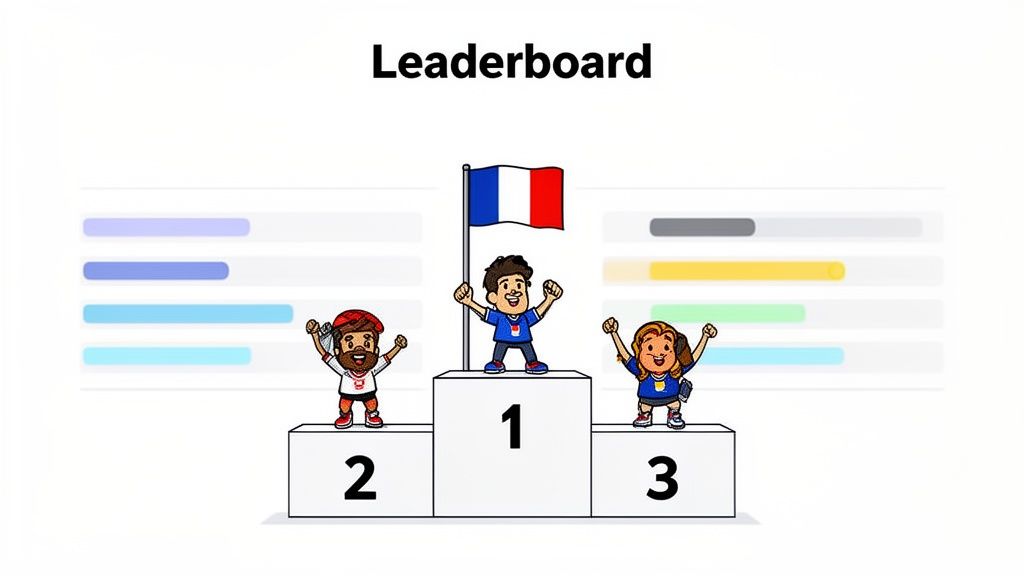
This idea channels competitive energy for a positive purpose. A logistics company we work with runs a monthly "Safety Showdown" between warehouse shifts, tracking incident-free days. The live leaderboard in their Pebb feed keeps everyone engaged, and the winning shift gets a catered lunch and bragging rights. It turned a routine safety checklist into a point of team pride.
How to make it work
A successful competition is more about the spirit of play than the prize. To keep it fun and fair, you need a game plan.
Make metrics fair and visible. Choose metrics that teams can directly control, like customer satisfaction scores. Post a live leaderboard in a dedicated Space so everyone can track their progress.
Rotate the themes. Keep things fresh by changing the focus. One month it could be safety, the next customer shout-outs. This gives different teams a chance to shine.
Celebrate more than just the winner. Recognize the top three teams, and consider a "Most Improved" category to reward effort.
Share what works. When the competition ends, have the winning team share their strategies in a company-wide post. This turns their victory into a learning opportunity for everyone.
6. Automate Milestone and Anniversary Recognition
A work anniversary can feel like just another Tuesday unless you make it mean something. Too often, these dates pass by with a calendar notification, if that. A formal milestone program changes this by turning tenure into a visible, celebrated part of your company's story.
This isn't just about remembering a date; it's about publicly honoring an employee's journey. A warehouse we work with celebrates five-year anniversaries by pairing an announcement with a tribute to that team member's impeccable safety record. A remote tech company uses automated Pebb posts to celebrate anniversaries, sparking congratulations from colleagues across time zones. It makes tenure feel tangible and valued.
How to make it work
A systematic approach prevents anyone from slipping through the cracks.
First, automate the foundation. Connect your HR system to your communication platform to automate anniversary alerts. This ensures no one is ever missed.
Next, create meaningful tiers. Establish special recognition for key milestones like 1, 5, and 10 years. Pair these with increasing perks or a note from leadership.
Then, personalize the praise. Require direct managers to add a personal comment to automated posts. A simple, "It's been great watching you master the new inventory system, congrats on year three!" is far more impactful than a generic "Happy Anniversary."
Finally, spotlight their story. Use your company feed to feature employees hitting major milestones. Share a brief story about their journey or a favorite memory to put a human face on their long-term commitment. For a deeper dive, you can learn how to build a recognition program for success and make it a core part of your culture.
7. Amplify Customer Compliments
Most customer praise vanishes into thin air. A customer tells a cashier they were helpful, a patient thanks a nurse for their kindness, and the moment is gone. What if you could capture that positive feedback and turn it into a powerful, public recognition tool?
This method creates a direct line between customer happiness and employee recognition. A logistics company we work with shares positive shipper feedback directly with their drivers in a Pebb Space, making a solitary job feel more connected. A hotel chain encourages managers to post guest compliments immediately, giving the entire team a real-time morale boost. By amplifying the customer's voice, you show employees that their hard work makes a real, human impact.
How to make it work
Building a system to share compliments is simple, but making it part of your culture requires a plan.
Create a central hub. Set up a dedicated "Customer Wins" Space in Pebb. Make it easy for managers to post screenshots of emails or notes from customers.
Make it immediate. Don't save compliments for a quarterly review. The impact is strongest when the praise is shared within hours or days. This immediacy reinforces the behavior you want to see.
Empower managers to share. Train supervisors to actively listen for and document positive customer interactions. Give them a simple process for uploading feedback on the go.
Link praise to profiles. When a compliment is shared, tag the employee. This builds a public record of their positive impact that is visible on their employee profile for everyone to see.
8. Spotlight Your "Hidden Heroes"
Some of the most critical work in any company happens behind the scenes. The IT team that ensures systems never fail, the HR coordinator who makes every new hire feel welcome, or the facilities crew that keeps a store looking perfect. These roles are the operational backbone, yet their contributions often go unnoticed. A "Hidden Heroes" initiative turns the spotlight on them.
This idea is about making invisible work visible. One logistics company uses their Pebb feed for warehouse managers to nominate payroll team members who fixed errors quickly. A hospital system encourages nurses to submit "Support Staff Shout-Outs" for the IT helpdesk. This approach doesn't just thank people; it educates the entire organization on how interconnected everyone's success truly is.
How to make it work
A successful "Hidden Heroes" program requires a system to consistently surface and celebrate these crucial contributions.
Create a nomination channel. Set up a dedicated Space or use a simple form where frontline employees can easily nominate support staff. Ask them to describe the specific problem that was solved and the impact it had.
Feature "Day in the Life" stories. Work with support teams to create short posts showcasing what they do. Highlighting the complexity of their roles builds empathy and appreciation.
Tie recognition to impact. Instead of a generic "thanks," quantify the contribution. For example, "Thanks to the data team's new report, we've reduced scheduling errors by 15%."
Let leaders amplify the message. When a director comments on a nomination for a support team member, it sends a powerful message that this work is valued at every level.
9. Celebrate Development and Growth
Praise for a job well done is essential, but what about celebrating the effort that happens before the big win? Appreciating an employee's commitment to learning and growth sends a powerful message: we invest in you, and we celebrate your ambition. This isn't about the end result; it's about recognizing the journey of skill-building.
This turns learning into a celebrated event. A logistics company we work with created a "Certification Wall of Fame" where they announce every new forklift or safety certification. It’s become a source of pride. A healthcare provider uses their feed to give shout-outs to clinical staff who complete continuing education credits, linking their dedication to better patient care. It reframes training from a requirement into a recognized achievement.
How to make it work
Celebrating growth requires more than just acknowledging a completed course. You have to connect it back to the employee's journey.
Create a "Learning Wins" channel. Dedicate a specific Space for all things growth-related. Announce new certifications, training completions, or when someone masters a new system.
Leaders should champion learning. When a manager publicly congratulates an employee for completing a challenging course, it shows the entire team that development is a core value.
Connect learning to opportunity. Don’t just celebrate the certificate; talk about what it means. Mention how these new skills will help the employee take on new projects.
Showcase the journey. Feature employees in a "Growth Spotlight" post. Ask them to share what they learned and how they plan to apply it. This inspires others.
10. Recognize Your Company Values in Action
Recognizing employees for hitting targets is easy. But what about recognizing them for how they hit those targets? A values-based appreciation system shifts the focus from just what gets done to how it gets done. It celebrates the behaviors that define your culture—integrity, collaboration, customer focus. This makes your core values more than words on a poster.
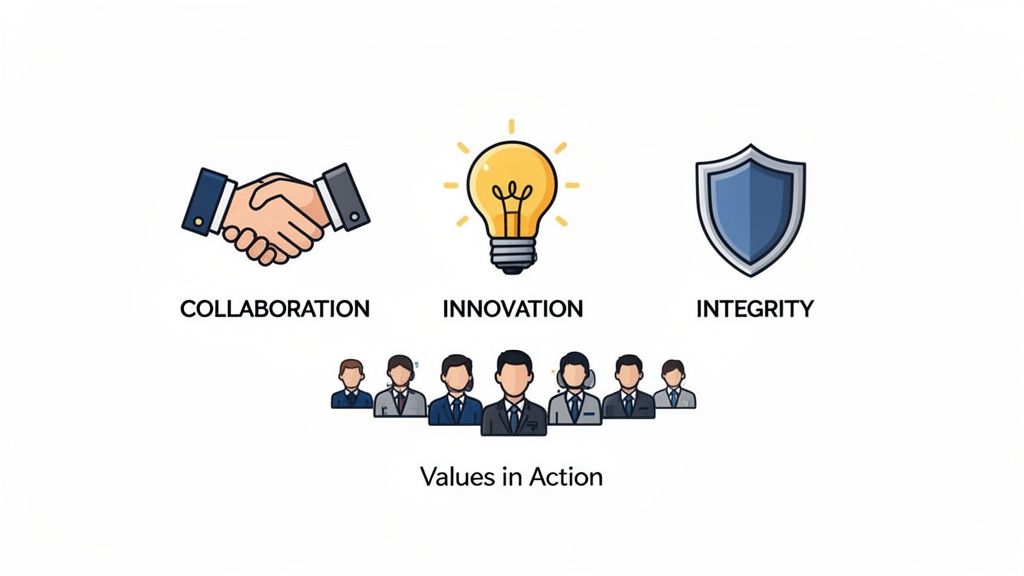
This turns appreciation into a powerful culture-building tool. Imagine a healthcare worker getting a shout-out for embodying the ‘Patient First’ value by comforting a nervous patient's family. Or a retail associate being celebrated for 'Integrity' after helping a customer find a better alternative. When you share these stories, you’re not just thanking one person; you’re teaching the entire organization what your values look like in action.
How to make it work
A values-based system needs structure to be effective. It can't be a vague feeling; it has to be tied to observable actions.
First, define clear behaviors. For each company value, define two or three specific, observable behaviors. For "Collaboration," this might be "proactively sharing resources with other teams."
Second, train your leaders. Teach managers to spot and celebrate these specific value-aligned behaviors, moving beyond generic praise to meaningful feedback.
Third, create dedicated spaces. Use a tool like Pebb to create a Space for each core value. Team members can post stories of their colleagues living that value, creating a powerful library of cultural touchstones.
Finally, share stories widely. Regularly feature values-based recognition stories in company-wide communications and all-hands meetings to show everyone what your culture is all about.
Comparison of 10 Appreciation Day Ideas
Program | 🔄 Implementation Complexity | ⚡ Resource Requirements | 📊 Expected Outcomes | Ideal Use Cases | ⭐ Key Advantages & 💡 Quick Tip |
|---|---|---|---|---|---|
Employee Recognition Spaces | Low–Medium — setup, templates, moderation | Moderate — admin time, ongoing moderation | Visible engagement uplift; recognition analytics | All frontline and office teams, distributed shifts | ⭐⭐⭐⭐ Builds transparent, inclusive culture. 💡 Establish guidelines and leaders model recognition. |
Frontline Hero Recognition Program | Medium — role-specific criteria, media, incentives | High — supervisor training, curation, reward integration | Higher frontline engagement and retention; pride boost | Organizations with significant frontline workforce | ⭐⭐⭐⭐ Directly reaches hard-to-reach employees. 💡 Rotate features and include peer nominations. |
Cross-Functional Collaboration Kudos | Medium–High — cross-leader coordination, multi-space visibility | Moderate — stakeholder time, documentation effort | Improved collaboration, fewer handoff errors, cultural cohesion | Multi-location, multi-shift organizations | ⭐⭐⭐ Breaks down silos and highlights interdependence. 💡 Use diverse selection committees and document lessons. |
Manager and Supervisor Appreciation Day | Low–Medium — scheduling, anonymous feedback setup | Low–Moderate — communications, video collection | Better manager retention; models appreciation downward | Organizations with multi-tier management structures | ⭐⭐⭐ Recognizes often-invisible leadership work. 💡 Time separately and enable anonymous feedback. |
Department/Team Competition Recognition | Medium — metric design and leaderboard management | Moderate — data tracking, fairness monitoring | Boosted engagement and performance; risk of rivalry | Organizations with multiple teams or locations | ⭐⭐⭐ Gamifies performance and fosters team pride. 💡 Include collaboration metrics and celebrate top several teams. |
Milestone and Anniversary Recognition Program | Low — automation and HR integration | Low — automated notifications, minor admin | Consistent recognition; increased belonging and retention | All organization sizes and industries | ⭐⭐⭐ Reliable, low-administration recognition. 💡 Personalize messages and pair with small perks. |
Customer Compliment Amplification | Medium — feedback capture, attribution, integration | Moderate — tools integration, curation effort | Strong link to customer impact; motivates quality service | Customer-facing organizations (retail, hospitality, healthcare) | ⭐⭐⭐⭐ Creates authentic, customer-linked recognition. 💡 Embed feedback forms and share compliments immediately. |
Hidden Heroes & Support Function Recognition | Medium — nomination process, story collection | Moderate — outreach and content creation | Greater visibility for support teams; reduced burnout | Organizations with dedicated support functions | ⭐⭐⭐ Highlights often-invisible contributions. 💡 Create "Day in the Life" content and solicit frontline nominations. |
Development and Growth Celebration | Medium — LMS/Learning integration and tracking | Moderate — tracking systems, manager input | Increased learning uptake; clearer growth pathways | Organizations investing in employee development | ⭐⭐⭐ Encourages continuous learning and retention. 💡 Tie recognitions to promotions and feature learning journeys. |
Company Values Embodiment Recognition | Medium–High — define behaviors, train evaluators | Moderate — training, ongoing reinforcement | Strong culture alignment and behavior change when authentic | Organizations with clearly defined, lived values | ⭐⭐⭐⭐ Makes values tangible and guides behavior. 💡 Define 2–3 observable behaviors per core value and train managers. |
It’s Not About the ‘Day.’ It’s About the Habit.
Let’s be honest. We’ve just walked through ten appreciation day ideas. But if you’re reading this and thinking, “Which one is perfect for our annual Employee Appreciation Day?” you might be missing the point.
Any of these ideas, done once a year, will feel just as empty as that cold pizza. The gesture is nice, but it’s temporary. The real magic isn’t in the idea itself, but in turning appreciation into a consistent, daily practice. It’s about building the muscle of recognition until it becomes a natural part of how your team operates.
The goal isn't just a checklist for a single event. It's to show you different ways to shine a light on the good work that’s already happening—work that often goes unnoticed. The most successful companies don’t host an annual party. They build systems where appreciation is woven into the fabric of their operations.
Think about it this way:
Consistency over intensity. A simple, heartfelt "thank you" shared in a public channel every Friday is more powerful than a big event every March.
Specificity over generality. Recognizing someone for how they embody a company value is far more meaningful than a generic "great job."
Authenticity over obligation. People can smell forced fun a mile away. The best appreciation feels genuine because it comes from real gratitude, not an HR mandate. This is why peer-to-peer recognition works so well.
Your next, smallest step
Feeling overwhelmed? Good. Don't try to do it all. You don’t need a huge budget or a grand plan to get started. You just need to begin.
Pick one. Just one.
Maybe it's the “Customer Compliment Amplification” idea. For the next 30 days, commit to finding one positive customer comment each week and sharing it in a company-wide channel, tagging the employee responsible. That's it. See what happens. Watch how that small, consistent action changes the conversation.
The goal isn’t to have the best ‘Appreciation Day.’ It’s to build a company where people feel seen and valued every single day. Where appreciation isn’t an event to be planned, but an instinct to be followed. And that’s a much more rewarding problem to solve.
Many of these ideas are simpler to manage when you have one place for communication, recognition, and scheduling. If you're tired of juggling different apps, check out Pebb. We built it to connect your entire team and make building a culture of appreciation an everyday habit, not a yearly headache.
