
Nightshift Handoff Notes Spaces
Nightshift handoff notes Spaces. Design, implement, and standardize nightshift handoff notes in Pebb Spaces. A step-by-step guide
Dan Robin

At 6:47 a.m., a night nurse handed over a patient who had become restless hours earlier. The day team heard “stable,” but missed the temporary oxygen change and the pending review that explained why.
Why Nightshift Handoffs Fail (And How Spaces Fix Them)
The failure usually isn't carelessness. It's context under pressure. The outgoing team is tired, the incoming team is arriving in fragments, and the handoff competes with call bells, alarms, questions, and unfinished work. A detail that feels obvious at 6:45 a.m. can become invisible by the time the next person opens the chart or joins the team chat.
Research on hospital handoffs shows how uneven this moment can be. In a 2024 survey of acute-care hospital nurses, only 6.3% said the shift-change handoff they received was always accurate, complete, and pertinent to patient conditions. Only 6.4% said patients were always involved. Half of respondents, 42.7% who disagreed and 7.3% who strongly disagreed, perceived important information being missed during shift changes, according to the 2024 acute-care nurse handoff study.

A verbal handoff still has value. Incoming staff can ask questions, read tone, and test their understanding. But the conversation shouldn't be the only place where the shift exists. A dedicated Space gives the night team a persistent home for updates, follow-up work, documents, and the history behind current decisions.
The handoff is an operating condition
The content matters, but the environment matters just as much. Patient-safety guidance recommends reducing noise and distractions, protecting dedicated handoff time, limiting competing meetings, and using a structured written tool that still leaves room for questions. It also points to a quiet setting, repeat-back, and two-way clarification in the patient-safety review of clinical handoffs.
That changes how we should think about nightshift handoff notes Spaces. The Space isn't a dumping ground for whatever the outgoing team remembers. It should make the right behavior easy when people are busy and tired: find the current note, see what needs action, open the relevant procedure, and confirm ownership.
Practical rule: A note isn't complete when it's posted. It's complete when the incoming person can understand it, question it, and act on it.
A searchable record also protects the team from repeating the same investigation. If a temporary fix was applied overnight, the next shift can see what happened, what remains unresolved, and who needs to follow up. The handoff becomes a shared operational memory instead of a disappearing conversation.
Building Your Night Shift Space
Start with one dedicated Space for overnight operations. Don't mix critical handoff notes into a general channel filled with celebrations, routine announcements, and casual questions. People scan differently when they know a specific area contains the information they need to take responsibility.
The setup should be simple enough that a tired supervisor can explain it in a minute. Use a main channel for broad overnight updates, then create a clearly named channel or pinned thread for the formal handoff. The name should tell the incoming team exactly what it contains, such as “Night Handoff” or “Shift Report.”
Give every item a clear home
A useful Space separates three kinds of work:
Handoff posts: The durable summary of what happened during the shift.
Tasks: Open loops that need an owner, priority, or follow-up.
Reference material: Policies, procedures, forms, and equipment instructions.
Enable the News Feed or Posts area for the handoff itself. A post is easier to review than a fast-moving chat thread, and it gives the team a consistent place to look at the start of each shift. Use chat for clarification, not as the permanent record.
The guide to how Spaces work is useful when deciding which areas belong together and which should stay separate. The principle is more important than the exact layout: keep the handoff close to the work, but don't bury it under unrelated conversation.
Set notifications for attention, not noise
Notifications need a deliberate pattern. The incoming shift should receive an alert when the handoff is posted or when a task is assigned to them. Everyone else doesn't need every comment pushed to their phone. Too many alerts train people to ignore the important ones.
Connect shift scheduling if your setup supports it, so the handoff reaches the people taking over rather than a broad group that may not be working. Give supervisors visibility into posts and tasks without making them responsible for manually forwarding every update.
Pin the current template and keep old notes searchable. Don't create a new structure for every shift. Familiarity is a safety feature. When staff already know where the status, blockers, and next actions belong, they spend less effort finding the format and more effort checking the facts.
Creating a Standardized Handoff Template
A blank post invites uneven reporting. One person writes a detailed narrative, another writes “quiet night,” and the incoming team has to guess whether the difference reflects the shift or the writer.
Use a repeating post template. It should be short enough to complete during the normal closeout, but specific enough to prevent vague updates. A foundational observational study recorded 77 handoffs across 40 shift changes and found that handoffs averaged 5.4 minutes per patient, with a range from 2 to 13 minutes. The same study found a tension between what incoming and outgoing nurses wanted, with incoming nurses preferring questions and eye contact while outgoing nurses preferred an uninterrupted account. Those findings are documented in the observational handoff study and I-PASS project.
That tension is why the template should carry the basic structure before the conversation begins.
A practical post format
Copy this into the pinned handoff post:
Night Shift Handoff, [date]
Outgoing: [name]
Incoming: [name or team]
Overall status: [stable, watch closely, urgent attention]
What changed:
[Important events, condition changes, incidents, or completed work.]
What is still open:
[Every unresolved item, including the current status and next step.]
What the incoming team should do first:
[Prioritized actions for the start of the shift.]
Watch items and contingencies:
[What to monitor, what might happen next, and when to escalate.]
Blockers:
[Dependencies on another team, approval, equipment, access, or a decision.]
Relevant references:
[Links to the procedure, policy, incident, or supporting file.]
Acknowledgment:
[Incoming person confirms receipt and raises questions.]
The “what changed” section prevents a handoff from becoming a list of problems with no timeline. The “what is still open” section prevents the outgoing team from confusing activity with completion. The blocker field is especially valuable because an unresolved task without its reason often looks like neglect, when the underlying issue is a missing approval, unavailable part, or restricted system.
A useful template for handing off work can help teams compare formats before settling on their own version. Borrow the structure, then remove anything your staff won't use.
Turn open loops into Tasks
A note tells people what happened. A Task tells them what happens next.
If a machine fails during the night, write the event in the handoff post, then create a Task for the repair or inspection. Assign it to the person or team who can act, add a priority, and include the relevant context in the description. If the task depends on another group, write that dependency plainly instead of assigning it to someone who can't move it forward.
Keep the post as the narrative record and the Task as the action record. That separation makes both easier to scan. It also gives supervisors a way to see which issues are being carried from shift to shift instead of relying on memory or repeated comments.
Don't turn every sentence into a task. “The unit was quieter than usual” is useful context, not an assignment. “Confirm the replacement monitor is working before the next admission” is an action and belongs in Tasks.
Using the Knowledge Library for Context
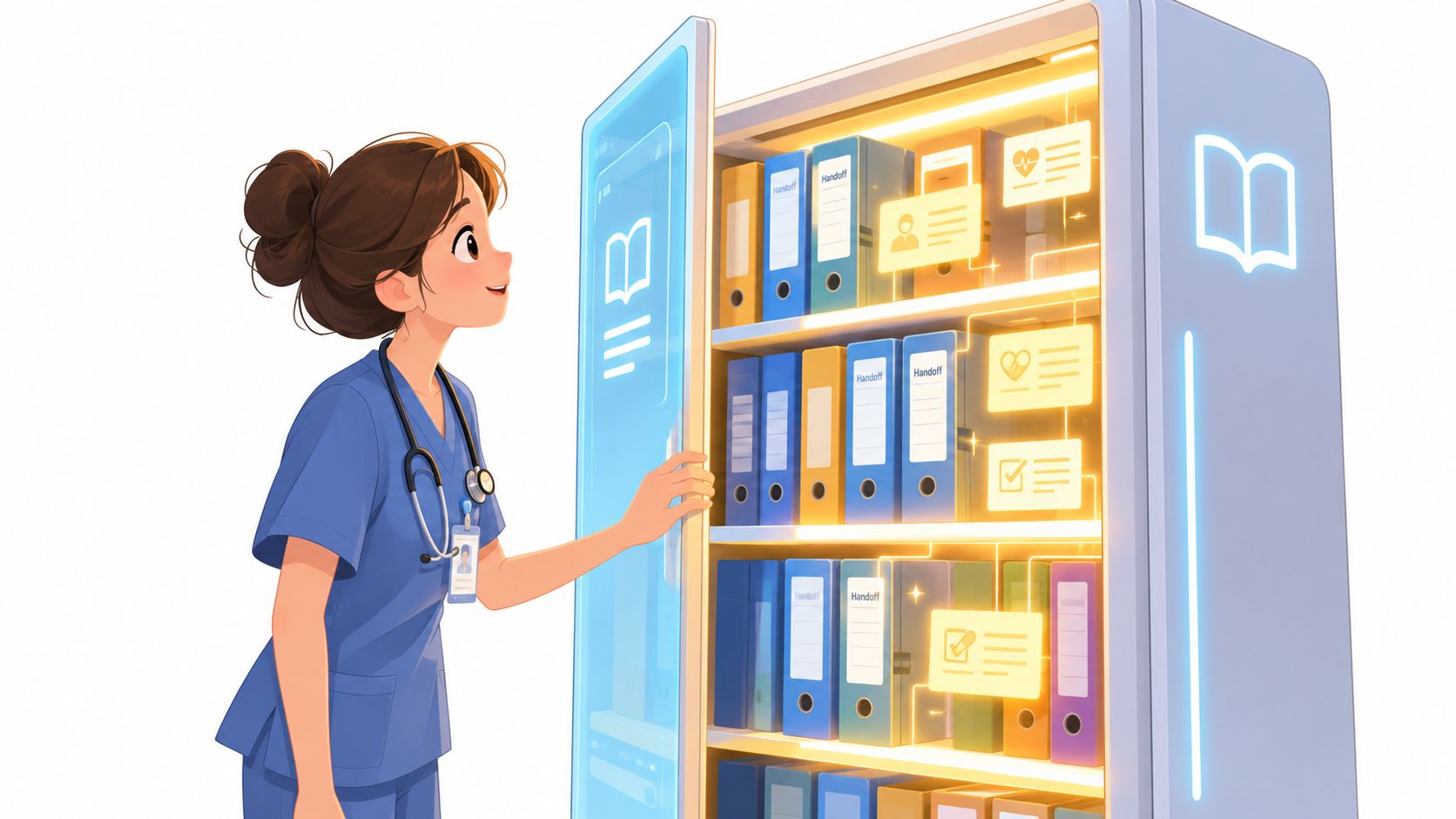
New staff often inherit a situation without inheriting the memory behind it. A temporary worker may know the procedure but not the local shortcut. A day supervisor may understand the policy but not know why the night team used a particular workaround. Repeating all of that background in every handoff makes notes long, stale, and harder to trust.
Keep the current shift in the handoff post and keep stable knowledge in the Knowledge Library. Link the applicable policy, safety procedure, equipment guide, or escalation path instead of copying it into the update. The note stays focused on what changed tonight, while the reference remains available when someone needs the full instructions.
The explanation of how the Knowledge Library works can help administrators decide how to organize shared material. A practical structure might use folders for policies, equipment, emergency procedures, onboarding, and location-specific instructions. Use names that match the words staff search for, not internal project names that only administrators recognize.
Keep the history useful
Searchable history is valuable only when people can distinguish current facts from old context. Date every handoff, use a consistent title, and avoid editing yesterday's post to make it look current. Add a new update when the situation changes, then link back to the earlier note if the sequence matters.
A good archive answers practical questions:
What happened: Which shift first noticed the issue?
What was tried: Which action helped, and which did not?
What remains: Is the item resolved, being monitored, or waiting on someone else?
Where is the source: Which policy or procedure supports the next step?
Permissions need the same care. Staff should have access to the material required for their role, while sensitive patient, employee, or incident information should stay limited to the appropriate group. Don't solve discoverability by making every document visible to everyone. A searchable workspace still needs boundaries.
The strongest setup combines a short, current post with a stable reference and a tracked action. That gives the incoming team enough context to act without forcing them to search through months of duplicated instructions.
Measuring Handoff Success with Analytics
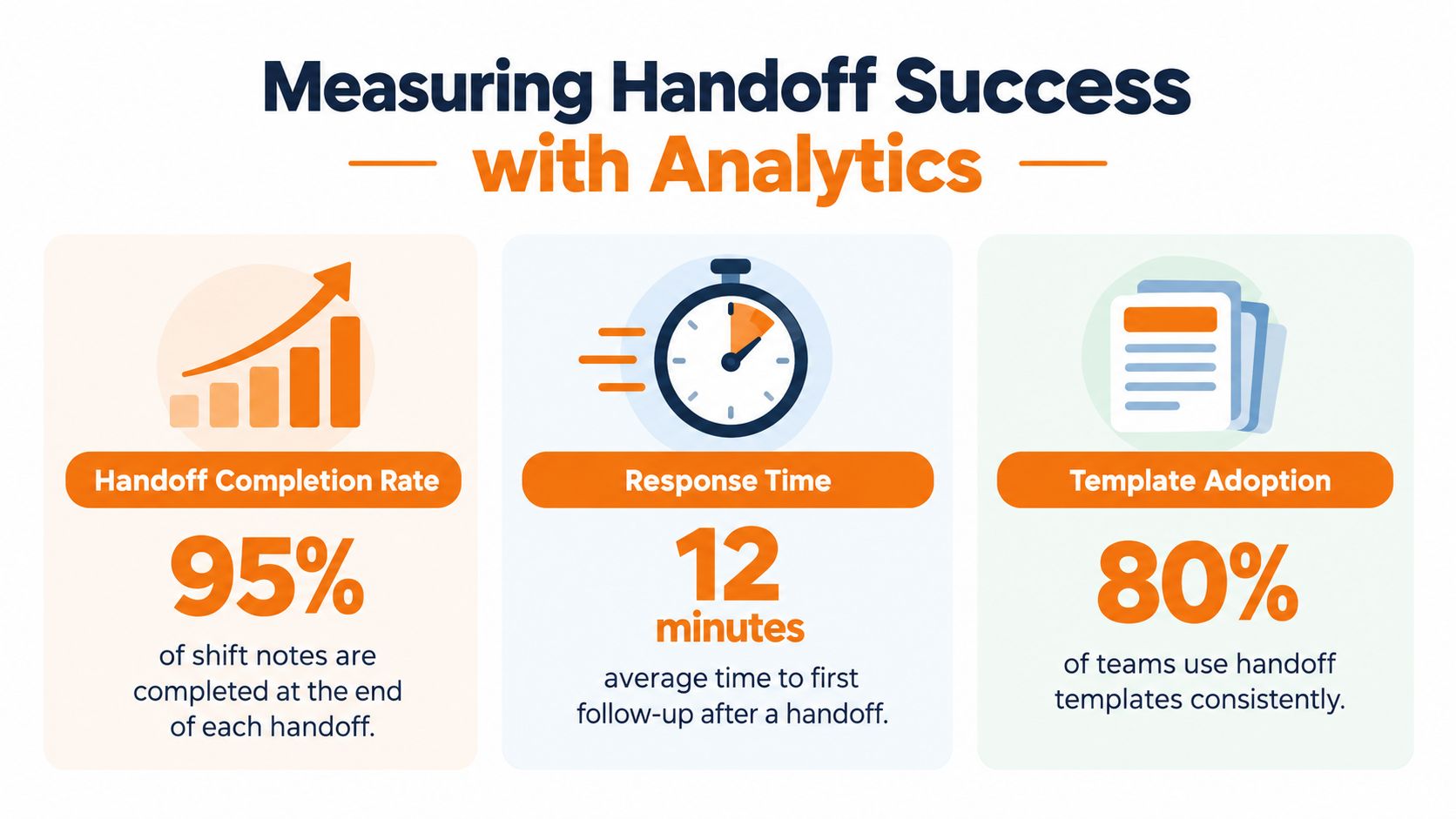
A Space can be full of notes and still fail. The useful question isn't whether people posted something. It's whether the incoming team read the right note, understood the open work, and acted before the next shift inherited the same confusion.
Use analytics to inspect behavior rather than reward activity. Start with whether the handoff post was created for each scheduled transition. Then look at whether incoming staff viewed it, whether assigned Tasks changed state, and whether comments or acknowledgments appeared when clarification was needed.
Read the signals together
A high posting rate can hide a weak process. Staff may be completing the form while leaving the important fields vague. A high view rate can also mislead if people open the note but don't acknowledge responsibility or pick up the tasks inside it.
Look for patterns across the whole handoff:
Signal | What it may reveal | What to check next |
|---|---|---|
Handoff posts appear consistently | The closeout habit exists | Review whether required sections contain useful detail |
Incoming staff view posts quickly | The note is discoverable | Check whether open Tasks are being assigned |
Tasks remain untouched | Ownership or priority is unclear | Review assignees, blockers, and escalation rules |
Comments cluster around one topic | The template may be missing context | Add a field or link for that recurring question |
One shift posts less consistently | The workflow may not fit that team | Observe the shift rather than sending another reminder |
Don't use analytics to shame a team for working through a difficult night. Use them to find friction. If one group has lower acknowledgment activity, the cause could be notification settings, a confusing channel, limited access, or a handoff period that collides with other duties.
The strongest measurement is often a short conversation with incoming staff. Ask which information they had to chase, which fields they ignored, and what they needed but couldn't find. Then change the workflow. A metric is useful when it leads to a better decision, not when it only fills a dashboard.
The Case for Asynchronous Written Handoffs
“Someone told them” isn't a handoff process. It's a hope that the right person was present, awake, listening, and able to remember the detail later.
Verbal exchange remains useful for nuance and questions, but it breaks down when the room is noisy or the receiving team hasn't arrived. Written notes create a second path. The outgoing person has to organize the facts, and the incoming person can review them before taking responsibility.
A large multi-hospital I-PASS study involved 32 diverse hospitals and reported a 47% reduction in adverse medical events over three years after a standardized handoff package was used. The same report described complete verbal handoffs rising from 20% to 66%, complete written handoffs from 10% to 74%, and high-quality incoming-provider synthesis from 31% to 83%, as detailed by Boston Children's Hospital's I-PASS handoff summary.
Writing changes the quality of the transfer
The point isn't to replace every conversation with typing. It's to stop treating the conversation as the only source of truth. A written handoff makes missing categories visible, preserves the sequence of events, and gives a supervisor something concrete to review when a problem returns.
The receiving person also has a job. They should read the note, verify the important details, and confirm what they understand. That confirmation turns a passive update into a transfer of responsibility. It should include blockers, too, so the incoming team knows whether an item is waiting on another department, an approval, equipment, or system access. Those expectations are reflected in this shift-handover guide.
For teams building better asynchronous habits beyond handoff notes, this overview of the retention boost from asynchronous training offers a useful parallel. People absorb information more reliably when they can review it at the point of need instead of depending on one crowded live exchange.
Use the guide to how team chat works for questions and clarification, but keep the formal handoff in the dedicated Space. Chat should help people understand the record, not replace it.
Pebb brings posts, chat, Tasks, file sharing, schedules, and searchable team information into one mobile and web workspace, so night teams can leave a clear record and incoming staff can act on it without hunting across tools. Visit Pebb to see how a dedicated Space can give your next shift a cleaner, more accountable handoff.
