
Measuring Staff Engagement Without the Fluff
Stop chasing scores. This guide shares a practical, human-centered approach to measuring staff engagement by focusing on signals that truly matter.
Dan Robin
For years, we’ve been measuring staff engagement all wrong. It’s become an annual ritual, like a check-up where the only goal is to get a score.
We send out a massive survey, crunch the numbers, and then… what? The report gets filed away, and we do it all again twelve months later. But let’s be honest: what does a single number, from a single point in time, actually tell us about the health of our teams? Not much.
The Old Way is Broken
The standard playbook was all about that big annual survey. We’d get a score, pat ourselves on the back or sound the alarms, and feel like we’d ticked the “engagement” box for the year.
The problem is, these methods are completely disconnected from the day-to-day reality of work. They capture a snapshot, often months after the moments that shaped those feelings have passed. It’s like trying to understand a relationship by looking at one photograph from last Christmas.
This isn't just an HR problem. Imagine walking into your office knowing only one in five people is genuinely bought-in. That’s the tough reality painted by a recent Gallup workplace report, which found global employee engagement has cratered to just 21%. It’s a staggering drop, costing the global economy an estimated $438 billion in lost productivity.
From Numbers to Signals
That data was a wake-up call for me. It’s what convinced me that measuring engagement isn't about chasing a number—it’s about learning to read the pulse of the company, moment to moment.
It’s about the small signals. Are people collaborating freely? Are managers having real conversations? Can people get great work done without hitting a wall of bureaucracy?
The goal isn’t a perfect score. It’s to build an environment where people can do their best work, feel seen, and want to stay. The measurement is just a tool to show you if you're on the right track.
This isn’t another lecture on why engagement matters. I want to get practical. We’re going to talk about why the old ways don’t work and share a new approach—one built on continuous listening and real conversations, not big, scary annual reports.
It’s time to stop chasing a score and start tuning into the signals that actually matter.
The Three Signals That Tell You What’s Really Going On
So, if the big annual survey is a broken tool, what do we use instead? I’ve wrestled with this for years. After trying everything from complex dashboards to those daily “how are you feeling?” polls, I’ve landed on a simple truth: real engagement isn’t a score. It’s a set of observable signals.
I’ve learned to stop asking, “How engaged are our people?” and instead ask, “Have we created an environment where great work can happen?” This shift led me to focus on three things: the team’s pulse, the quality of its conversations, and the energy behind the work.
The Pulse of The Team
When I talk about "pulse," I don't mean pestering people with daily happiness surveys. That’s just noise. A real pulse check is about quietly and regularly asking two simple questions:
“Are you clear on what you need to do?”
“Is anything blocking your progress?”
That’s it. These questions cut through the fluff. They get to the heart of what matters because clarity and momentum are the bedrock of meaningful work. When people know their target and feel they can make progress, engagement often takes care of itself.
This check-in gives you a real-time reading on friction in the system. It’s not about judging people; it’s about spotting systemic issues before they spiral.
This shift—from old metrics to real-time health—is a fundamental change in how we see things.
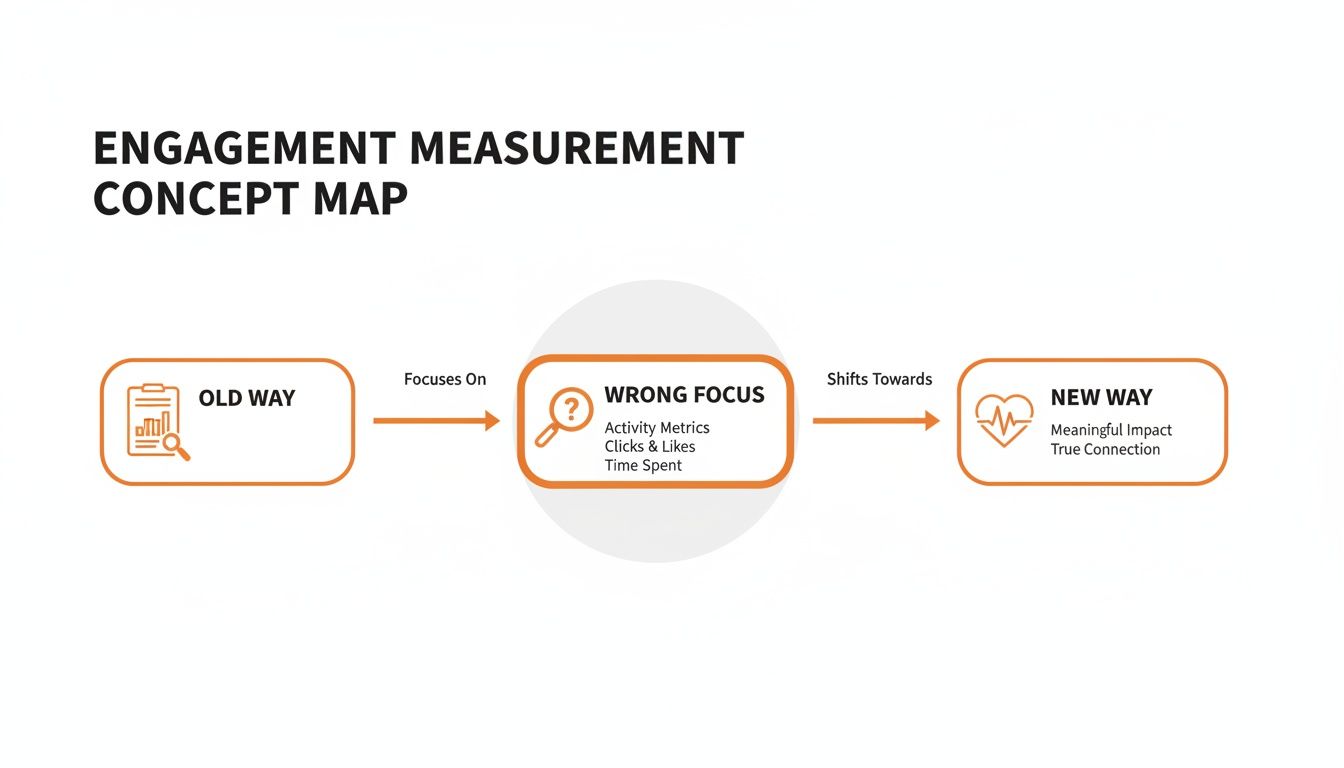
This image captures the move away from complex, after-the-fact reports toward a simple, real-time understanding of team health. It's like checking a heartbeat instead of waiting for an autopsy.
The Quality of Conversations
The second signal is the health of conversations, especially between managers and their teams. Are one-on-ones actually happening? And more importantly, are they any good?
A healthy one-on-one is never just a status update. It’s a dedicated space for coaching, honest feedback, and clearing roadblocks. It’s where trust is built. When these conversations are constantly rescheduled or feel like a chore, that’s a massive red flag.
I also look at the direction feedback flows. Does it only travel downhill, or do people feel comfortable challenging ideas? The goal isn’t constant agreement; it’s psychological safety. You know you have a foundation for real engagement when people feel safe enough to be candid. We explore this further in our deep dive on the 3 metrics that actually predict employee engagement.
The Energy in The Work
Finally, I look at the work itself. This is the most qualitative signal, but it's often the most telling. Are people shipping projects? Are they jumping into a Slack channel to help a colleague without being asked? Is there a tangible sense of forward motion?
You can see it. When a team is engaged, they produce. They solve tricky problems. They share what they’ve learned. When they’re disengaged, work slows, deadlines slip, and the energy evaporates.
This isn't about employee surveillance. It’s about paying attention to the natural byproducts of a healthy, functioning team. Engagement isn’t a feeling you manufacture with perks; it's what you get when the environment is right.
To get a clearer picture, it helps to compare the old methods with this new approach.
From Lagging Indicators to Leading Signals
The old playbook relied on metrics that told you what already happened. The modern approach tunes into signals that predict what will happen.
Outdated Method (Lagging Indicator) | Modern Approach (Leading Signal) | Why It's Better |
|---|---|---|
Annual Engagement Survey Score | Regular "Clarity & Blockers" Pulse | Provides real-time, actionable data on friction, not a stale snapshot. |
Employee Turnover Rate | 1-on-1 Frequency & Quality | Helps you spot relationship breakdowns before someone decides to leave. |
Absenteeism Data | Peer-to-Peer Recognition & Kudos | Shows proactive collaboration, a powerful sign of a healthy team dynamic. |
This isn’t just about swapping one metric for another. It’s a shift from a reactive, historical view to a proactive, continuous understanding of your team’s health. It’s the difference between driving by looking in the rearview mirror and looking at the road ahead.
Reading these signals doesn't require a complicated platform. It requires attentive managers and a culture of trust. You're not chasing a number; you're cultivating a quiet awareness of how your team is really doing.
Your Toolkit for Measuring What Counts
Alright, let’s get practical. It’s one thing to talk about signals; it’s another to build simple tools to capture them without creating a bureaucratic mess. This isn't about buying a big, complicated "solution." It's about being resourceful and focusing on what gets you clear information with the least friction.
After years of experiments, here's our stripped-down, no-nonsense toolkit. It’s designed to gather just enough data to spark better conversations, not drown you in spreadsheets.

The Two-Question Pulse Check
Forget long surveys. For years, our go-to pulse check has been a simple, automated message that goes out once a month. Not weekly—that’s just noise. Monthly is the right rhythm to spot trends without creating survey fatigue.
It asks just two questions:
On a scale of 1-5, how clear are you on what you need to do this month?
Is anything blocking your progress? (This is an open text field).
That’s it. The first question gives us a quick read on clarity. The second is where the gold is. It’s a direct line to the friction points—the broken processes, the confusing priorities, the resource gaps—that kill momentum.
We automate this with a simple Slack workflow. The results feed into a basic spreadsheet. No fancy software needed. The point is to make it lightweight.
One-on-Ones That Aren’t Status Reports
A good one-on-one is the most powerful engagement tool on the planet. A bad one is a waste of time. The difference is the agenda.
We encourage our managers to use a simple, shared document for every direct report, with a template focused on growth and removing obstacles. The agenda isn't about asking, "What are you working on?" It’s about asking better questions:
What’s one thing going well right now?
What’s been the most frustrating thing you’ve dealt with recently?
Is there anything I can do to make your work easier?
What’s one skill you’d like to develop?
This shifts the conversation from a backward-looking report to a forward-looking coaching session. It’s about development, not judgment. A manager’s job isn’t to track tasks; it’s to clear the path. A healthy work environment also leads to better output, making it useful to understand how to measure employee productivity as a tangible outcome.
Tracking The Good Stuff
The final piece of our toolkit is about capturing positive energy. We found that one of the purest signals of a healthy team is unsolicited peer-to-peer recognition. It’s a real indicator that people are paying attention, appreciate each other's work, and feel connected.
We have a public Slack channel called #kudos. Anyone can post in it to thank a colleague, celebrate a launch, or acknowledge a job well done. It’s not forced. There are no rewards. It’s just a space for genuine appreciation.
HR doesn't manage it. Managers don't mandate it. It lives on its own. We simply keep an eye on its activity. A vibrant kudos channel is a sign of strong team cohesion. A quiet one tells us something might be off.
It’s a simple, human metric. Are people helping and thanking each other? If they are, you’re probably doing a lot of things right. If they aren’t, no engagement score is going to fix that.
The ripple effects of this stuff are massive. Engaged teams don't just feel better; they deliver. Studies show engaged workplaces see 78% lower absenteeism, and turnover can drop by as much as 51%. These aren't just HR metrics; they're business results.
Putting these simple tools in place—a two-question pulse, a better one-on-one template, and a space for kudos—doesn’t require a budget. It just requires a belief that small, consistent, human interactions are what truly build an engaged team.
This isn’t about adding more work. It’s about making the work you’re already doing more meaningful.
How to Read the Signs Without Getting Lost
Collecting data is easy. We’re swimming in it. But turning all that noise into a clear signal? That’s the real work.
It’s tempting to stare at a number. An eNPS of +25. A pulse score of 4.2. A raw score, pulled from a single survey on a random Tuesday, is basically useless on its own. Context is everything.
Look For The Story
Instead of fixating on one number, we've learned to look for trends. You have to zoom out.
Is a team’s clarity score slowly trending down over a quarter? That’s a signal. It might point to a shift in strategy that wasn’t communicated well, or a manager who’s struggling to set priorities.
What if a manager’s one-on-one frequency drops off? That’s not a scheduling blip; it’s a leading indicator of potential team friction. These are the subtle patterns that matter far more than a single data point.
The most important question isn't "What's our score?" It's "What's the story this data is trying to tell us?" One data point is a guess. A trend is a conversation starter.
To really get to the heart of what's happening, it's critical to effectively analyze survey data. This is how you move from just collecting numbers to understanding the human story behind them.
Compare Groups to Find Hidden Friction
Another mistake is looking at the company as one big block. Your overall engagement score can easily hide serious problems in a specific corner of the business.
This is where cohort analysis comes in. It’s a simple way of slicing the data to compare groups.
By Department: How does engineering’s engagement compare to sales? A big gap might reveal process issues or leadership differences.
By Tenure: Are new hires less engaged than people who’ve been here for years? That could be a red flag for your onboarding.
By Location: If you have multiple offices, are there disparities? One office lagging behind could point to a local culture problem.
Comparing these groups helps you move from what the data says to why. It turns a vague, company-wide problem into a focused, solvable issue.
Forget Benchmarks, Find Your Baseline
One of the first questions I hear is, “What’s a ‘good’ score?” Everyone wants a universal benchmark. But here’s my take: external benchmarks are mostly a distraction.
Comparing your company to a "best-in-class" organization in a different industry is a waste of time. A 70% score at your startup might be a sign of trouble, while a 50% score at a massive institution could be a huge victory.
The only benchmark that matters is your own. The goal isn't to beat some industry average; it’s to get a little better than you were last quarter.
Here's a more practical approach:
Measure Consistently: Use the same simple pulse check for a few quarters. No changing the questions.
Establish Your Baseline: The average score over that period is your "normal."
Set Your Thresholds: Decide what a meaningful change looks like. A 5% drop from your baseline might be your trigger to dig deeper.
This is about understanding your own organization's rhythm. It’s about competing with who you were yesterday, not with a company you read about in an article. It’s a calmer, more honest way to measure what counts.
Why The Manager Is The Measurement
Here’s the thing we’ve learned above all else: you can’t separate team engagement from the person they report to. If a team is disengaged, the problem—and the solution—almost always lies with their direct leader. For years, we treated engagement as a big, nebulous issue for HR to solve. That was a mistake.
The single most accurate tool for measuring staff engagement is the manager. They aren’t just a factor; they are the entire system.
Your Managers Are Your Front-Line Sensors
Think about it. Who knows if a team member is struggling? Who sees the first signs of burnout? Who hears the quiet frustrations about a broken process? It’s not an annual survey. It’s the manager in the trenches with their team every day.
Equipping them to be better listeners is the most important investment you can make. They are your front-line sensors, picking up on the qualitative data—the tone in a meeting, the hesitation in a one-on-one—that no dashboard will ever capture.
This isn’t just a feeling. The data is clear. A stunning 70% of a team's engagement variance hinges directly on their manager. The full story behind these powerful manager impact statistics shows just how deep this connection runs.

Give Them Tools, Then Get Out Of The Way
This means giving managers the autonomy to solve the problems their teams face. It starts with giving them the data, but data is only the beginning.
More importantly, it means giving them the support to have tough conversations, push back on unrealistic deadlines, and advocate for their people. It means trusting their judgment. A manager who has to ask for permission for every small change can’t truly lead.
When a manager is engaged, their team is far more likely to be. When a manager is checked out or burned out, that feeling cascades downhill with frightening speed. Their engagement is the team's engagement.
Effective leadership communication is the cornerstone of this entire approach. To build a team of empowered managers, you must first understand how leadership communication impacts employee engagement.
Let’s be honest with ourselves. If you want to really understand and improve engagement, stop pouring energy into company-wide surveys and start developing your managers. They aren’t just part of the equation. They are the entire measurement.
Got Questions? We Get It.
When you rethink something as core as employee engagement, questions come up. Moving to a more intuitive, signal-based approach can feel a bit fuzzy at first.
Let's walk through some common questions with some honest answers.
How often should we be doing this?
The goal is to get into a natural, continuous rhythm.
Think of it less like a yearly physical and more like keeping a finger on the pulse. We’ve found that quick, lightweight pulse checks are great every few weeks or once a month. Any more than that and you risk survey fatigue. The qualitative stuff, like the vibe in one-on-ones, is about staying tuned in all the time, not constantly polling people.
What’s a good eNPS score?
Honestly? We don't lose sleep over eNPS. It’s a simple metric, but that simplicity is also its greatest weakness.
The question, “How likely are you to recommend this company as a place to work?” is a blunt instrument. A "good" score is completely relative. It’s a vanity metric.
Instead of chasing a number, it's far more powerful to ask why someone would or wouldn't recommend your company. The real insight is in the open-ended comments, not the score.
How do we measure engagement for our frontline teams?
This is a critical question. So many tools are built for people at a desk. The principles are universal, but your methods have to adapt.
Meet people where they are. Instead of a Slack poll, maybe it's a simple two-question SMS survey. Instead of a digital kudos channel, maybe you have a physical recognition board in the break room.
But the single most powerful tool for non-desk teams is the frontline manager. They are on the ground, seeing the signals firsthand—the body language, the energy levels, the informal chatter no survey can capture.
Trust their observations as a primary—and incredibly valuable—form of measurement.
Should we share the results with the whole company?
Yes, absolutely—but with care and context. Transparency builds trust.
What you should never do is share raw, team-level data publicly. That just turns into a blame game. The right way is to arm individual managers with their own team’s results and help them create simple action plans.
Your company-wide message should focus on the big picture: “Here’s what we learned,” and “Here are the two things we’re committed to improving.” This builds collective ownership, not a culture of finger-pointing.
At Pebb, we believe that communication and engagement are two sides of the same coin. Our all-in-one platform helps you connect with every employee, whether they're at a desk or on the front line, making it easier to listen to the signals that truly matter. See how Pebb can help you build a more connected and engaged workforce.
