
How to Improve Communication Skills in the Workplace
Learn how to improve communication skills in the workplace with practical, human-centered strategies. Build trust, clarity, and collaboration with your team.
Dan Robin
If you want to improve communication at work, forget the corporate jargon. It comes down to three things: truly listening to what people are saying, speaking with enough clarity that there's no room for guesswork, and giving feedback that actually helps people grow. It’s not about buzzwords; it’s about respecting each other’s time and attention.
Let’s be honest about workplace communication
We’ve all been there. Stuck in a meeting that should have been an email. Trying to decipher a vague request that wastes half your day. These aren't just minor annoyances; they're symptoms of a bigger problem.
It’s not like we don’t have the tools. We’re drowning in apps that promise to keep us connected, yet real connection feels miles away. The real issue is a breakdown in thoughtful, intentional communication—the invisible friction that grinds down morale and kills productivity.
The numbers back this up. A staggering 86% of employees and executives point to poor communication as the main reason for workplace failures. On top of that, 63% say it's their single biggest time-waster. There's a huge gap between what we mean to say and what people actually hear.

Moving beyond the buzzwords
Getting better at how we talk to each other isn't some abstract HR project. It's about building practical, everyday habits that foster trust and help us do work that matters. So, this guide isn't going to tell you to "circle back" or "synergize." Instead, we're going to get real about what it actually takes to communicate well.
The goal is to shift from communication that just passes along information to communication that builds a shared understanding. That's where the real magic happens.
At its heart, solid workplace communication means being clearer, listening more intently, and treating everyone's attention like the precious resource it is. This guide is about the small, deliberate changes that have an outsized impact. We’ll start with the most powerful—and most overlooked—skill of all: listening.
Mastering the underrated power of listening
Most of us think we’re good listeners. We sit quietly, nod along, and wait for our turn to speak. But let’s be honest: that’s just waiting to talk.
Real listening is an active, and frankly, sometimes difficult practice. It means silencing your own internal monologue—your rebuttals, your brilliant ideas, your next talking point—and focusing on genuinely understanding what the other person is trying to say. It's a skill that can single-handedly stop countless misunderstandings before they start. It builds the kind of trust that holds a team together.
Hearing the words vs. understanding the meaning
Picture a one-on-one meeting. Your team member is describing a roadblock, but you’re already formulating solutions in your head. You hear the problem, sure, but do you hear the frustration behind their words? Do you notice the hesitation that hints at a bigger issue they aren’t ready to bring up?
This is where the real work of communication happens—in the space between the words. A simple yet powerful habit is to confirm what you’ve heard before you jump in with a response.
Try saying something like, “Okay, so if I'm understanding you correctly, the real issue isn't just shipping the feature, but figuring out why the customer data is so inconsistent. Is that right?”
That one sentence does two crucial things. First, it proves you were actually listening. Second, it gives them a chance to clarify before you both charge off in the wrong direction. This small habit is a cornerstone of making people feel genuinely respected and heard.
Turning listening into a team sport
This isn't just a skill for managers; it's a habit the whole team needs to build. In meetings, it means creating space for people to finish their thoughts without being interrupted. It means asking clarifying questions instead of defaulting to assumptions.
Here’s a practical way to get this going: in a heated discussion, make it a rule that anyone who wants to speak must first paraphrase the previous person's point. It feels a little clunky at first, but it forces everyone to slow down and actually process what’s being said. Another idea? Embrace the pause. After you ask a question, try waiting five full seconds before saying anything. It gives the more thoughtful people in the room time to formulate a great response.
Ultimately, great listening boils down to curiosity. It's about entering a conversation with the mindset that you have something to learn, not just something to say. Learning how to make employees feel heard is less about memorizing techniques and more about a genuine shift from broadcasting your own ideas to truly receiving someone else's.
Why clarity is the ultimate form of kindness
We’ve all gotten that email. The one-liner that says, “Can you look into this?” No context. No deadline. No clue what “this” even is. What seems like a simple request becomes a time-sucking scavenger hunt, forcing you to chase down the sender just to figure out what they want.
This isn't a minor annoyance; it’s a symptom of ambiguity, the silent killer of productivity. When our communication is vague, we aren't saving time—we're just pushing the hard work of creating clarity onto someone else. Being clear isn’t about being bossy. It's one of the most fundamental ways we can respect our colleagues' time and focus. It’s the kindest and most efficient way to get things done.
The anatomy of a clear request
Switching from vague to clear isn't complicated. It just takes a moment of thought. Before you hit send, run through a quick mental checklist.
Start with the goal. Why are you asking for this? Giving someone the "why" helps them see the bigger picture and make smarter decisions without having to constantly check in. Next, provide the essential context. What do they need to know to get started? Finally, define the expected outcome. What does "done" actually look like? Be specific about the format, the deadline, and the action you need them to take.
The difference between "Please check on the sales numbers" and "Can you pull the Q3 sales report, highlight the top three performing regions, and send it to me as a PDF before our 3 PM meeting?" is the difference between friction and flow.
Think of it like this: you can't truly understand or confirm something if the message was murky from the start.
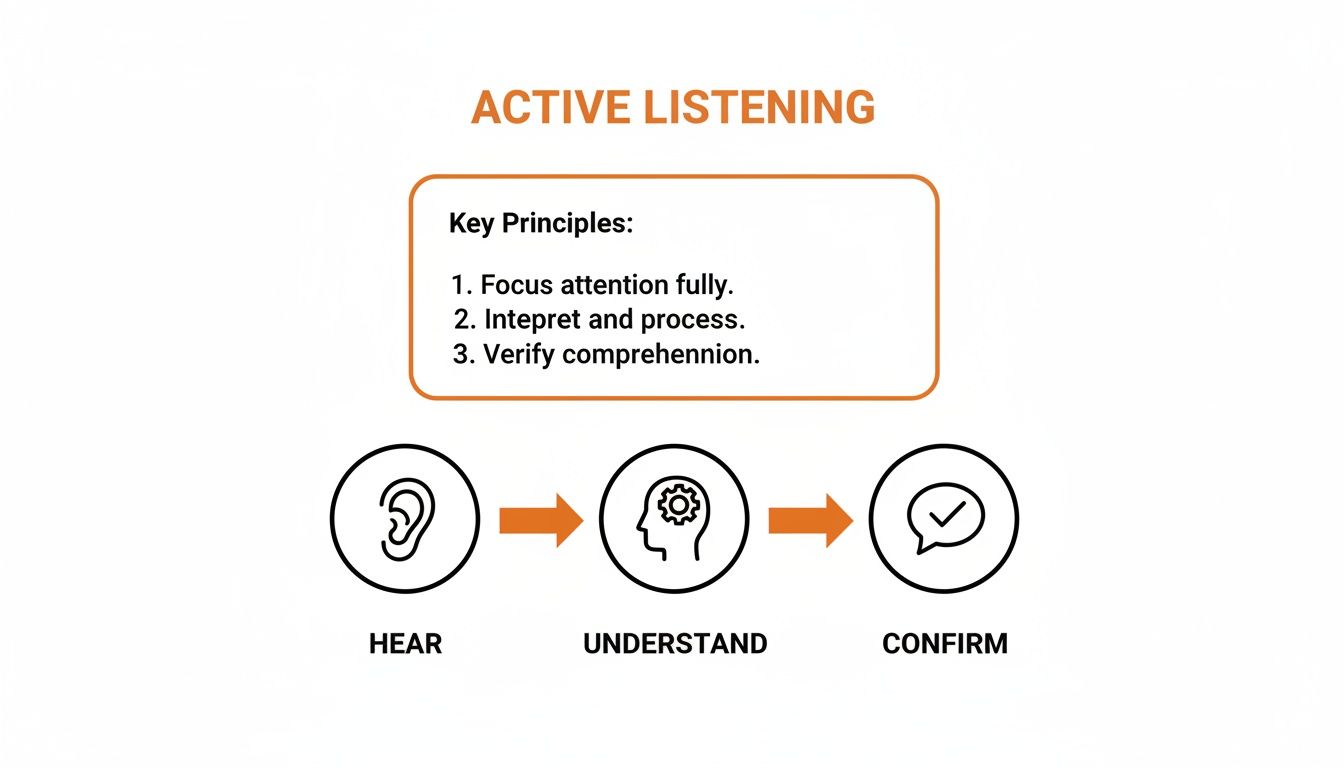
This whole process—hearing, understanding, and confirming—is a two-way street, but it stalls if the initial request is a dead end.
From vague requests to actionable communication
Seeing the difference in action makes it obvious. Vague requests create a cycle of follow-up questions. Clear alternatives get things moving.
Vague Request | Clear & Actionable Alternative | Why It Works |
|---|---|---|
"Can you look into the website bug?" | "Can you investigate the 'Submit' button error on the contact page? It's not working on Chrome. Please find the root cause by EOD." | Specifies the exact problem, location, and a clear deadline. |
"I need your feedback on the draft." | "Please review pages 3-5 of the proposal for factual accuracy and tone. Add your comments to the Google Doc by Tuesday at 4 PM." | Defines the scope (which pages), the type of feedback needed, and the deadline. |
"Let's touch base on the project." | "Can we schedule a 15-minute sync to finalize the marketing budget for the Q4 launch? Please come prepared with your latest estimates." | Sets a clear agenda, time limit, and expectation for what to bring to the meeting. |
"Update me on your progress." | "Please send me a bullet-point summary of your top three accomplishments and any blockers you're facing this week by Friday morning." | Asks for a specific format and focuses on the most critical information. |
The goal isn't to micromanage. It's to eliminate the back-and-forth that wastes everyone's energy.
Stripping out the fluff
Clarity also comes from ruthless editing. We often pad our writing with filler words and corporate jargon because we think it sounds more professional. Phrases like “I was hoping we could circle back to leverage the synergies…” don’t add value—they just create a fog of confusion.
Try this: before you send an important email, read it out loud. Does it sound like something a real person would say? If not, rewrite it.
Instead of: "It would be greatly appreciated if you could provide an update..."
Try: "Can you send me an update by noon?"
This isn’t about being blunt. It's about recognizing that the most valuable thing you can give a busy colleague is a message that’s easy to understand and act on. It’s a quiet habit, but its impact is massive. When you commit to being clear, you raise the bar for everyone around you.
Giving feedback that actually helps people grow
Let’s be honest. Most of us get tense when it's time to give feedback. We often use the “feedback sandwich”—a slice of praise, a bit of criticism, then more praise—hoping to cushion the blow. But it usually just leaves people confused, bracing for the inevitable "but."
The point of feedback isn't to soften a critique or check a box. It's supposed to be a tool for growth. When done poorly, it feels like a personal attack. There's a better way. It’s about having direct, honest conversations rooted in kindness and a shared goal of getting better.

A simple model for better feedback
Great feedback focuses on an observable behavior and its impact, not on personality. This simple shift removes the personal sting and keeps the focus on the work. I've found a straightforward, two-part formula works wonders: “When you do X, the impact is Y.”
This model works because it deals in facts, not feelings. It moves the conversation from accusation to observation.
For example, instead of saying, “You’re unreliable”—a vague judgment that puts someone on the defensive—try this: “When the weekly project updates are a day late, it delays the rest of the team’s planning for the week.”
See the difference? This isn't a confrontation; it's a statement of cause and effect. It's hard to argue with and opens the door to a productive chat about why it happened and how to fix it. This is how you build a culture where feedback is seen as a tool to help everyone improve. We explore this in our complete guide to employee feedback, which offers more examples and tips.
It’s not just about giving it
Of course, communication is a two-way street. Learning to receive feedback gracefully is just as important as giving it well. It’s human nature to get defensive when we hear criticism; our brains are wired to see it as a threat.
The key is to train yourself to pause before you react. Seriously, just take a breath. Instead of jumping in with an explanation, just listen.
Your first response should always be a clarifying question, not a defense. Something as simple as, “Can you give me a specific example?” or “Help me understand the impact that had” can completely change the dynamic.
This approach shows you’re treating the feedback as valuable information, not a personal attack. And it buys you a moment to process what was said while signaling to the other person that you’re genuinely trying to understand.
Feedback isn't a one-off event; it's an ongoing dialogue. When a team masters these small, direct, and respectful exchanges, continuous improvement stops being a buzzword and becomes how you actually get work done.
Adapting your style for a global team
The idea of a single "office" feels almost nostalgic now, doesn't it? Our teams are spread across cities, countries, and continents, making cross-cultural communication less of a niche topic and more of a daily reality. Getting this right isn’t about memorizing cultural stereotypes; it’s about developing a more thoughtful and flexible approach to how we connect.
It starts with simple things, like the words we choose. I once used the phrase "let's hit a home run" in a project kickoff with a global team. The silence was deafening. My American baseball metaphor meant nothing to my colleagues in Berlin and Mumbai. It was a good reminder: clarity means ditching idioms and slang that don’t travel well.
Finding a shared language
But that’s only half the story. The real challenge is navigating different cultural approaches to directness, feedback, and even silence. In some cultures, getting straight to the point is a sign of respect. In others, it can come across as rude. There’s no single "right" way.
This is where establishing clear, team-wide norms is so important. Instead of leaving it to chance, have an open conversation about it. You could decide together: "On this team, we'll give feedback directly but always in a private message, focusing on the work, not the person." Setting these ground rules creates a shared language that respects everyone's background. It's also crucial to acknowledge the unique challenges faced when understanding a second language but struggling to speak it. Patience is key.
Asynchronous work as the great equalizer
Here’s the thing about a global team: you'll almost never all be in the same room at the same time. This is where asynchronous communication becomes your best friend. It’s not just for managing time zones; it’s a powerful equalizer.
When you move important discussions out of fast-paced, real-time meetings and into shared documents or project threads, you give everyone a chance to contribute thoughtfully. Your team members who aren't native English speakers get time to compose their thoughts without the pressure of a live conversation. Your deep thinkers get the space they need to reflect.
A well-written update is more inclusive than a fast-paced meeting. It levels the playing field, ensuring the best idea wins, not just the loudest or fastest voice.
The modern workplace is global. A 2024 McKinsey study found that diverse teams are more innovative. But that diversity only pays off if everyone can contribute effectively. Research on workplace communication trends at Pumble.com shows 62% of corporate employees work with colleagues from three or more cultures, making this skill essential. Adapting isn't about losing your style. It’s about expanding it—becoming more patient and more intentional about creating a space where everyone can do their best work together.
Building the quiet habits that last
Improving how we talk to each other isn't a project with a start and end date. It's more like a craft you hone over time. Real change doesn't happen because of some company-wide initiative. It’s built on the small, quiet habits we practice every day.
Think about it. Big gestures are memorable, but it's the small, consistent rituals that actually shift a culture. One of the simplest is the agenda-and-action-items rule. Start every meeting by stating the goal. End it by defining who is doing what, by when. This isn't bureaucracy; it's respecting everyone's time.
The power of the personal retro
Another powerful habit is the personal retrospective. After a tough conversation or a tricky project meeting, take two minutes to reflect. Ask yourself: What went well? What could I have done differently?
This isn’t about self-criticism. It's a simple way to build self-awareness. You might realize you cut someone off, or that one clarifying question could have saved thirty minutes of confusion. This habit costs nothing but a moment of honest thought, and the returns are massive. You can find more resources with practical exercises to improve speaking skills to help build these habits.
The goal isn't to achieve perfect communication overnight. The goal is to get a little bit better, a little bit clearer, and a little bit more intentional each day.
In the end, these small, consistent actions add up. They create a ripple effect, slowly building a workplace that's not just more productive, but more thoughtful and human. It's the steady, quiet work that builds the kind of communication that truly lasts.
Frequently Asked Questions
What's the single most important communication skill?
If I had to pick just one, it’s active listening. Hands down.
So many problems—misunderstandings, missed deadlines, hurt feelings—happen because we're too busy thinking about our reply instead of actually hearing what someone is saying. When you truly listen to understand, you build trust and make people feel seen. Everything else flows from that foundation.
How can I communicate better with a manager who is a poor communicator?
This is a tough one. You can't force your manager to change, but you can control your side of the conversation to create clarity where there is none.
My best strategy has always been to become the "master of the follow-up." After a vague meeting or a confusing request, send a short, simple email to confirm your understanding. Try something like, "Just to make sure I'm on the right track, my understanding is that the next steps are X and Y, due by Friday. Does that sound right?"
This does two things: it creates a written record and gently nudges them toward being more specific without you having to be confrontational.
Are tools like Slack and Teams helping or hurting?
This is the million-dollar question, isn't it? Here's my take: these tools are just amplifiers.
If your team already has healthy communication habits—being clear, respecting each other's time—then tools like Slack or Microsoft Teams can make you faster and more connected.
But if your communication habits are a mess—vague requests, constant interruptions, passive-aggressive DMs—those same tools will only amplify the chaos.
The tool itself is never the fix. The real solution comes from your team agreeing on how you'll use it.
Ready to transform your team's communication from chaotic to clear? Pebb brings all your internal communications—from one-on-one chats to company-wide announcements—into one seamless platform. See how Pebb can help your team today.
