
The Mess We Made With Messaging
Explore how instant messaging and business communication can move beyond fragmented chats to create a calm, unified operational hub for your entire team.
Dan Robin
Instant messaging was supposed to be the answer. For years, it promised to fix business communication, to make work simpler. Instead, it just added to the noise. We traded one overflowing inbox for a dozen blinking apps, each one claiming to be the magic bullet. The reality? A complete mess.
We’ve lived this story. And if you’re reading this, you probably have too.
The Great Unbundling Broke Our Workday
Let’s be honest. The whole pitch for modern workplace tech was to make our lives easier. For a long time, it did the exact opposite. We were sold this idea of specialized, "best-in-class" apps, where every tool would solve one tiny problem perfectly.
So you got a tool for chat. Another for tasks. A third for schedules, and maybe a fourth for company announcements. It looked good on paper. It was a disaster in practice.
The Fragmentation Problem
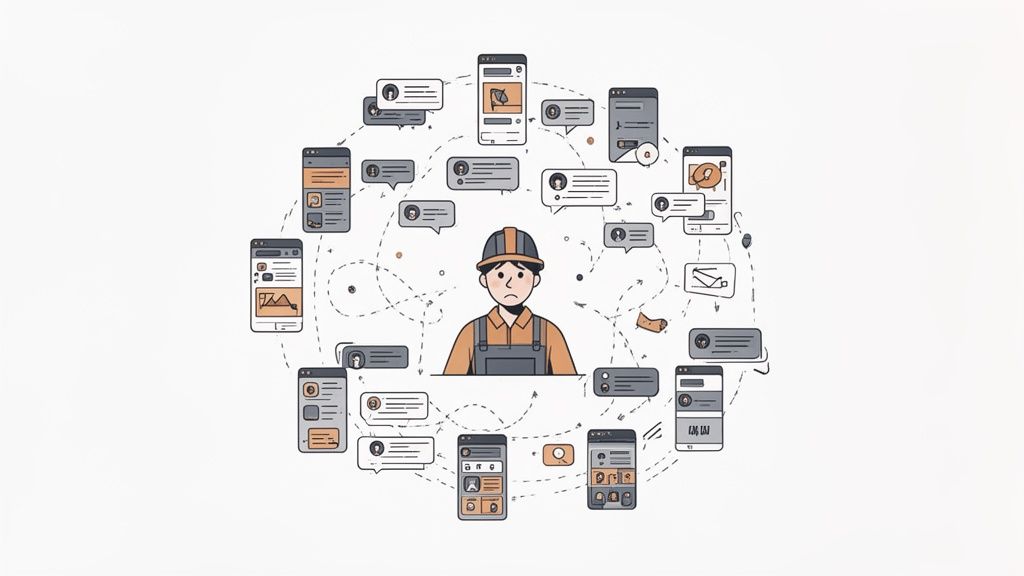
What we actually got was a workday shattered into a million little pieces. Each app became its own island, cut off from everything else. This created a jarring, fragmented experience that hit our frontline teams the hardest—the very people who aren’t sitting at a desk all day.
We ended up with a digital junk drawer. Important information was scattered everywhere, context was constantly lost jumping between apps, and finding a simple file felt like a treasure hunt.
This isn't just inefficient; it’s exhausting. Think about it: one study found the average employee gets hit with 153 messages on their team apps every single day. When those pings come from half a dozen different places, it creates a constant hum of distraction that’s impossible to tune out.
The Human Cost of Too Many Tools
This "great unbundling" of work led to some pretty predictable problems. Notification fatigue became the new normal. Information gaps between departments grew wider. The tech that was supposed to bring us closer actually created a real disconnect between teams. We’ve written about this before—you can learn about the real cost of communication silos and how to break them.
Here’s what that broken system actually feels like:
Lost Context: A conversation about a project starts in a chat app, but the final decision is buried in an email chain, while the action items live in a totally separate task tool. The thread is broken.
Duplicated Work: Without one central place for everything, teams waste time redoing work that already exists, all because they couldn’t find the original.
Employee Burnout: Constantly switching between apps isn't just a chore. It makes people feel like they’re always on, perpetually trying to catch up, and never in control of their workday.
The point here isn't just to complain. It's to acknowledge something we've all felt. If you’ve ever been overwhelmed by the very tools meant to help you, you’re not alone. We’ve been there. Trying to run a business on a dozen different apps just isn't sustainable.
Instant Messaging Was Never Just About Speed
For a long time, we got stuck on the idea that instant messaging in business was all about speed. It seemed obvious. The goal was simply to make conversations happen faster than email. Let's be honest, it was an easy trap to fall into. The word "instant" is right there in the name.
But that’s only half the story. The real game-changer wasn't just velocity. It was making communication conversational and continuous—a lot more like how we actually talk and think.
Email is transactional. It’s a series of starts and stops. You send a formal request and wait for a formal reply. It’s great for creating archives, but not so much for creating dialogues. Messaging, on the other hand, feels like a living conversation. It’s an ongoing stream of consciousness that builds and evolves.
From Static Records To Living Conversations
Think about it this way: an email chain is like a stack of letters. Each one is its own self-contained package. A message thread is more like the shared whiteboard in a project room—a little messy, dynamic, and constantly being updated by the team.
That distinction is everything. When communication flows like a real conversation, it changes how teams work. Problems get solved in the moment instead of being scheduled for a meeting next Tuesday. Ideas get workshopped collaboratively on the fly, not pitched in a formal document that took hours to perfect.
The goal was never just to send messages faster. It was to create a shared space where the pulse of the company could be felt in real-time—a single source of truth that moves as fast as the business does.
This living conversation is where company culture is built. It’s where inside jokes are born, where a quick "good job!" in a group channel makes someone’s day, and where a team instantly rallies to tackle a tough challenge. You just can't get that energy from an inbox.
Keeping Everyone on the Same Page
The real power of this continuous dialogue is how it naturally breaks down silos. When discussions happen in open channels instead of being locked away in private inboxes, information becomes accessible. A junior designer can see the context behind a marketing decision. A warehouse manager can understand a sudden change in shipping priorities without waiting for a formal memo.
This transparency keeps everyone aligned, from the executive team down to the frontline crew. It’s about more than efficiency; it’s about creating a shared understanding of what’s happening and why it matters. We’ve gone deeper on how real-time communication improves teamwork if you’re curious.
The scale of this shift is massive. Just look at the tools people use every day. WhatsApp, for example, connects over 3 billion monthly active users worldwide. Its platform delivers roughly 150 billion messages daily, which shows just how deeply this conversational model is woven into our lives.
For businesses looking to adopt this model, moving beyond basic speed often means exploring advanced tools. Sometimes, this even leads to building a custom chat messaging app that fits a company's unique workflow perfectly.
No matter the tool, the core idea is the same. It’s not about how quickly you can fire off a message. It’s about creating a continuous, shared space where work happens, culture grows, and everyone stays connected. That was the quiet revolution, and it was never just about speed.
Connecting The Two Halves Of Your Company
I’ve seen it in countless companies: the business is split into two different worlds. It's an unspoken truth, but it’s there. You have the office workers, glued to their laptops and a reliable Wi-Fi signal. Then you have the frontline workers.
These are the nurses making rounds on a busy hospital floor, the cashiers managing a slammed retail store, or the drivers navigating a delivery route. For far too long, the technology we built for work served one of these worlds beautifully while completely ignoring the other. This created a divide that wasn’t just digital—it was cultural.
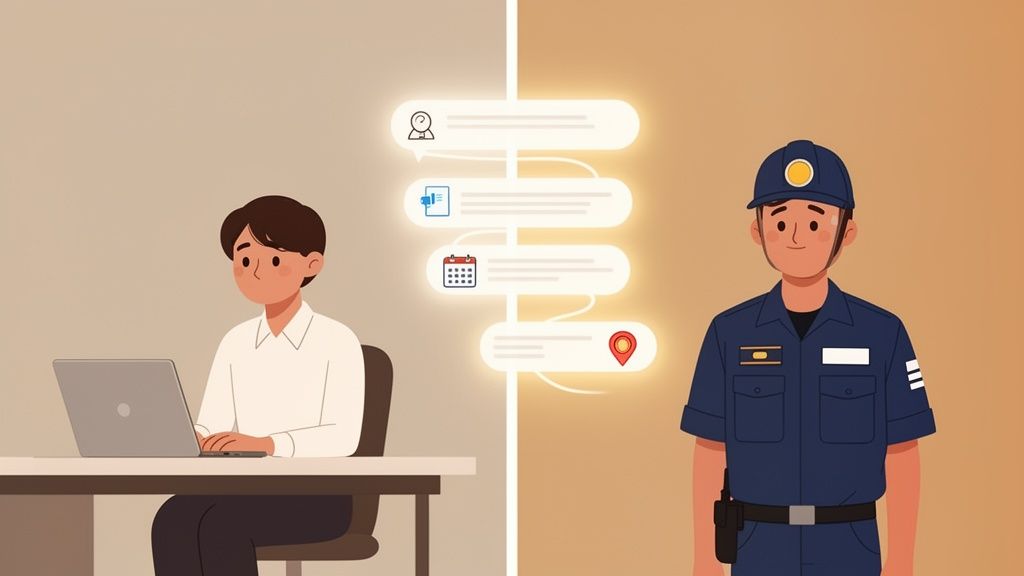
The real challenge was never just about pushing messages out to people who don't have a desk. It was about making them feel like a valued part of the same company, with access to the same information and a connection to the same mission. This is where a thoughtful approach to instant messaging and business operations can truly change the game.
More Than Just A Chat App
Let's be real for a second. Handing a frontline team a basic chat app is like giving a construction crew a single hammer and expecting them to build a skyscraper. Sure, it’s a tool, but it’s not a complete system. The real magic happens when instant messaging becomes the central nervous system for the entire organization.
This isn't about replicating the office experience for frontline teams. It's about building a new, shared experience that actually works for everyone, no matter where they clock in.
Think about a logistics company. The dispatch team at headquarters needs to communicate a last-minute route change. In the old world, that meant a frantic phone call or a text that gets lost in a sea of personal notifications. In a unified system, it’s a direct message in a dedicated channel that every driver sees instantly, with a map pin attached. It’s calm, clear, and confirmed.
Practical Realities In The Real World
The gap between the office and the front line isn't just about communication; it's about operations. Things like shift scheduling, task management, and critical policy updates often live in systems that frontline workers can't easily get to.
A truly integrated platform bridges that gap.
In Healthcare: A nurse can use a secure channel to quickly confirm a patient's medication change with the on-call doctor, slashing delays and reducing errors. The old way? Pagers and endless phone tag.
In Retail: A store manager can share new visual merchandising guidelines with the entire team through a post in their store’s channel, complete with images and instructions. Everyone gets the update before their next shift.
In Logistics: A warehouse supervisor can assign a rush order to a specific team member through a task feature inside their chat, tracking its progress without ever leaving the conversation.
In each of these scenarios, instant messaging isn’t just for talking. It’s for doing. It becomes the connective tissue that links the strategy discussed at headquarters to the execution happening on the ground floor. It’s the platform where work gets done.
The shift from disjointed tools to a unified platform is a big one. Here’s a quick look at how it changes daily operations:
Old Way vs New Way of Frontline Communication
Operational Task | Fragmented Tools (The Old Way) | Unified App (The New Way) |
|---|---|---|
Urgent Updates | Phone calls, personal texts, word of mouth | Instant message in a dedicated channel |
Shift Scheduling | Posted paper schedules, separate scheduling app | In-app schedule viewing, swaps, and requests |
Task Assignment | Verbal instructions, checklists on clipboards | Digital tasks assigned and tracked in-app |
Policy Changes | Handouts in the breakroom, buried emails | Pinned post with read-receipts in the team channel |
Team Recognition | Occasional mention in a meeting | Company-wide channel for celebrating wins |
This table highlights the jump from chaotic, manual processes to a single, coherent workflow where nothing falls through the cracks.
Fostering A True Sense Of Community
Beyond all the operational nuts and bolts, a unified platform is where a company’s culture actually lives. It gives everyone a voice, from the CEO in the corner office to the part-time cashier. A company-wide channel for "wins" lets a warehouse worker in Ohio celebrate a record shipping day with a marketing manager in California.
That's not a small thing. It’s what transforms a collection of employees into a real team. It builds a sense of loyalty and belonging that you can't manufacture with a corporate newsletter.
And the data backs this up. Businesses that use messaging see incredible results. Those texting customers are 683% more likely to succeed in their digital marketing, with open rates of 90-98% that blow email’s typical 20-30% out of the water. This same power works wonders for internal teams. You can discover more insights about messaging effectiveness that show how 63% of organizations now use SMS for scheduling and reminders alone.
Ultimately, the goal isn’t to find the perfect chat app. The goal is to find a single, coherent space where the two halves of your company can finally come together, communicate clearly, and work as one. It's about building a bridge, not just sending a message.
The Hidden Costs Of 'Free' Messaging Apps
It’s tempting. I get it. Especially when you're just starting out. Your team needs to talk, and everyone already has WhatsApp or Messenger on their phones. Setting up a group chat is free, quick, and feels like a clever shortcut.
But that feeling doesn't last. What starts as a scrappy, cost-saving move soon becomes a major liability. The "free" part is a mirage. The real price you pay is hiding in plain sight.
You aren’t saving money. You’re trading it for risk, disorganization, and a slow drain on your team's focus.
The Security And Compliance Nightmare
The biggest problem is a total lack of control. When your business communication lives inside a consumer chat app, you have zero administrative oversight.
Think about it. Who has access to your sensitive company data? Anyone in the group chat. What happens when an employee leaves? All that proprietary information walks right out the door with them, still sitting on their personal phone. You have no way to manage permissions, revoke access, or make sure confidential files stay confidential.
These 'free' tools weren't built for business. They were built for casual chats between friends. Using them for work is like leaving the front door of your office wide open.
This goes from risky to downright dangerous in regulated industries like healthcare or finance. Compliance with laws like HIPAA or GDPR isn't a suggestion—it's the law. A single violation from a careless conversation on a non-compliant app can lead to crippling fines. For any serious business, that risk alone should make free apps a non-starter. We wrote a deeper comparison between secure messaging versus non-compliant platforms if you want to understand the stakes.
The Blurring Line Between Work And Life
Then there's the human cost. When your team is talking shop on the same app they use to coordinate weekend plans, the boundary between work and life evaporates.
Work notifications start pinging at all hours, pulling people back into work mode long after they've clocked out. A casual question feels urgent when it pops up next to a message from their mom. This constant "on" switch is a straight path to burnout.
A proper business communication tool creates a much-needed separation. It’s a dedicated space for work. When you're in the app, you're at work. When you log off, you're done. That simple distinction is vital for protecting your team’s sanity.
Here's a rundown of what those "free" apps actually cost you:
Data Breaches: Without real security controls, your sensitive information is a sitting duck.
Compliance Fines: One audit can uncover huge violations, leading to fines that make a professional tool look like pocket change.
Lost Productivity: Trying to find a file in a chaotic, endless chat thread is a massive time-waster. One study found that employees lose over 35 days a year to bad communication habits.
Employee Burnout: The always-on culture that personal chat apps create leads directly to higher stress and, eventually, higher turnover.
At the end of the day, those so-called free apps are anything but. They expose your company to major threats, create compliance headaches, and burn out your best people. A dedicated business communication app isn't a luxury—it's foundational.
From Messaging To An Operating System
For years, we all assumed the future of business messaging was just… more messaging. Quicker replies, more emojis, maybe better video calls. But that was a failure of imagination. The real evolution isn't about adding more chat features. It's about the chat app itself becoming the central operating system for how your team works.
This is a huge shift. It’s the idea that your conversations, your operations, and your culture shouldn't be in different apps. They belong together, in one place where conversation is the engine for work.
The Conversation as The Command Center
Think about it. When a new project starts, where does it really begin? In a conversation. The message thread is where the first idea is shared, where the team throws around possibilities, and where the first decisions are made. So why would we immediately leave that living history and scatter the work across a dozen other tools?
When you treat your communication platform like an operating system, that message thread becomes the project hub.
You don't "switch" to a task manager to assign something. You create and assign the task right there in the conversation where it came up. The context isn't lost because the context is the work.
This is what it looks like in practice. A manager shares a new policy document in the team channel, and that file is automatically saved into a searchable knowledge base. A frontline employee requests time off right from their schedule, which lives in the same app they use to chat with their supervisor. Nothing gets lost.
When a platform is designed this way, instant messaging and business tools merge into a single digital home for the entire company, boosting both efficiency and a genuine sense of connection.
Integrating The Tools of The Trade
This isn't just theory; it's a practical way to calm the chaos. Instead of constantly toggling between apps, everything you need is built right around the conversation itself.
Task Management: Assigning a to-do is as simple as tagging a colleague in a message.
File Sharing: Key documents live alongside the discussions about them, not buried in some forgotten folder.
Knowledge Libraries: Important announcements and procedures are automatically archived and easy to find.
Scheduling: Shift swaps and team calendars are handled without ever leaving the app.
Of course, some businesses have unique needs that an off-the-shelf tool can't handle. In those cases, a bespoke software development service can build a truly custom system, transforming a simple messaging app into an operating system that fits perfectly.
The chart below shows exactly why this is so important, breaking down the risks that come with using free, disconnected consumer apps for work.
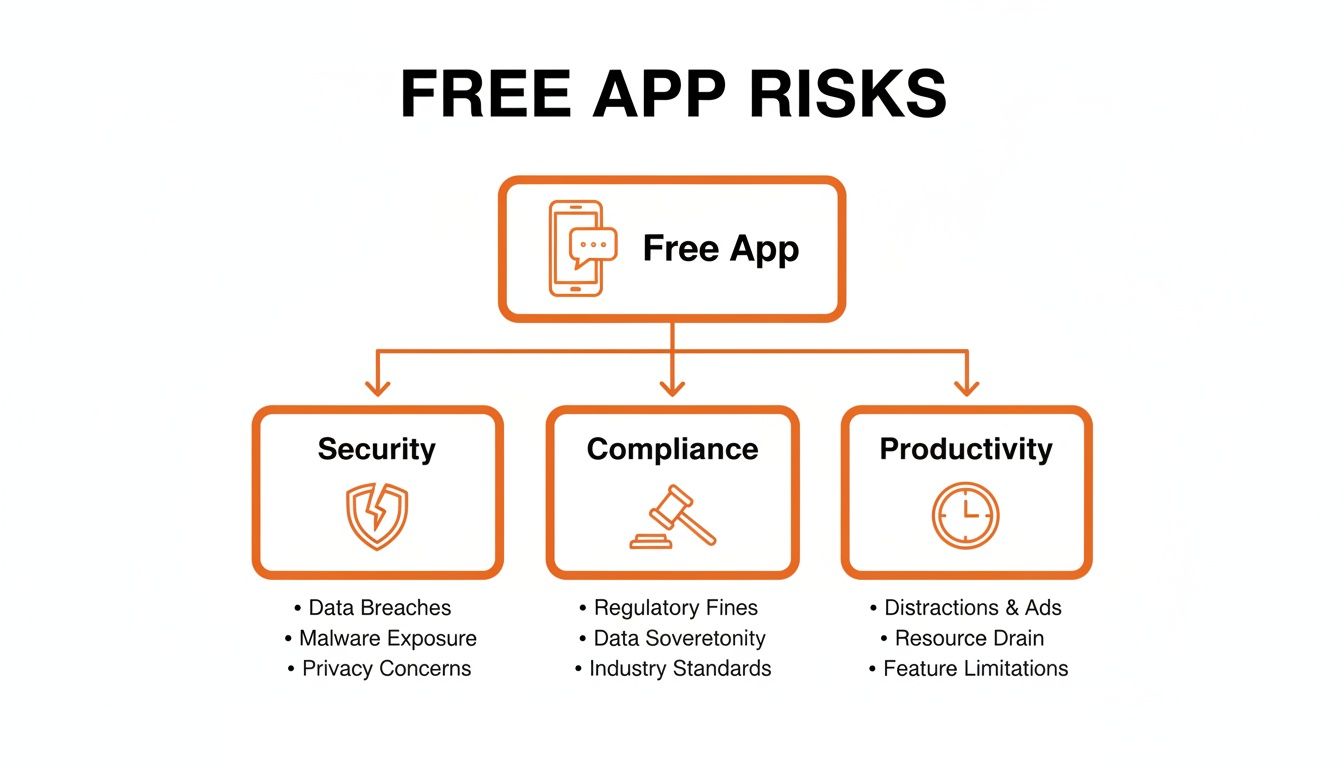
This drives the point home: a purpose-built system is designed to solve these problems from the beginning, not as a messy afterthought.
The momentum behind this all-in-one approach is undeniable. Global business messaging traffic is projected to hit nearly 3 trillion messages by 2030. A huge part of that growth is this shift toward richer experiences where people can do more than just talk.
In the end, this evolution is about one thing: calm. It’s about taking the digital clutter of a dozen different apps and bringing everything together into one thoughtful space. It’s not just a better way to chat. It’s a fundamentally better way to work.
So, What's Next?
We've walked through the digital chaos many teams are drowning in. We’ve talked about a calmer, more unified way of working. But reading an article is one thing. Making a real change is another.
So where do you go from here?
This isn't a sales pitch. It's an invitation to pause and think about the tools your team relies on every day. Take an honest look at your company's tech. Does it feel like a cohesive machine, or more like a constant, low-level headache nobody wants to admit to?
Asking the Right Questions
The software we choose does more than just help us get work done—it sets the tone for our culture. It dictates how colleagues connect, how information travels, and whether your team feels like a unified force or just a group of people working near each other.
It’s worth asking some tough questions:
Is our current setup bringing people together, or is it creating invisible silos?
Are our tools actually making work simpler, or are they just adding more clicks?
Could a new hire get up to speed without having to learn four different apps just to find one piece of information?
Let's be real. The answers to these questions cut right to the heart of how your business operates. The connection between instant messaging and business isn't just a technical detail; it’s a deeply human one.
The goal shouldn't be to collect more apps. It should be to find more clarity. It's about choosing calm, connected work over the scattered, frantic energy of a dozen tools fighting for our attention.
It all comes down to a simple choice: deciding that communication isn’t just part of the business—it is the business. Everything else rests on that foundation. What kind of foundation are you building on?
Got Questions? We've Got Answers
Thinking about moving your company's communication to an instant messaging platform brings up a lot of questions. Good. We’re talking about the communication hub for your entire business. It pays to be thorough.
Let's dig into a few of the most common questions we hear.
Is It Secure To Use Instant Messaging For Business?
This is usually the first question, and the answer is: it depends entirely on the tool you pick.
If your teams are using consumer apps like WhatsApp or Facebook Messenger for work, then no, that's not secure. Those tools were built for personal chats, not for protecting sensitive business information.
A dedicated business communication platform is built from the ground up with security in mind. It's not an afterthought; it's the foundation.
Think of it this way: you wouldn't use a personal email for official company finances. The same logic applies here. Proper business tools come with non-negotiable features like end-to-end data encryption, administrative controls, and the ability to manage who has access to what. These are essential for keeping your company's data safe.
How Does Instant Messaging Improve Frontline Engagement?
For your frontline workers—the people in your stores, warehouses, or out in the field—a dedicated messaging app is more than a chat tool. It’s their lifeline to the rest of the company. It’s their digital HQ.
It’s where they get urgent safety alerts, check shift schedules, or pull up a training video on their phone. A company-wide channel for shouting out a big sales win can make a driver in Texas feel connected to a cashier in Florida. It builds a sense of a single, unified team.
This direct line of communication makes people feel seen and valued. It’s a powerful way to boost engagement and hang onto great employees, especially in industries that fight high turnover.
Won't More Messaging Create More Distractions?
This is probably the biggest fear we hear, and it’s a valid one. Nobody wants to replace email chaos with chat chaos. The concern is that more messages will just create more noise.
But here’s the thing: that feeling of distraction usually comes from using the wrong tools—a messy patchwork of texts, emails, and consumer chat apps. A great business messaging platform does the opposite. It cuts through the noise.
Instead of scattered conversations, everything is organized into specific, searchable channels. You can follow the conversations that matter and mute the ones that don't. Threads keep side-chats from derailing a project update. It’s all about creating a more focused, organized, and dare we say, calmer way to communicate.
Ready to replace chaos with calm? Pebb is the all-in-one work app that brings your communication, operations, and culture together in one simple, modern, and delightful space. See how Pebb works.
