
A Guide to Improving Organizational Culture Without the Nonsense
Stop chasing perks. This is a practical guide to improving organizational culture by focusing on clarity, trust, and consistent work—not magic formulas.
Dan Robin
Let's be honest for a second. Most talk about "company culture" is fluff. We hear about mission statements on the wall and fancy perks that look great on a careers page but don't fix what's actually broken.
We’ve all seen it. The company with all the trendy benefits but a toxic undercurrent of chaos, where nobody really knows who’s doing what or why. The problem is we treat culture like a feature—something you can just install. It doesn't work that way.
Improving your culture isn't about adding a ping-pong table. It's the quiet, consistent result of how your company actually operates. It’s found in the clarity of your communication, not the brand of your coffee.
Your Culture Is What You Do, Not What You Say
Culture isn't something you declare. It’s what happens when no one is looking.
Culture is the byproduct of consistent behavior. It’s the sum of every decision, every interaction, and every process your team navigates, day after day.
A "great culture" is really just a company that runs well. It's a place where work feels calm, organized, and clear. People aren't stressed because they can't find basic information or they're getting conflicting messages from three different managers. They feel trusted because they have the autonomy to do their jobs without fighting needless friction.
The Real Foundation of Culture
So if we want to improve our culture, what are we really talking about? We’re talking about fixing the fundamentals—the plumbing of the organization.
How information flows: Is critical news shared clearly, or does it get lost in a chaotic chat app?
How decisions are made: Is there a straightforward process, or does it all depend on who you know?
How people find what they need: Can someone look up a company policy, or is it a digital scavenger hunt every time?
These aren't glamorous topics. I know. But a company with clean pipes and clear pathways is a company where people can do their best work without burning out. It’s a place where trust takes root. For a deeper look, you can learn more about how internal communications shapes company culture.
This guide cuts through the noise. We won't give you a checklist of perks to buy. Instead, we'll offer a practical playbook for building a clearer, more consistent company.
Forget trying to "build a culture." Focus on building a better-run organization. The culture you want will follow.
Conducting an Honest Audit of Your Workplace
Before you can fix your culture, you have to see it for what it is. And let’s be honest, most of us are over surveys. Sending another anonymous form into the void and hoping for candid feedback rarely paints the full picture.
The real audit doesn't happen in a spreadsheet. It happens when you quietly observe how work actually gets done. It’s about seeing your own company with fresh eyes.
Look for Friction, Not Feelings
Instead of asking people how they feel, watch where they get stuck. Where does the daily work grind to a halt?
Communication Breakdowns: Are critical announcements about schedule changes getting lost in a noisy, all-company chat channel? Do your frontline workers feel like they’re the last to know anything?
Information Hoarding: Can a new hire easily find the PTO policy, or do they have to ask three different people? When essential information isn’t accessible, you bake dependency right into the job.
Role Ambiguity: When someone needs help from another department, is it obvious who to contact? Or does it turn into a game of detective work?
These small points of friction are the real symptoms of a deeper cultural problem. They reveal the gap between what you say your company is like and the reality of working there. High employee turnover is a massive red flag, and implementing effective strategies to reduce employee turnover is nearly impossible without first understanding these friction points.
This diagram shows a journey I’ve seen countless companies take—from superficial perks to operational chaos, before finally realizing they need clarity.
It’s a great visual reminder that simply adding benefits doesn't solve core issues. More often, it just masks the chaos until a company finally decides to get intentional about clarity.
Diagnose Root Causes, Not Symptoms
High turnover isn't just a "people problem." It's almost always a symptom of a systemic breakdown. The same goes for low engagement—people don't just decide to check out for no reason.
And the data backs this up. A recent Gallup report found that a staggering 59% of employees are "quiet quitters." When asked what they'd change about their job, 41% pointed directly to engagement or culture—far more than the 28% who mentioned pay.
This disengagement is costing the global economy an estimated $8.8 trillion. It's clear that a company's operational backbone is a massive driver of employee stress.
So, when you see a symptom like burnout, dig deeper. Is it because their scheduling system is a mess? Do they lack a single source of truth for procedures? These are the operational roots of cultural decay.
The goal of an audit isn't to assign blame. It's to gain clarity. You're looking for patterns in the system, not flaws in the people.
This whole process requires some humility. It means accepting that systems you helped build might be the very things causing the problems. But that’s the only way forward. You can't chart a new course until you know exactly where you are.
For practical ways to gather this kind of real-world feedback, check out our guide on how to make employees feel seen without forcing another survey.
Think of this audit as your starting point. It's the honest, unvarnished truth that lets you stop guessing and start building from the ground up.
Replacing Chaos with Clarity and Calm
Let's be real. The antidote to a chaotic culture isn't another motivational poster. It’s relentless, boring, wonderful clarity. This is where the real work of improving organizational culture begins.
Most workplace stress doesn't come from the work itself. It comes from the chaos surrounding the work—the firehose of messages, the mystery of who’s responsible for what, and the endless hunt for basic information. It’s exhausting.
So, how do we fix it? We stop adding noise and start creating calm. We do this by focusing on three areas: how you communicate, how you define roles, and how you share information.
Create a Single Source of Truth
Most companies don't have a communication problem; they have a "too many channels" problem. Important news gets buried in a chat thread, tasks are sent via email, and schedule changes are posted on a physical bulletin board. It’s a recipe for confusion.
The fix is to establish one place for official, need-to-know information. This isn't about shutting down conversation; it's about giving it a proper home.
When you create a single, reliable channel for essential updates, you give your team the gift of attention. They no longer have to monitor ten things at once.
This single source of truth becomes the home for:
Official announcements and policy updates.
Tasks, schedules, and responsibilities.
Critical operational changes and safety protocols.
Everything else—the casual chats, the team banter—can happen in other, more informal spaces. By separating the signal from the noise, you reduce the mental load on everyone. People trust systems that are predictable.
Make Roles and Responsibilities Obvious
One of the biggest hidden stressors in any company is role ambiguity. "Who do I ask about payroll?" "Is Sarah or Tom in charge of inventory?" Every time an employee asks one of these questions, it’s a tiny moment of friction that adds up.
A searchable people directory isn't just a contact list. It’s a map of your organization. It should make it instantly clear who does what, who reports to whom, and what each person is responsible for.
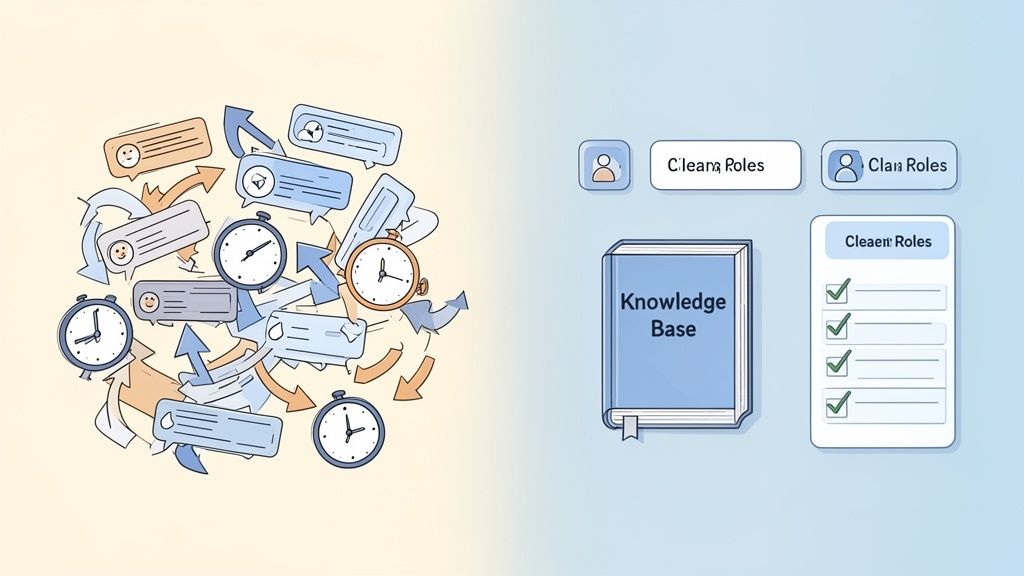
This is more than just a list of names; it’s a tool for direct collaboration. This simple clarity helps new hires get up to speed faster and helps existing employees solve problems on their own.
Build a Library, Not a Landfill
Finally, let's talk about information. Every company has a mountain of essential documents: policies, procedures, training guides. But in most places, this knowledge is scattered across forgotten folders, buried in email attachments, or—worst of all—locked in someone's head.
This creates a culture of dependency. Employees are forced to interrupt their managers to get answers to routine questions. It’s inefficient and disempowering.
The solution is a central, easy-to-search knowledge library. Think of it as your company's internal brain. Using a tool like Pebb, you can create a place where anyone can go to find their own answers, anytime. When policies are clear and accessible, you reduce confusion and create a sense of fairness. Everyone is playing by the same rules because everyone can find them.
This isn’t about more bureaucracy. It's about building a system that fosters autonomy. When you give people the tools to find their own answers, you’re telling them you trust them to do their jobs.
This table breaks down how to move from firefighting to focused work.
From Chaos to Clarity: A Practical Shift
The Problem (Chaos) | The Fix (Clarity) | How a Unified Platform Helps |
|---|---|---|
Scattered Messages: Updates lost across chat, email, and texts. | Centralized Announcements: A single feed for official, need-to-know news. | Pebb Spaces: Create dedicated channels for high-signal, low-noise communication. |
Role Confusion: "Who's in charge of...?" is a daily question. | Visible Org Chart: A searchable directory showing roles and teams. | Pebb People Directory: Instantly find who does what and how to connect with them. |
Hidden Information: Key documents are buried in folders or inboxes. | Searchable Knowledge Base: One place for all policies, procedures, and guides. | Pebb Knowledge Library: Empower staff to find answers independently, 24/7. |
Verbal Task Assignments: "Hey, can you...?" with no paper trail. | Trackable Tasks: Clear assignments with due dates and owners. | Pebb Tasks: Assign work, track progress, and ensure accountability without the guesswork. |
By implementing these fixes, you're not just organizing information; you're building a more resilient, predictable, and calm working environment.
Replacing chaos with calm isn’t a one-time project. It’s a commitment. But by focusing on these three pillars, you start building an operating system that allows a healthy culture to emerge on its own.
Building for Connection, Not Just Communication
We often confuse communication with connection. Just because people are talking doesn't mean they feel like they belong. A busy chat channel isn't a community. It's a firehose. This is the hard truth I've seen, especially for companies with distributed or frontline teams.
Real connection is deeper. It’s that feeling of being part of a crew, where you’re seen as a person, not just a job title. Improving your company culture means being intentional about creating that feeling. It doesn't happen by accident.

Here’s where so many well-intentioned efforts go wrong. We send newsletters and post announcements, checking the "communication" box. But connection is built in the smaller, human moments—a thoughtful welcome, genuine recognition, and tools that help people find each other, not just manage tasks.
Make Recognition Visible and Meaningful
Let's be honest: most corporate recognition programs feel hollow. An "Employee of the Month" plaque often feels more like a management gesture than a genuine thank you.
The recognition that actually sticks is peer-to-peer. It's a specific shout-out from a colleague for helping during a tough shift. It's a manager highlighting a small act of ingenuity that saved the team an hour. These are the moments that act as glue.
When you make recognition visible—posted in a shared space where everyone can see it—it does two powerful things:
It validates the person being recognized, making them feel seen.
It reinforces the exact behaviors you want more of, showing everyone what "good" looks like.
This isn't just a nice-to-have. A 2023 O.C. Tanner study found that regular team recognition improved the strength of a workplace community by 19% and amplified the odds of having a strong community by a staggering 508%. When people feel valued, they stick around.
Treat Onboarding as a Cultural Cornerstone
A new hire’s first few weeks are your most critical window. You can tell them all about your amazing culture, but their direct experience is the only thing that matters. Onboarding is your first—and best—chance to show them what it’s like to work here.
A chaotic onboarding sends a clear message: "You're on your own." A structured, welcoming experience says, "We're glad you're here, and we've prepared for you."
Onboarding isn’t just paperwork. It's the first chapter of an employee's story with your company. Make it a good one.
This is where a simple task list becomes a powerful tool. Instead of feeling lost, a new person has a clear path. Pair that with a people directory that makes it easy to find new teammates, and they’re not just learning processes; they’re building relationships from day one.
A solid onboarding plan should help every new hire answer three questions:
What do I need to do? (A clear task list)
What do I need to know? (Easy access to a knowledge library)
Who do I need to know? (A searchable directory with faces and roles)
When you answer these questions for them, you replace first-day anxiety with a sense of calm and belonging.
Use Technology to Foster Human Connection
It's easy to see technology as a cold tool for efficiency. But the best tools do more. They create spaces where human connection can happen naturally, even across different shifts and locations.
Think of your company’s communication platform not as a message board, but as a digital town square. It’s where people can share successes, ask for help, and get to know the person behind the job title. To truly boost team chemistry, you can weave in some high-impact corporate team building events to complement what you're doing digitally.
Ultimately, building for connection means seeing your employees as whole people. It’s about creating an environment where they feel safe, respected, and part of something bigger than themselves. When people feel that sense of belonging, they don’t just show up for a paycheck. They show up for each other. That’s a culture worth building.
Measure Behaviors, Not Feelings
"If you can't measure it, you can't improve it." We've all heard that line. But when it comes to culture, what we're told to measure is… fuzzy. Satisfaction scores, eNPS, anonymous feedback—these are all snapshots of feelings.
They aren't useless, but they’re only half the story. Feelings are fickle. Behaviors, on the other hand, are facts. They show you what people are actually doing.
Trying to get a perfect satisfaction score is like trying to nail Jell-O to a wall. I’ve learned it's far more effective to measure the pulse of the organization by looking at simple, observable actions.
From Vanity Metrics to Vital Signs
So, what should you track? Think less about happiness percentages and more about activity trends. These are the true vital signs of a healthy system.
Here are a few behaviors we pay close attention to:
Information Consumption: Are people reading important company updates? A high open rate on a critical policy change tells you your communication system is working. Silence tells you it’s broken.
Task Completion: Are tasks getting done on time without endless follow-ups? This is a direct signal of clarity and accountability. When deadlines are met, it means roles are clear.
Peer-to-Peer Recognition: How often do people publicly thank a colleague for their help? A steady stream of peer recognition is a powerful sign of a collaborative, supportive environment.
These aren't meant to judge individuals. Think of them as diagnostics for the system itself. They help you see where things are flowing smoothly and where the blockages are.
Using Data to Ask Better Questions
Here’s the thing: the goal of measurement isn't to find a single number that tells you if your culture is "good" or "bad." It's to find clues that lead you to ask better questions.
For instance, if you notice that engagement with announcements is low in one department, you don't just tell them to "be more engaged." You get curious.
Is the information not relevant? Is it delivered at the wrong time? Is the channel just too noisy? The data isn't the answer; it's the start of a conversation.
This turns analytics from a scary report card into a helpful diagnostic tool. It’s about making small, informed adjustments, not sweeping judgments. Maybe you find your frontline team never engages with long posts sent at 9 AM, but they read short, visual updates sent just before their shift. That's a simple, powerful insight you can act on.
Chasing 100% engagement is a waste of time. You’re looking for patterns. You want to see a general upward trend in clarity and a downward trend in confusion. If you want to go deeper, we've outlined more on the 3 metrics that actually predict employee engagement.
Ultimately, measuring behavior respects your team. It moves you from asking, "Are you happy?"—a vague question—to observing, "Is the system we built actually working for you?" And that’s a far more practical place to start.
Playing the Long Game: How to Keep Your Culture Thriving
We’ve walked through diagnosing problems, clarifying roles, and building connections. But if there’s one thing I’ve learned, it’s this: fixing your culture isn’t a project. It doesn’t have a finish line.
Think of it more like tending a garden. It needs consistent care to flourish.
The frameworks we've covered only work if you build lasting habits around them. A great culture isn't born from a single initiative. It’s forged in the quiet, consistent repetition of small, positive actions.
It’s the daily check-in everyone can count on. The way you consistently share news so no one feels out of the loop. The predictable weekly schedule that brings calm to an otherwise chaotic environment. These are the things that build trust over time.
Why Small and Steady Wins the Race
Let’s be real. Trying to change everything at once is a surefire path to overwhelming your team and burning yourself out. The magic isn’t in some revolutionary overhaul; it’s in a thousand tiny, intentional adjustments. It’s about choosing consistency over intensity.
Culture is simply the sum of your habits. What you do every day is what you become. There’s no big secret.
This isn't a quest for perfection. It's about committing to a direction and then taking one steady step after another. It's about the practice, not the finished product.
So, instead of a tidy summary, I'll leave you with a direct challenge:
What is one small, consistent change you can commit to this week?
Maybe it’s making sure every new task assigned has a clear owner. Perhaps it's posting one piece of public recognition for a teammate. Or maybe it’s just dedicating 15 minutes to cleaning up one outdated section of your knowledge library.
Just pick one thing. Do it consistently. Then pick the next.
That’s how you build something that lasts. It’s not about the big, splashy launch. It’s about the quiet, relentless dedication to making work a little bit clearer, calmer, and more connected, day after day.
Frequently Asked Questions
People often ask us the same few questions when they start thinking seriously about improving their company culture. They’re good questions. Here are our honest, straightforward answers.
Where Do We Start If Our Culture Feels Completely Broken?
Start small. Seriously. The biggest mistake is trying to fix everything at once. That's a recipe for burnout.
The best place to begin is almost always with communication clarity. Pick one, high-impact problem and solve it. For example, create a single, official channel for important updates. By solving just this one issue, you cut down on chaos and build a tiny bit of trust.
That momentum is what you'll need to tackle the next problem.
How Do You Get Buy-In From Leaders Who Only Care About Financial ROI?
You have to speak their language. Frame the conversation around operational efficiency and risk, not just feelings.
Connect the cultural problems directly to business outcomes. Show them the real cost of high turnover in a department with poor communication. Explain that a unified platform reduces time wasted searching for information, cuts down on missed shifts, and lowers compliance risks.
Culture isn’t an expense; it’s an operating system. A calm, clear system is a more profitable one. Don’t talk about making people happier; talk about making the business run better.
Can a Single App Really Change Our Company Culture?
No, an app by itself changes nothing. But it can provide the structure to support the right habits.
Culture is the sum of how your team behaves. If your current tools are fragmented and chaotic, they encourage chaotic behaviors. A calm, organized platform provides the right environment where clear communication and consistent processes can become the new default.
The tool enables the change; your commitment to using it consistently is what makes the change stick.
Ready to build a calmer, more connected culture? Pebb unifies your communication, operations, and engagement into one simple app. See how Pebb can help your team today.
