
How to improve team productivity, calmly
Discover how to improve team productivity with clear goals, better communication, and real connection. A practical guide for leaders who care about people.
Dan Robin
Productivity isn't about squeezing more out of people. It's not about more apps, more meetings, or more "hacks." We've learned that the hard way. Real, sustainable productivity comes from subtraction, not addition. It's about creating clarity and reducing noise so your team can finally focus on the work that matters.
The Productivity Trap is Real
We’ve all been there. A new quarter starts, and someone up high declares, "We need to be more productive."
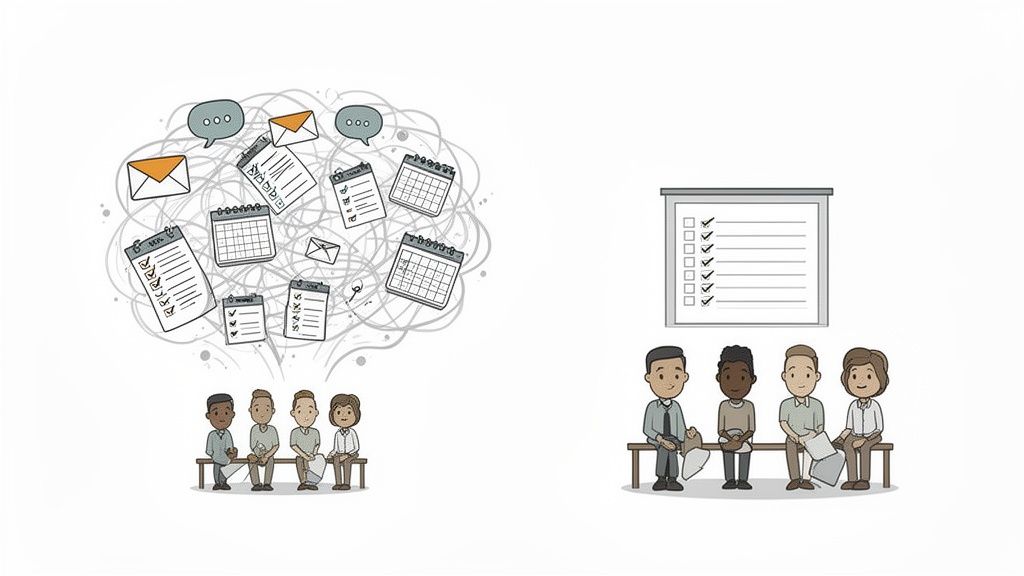
The knee-jerk reaction is always to add something. More software. More check-ins. More process layered on top of old, broken process. For a while, we fell right into this trap. We ended up with a tangled mess of chat apps, endless email chains, and project boards that nobody updated. It was supposed to help, but it just created confusion.
Important updates got lost. No one knew where the single source of truth was. The very tools meant to connect us just made everyone feel more scattered and anxious.
This is the classic productivity paradox: the relentless chase for efficiency often leads to the exact opposite. You create a culture where being busy is mistaken for being productive. Constant notifications and context-switching don't just waste time; they drain mental energy and lead straight to burnout. A 2023 report noted that disengaged workers cost employers a staggering $1.9 trillion globally. No wonder. When people are overwhelmed, they check out.
From Activity to Actual Progress
For frontline and distributed teams, it's even worse. When you don’t share the same physical space, the digital noise gets louder and the feeling of disconnect grows.
A retail employee trying to find the latest policy update shouldn't have to dig through five different apps. A warehouse worker looking for a shift change shouldn't have to scroll through a chaotic group chat. It’s a waste of their time and a huge source of frustration.
Let’s be honest. Another top-ten list of productivity "hacks" isn't going to fix this. The real way forward is a calmer, more human approach.
It’s about creating an environment where people can do their best work because they have what they need, when they need it, without fighting through the noise.
This isn’t about squeezing more out of every minute. It’s about making those minutes count. It means prioritizing clarity over chaos, connection over constant pings, and deep focus over digital fragmentation.
So, before adding another tool or process, let's start by asking a better question: what can we take away?
Clarity is the Only Metric That Matters
Let's get one thing straight: real productivity doesn't come from a new app or a perfectly crafted to-do list. It starts with clarity. When your team is scratching their heads about what actually matters, where to find crucial information, or who to even ask, everything grinds to a halt. It’s the small, daily frictions that drain all the momentum from your day.
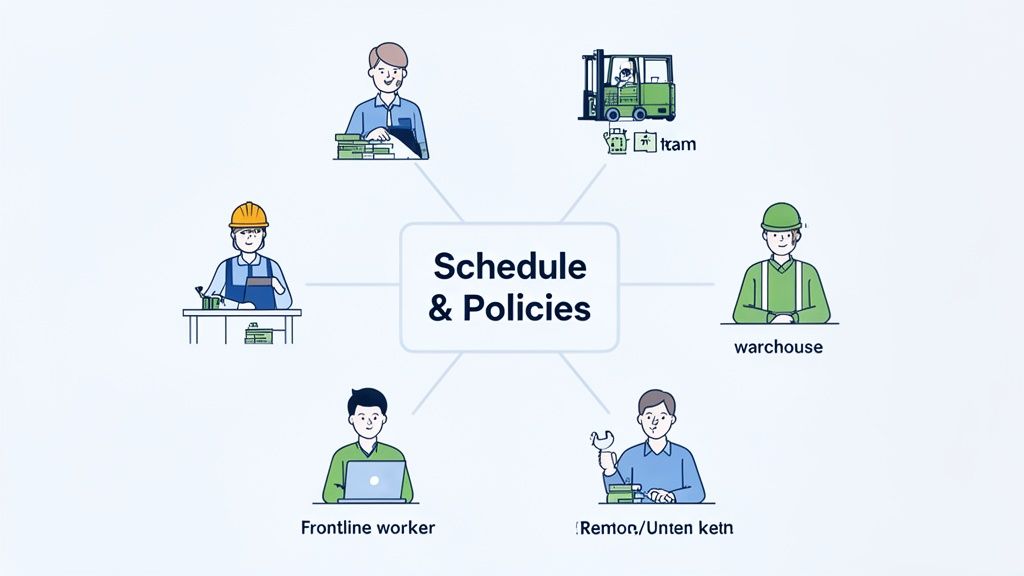
I’ve seen this play out a thousand times. A retail manager pins the weekly schedule to a bulletin board, but then texts last-minute shift changes to a few people. The result is pure chaos. Someone inevitably misses the memo, which leads to no-shows, understaffed shifts, and a team that’s completely fed up. The issue wasn't the schedule itself—it was the lack of a single, trustworthy source of truth.
Moving from Chaos to Cohesion
Let's be real. Critical updates, safety protocols, and company policies have no business being buried in an email thread from last Tuesday or a forgotten chat channel. Creating clarity means yanking that essential information out of the daily noise and putting it somewhere everyone can find it. Every single time.
Think about a logistics worker who needs to double-check a new safety procedure. Instead of tracking down their supervisor or flipping through a dusty binder, they should be able to pull it up on their phone in seconds. That small bit of time saved, multiplied across your entire team every single day, adds up. This isn't some top-down directive; it's just plain respect for your team's time and attention.
When you make information easy to find, you give people back their most valuable resource: their attention. They can spend it on their actual work, not on the work about the work.
A huge part of this is building a central knowledge hub for your team. This becomes the one place where everyone—whether at a desk or on the shop floor—knows they can go to get the right answer, right now.
The Foundation of Good Work
The goal is incredibly simple. Every person on your team should be able to answer three basic questions at any given moment:
What am I supposed to be doing?
What are our team's main priorities right now?
Where can I find what I need to do my job?
If the answers are fuzzy, you don’t have an efficiency problem—you have a clarity problem. No amount of software will fix that. But when you provide clear schedules, well-defined tasks, and instant access to company resources, a stressful workday becomes a smooth one.
This has nothing to do with micromanaging. It's about building a calm, stable environment where people feel trusted because they have the context they need to succeed. So before you introduce another tool, just ask yourself: does this create more clarity, or does it just add to the noise? The answer will tell you everything.
Connect Your People, Not Just Their Workflows
You can have the clearest goals on the planet, but none of it matters if your team feels disconnected. Disengagement is the quiet killer of productivity. It runs rampant when people feel like they’re on an island—isolated from their managers, their coworkers, and the bigger picture.
When work feels purely transactional, people check out. They stop bringing their best ideas forward and start doing just enough to get by. That spark? Gone.
And this isn't just a vibe thing; it's a massive financial drain. A recent Gallup report on the global workplace found that only 21% of employees are truly engaged at work. That lack of engagement costs the global economy an eye-watering $8.8 trillion.
From Colleagues to a Community
Building genuine human connection is non-negotiable, especially for hybrid teams or frontline workers who don't get those spontaneous "water cooler" moments. You have to be intentional about creating a sense of community.
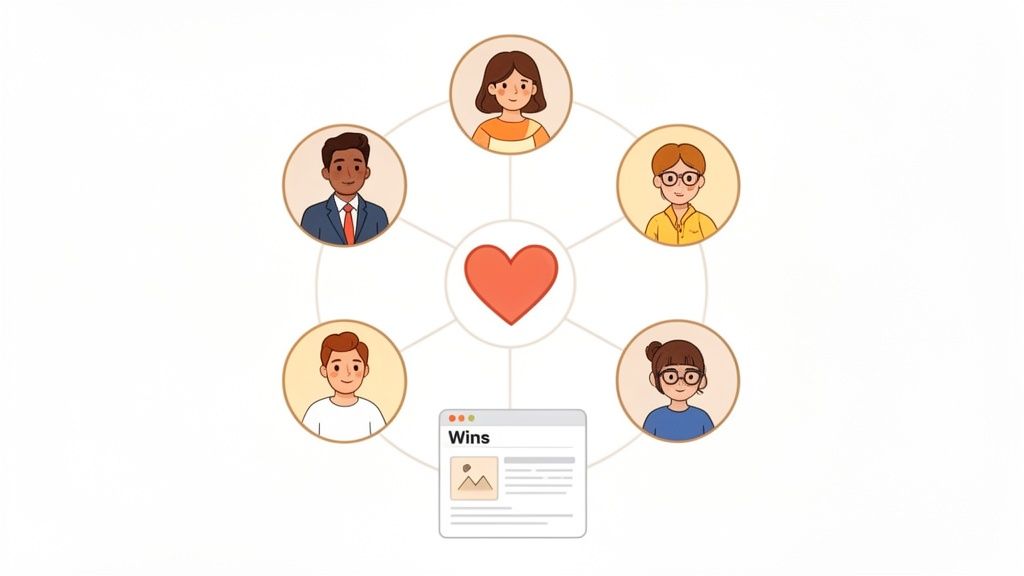
It’s often the simple things that move the needle. A company-wide news feed that celebrates personal and professional wins. A searchable people directory that helps put faces to names. Digital channels for non-work chat, like sharing pet photos or planning a weekend hike.
These small touches transform a group of individuals into a team. They remind everyone they’re part of something bigger than their daily to-do list.
When people feel seen and valued as humans first and employees second, their commitment to the work and to each other skyrockets.
For leaders looking to help their teams grow, exploring something like business coaching can be a powerful way to unlock both individual and team potential.
The Manager is the Keystone
If you're looking for the single most important link in the engagement chain, it's the manager. The same Gallup report revealed that managers account for a staggering 70% of the variance in team engagement. A manager who is present, communicative, and genuinely supportive can single-handedly elevate their team.
They are the bridge connecting an employee to the rest of the company. A great one ensures their people feel heard, supported, and dialed into the mission. But they can't do that if they're drowning in admin or don't have the right tools to communicate well.
A unified platform helps managers be true leaders, not just taskmasters. It gives them a central place to celebrate wins, share critical updates, and check in on their team.
If you want to improve team productivity, look up from the spreadsheets and focus on your people. Connected people simply do better work. It’s that simple.
Rethink Your Tools, Reclaim Your Time
Let's be honest about the modern workplace. We're drowning in apps. Each one promised to make life easier, but together they've created a digital Frankenstein's monster. The constant switching between a dozen logins, the barrage of notifications, the treasure hunt for a single piece of information scattered across five platforms.
This isn't just a minor headache; it's a massive drain on productivity. It's called tool fatigue. And it's what happens when your tech stack is a jumbled mess. Every time an employee jumps from their chat app to a project board, then over to the scheduling tool, their focus shatters. This constant context-switching kills deep work.
The Hidden Cost of Complexity
The whole idea behind a digital workplace was to cut distractions and let people focus. But for too many, the opposite has happened. While studies show remote and flexible work can boost productivity, a shocking 60% of employees are burning out from digital overload. A big reason? The average business now uses over 17 different work apps. That’s a lot of noise.
This tech chaos doesn't just create stress. It forces your team to waste time on manual, mind-numbing tasks, like copying information from one system to another because the tools don't talk to each other. It's a hidden tax on everyone's time.
The goal isn’t to find the single "best" app for every little task. It’s to build the calmest, most integrated digital workspace for your entire team.
From Fragmentation to Flow
So what’s the alternative? Radical simplification. Picture a single digital hub where everything your team needs lives in one place. Communication, operations, and engagement are no longer siloed in separate apps; they're woven together. If you're curious about how this works, it's worth exploring what internal communication software can do.
When your team has one place to chat, check schedules, find documents, and get company updates, the work just flows. Instead of fighting their tools, they can finally focus on their jobs.
For a frontline employee, this means everything they need is on their phone. For a manager, it provides a single, clear view of what’s happening.
This isn’t about minimalism for its own sake. It’s about being intentional. It's about designing a digital experience that respects your team's attention and gives them back the mental space they need to do great work.
Fragmented vs. Unified: A Day in the Life
The contrast between a chaotic, multi-app environment and a single, unified platform is stark. Here's what it looks like.
Challenge | The Fragmented Way (Multiple Apps) | The Unified Way (One Platform) |
|---|---|---|
Morning Huddle | Manager posts in a chat app. Team members have to open a separate app for tasks, and another for the daily schedule. | Manager posts a single update with the schedule, tasks, and key info attached. Everything is in one place. |
Finding Information | "Where's the new safety protocol?" Employee searches the chat history, then the shared drive, then asks a coworker. | Employee uses the central search bar and finds the protocol instantly in the resource library. |
Schedule Changes | Supervisor texts a few people, posts in a chat group, and hopes everyone sees the update in time. Confusion ensues. | Supervisor updates the schedule in the platform. Everyone involved gets an instant, automatic notification. |
Giving Feedback | An employee has a great idea but isn't sure who to tell. They mention it in passing, and it gets forgotten. | Employee submits the idea through a dedicated feedback feature, where it's tracked and seen by the right people. |
A unified platform isn't a "nice-to-have." It removes countless small points of friction that add up to major frustration and wasted time. It gives your team the clarity and focus they deserve.
How to Actually Get Started
All this talk about clarity, connection, and simplifying tools is great in theory. But how do you start making these changes without grinding your entire operation to a halt?
Let’s be honest. A massive, disruptive overhaul is the last thing anyone wants. The good news is, you don’t need one. Real, lasting improvement is a gradual process of listening, testing, and refining. It starts small.
Listen First, Act Second
Before you change a single thing, you have to understand what’s actually broken from your team’s perspective. What are their biggest productivity blockers? It’s almost never what you think.
Instead of rolling out some huge new initiative, just start by asking simple questions. Use informal check-ins or quick surveys to get a feel for the daily friction. You’ll probably hear things like:
“The schedule changes so often, I never know if I’m looking at the latest version.”
“Finding the right safety form takes me ten minutes every single time.”
“I just wish there was one place to see all the company announcements.”
These aren’t complaints; they’re a roadmap. They tell you exactly where to focus your efforts for the biggest impact.
The most powerful way to improve team productivity is to solve the real, nagging problems your people face every day. Don't guess what they need—ask them.
The market for productivity software is booming, projected to grow at a 14.1% rate through 2030. Yet, a recent CEO survey found that only 37% of leaders actually saw productivity gains from their tech investments. This tells us that another tool isn't the answer unless it solves a real-world problem. You can dig deeper into these productivity statistics for more context.
Start with One Small Win
Once you've identified a common pain point, pick just one to solve. Seriously. Don’t try to fix everything at once. Your goal is to prove the value of a new approach quickly and build momentum.
This process of moving from a messy, fragmented system to a unified one is actually pretty straightforward when you break it down.
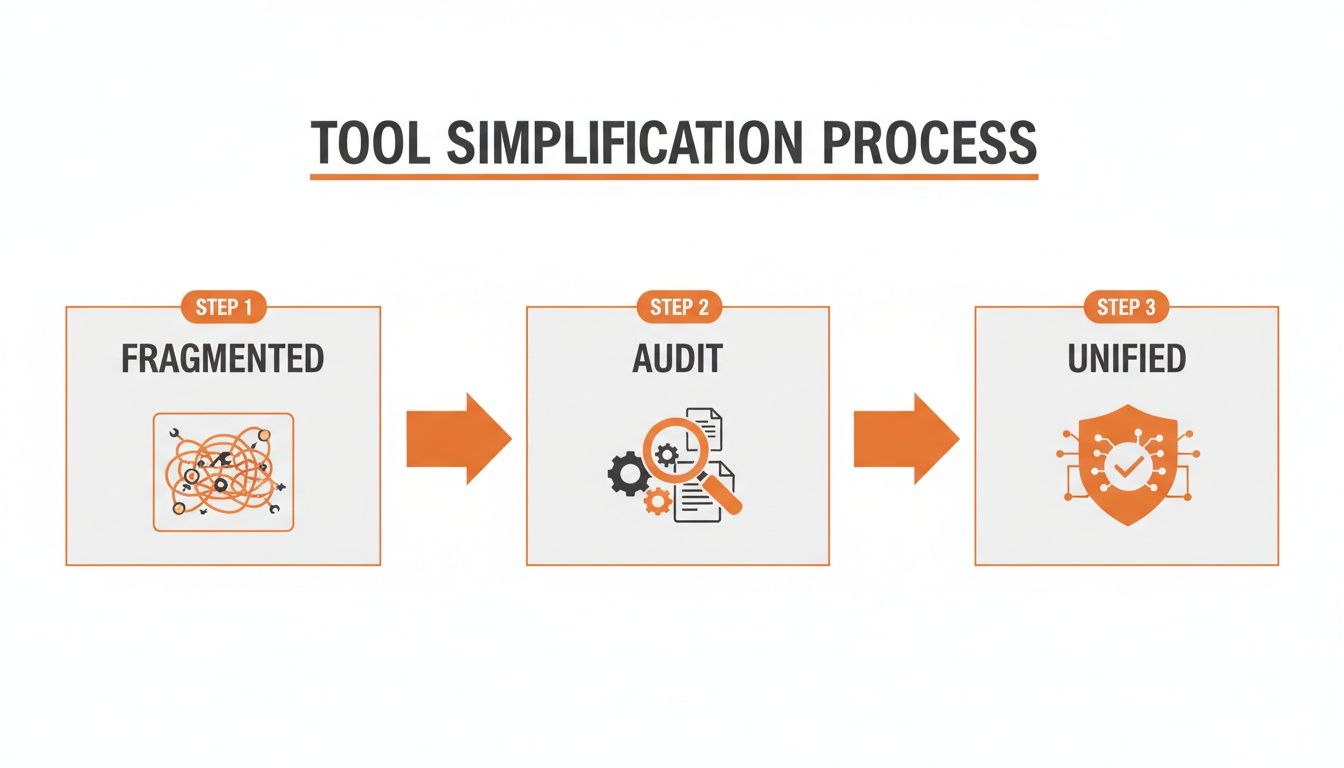
The takeaway here is that you don't jump straight from chaos to order. That middle step—listening to your team and finding the true source of friction—is the most critical part.
Maybe you start by centralizing all team updates in one place. Or perhaps you focus on streamlining shift schedules with a mobile-first tool. Whatever it is, pick one thing, implement it with a small, receptive team, and let them become your champions.
Their success will do more to convince the rest of the organization than any top-down mandate ever could. This isn't about a magic fix. It’s about building a sustainable system that actually supports your team, one thoughtful step at a time.
A Few Honest Questions
We've covered a lot of ground. It all sounds great on paper, but I get it. You're probably wondering how this translates to the real world—with real teams, messy schedules, and tight budgets.
Let's tackle some of the tough questions that always come up.
How do we improve productivity without micromanaging?
This is the big one. The goal is to support your team, not to become Big Brother. Real productivity comes from clearing roadblocks, not watching every click. Nobody does their best work with a manager breathing down their neck.
So, shift your focus from tracking activity to understanding outcomes. Use your tools to spot trends, not to police individuals. Are people actually seeing crucial safety updates? Are projects hitting the same bottleneck every time? Those are the questions that lead to real improvements.
The conversation should always be, “How can we make your work easier?” not, “Why aren’t you working faster?”
When your team sees that new tools are genuinely designed to help them have a less frustrating day, they'll get on board. It starts with trust.
Our team isn't very tech-savvy. How do we start?
Getting your team to adopt a new tool comes down to two things: it has to be incredibly easy to use, and it has to solve an obvious problem for them. If a new platform is clunky, confusing, or feels like corporate homework, it’s dead on arrival.
The trick is to start small. Don't roll out twenty new features at once. Pick one major headache and solve it. For many frontline teams, that headache is getting a clear, up-to-date shift schedule on their phone. Start there. That's it.
Then, run a pilot program with just one team. Find a couple of enthusiastic people in that group to be your champions. Their success and positive word-of-mouth will be far more persuasive than any top-down mandate.
Is this worth it for a small business?
For a small business, I’d argue this is essential. Think about the hidden costs you're dealing with right now. How many hours does your team waste every week digging through old email chains just to find a simple piece of information? What's the true cost of losing a great employee who's burned out from the daily chaos?
A unified platform often replaces several other tools you’re already paying for (like separate apps for chat, tasks, and file storage), so you can see direct savings. But more importantly, it gives your small team back its most valuable, non-renewable resource: time.
And remember, help is often available. To put new strategies in place, you might look into programs like funding for business scale-up and productivity, which can provide support to make these upgrades happen. This frees up your people to focus on what truly grows the business: taking care of customers. It’s not just another expense; it's an investment in focus and sanity.
Ready to build a calmer, more productive workplace? Pebb unifies your team’s communication, operations, and engagement in one simple app. See how it works at https://pebb.io.
