
Improving Employee Satisfaction: Boost Team Morale
Stop guessing. Learn proven steps for improving employee satisfaction with a clear, human-first program for all teams. Get results that really work in 2026.
Dan Robin
We bought a nicer coffee machine once. We also approved a bigger lunch budget. The team was still tired, still annoyed, and still subtly checking out.
That was a useful failure.
A lot of companies try to improve satisfaction with gestures. Free food. Swag. A one-off event. A cheerful memo from leadership. None of that is harmful on its own. It just doesn't fix the actual experience of work. If people are getting last-minute schedule changes, chasing updates across five tools, and hearing about problems only after something breaks, no snack budget is going to save you.
We Tried Everything Except What Mattered
For a while, we confused activity with progress. If morale dipped, we added something. A lunch. A gift card. A themed appreciation day. It looked responsive from the outside. Inside the work itself, nothing changed.
People still didn't know where to find the latest policy. Managers still delivered feedback inconsistently. One team had decent coverage and another was stretched thin. Frontline staff got information late because everything was built around email, even though many of them weren't sitting at a laptop all day. The problem wasn't that people needed more pizza. The problem was that work felt harder than it should have.
That's the part many leaders miss when they talk about improving employee satisfaction. Satisfaction usually rises when work gets clearer, fairer, and more humane. People want to know what's expected, whether their manager notices effort, whether schedules feel reasonable, and whether speaking up changes anything.
A useful baseline comes from Gallup's long-running workplace research. In 2023, only 21% of employees worldwide were engaged at work, according to this summary of Gallup's State of the Global Workplace reporting. That number matters because engagement and satisfaction aren't the same thing, but they're closely tied. When employees feel heard, supported, and recognized in the flow of work, satisfaction usually improves too.
Morale theater versus real operating changes
The hard truth is that many morale problems are operating problems wearing a cultural label.
If your handoffs are sloppy, employees feel blamed for confusion they didn't create. If managers only talk to people when something goes wrong, employees feel invisible. If scheduling feels arbitrary, people stop trusting leadership even if pay is competitive. That isn't a branding issue. It's a systems issue.
Practical rule: If a morale booster doesn't change how work feels on Tuesday morning, it probably won't matter much.
I've become skeptical of anything that only appears during “employee appreciation week.” The better approach is quieter. Fix how updates are shared. Fix how recognition happens. Fix how shifts are assigned and changed. Fix how managers follow up after feedback.
That's also why broad ideas like “boost morale” can send teams in the wrong direction. A better starting point is to look at the small frictions employees live with every day. If you need examples of those day-to-day fixes, these employee morale boosters are much closer to the mark than the usual perk list.
What people actually remember
Employees rarely remember the bagels in the break room for long. They remember whether they had enough notice to swap childcare before a shift change. They remember whether a manager thanked them in public and coached them in private. They remember whether the company asked for feedback and then did something with it.
That's the work. Not glamorous. Not flashy. But real.
Find the Real Problems Before You Fix Them
Most satisfaction work goes wrong at the diagnosis stage. Leaders hear “people are unhappy” and jump straight to fixes. Better benefits. A new recognition program. A town hall. Sometimes those help. Often they miss the point because the underlying problem was never named clearly.
You need a listening system, not a one-time survey.
Rippling's guidance is useful here. A practical approach is to define objectives, run a survey with both quantitative and qualitative questions, segment the results by department or demographic, calculate measures such as eNPS, publish an action plan, and follow up on impact. It also stresses breaking feedback down by areas like compensation, management, and teamwork because broad averages can hide localized problems. You can read that approach in Rippling's guide to measuring employee satisfaction.
Scores tell you where to look
A number can tell you that something is off. It can't tell you why.
If one location reports low satisfaction, that's just the start. You still need comments, manager notes, and direct conversations to understand whether the issue is workload, scheduling, poor communication, weak supervision, or conflict inside the team. Without that second layer, leaders end up treating symptoms.
Many annual surveys often fail. They produce a polished deck and almost no operational insight. By the time leaders react, the moment has passed and employees have already decided that giving feedback is a waste of time.
A better rhythm is lighter and more regular. Short pulse checks. Open comment boxes. Team-level conversations. Quick follow-ups when a pattern appears.
Segment the experience
One of the biggest mistakes is assuming “the employee experience” is one thing. It isn't.
Frontline teams often care about schedule clarity, shift coverage, and mobile access to updates. Hybrid teams may care more about meeting overload, manager availability, or uneven visibility. New hires usually struggle with onboarding and information access. Tenured staff may be frustrated by inconsistent follow-through.
If you don't separate those groups, your average score lies to you.
Common Symptom (What you hear) | Potential Root Cause (What to look for) |
|---|---|
“Communication is bad” | Updates are scattered across email, chat, paper notices, and word of mouth |
“Nobody listens” | Feedback is collected, but leaders don't report actions back |
“Schedules are unfair” | Shift changes happen inconsistently, with weak rules and poor visibility |
“Recognition feels random” | Praise depends on manager style instead of a shared team habit |
“Training is weak” | New hires can't easily access policies, how-to guides, or role expectations |
“People seem burned out” | Workloads are uneven, after-hours boundaries are unclear, and staffing gaps keep spilling over |
The comment is usually more valuable than the score. The score points at the room. The comment tells you where the fire is.
If you want a practical template for gathering this kind of feedback, this guide on survey job satisfaction is a solid place to start.
Close the loop early
You don't need a perfect answer before you respond. You do need to show people you heard them.
Even a simple message helps: we heard that weekend handoffs are messy, we're testing a new process, and we'll check back in next month. That kind of follow-through builds trust fast because it proves feedback is connected to change.
Focus on What Actually Moves the Needle
Once you understand the underlying problems, the temptation is to fix everything at once. Resist that. Satisfaction improves faster when you choose a few drivers that shape daily work and handle them with discipline.
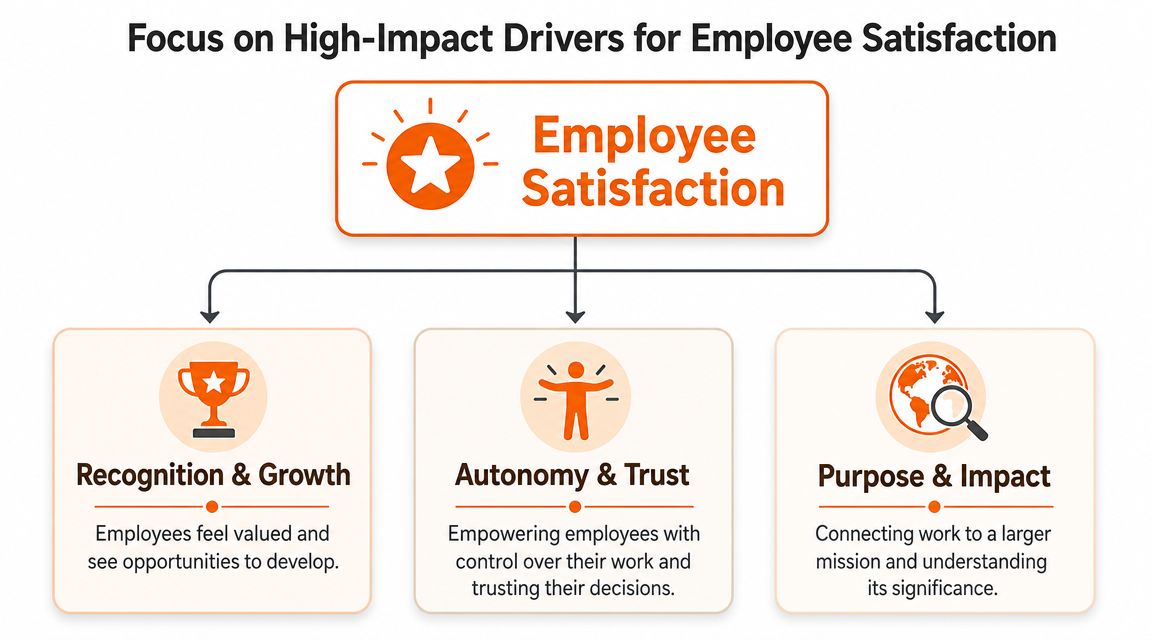
Guidance across Gallup and the U.S. Chamber points in a consistent direction. Employee satisfaction tends to improve when organizations focus on autonomy, recognition, development, and ongoing feedback, not just perks. Gallup also identifies five core engagement drivers: purpose, development, caring managers, ongoing conversations, and strengths-based work. The U.S. Chamber summary captures those ideas well in its advice on improving employee satisfaction and productivity.
Start with the boring basics
The highest-impact work is usually less exciting than the brainstorm session.
Communication matters because confusion drains people. Recognition matters because effort without acknowledgment feels hollow. Scheduling matters because fairness is emotional, not just administrative. Development matters because stagnation wears people down. Wellbeing matters because no initiative survives chronic overload.
That's true in any office. It's even more true for frontline and hybrid teams, where access and timing shape the entire employee experience.
Five priorities worth your attention
Communication that reaches people: A warehouse lead needs shift updates on a phone, not buried in an inbox. A nurse needs policy changes in one reliable place, not spread across hallway conversations and PDFs.
Recognition that happens in the open: Private appreciation is good. Visible appreciation builds norms. It shows people what the organization values.
Scheduling that feels fair: People can handle busy seasons. They struggle with chaos, surprises, and favoritism.
Development that feels real: Not vague promises. Actual coaching, clearer paths, and useful training.
Wellbeing that reduces friction: Sometimes the kindest thing you can do is remove unnecessary complexity from the day.
There's a reason these basics keep showing up in serious discussions about ways to increase employee engagement. They're not trendy. They work.
Fancy perks are decoration. Clarity, trust, and manager consistency are structure.
What not to overvalue
Perks aren't useless. They're just secondary.
A lunch budget can complement a healthy workplace. It can't substitute for one. The same goes for branded gifts, office redesigns, and celebratory events. If the underlying experience is weak, those things can even backfire because employees read them as avoidance.
I'd rather see a company make schedules more predictable than buy everyone hoodies. I'd rather see managers trained to hold steady one-on-ones than launch a flashy recognition campaign nobody uses after month one.
Practical Ways to Make Work Life Better
The first time I realized satisfaction was mostly an operations problem, not a perks problem, it was after a rough month in a frontline-heavy team. We had recognition posts, a wellness session, and free lunch on a Friday. People were still frustrated. The actual complaints were plain: nobody knew where updates lived, schedules kept changing late, and new hires had to ask three people to get one answer.
That pattern shows up across a lot of organizations. Analysts at Gallup, in their piece on improving employee engagement in the workplace, point back to manager habits and communication systems that shape the day-to-day experience. For frontline, deskless, and hybrid teams, satisfaction usually rises when the workday gets clearer and less chaotic.
Replace scattered updates with one home for information
Confusion is expensive.
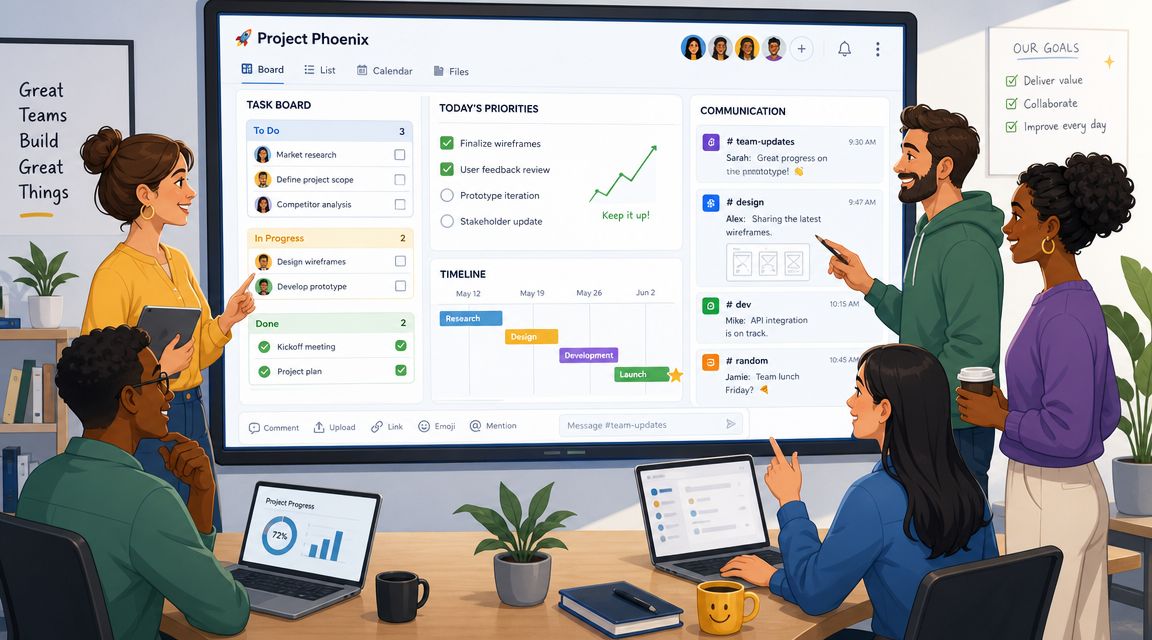
If employees have to check email, group chat, a paper notice in the break room, and a supervisor's memory to confirm a policy change, the system is the problem. People waste time. Managers repeat themselves. Rumors fill the gaps.
Choose one place that counts as official. Put company updates, policy changes, shift notes, task follow-ups, and key documents there. A work app such as Pebb can combine updates, chat, tasks, a people directory, scheduling, and knowledge access in one place, which helps when office staff and frontline employees need the same information on mobile and web.
Make recognition public, specific, and tied to the work
Recognition gets dismissed because companies often do it badly. Generic praise fades into the background. Monthly awards chosen behind closed doors can feel political.
The useful version is simpler. Create a visible place where managers and peers can call out real contributions: covering a tough shift, fixing a handoff issue, helping a new coworker get up to speed, catching a preventable error before it hits a customer. That kind of recognition does two jobs at once. It thanks the person, and it shows the team what good work looks like.
Specific beats enthusiastic every time. “Thanks for staying late to clean up the inventory mismatch so the morning crew started on time” is better than “great job.”
Fix scheduling first
Pizza parties do not fix a bad rota.
For frontline and hybrid teams, scheduling is one of the fastest ways to improve or damage satisfaction. People can handle busy periods. What wears them down is late notice, inconsistent rules, clumsy swap processes, and the sense that flexibility depends on who your manager likes.
Good scheduling is plain and repeatable. Publish shifts earlier. Set rules for changes and follow them. Make shift swaps visible. Give people a clear way to request time off without chasing someone in person. If a shift changes, notify the employee directly in the same tool they already use for work.
Fairness shows up on the calendar long before it shows up in a survey.
Make onboarding lighter and self-service easier
New hires should not need a scavenger hunt to do basic tasks.
A mobile-friendly knowledge base cuts friction quickly, especially in roles where people are rarely at a desk. Put the common answers in one place: PTO rules, safety steps, uniform expectations, contact lists, opening and closing checklists, training steps. Then keep it current.
This helps more than HR teams sometimes expect. New employees get answers faster. Supervisors spend less time repeating the same instructions. The workday feels more stable because people know where to look before they have to interrupt someone.
Use in-person events for connection, not cover
Shared experiences still matter. They just need an honest purpose.
If your communication is messy and your scheduling is unfair, an offsite will not repair trust. If the basics are already steady, getting people together can strengthen relationships that make daily coordination easier. Teams that want something more thoughtful than another lunch can explore team-building events that give people room to connect without forcing fake fun.
Culture grows from repeated habits. Events can support those habits. They cannot substitute for them.
Measure What You Do and Talk About It
If you improve a few daily frictions and never measure the result, you're guessing. If you measure and never report back, you're eroding trust.
The strongest satisfaction work closes the loop. It asks, acts, measures again, and tells employees what changed.
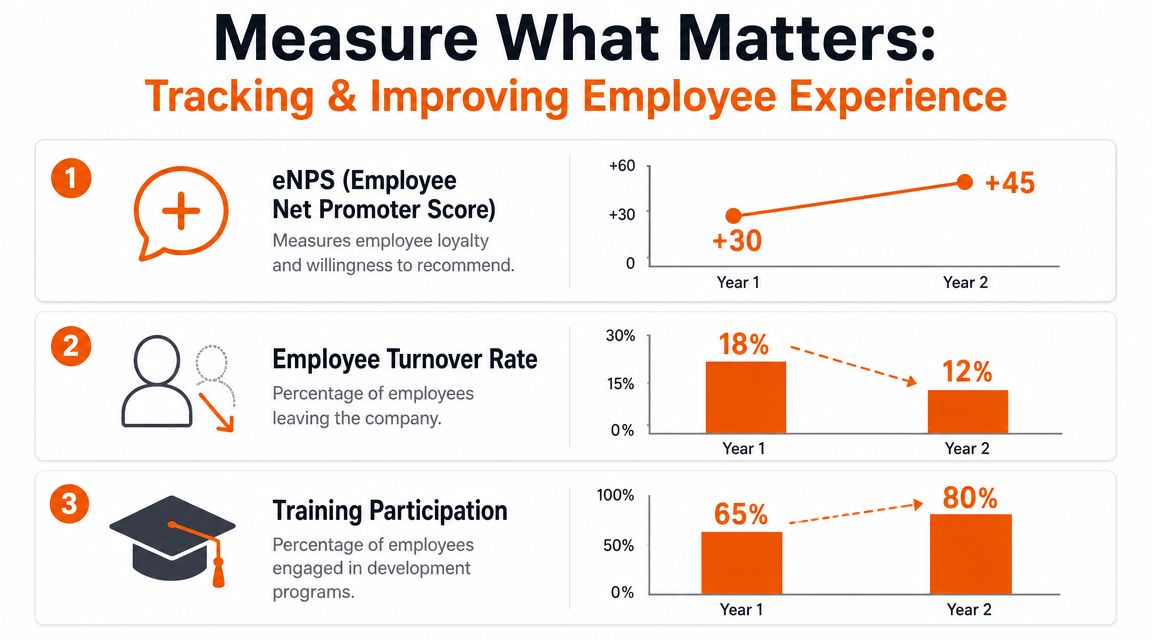
BambooHR's 2025 analysis offers a useful signal here. It found that overall employee satisfaction rose 12% since 2024, and it also noted that eNPS volatility dropped from as much as 118 percentage points in 2020 to 20 percentage points by 2023, which suggests a more stable employee experience when organizations listen and respond more consistently. That's from BambooHR's employee satisfaction infographic.
Track a small set of useful signals
You don't need a giant dashboard to know whether things are getting better. You need a few measures that connect to the experience you're trying to improve.
eNPS and pulse responses: These show whether employee sentiment is shifting.
Turnover patterns: Especially voluntary exits in teams where known pain points were highest.
Participation signals: Are people using the new channels, reading updates, joining recognition, or completing training?
Operational indicators: Missed handoffs, schedule conflicts, unresolved requests, or repeat questions can tell you whether friction is dropping.
If you want a practical framework for connecting activity to output without becoming obsessive, this piece on mastering productivity tracking is a useful companion.
Say what you heard and what you changed
Many efforts often collapse due to a lack of follow-through. Leaders collect feedback, hold meetings, maybe even make decisions, and then tell employees nothing. Silence teaches people that surveys disappear into management space and never come back.
The better pattern is plain communication.
We heard that shift updates were arriving too late. We changed the approval process, moved updates into one channel, and we'll check whether the complaints drop over the next month.
That kind of message does two things at once. It proves feedback mattered, and it makes improvement visible. Employees don't expect perfection. They do expect evidence that someone is paying attention.
Stability is the real win
I care less about a single positive survey bump than about whether the workplace feels steadier.
Are managers talking to people regularly. Are updates consistent. Are people less surprised by avoidable chaos. Are recognition and development becoming normal rather than occasional. That's what durable progress looks like.
The point of measurement isn't to produce executive wallpaper. It's to support a conversation with the people doing the work.
This Is a Practice Not a Project
Improving employee satisfaction isn't something you launch in Q2 and declare done by Q4. Work changes. Teams grow. Managers leave. Busy seasons hit. New friction shows up.
That's normal.
The companies that get this right don't chase a permanent state of happiness. They build a steady practice of noticing where work feels harder than it should, then fixing those points with patience and follow-through. They ask better questions. They simplify where they can. They train managers to communicate like adults. They respect people's time.
What holds up over time
The strongest systems are usually simple:
Listen often: Not just annually, and not only when there's a problem.
Fix the daily annoyances: Scheduling, communication gaps, poor handoffs, missing information.
Back managers with structure: Expectations for check-ins, feedback, recognition, and follow-up.
Report back: Employees should never wonder whether their input vanished.
That practice is less dramatic than a culture campaign. It's also more humane.
I've learned to trust the quiet signs. Fewer confused messages. Fewer last-minute scrambles. More visible appreciation. Better questions from managers. Less eye-rolling when leadership asks for feedback. When those things improve, satisfaction usually follows.
And that's the core point. Not to manufacture enthusiasm, but to build a place where work feels clear, fair, and worth doing.
If you're trying to make work simpler for frontline, hybrid, and office teams, Pebb is worth a look. It brings communication, updates, chat, tasks, scheduling, knowledge access, and engagement into one place, which makes it easier to reduce the small daily frictions that drag satisfaction down.
