
How to Enhance Communication in the Workplace
Discover how to enhance communication in the workplace with human-centered strategies that fix broken systems and build genuine team connection.
Dan Robin

Most workplace communication is broken. It’s a mess of missed updates, confusing email chains, and people on the front lines feeling completely disconnected from the home office. We’ve all lived it. And it's not just frustrating; it's expensive.
Picture a warehouse manager trying to coordinate a simple shift change while juggling three different apps. That chaos isn't just an annoyance. It’s a quiet tax on everything your company tries to do. The real damage isn't in the obvious costs; it's in the slow, steady erosion of morale and momentum.
The True Cost of Talking Past Each Other
When communication breaks down, it creates real, measurable damage. We're talking lost productivity, failed projects, and a slow drain on morale that can cripple even the strongest teams.

A Problem Measured in Trillions
This isn’t hyperbole. Poor workplace communication costs U.S. companies a shocking $1.2 trillion annually. That number is the sum of a million tiny failures: the misread email, the unclear instruction, the missed update that snowballs into an operational disaster.
It's a global problem. Research consistently shows that a staggering 86% of workplace failures trace back to poor collaboration and communication. When information doesn’t flow, people disconnect.
We’ve seen this lead to what are often called "communication silos"—isolated pockets where teams operate with different information and different goals. Silos are where good intentions go to die.
These aren't just buzzwords. They're real barriers preventing your teams from doing their best work. To really get into the weeds on this, you can check out our deep dive into the cost of communication silos and how to break them.
More Than Just Money
But that’s only half the story. The human cost is just as high, if not higher.
When communication fails, trust evaporates. Morale plummets. Your best people start polishing their resumes because they feel unheard, undervalued, and out of the loop. It’s no surprise that Gallup found only 23% of employees globally feel engaged at work. A lack of clear communication is a huge reason why.
This isn’t about fear. It’s about honesty. You can't fix a problem you refuse to see. Before you can build something better, you have to get real about the damage being done every single day by systems that just don't work for the people using them.
Admitting it’s broken is the first step.
Find the Leaks Before You Buy a New Faucet
When communication feels broken, the knee-jerk reaction is almost always the same: “We need a new tool.” I’ve seen this play out dozens of times. Let me be blunt: it’s a trap.
Throwing a new app at a tangled process is like slapping a fresh coat of paint on a leaky pipe. It looks better for a minute, but you haven’t fixed a thing.

The first step isn't to shop for software. It’s to pause and listen. The goal isn’t to create complex process maps; it’s to understand the human experience of sharing—or failing to share—information inside your company right now.
This means having real conversations, not sending another survey that gets ignored. People won’t tell you what’s truly broken if they’re afraid of the consequences. You have to make it safe to be honest.
Ask Questions That Get Real Answers
Forget vague questions like, “How can we improve communication?” You’ll get vague, unhelpful answers.
Instead, get specific. Your mission is to uncover the friction in someone’s actual workday.
Here are a few questions I’ve found that cut through the noise:
“When you need an urgent answer from another team, where do you go first? Why there?” This reveals their default path—and whether it works or is just a bad habit.
“What’s one piece of company news you wish you’d heard sooner? How did you eventually find out?” This is brilliant for uncovering where important information falls through the cracks.
“Think about the last time you felt confused about a project. What one thing would have made it clearer?” This moves from abstract complaints to a concrete need.
These aren't interrogation questions. They're conversation starters. Listen more than you talk. You’re hunting for patterns, not just isolated complaints.
The Story of the Weekend Crew
I once worked with a retailer struggling with consistency. The weekday staff seemed aligned, but the weekend teams were constantly out of sync. It led to frustrated customers and messy handovers.
Naturally, management was convinced they needed a new, expensive scheduling app.
But before buying anything, we just talked to the weekend staff.
It didn’t take long to find the real problem. All crucial updates—new promotions, policy changes, inventory notes—were sent in a company-wide email at 4:00 p.m. every Friday. The weekday managers read it and prepped their teams. The weekend crew, however, came in fresh on Saturday morning, completely unaware. They were being set up to fail.
The fix wasn't a new app. It was a simple process change. They started sending a separate, concise "Weekend Kick-Off" update directly to a mobile channel that supervisors could see before their shifts. The problem vanished almost overnight.
This story is why diagnosis is everything. The company was ready to spend thousands on software to solve a problem that a simple conversation fixed entirely.
Quick Communication Audit Checklist
You don't need a massive project to get started. Just ask. This simple table can help you pinpoint common symptoms and start a more focused conversation.
Symptom | Potential Cause | Who It Affects Most | First Question to Ask |
|---|---|---|---|
"I didn't know about that." | Information isn't reaching the right people. | Frontline workers, remote staff | "How do you normally get important company updates?" |
Low engagement on company-wide emails | Information overload or irrelevant content. | Office/desk-based employees | "What was the last company email you read top to bottom? Why?" |
Different teams are working on the same thing, unknowingly. | Cross-functional channels are broken. | Project teams, R&D, Marketing | "How do you find out what other departments are working on?" |
Urgent messages are missed. | The "urgent" channel is cluttered or doesn't exist. | Everyone | "If you had a critical message for your team right now, how would you send it?" |
Managers struggle to cascade information accurately. | Lack of clear guidance or tools. | Middle managers, team leads | "What's the hardest part about sharing updates from leadership with your team?" |
Use this as a starting point. Your goal is to gather real stories, not just check boxes.
Before you invest a dollar in new technology, invest time in understanding your current reality. An honest picture of what’s broken is the only foundation for building something better. Without it, you're just guessing. And guessing is expensive.
Design a System That Connects People
Alright, you’ve done the hard work. You've listened, asked tough questions, and now you have an honest picture of where things fall apart. So, what’s next?
Forget drafting a 20-page “Internal Communications Strategy” destined to collect digital dust. This is about agreeing on a few simple principles for how your company shares information. It’s about building a system that feels less like a corporate mandate and more like a shared understanding.
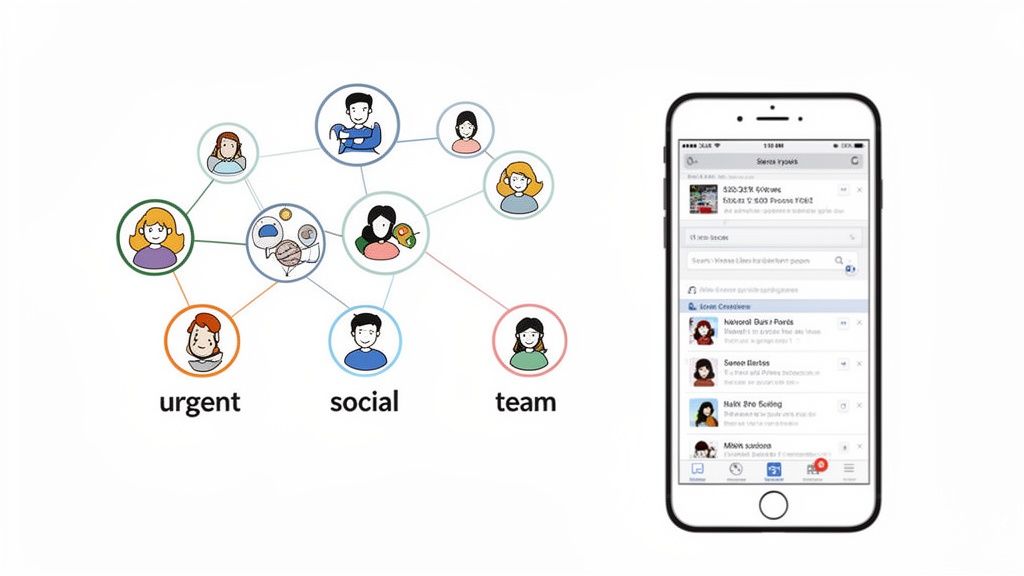
I’m a big believer in ‘less is more’ here. The goal is clarity, not more noise. A system that truly works should reduce cognitive load, not add to it.
Give Every Conversation a Home
The heart of a great system is simple: decide which conversation belongs where. This one discipline can instantly cut through the chaos and eliminate that nagging question, “Where do I post this?”
Think of it like organizing your kitchen. You don't toss forks in with the coffee mugs. It's just common sense. The same logic applies to your digital workspace.
Here’s a practical way to think about it:
Urgent & Important: This is for the must-know, right-now stuff, like a system outage or a safety alert. This needs its own dedicated, high-visibility channel. No memes, no banter. Just the essentials.
Team & Project Work: This is where the day-to-day happens. Every team and major project should have its own space. Your marketing folks shouldn't have to wade through updates from the logistics crew to find what they need.
Social & Culture: This is your digital watercooler. The spot for celebrating birthdays, sharing pet photos, and connecting as people. Giving this chatter its own home is crucial because it protects the focus of your work channels.
When you create these clear distinctions, you replace chaos with calm. Everyone knows where to look and where to share.
Don't Forget the People Without Desks
Here’s a reality check. For a huge portion of the workforce, "workplace communication" has nothing to do with a laptop. I’m talking about your frontline employees—the people in warehouses, on retail floors, and in clinics.
For them, a mobile-first approach isn't a "nice-to-have." It's the only approach that works. They don’t have time to hunt down a terminal and log into a clunky portal. They need information in their pocket, accessible in seconds.
Designing a system that connects everyone means starting with the people who are hardest to reach. If you solve for them, you solve for everyone.
The right tools for frontline teams are often simple. In fact, research shows that teams with effective communication channels can boost their productivity by up to 25%. While traditional intranets are still seen as effective by 51% of communicators, modern employee apps—favored by 34% of leaders—are designed for this mobile reality.
A few mobile features can be a game-changer:
A simple news feed: Keeps them in the loop on company updates without being overwhelming.
A searchable people directory: Helps them find and connect with colleagues across different shifts and locations.
A mobile knowledge library: Gives them instant access to key documents and training materials right from their phone. No more hunting for a binder in a back office.
To make sure your system truly connects people, it helps to explore powerful community engagement strategies that build a sense of shared purpose. It’s never just about pushing information out; it's about creating a space where people feel seen and heard.
Ultimately, you’re not building a complicated machine. You're designing a simple system that respects people's time and attention—one that makes it easier, not harder, to do great work and feel like part of a team.
How to Roll It Out Like a Human
You’ve designed a brilliant new communication system. It’s logical, it’s clean, and it’s going to solve so many problems. But here’s the truth: a perfect plan is useless if nobody uses it.
A successful launch has very little to do with technology and everything to do with people. I’ve seen companies spend a fortune on a new tool only to launch it with a single, soulless mass email. It never, ever works.
Forget that approach. This is about building momentum, not flipping a switch. You have to make people want to show up.
Start with Champions, Not Mandates
Your first step isn’t to tell everyone what’s happening. It’s to find your allies. We call them champions—a small group of respected, influential people from different corners of the company.
These aren’t necessarily managers. They’re the people others naturally turn to for help. The veteran warehouse supervisor everyone trusts, the optimistic barista who sets the morning tone, the quiet engineer who knows how everything really works.
Give them early access and ask for their honest feedback. Arm them with simple talking points that answer the only question their peers will have: “What’s in it for me?”
Think less “corporate mandate” and more “hey, this new app makes swapping shifts way easier.”
Run a Pilot, Get Real Feedback
A big-bang, company-wide launch is a recipe for chaos. Start small with a pilot group. This group should be a microcosm of your organization—a mix of office staff, frontline workers, and managers.
Set a clear, short-term goal. Maybe it’s using the new system to manage all shift-swapping for one location for two weeks.
The purpose isn't just to find bugs in the software. It’s to find the friction in the human process. Their feedback is gold. It will reveal the confusing parts, the frustrating steps, and the unexpected benefits you never considered. Listen, adapt, and make changes based on what they tell you. This turns your early users into co-creators.
A pilot program does more than just test the technology; it stress-tests your assumptions. You learn what resonates with real people, not just what looked good in a demo.
Successful launches feel less like a top-down order and more like a groundswell of interest. This is exactly what internal campaigns are designed to do. To see how this works, you can learn more about how internal campaigns drive platform adoption and build that crucial early momentum.
Make the Launch an Event, Not an Email
When it’s time to go wide, treat it like an event. People are busy. You have to cut through the noise.
This doesn't have to be expensive. We've seen clients have huge success with simple, human touches.
Host informal Q&A sessions: Set up a table in the breakroom with coffee and donuts. Be there to answer questions and help people log in for the first time.
Create short video guides: Make a two-minute screen recording showing how to do one common task, like requesting time off. Post it in the new tool itself.
Celebrate early wins publicly: When a team uses the new system to solve a real problem, share that story. Post a screenshot and a quick note saying, "Kudos to the weekend crew for sorting out the schedule change in record time!"
This is the kind of genuine recognition that gets other people interested.
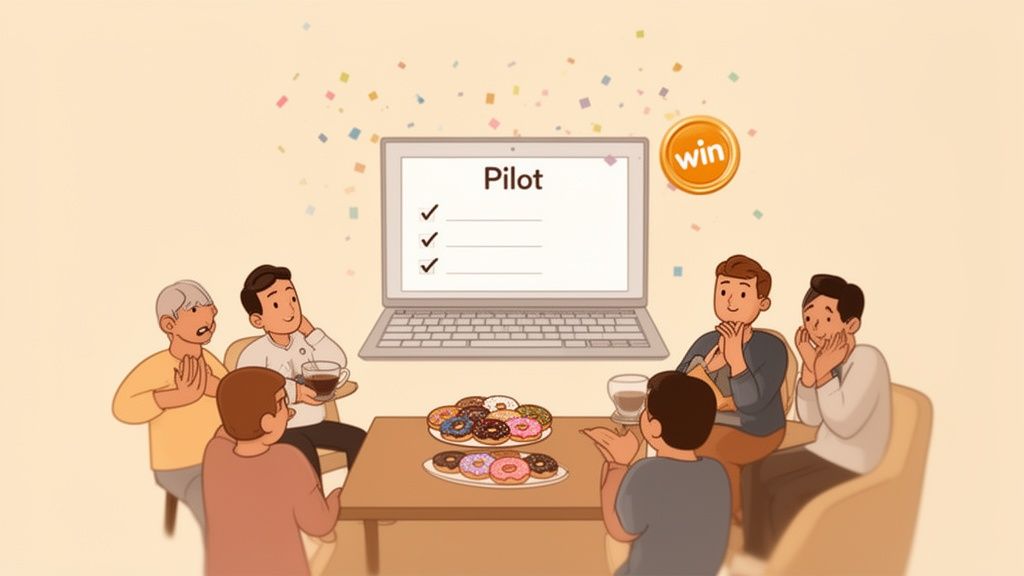
This kind of visual celebration makes success feel tangible. It’s not just an announcement; it’s proof that this new way of working is already making a difference.
Rolling out a new way of communicating is a human challenge. It requires patience, empathy, and a genuine desire to make someone’s workday a little bit better. If you lead with that, people will follow.
So, Is Any of This Working?
You did it. The new system is live, the launch-day buzz has faded. Now for the hard part. It’s tempting to dust off your hands and call it a win, but how do you really know if it’s making a difference?
The final piece is measuring what matters. This isn't about counting clicks or policing channels. It's about figuring out if you've made a genuine impact on how people work. To do that, you have to look past the surface-level numbers and start asking better questions.
Use Data to Get Real Answers
Analytics dashboards can feel sterile. But if you look at them through the right lens, they can tell a surprisingly human story about how your teams are connecting.
Forget fixating on "daily active users." Instead, use data to answer practical questions that affect your business.
Are your frontline teams getting those critical safety updates? Check the read receipts for those specific announcements.
Are folks in your Boston and San Francisco offices finally collaborating? Look for a spike in cross-regional @mentions in shared channels.
Which teams are best at sharing what they know? Pinpoint the project spaces with the most back-and-forth discussion.
This isn't about playing Big Brother. It’s about using data to spot positive trends and see where people might need a little extra help. You can dive deeper by exploring specific metrics for measuring communication change and what they reveal about your culture.
Numbers Are Only Half the Story
Let’s be honest: a dashboard will never give you the full picture. The richest insights come from pairing that data with good old-fashioned feedback. Those conversations you had when diagnosing the problems? They shouldn't stop now.
This is how you find out the why behind the numbers. A low adoption rate in the warehouse might look like stubbornness on a chart. But a five-minute chat could reveal the Wi-Fi out there is terrible. You'd never get that from a spreadsheet.
Communication is a living part of your culture. Your system has to evolve with it. The goal was never a one-and-done fix; it’s about creating a continuous feedback loop to keep making things better.
Getting this feedback doesn't have to be a huge production. Forget long, annual surveys.
Pulse Surveys: Every few months, send a simple, two-question poll. "On a scale of 1-5, how easy is it to find the information you need?" followed by "What's one thing we could improve?"
Informal Check-ins: Just ask people. In the breakroom or at the start of a team huddle, ask, "Hey, how's the new app working for you?" The candid answers are gold.
This blend of hard data and human dialogue is critical. A recent Axios HQ report found that while 66% of leaders feel they're on the same page as their staff, only 44% of employees agree. That’s a massive perception gap. It proves you can't rely on gut feelings. You have to ask.
Improving workplace communication isn't a project with a finish line. It’s an ongoing practice of listening, adapting, and staying curious about what your people need to succeed.
Common Questions We Hear
When you decide to overhaul something as fundamental as how your company talks, tough questions come up. That’s a good thing. It means people are thinking.
Here are a few we hear most often, with straight answers based on our experience.
How Do We Get Leadership to Buy In?
This is the big one. The key is to stop talking about features and start talking about business problems. Your CEO doesn’t care about a new app; they care about reducing turnover, preventing costly mistakes, and improving productivity.
Frame your pitch around solving those problems. Use data. For example, a startling 63% of employees have considered quitting their jobs because of poor communication. That's a number that gets attention.
Present this not as a software purchase, but as a strategic investment in retention and efficiency. The best way to prove it? Run a small pilot with one team and show them your own results. A real-world win is the most powerful argument you can make.
What Is the Biggest Mistake Companies Make?
The single biggest mistake is treating this as a technology problem instead of a people problem. We’ve seen it a hundred times: a company buys a shiny new tool, hoping it will magically fix a broken culture.
It never does.
You can't just replace a chaotic inbox with a chaotic chat app and expect a different outcome. The tool is just an enabler. The real work is in diagnosing your communication gaps and setting simple guidelines for how to talk to each other.
The tool doesn't change your habits; you have to change your habits for the tool. The technology is the easy part. Changing how people work is the challenge.
How Can We Include Frontline Workers Without Company Phones?
This is a critical concern. Forcing people to use personal devices for work can feel like an overstep. The solution is a combination of smart policy and genuine value.
First, you need a "Bring Your Own Device" (BYOD) policy that is clear and fair. Paired with this, you need a tool that is extremely lightweight and secure. It absolutely cannot feel like a chore.
The second, more important piece is what's in it for the employee. You must clearly communicate why it makes their life easier.
"This app gives you direct access to your schedule."
"You can swap shifts with a teammate in 30 seconds."
"Get instant access to that training video you need right on the floor."
Some companies offer a small monthly data stipend to show they respect their employees' resources. It’s a small gesture that goes a long way. When the tool is so genuinely useful that people want to use it, the device issue often fades away.
Fixing workplace communication isn’t about finding one perfect answer. It's about staying curious, asking the right questions, and being willing to adapt. It’s a continuous process, not a destination.
Ready to build a communication system that actually works for everyone? Pebb unifies communication, operations, and engagement for frontline and office teams in one simple, modern app. See how Pebb can help your team connect and collaborate better.
