
How to Create a Work Schedule That Actually Works
Learn how to create a work schedule that balances business needs and team sanity. Our guide offers calm, practical strategies for modern teams.
Dan Robin
Trying to create a work schedule can feel like a high-stakes game of Tetris, but one where the pieces keep changing shape and your team’s well-being is on the line. It's so much more than an admin task—it's the heartbeat of your business.
We've all been there: hunched over a spreadsheet late at night, trying to plug gaps in the schedule while hoping we don't burn out our best people. When the schedule is a mess, everything else starts to feel off-kilter.

The friction is felt everywhere. Team morale takes a hit. Customers notice the strain when you're understaffed during a rush. And you? You end up putting out fires instead of leading your team.
Here's the thing, though. The problem usually isn't your effort. It’s that the old way of doing things—a chaotic mix of text messages, sticky notes, and wishful thinking—is broken. It just doesn't scale.
A bad schedule isn't a planning problem; it's a culture problem. It sends a clear message that the team's time isn't valued, which erodes trust faster than anything else.
Think about it—poorly managed schedules are a massive reason people quit. A recent study found that 83% of hospitality workers have left a job because of a lack of schedule flexibility. When your employees can't plan their own lives, they start planning their exit.
The good news? It doesn't have to be this way. With a different perspective and a few solid principles, you can build a system that works for your team and your business. Let’s walk through it.
Build Around People, Not Empty Shifts
I've seen it a thousand times. A manager opens a spreadsheet, stares at a grid of empty shifts, and starts plugging in names. Morning shift, closing shift, mid-day. It seems logical, but it's completely backward. This treats your employees like interchangeable cogs in a machine.
A truly effective schedule isn't built around empty slots. It’s built around the people on your team.
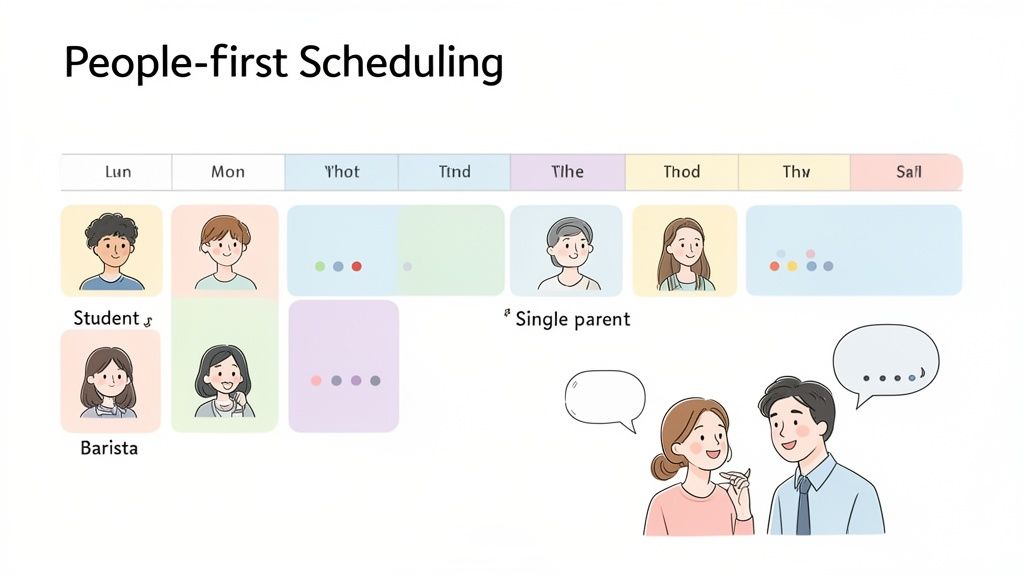
Before you even think about who covers what, you have to gather the human context. Who are these people? What are their strengths, their commitments outside of work, their preferences? This is where the real work of scheduling begins.
Start with conversations, not just forms. Sure, availability forms are useful, but they never tell the whole story. The real gold is in the conversations you have.
This is how you learn that Sarah, your best barista, has a mandatory lab class every Tuesday morning. Or that David, a key warehouse lead, is a single dad who needs predictable hours to line up childcare. These aren't minor inconveniences—they are the real-world facts you need to build a schedule that actually works.
Of course, this doesn't mean everyone gets their dream schedule every week. That's not realistic. But it does show you respect their lives beyond the workplace. A 2024 study from McKinsey highlighted that when employees feel a company is invested in them as people, their motivation skyrockets. That investment starts here.
A schedule built on empathy doesn't just fill slots; it builds loyalty.
Once you’ve mapped out this human landscape, it’s time to layer in the business needs. This is about being crystal clear on what the business needs to thrive. Think of it as a "non-negotiables" list. Yours might include minimum coverage for the weekend rush, specific skill requirements for a closing shift, or hard limits set by labor laws.
This people-first approach flips the script. It transforms scheduling from a top-down chore into a collaborative puzzle. You’re no longer jamming names into boxes. Instead, you're thoughtfully designing a system that supports your employees while guaranteeing the business has what it needs to succeed. It takes more care up front, but it will save you countless headaches.
Swap Guesswork for Data
Let’s be honest. Gut feelings have their place, but they're a terrible way to build a work schedule. If you're still creating schedules based on what feels right, you're likely wasting money and burning out your team.
It’s time to stop guessing and start looking at the data you already have.
By digging into your past performance, you’ll uncover patterns you never knew existed. When do sales reliably pick up? Are there more support tickets on the first Monday of the month? Is your shop a ghost town on Wednesday afternoons? I’ve seen it time and again: a little data analysis turns scheduling from a frantic chore into a calm, proactive strategy.
Every business has its own pulse. Your job is to find it. You don't need a data science degree to do it.
Ask a few simple questions:
When are you busiest? Pull up your sales data or appointment logs. A simple chart might make it obvious you need three people on shift during the lunch rush, not just two.
When do you need specific skills? Maybe your warehouse gets slammed with inventory on Monday mornings, meaning you need more people trained on receiving.
What outside factors play a role? Think about local events, holidays, and even the weather. A sunny Saturday can double your patio sales.
When you ground your schedule in real data, you staff smarter. Period. It cuts down on wasted labor hours and prevents the stress of being short-staffed. If you want to get a better handle on this, you can explore the basics of what is workforce analytics.
This isn’t a nice-to-have. It’s good business. We’ve seen companies cut labor costs by 8-12% just by using their own historical data to build better schedules—all without hurting service quality. The same logic applies to non-customer-facing teams, like using a preventive maintenance schedule template to forecast work orders based on past equipment issues.
The goal isn't to become a data expert. It's to use simple facts to make smarter decisions.
Ultimately, this is about shifting from a state of constant firefighting to one of calm preparation. It’s a change both your employees and your customers will notice.
Design a Flexible Framework, Not a Rigid Cage
Alright, you’ve crunched the numbers and, more importantly, you’ve talked to your people. Now it’s time to build the schedule. But here's where many fall into a trap: they treat the schedule like a finished, unchangeable document. That’s a mistake.
A great schedule isn't a cage. It's a flexible framework—a living blueprint that guides your operations but has enough give to handle the unexpected.
The first step is turning your historical data into a reliable forecast. It's a straightforward process, but getting it right is the foundation for everything else.
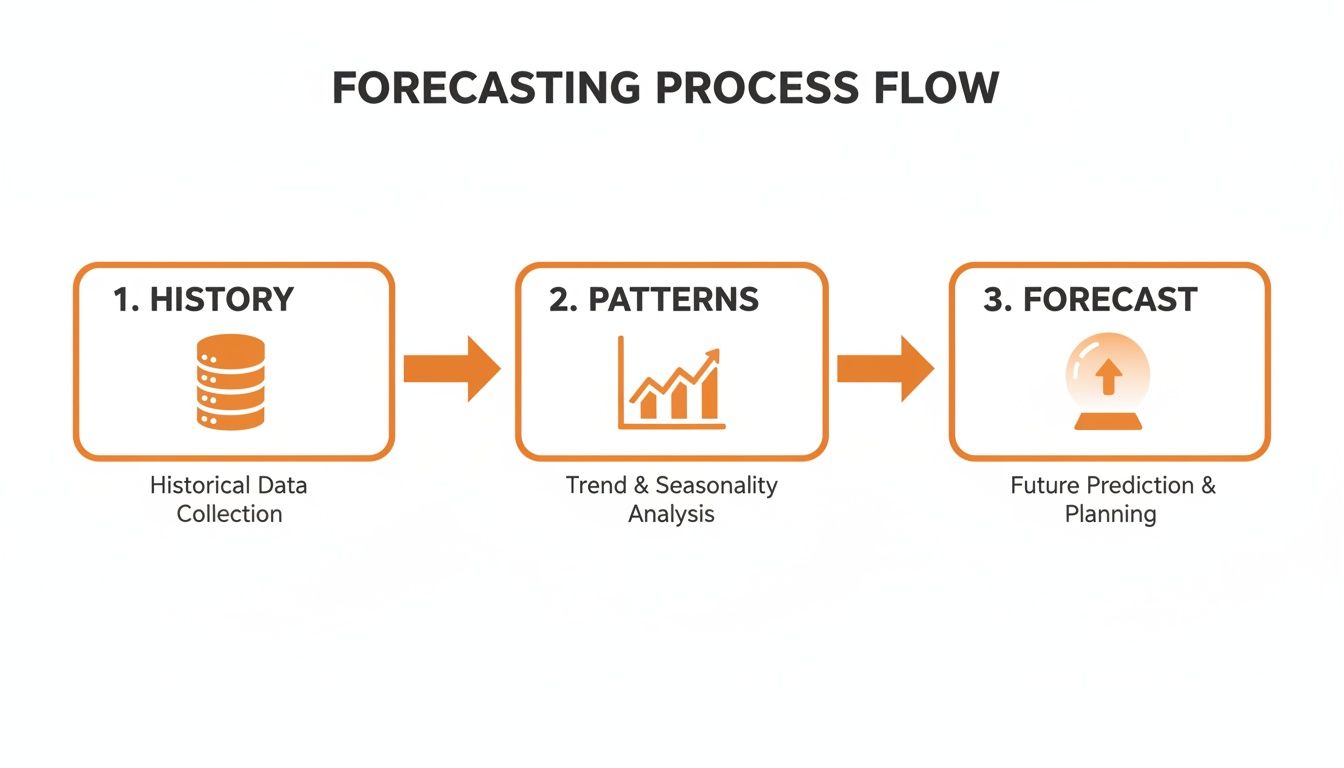
You’re simply looking at the past to find patterns that help you predict the future. A solid, data-backed forecast is your best defense against the costs of both overstaffing and understaffing.
Next, find the right shift pattern. This is the skeleton of your schedule. You don't need a ridiculously complex system. A restaurant, for instance, might use a simple rotating schedule to ensure weekend shifts are shared fairly. An office team could try a 4/10 compressed workweek, where employees work four 10-hour days. A 2026 Microsoft update on flexible work showed that this kind of autonomy is a massive driver of job satisfaction. The best pattern depends on your business. If you need ideas, our guide on a shifts schedule template has some great starting points.
Once you have a draft, do not—I repeat, do not—carve it in stone. Share the draft with your team. Post it in a shared channel and ask for feedback. Be clear about what you're asking. This isn't an open invitation for everyone to design their personal dream schedule.
You’re not seeking permission. You're stress-testing your plan.
Let’s be honest. Your team will see things you missed. Maybe you accidentally scheduled your two best forklift operators on the same shift, leaving the next one uncovered. They know the ground-level reality better than anyone.
By inviting them into the process, you accomplish two things. First, you create a better schedule. Second, you show your team you respect their input. That trust is priceless. It transforms the schedule from a top-down mandate into something everyone has a stake in.
Make Communication and Changes Effortless
So, the schedule is posted. Your work is done, right? Not even close. I used to think a published schedule was the finish line. I quickly learned it's just the starting gun.
The true test of any scheduling process is how it handles the chaos of real life. People get sick. Babysitters cancel. If your system for managing changes is a messy web of text messages and sticky notes, that perfect schedule will fall apart by Tuesday.
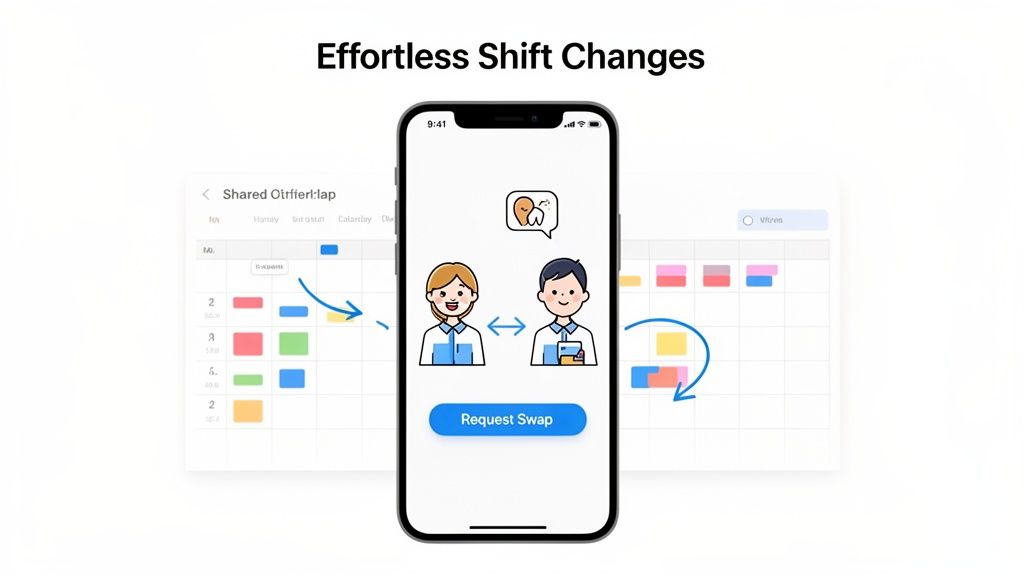
This is where having a single, unified tool isn’t a nice-to-have. It’s essential.
The secret to managing changes calmly is to have one—and only one—official channel for all requests. No exceptions.
Picture this: An employee needs to swap their Friday shift. Instead of texting you and three coworkers, they open an app. They see who's available and has the right skills. They send a swap request. The coworker accepts. You get one notification, see the whole picture, and approve it. The schedule updates immediately for everyone.
A process that once took six text messages, a phone call, and a manual spreadsheet update now happens in under a minute. This isn’t about fancy tech; it’s about getting out of the way.
This simple workflow is a game-changer. It removes you as the bottleneck and helps your team solve their own conflicts.
When your schedule lives in one central place that updates in real-time, you eliminate confusion. No more, "I didn't know I was working." Research shows a proper scheduling tool can slash the time spent on schedule administration by 30-40%. Before these tools, managers often burned up to eight hours a week just juggling shifts. You can explore the research on scheduling efficiency to see the full impact.
A unified system gives you transparency, employee autonomy, and your sanity back. Think of it like good plumbing. The water flows where it needs to without you having to manually open every valve. It’s calm, it’s simple, and it respects everyone’s time.
Your Schedule Isn't Set in Stone—It's a Living Document
Once the schedule is posted, it’s tempting to move on. But that’s when the real learning begins. Think of your schedule not as a finished product, but as a living document that needs to adapt.
I’ve found that a regular check-in—monthly or quarterly—is non-negotiable. This is your time to step back and honestly assess what’s working and what isn’t. Don't just go with your gut. Dig into the data.
Are you constantly scrambling to cover Tuesday mornings? Are a couple of people always picking up extra shifts and creeping toward burnout? A sudden flood of shift swap requests is a huge red flag. These aren't just metrics; they're telling you a story.
But numbers only tell you what is happening, not why. You need to get out from behind the screen and talk to your people. The next time you're on the floor, pull an employee aside and ask, "Hey, how's the schedule feeling lately?" The feedback you get in these moments is often more valuable than any spreadsheet.
A schedule only truly works if it works for the people who live it every day.
This constant loop—looking at the data, talking to your team, and making small tweaks—is how you build a resilient scheduling process.
The more you review and refine, the more historical data you build. This isn't just for looking back; it’s your best tool for forecasting the future with far greater accuracy. For example, statistical analysis shows that using metrics from past tasks can forecast project completion dates with 85-90% accuracy. You can learn more about forecasting with historical data on Screenful.
This isn't about chasing a "perfect" week. That rarely exists. The goal is to build a system that’s strong enough to handle reality and flexible enough to change. The schedule stops being a source of stress and becomes what it should have been all along: a quiet, reliable tool that helps everyone do their best work.
Common Scheduling Questions
After years of managing teams, I’ve found a few questions always pop up. They usually circle back to fairness, flexibility, and what to do when the plan goes sideways.
Here’s my take.
How can I make schedules fair for everyone?
Fairness isn't about making everything equal. It’s about being transparent and consistent. Rotate the less desirable shifts among all eligible staff. Use a system to track who gets what. This way, you can make sure that opportunities, like picking up extra hours, are spread around evenly over time. Trust is built on objective rules, not favoritism.
What is the best way to handle last-minute call-outs?
A call-out can feel like a crisis, but it doesn't have to be. Have a clear policy and a great tool. Your policy should be dead simple: who to notify and by when. Your tool should do the heavy lifting. Instead of making panicked phone calls, a manager can broadcast an open shift to qualified employees. Someone claims it, and the problem is solved.
A last-minute opening doesn't have to be a fire you need to put out. With the right system, it’s just information for the team to act on.
How far in advance should I post the work schedule?
While some local laws dictate a minimum notice, my advice is to always post schedules at least two weeks in advance. Anything less feels disrespectful. Giving people that window allows them to plan their lives—to schedule appointments, arrange childcare, or just make plans with friends. It's one of the easiest ways to build morale. For a deeper dive into common scheduling questions, you can find great insights on work scheduling from the Parakeet AI blog.
With Pebb, you can bring your entire scheduling process—from creation to communication and last-minute changes—into one simple, unified app. Build a schedule that works for everyone.
