
A Better Happy New Year Signature Email: 7 Examples
Stop sending bland holiday wishes. Get 7 practical examples for your happy new year signature email to connect your team and boost engagement in 2026.
Dan Robin
The first week of January always looks the same in my inbox. A pile of cheerful emails, all saying roughly the same thing, all forgotten a minute later. The part often overlooked isn't the message. It's the signature.
We still treat signatures like a digital business card. That's too small a view. A signature shows up on every reply, follow-up, handoff, and update, which is why a 2026 email signature analysis frames signatures as a high-reach branding asset and estimates that a 100-employee company can generate about 60,000 to 80,000 branded signature impressions per month. Around New Year, that tiny block does more than say “best wishes.” It tells people how your company communicates, how coordinated your team is, and whether anyone is paying attention. If you're already sending January thank-yous, kickoff notes, and fresh-start check-ins, it can even sit nicely alongside gestures like Online Gifts Canada's holiday baskets without turning into another noisy campaign.
A good Happy New Year signature email is small on purpose. Small enough to repeat. Small enough to trust. Small enough to be used.
1. Professional New Year Team Unity Signature
If you run HR or operations, this is the cleanest version to roll out. It isn't cute. It isn't clever. It clearly tells people, “We're starting the year together, and we're doing it in a coordinated way.”
That matters more in organizations with multiple sites, rotating shifts, or teams that rarely see each other in person. A hospital network, a retail group, or a logistics company doesn't need twelve variations of seasonal enthusiasm from twelve managers. It needs one calm, consistent signature that reinforces shared direction.
What it looks like
Use a short line such as: “Happy New Year from the [Company] team. Here's to a connected, successful year ahead.” Then keep the rest of the signature standard across managers and team leads.
I'd keep the seasonal note to no more than three lines total, including any banner text. The benchmark guidance in the verified data also supports narrow, mobile-friendly signature layouts and concise text, which is exactly why overstuffed signatures fail in practice.
Use one approved format: Every manager should use the same layout, same logo treatment, and same wording.
Point people to one shared workspace: If your team runs communication in Pebb, link directly to your employee communication platform instead of scattering people across tools.
Refresh on a real cadence: Seasonal signatures work best when they feel current, not forgotten leftovers from January.
Practical rule: Unity shows up in repetition. If every leader signs off differently, people feel the fragmentation even if nobody says it out loud.
One reason this format gets attention is simple. Many teams don't change signatures often. The same 2026 analysis notes that 44.4% of users update their signatures 2 to 4 times per year, while 31.6% update them only once every few years, so a seasonal change stands out because recipients aren't used to seeing one. That's useful in January, when teams are reintroducing priorities and trying to sound organized from day one.
2. Frontline-Focused Mobile-First Signature
Frontline teams don't need a holiday banner that looks great on a laptop and falls apart on a phone. They need something fast, readable, and obvious.
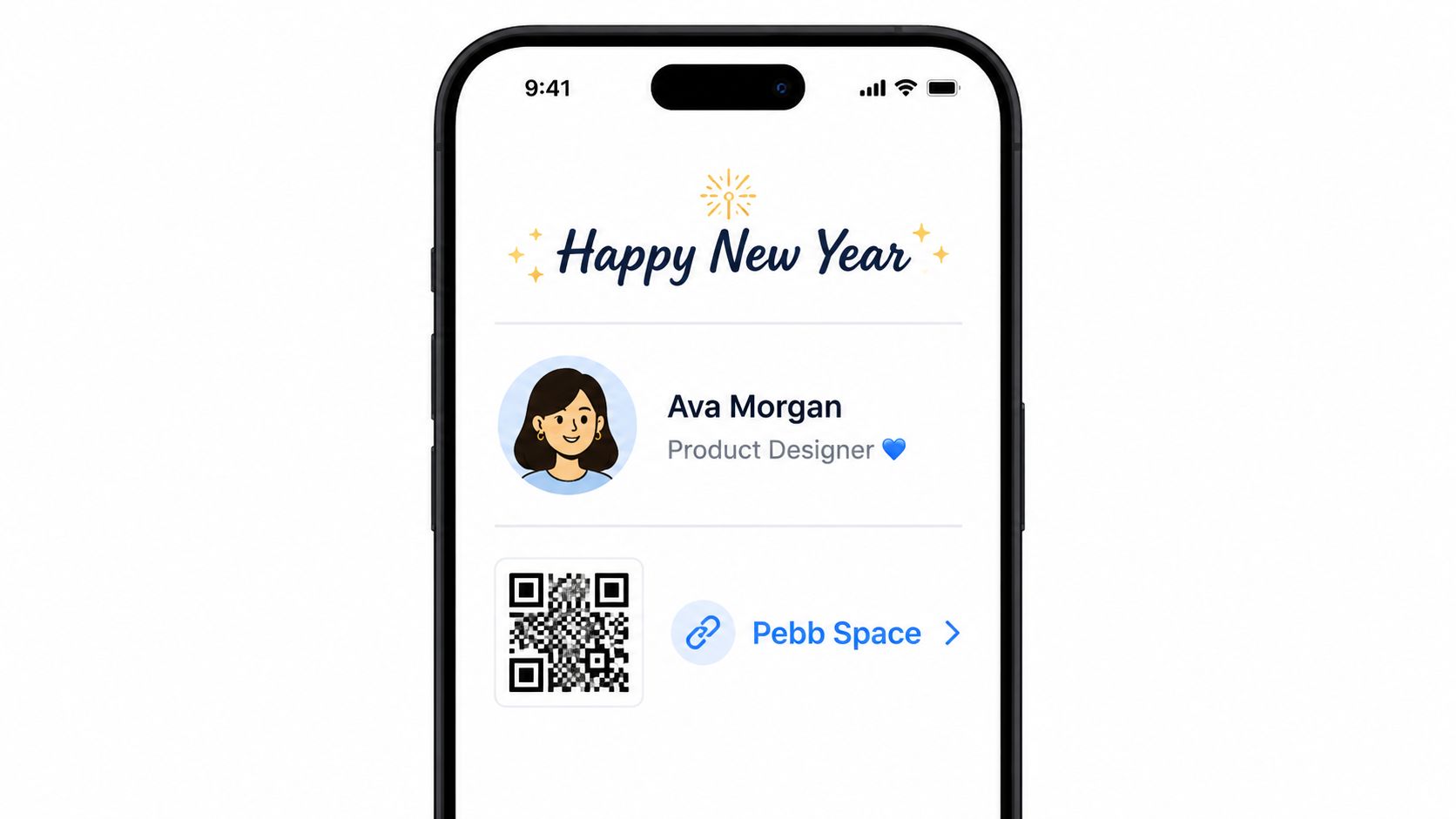
A restaurant manager sending shift updates, a retail supervisor coordinating promotions, or a charge nurse sharing a quick handoff note is usually writing for someone who will glance at that email between tasks. Long signatures get skipped. Tiny links get missed. Decorative clutter turns into friction.
What works on a phone
Keep the message conversational. One short New Year line is enough. If you want personality, use a single emoji and stop there.
A practical version looks like this: “Happy New Year from our team. Need the latest schedule or updates? Join us in Pebb.” Then link to the right space and move on.
A 2026 professional guide to New Year signature banners recommends placing the greeting inside the standard signature as a stylized banner instead of attaching a PDF or image file, and it advises keeping the banner live for the first two weeks of January before returning to normal branding by mid-January. That's the right instinct for frontline teams. Attachments slow things down. Signatures should not.
Design for the thumb: Put the most important link high enough and clear enough to tap.
Keep one action: A direct path to your employee app for frontline workers is better than three competing links.
Test on an actual phone: Don't trust a desktop preview for a mobile habit.
In practice, this style works well for teams that live inside scheduling, task updates, and quick coordination. The signature isn't there to impress anyone. It's there to remove one more small barrier.
3. Departmental Culture-Building Signature
A company-wide signature keeps the brand steady. A departmental signature gives teams a little identity without breaking that system.
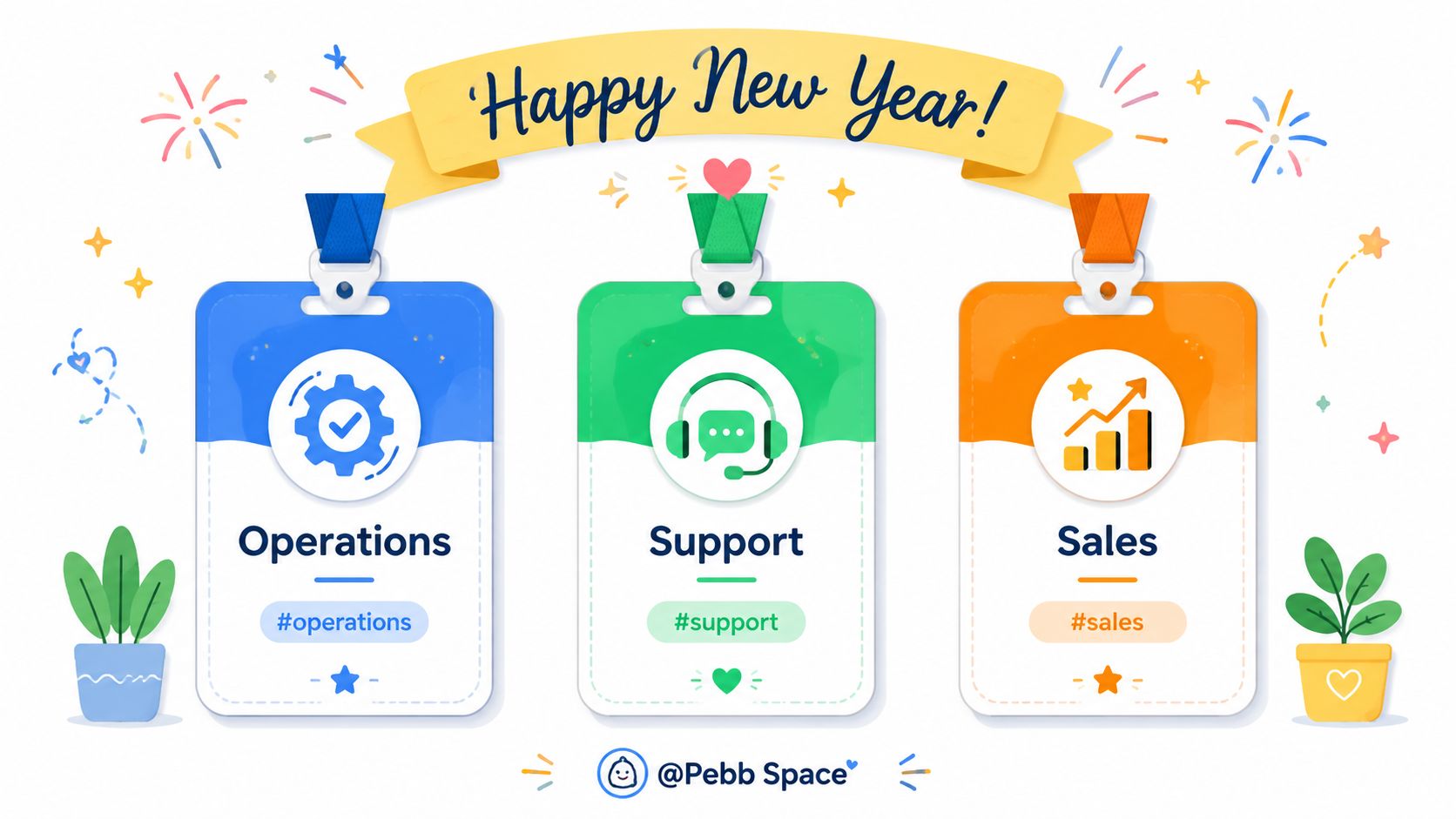
This works best when the department already has a clear rhythm. Operations might use “New Year, New Efficiency.” Support might say “Connected Team, Better Service.” Warehouse leadership might keep it even simpler with “One Space, One Goal.”
Where teams usually get this wrong
They turn the signature into a mini campaign. Too much copy. Too many badges. Too much internal language that means nothing outside the department.
A better approach is to let the department voice show up in one line, then anchor it to a practical place like a Pebb Space handle, a knowledge base, or an onboarding page. You want recognition, not noise.
A department signature should sound like the team, not like a poster from the marketing closet.
If you want a little rotation, change the line monthly or by quarter. Keep the structure fixed. People should recognize the format even when the message changes.
This format is especially useful when teams are trying to build cross-functional familiarity. Sales learns how support refers to itself. Operations sees how fulfillment presents its priorities. That may sound small, but small repeated cues are often how culture becomes visible.
4. Distributed and Hybrid Team Connection Signature
Distributed teams have a predictable January problem. Everyone's back, but not at the same time, not in the same place, and not always in the same timezone. A good Happy New Year signature email can remind people where connection happens.
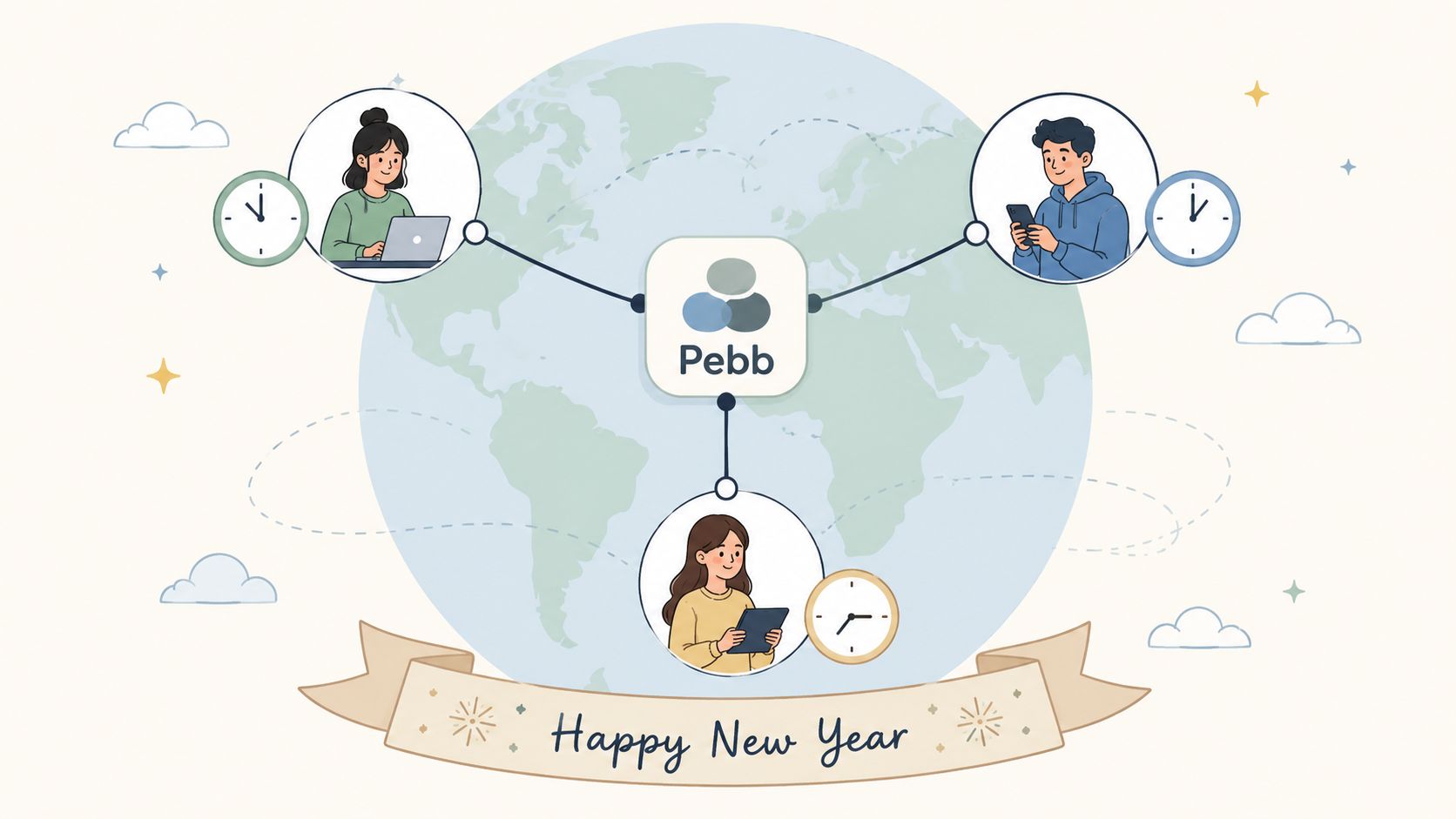
The message here should be reassuring, not performative. Something like: “Happy New Year from our distributed team. Pebb keeps us connected across every shift and timezone.” That's enough. Then let the signature point to the shared space where updates, message threads, and async communication already live.
Timing matters here
The strongest distributed-team signatures don't go out on December 31 when people are half offline and messages are buried. Verified benchmark data says Happy New Year signature campaigns sent between January 5 and 8 achieved 35% higher inbox placement rates than those sent on December 31, because inbox clutter drops as people catch up in early January. For hybrid and global teams, that timing is practical, not cosmetic.
You also want to respect mobile-first design. The same benchmark set calls for narrow signature widths, legible fonts, and HTTPS-secured links. That's a good reminder that trust and clarity are part of the message.
Reference your team's workflow: Mention async updates, message threads, or web-and-mobile access only if your team uses them.
Avoid fake warmth: “We're all one big family” usually lands badly across distributed teams. Keep it grounded.
Make the destination obvious: If collaboration happens in Pebb, your signature should make that easy to find.
A lot of hybrid culture problems start with simple inconsistency. One office hears things first. One team gets more context. One region misses the thread. A disciplined signature won't solve all of that, but it does reinforce the habit of meeting in the same place.
5. Engagement-Driven Analytics-Focused Signature
This version is for leaders who want January communication to pull people back into the rhythm of the company. Not with pressure. With visibility.
A New Year signature can invite people into a survey, a team pulse, a learning space, or a kickoff page. Done well, it tells employees that leadership is paying attention to engagement without sounding like it's tracking them for sport.
Keep the tone human
The temptation is to cram in proof. Resist that. Nobody wants an email signature that sounds like a dashboard screenshot.
What does work is a line that ties care to participation. For example: “Happy New Year. We're listening, learning, and improving how we work together. Join the conversation in Pebb.” Then link to the place where that conversation happens.
A real-world case study from Templafy found that adding branded Happy New Year signature emails to a corporate campaign led to a 24% increase in website traffic from email sources, while click-through rates rose from 1.8% to 2.3%. The study also reported that 47% of recipients felt more confident about the brand and 43% reported a more positive perception of brand trust after seeing professionally branded signatures with holiday-specific banners. The useful lesson isn't “add more graphics.” It's that people notice polish and consistency when it feels credible.
Metrics help when they support care. They hurt when they replace it.
If your HR or operations team uses Pebb analytics, the signature should point toward participation, not surveillance. Invite feedback. Link to learning resources. Give people a reason to click that benefits them too.
6. Onboarding and Welcome Signature
January is when many teams hire, reshuffle, and restart. New people show up while old habits are still settling back in. That makes the welcome signature one of the most useful versions you can deploy.
This one isn't for broad celebration. It's for reducing friction. If a new nurse, store associate, warehouse operator, or office hire gets an email from a manager during their first week, the signature should answer a practical question before they ask it. Where do I go now?
Make the next step obvious
A strong onboarding signature says something like: “Happy New Year, and welcome aboard. Start here for schedules, updates, tasks, and team chat.” Then it gives one clear invite into Pebb.
That one-link rule matters. New hires don't need a menu of options. They need a front door. A direct link to your onboarding flow, knowledge library, or role-specific space is better than piling on policy docs.
Use simple language. Avoid product-heavy labels unless the person already knows them. If you're refining your larger process, this is a good place to tighten it alongside your employee onboarding best practices.
Match the role: A warehouse hire needs shifts and tasks first. A people manager may need approvals, team chat, and documents.
Keep support visible: Include a real contact name or team alias for onboarding help.
Update as the platform changes: Signatures go stale fast when the destination no longer matches the message.
This kind of signature does more than welcome someone. It signals that your company values clarity over ceremony. New hires feel that immediately.
7. Leadership Accountability and Goal-Setting Signature
Executives often use New Year language badly. Too many promises. Too much polish. Not enough evidence that anyone will follow through.
A better leadership signature is modest. It names a direction, shows availability, and points people toward the channel where that availability is real. “Happy New Year. We're focused on better communication, better decisions, and fewer silos. I'm available on Pebb.” That's enough.
The signature has to match behavior
If leaders say “let's connect” but never answer in the company platform, the signature becomes a credibility problem. If they talk about transparency and hide in email, same issue.
The benchmark analysis in the verified data reported results across 150 enterprise campaigns, showing that dynamic New Year signature banners increased brand recall by 47% and trust scores by 37%, while click-through rates improved from 1.5% to 2.1% when paired with thoughtful subject lines. It also noted that 63% of organizations had low engagement with signature links before branded holiday signatures, and that engagement rose by 28% after adding holiday banners and mobile-optimized images. The practical takeaway for leaders is straightforward. Visibility improves when the signal is clear and the path is easy.
State one real priority: Don't stack five strategic themes into a signature.
Keep executive signatures aligned: Different wording across the leadership team creates mixed signals.
Use the same channel you promote: If the signature points to Pebb, leaders should be active there.
People don't expect miracles from a signature. They do expect honesty. That's why this format works when the company is serious about leadership visibility and falls flat when it isn't.
7-Point Comparison: Happy New Year Email Signatures
Signature Type | 🔄 Implementation Complexity | 💡 Resource Requirements & Tips | ⭐ Expected Effectiveness | 📊 Expected Outcomes | Ideal Use Cases |
|---|---|---|---|---|---|
Professional New Year Team Unity Signature | Medium, brand rollout & template control | Company logo, consistent brand guidelines; keep message <3 lines; include Pebb link; update quarterly | High ⭐⭐⭐⭐ | Strong company-wide cohesion; consistent messaging; improved initiative participation | HR/internal comms; operations managers; mid-to-enterprise orgs |
Frontline-Focused Mobile-First Signature | Low, simple, mobile-optimized | Minimal assets; smartphone testing; single emoji/QR; prominent Pebb Space link | High for frontline use ⭐⭐⭐⭐ | Faster access to shift info; higher Pebb adoption on mobile; quick reads | Retail/hospitality supervisors; warehouse; healthcare shift leaders |
Departmental Culture-Building Signature | High, multiple custom versions & coordination | Dept-specific badges/handles; coordinate with managers; rotate content monthly; link to resources | High for identity building ⭐⭐⭐⭐ | Stronger departmental identity; increased use of Pebb features; risk of silos if uncoordinated | Multi-location orgs with distinct departments; Pebb Spaces users |
Distributed/Hybrid Team Connection Signature | Medium-High, timezone & cross-platform messaging | Cross-platform links, timezone tools, async/sync references; highlight web/mobile availability | High for distributed teams ⭐⭐⭐⭐ | Improved remote cohesion; increased integrated tool adoption; clearer global coordination | Remote-first, hybrid, or global companies; enterprises with distributed ops |
Engagement-Driven Analytics-Focused Signature | Medium, analytics access & follow-up required | Access to engagement metrics; link to dashboards/surveys; balance data with care; opt-in language | High for measurable impact ⭐⭐⭐⭐ | Measurable adoption and visibility for leadership; improved engagement metrics; possible skepticism | HR/ops leaders; enterprises with formal engagement programs |
Onboarding and Welcome Signature | Medium, HR coordination and possible automation | Single invite link, role-specific versions, onboarding resources; mobile-first; update frequently | High for new hires ⭐⭐⭐⭐ | Reduced onboarding friction; early platform adoption; positive first impressions | Organizations rolling out Pebb; seasonal hiring; high-turnover teams |
Leadership Accountability & Goal-Setting Signature | Low-Medium, needs authentic leader commitment | Exec alignment, clear commitments, "Available on Pebb" links; change annually; ensure follow-through | High when authentic ⭐⭐⭐⭐ | Sets organizational tone; models transparency; encourages leader engagement; can seem performative if not backed | Executives/directors; orgs prioritizing transparency and top-down change |
Your Signature Is a Signal
In the end, your email signature is a small space that tells a big story. It signals what your company values. Clarity, connection, usefulness, or clutter. Teams often leave that space on autopilot, then wonder why their communication feels scattered.
A well-built Happy New Year signature email does something subtle but important. It turns a routine message into a repeated cue. It reminds people where the team meets, how leaders show up, what kind of tone the company wants, and whether the basics are handled with care. That's why I think this tiny detail matters more than it looks like it should.
The design part is not hard. Keep it short. Keep it mobile-friendly. Keep links secure. Keep the seasonal message inside the normal signature instead of attaching extra files. Verified benchmark guidance also recommends concise signatures with only a few lines of text, web-safe fonts, and authenticated image hosting for deliverability, which matches what most experienced operators already know from trial and error. Simple survives.
The harder part is being intentional. A team unity signature says one thing. A frontline signature says another. A leadership signature says even more, especially when leaders don't live up to it. The right choice depends on what January means inside your company. Fresh hires. Reopened client conversations. Shift coordination. Culture repair. A reset in how information flows.
That's also why I wouldn't copy a template blindly. The wording matters less than the signal. If your signature points to an empty workspace, people notice. If it promises access but leaders stay silent, people notice that too. If it helps someone find the right place, the right person, or the right update one step faster, they notice that as well.
A lot of internal communication advice overcomplicates things. This one doesn't need to. Make the signature useful. Make it consistent. Make it honest. If you want another simple example of how small linking choices shape visibility and behavior, this guide on linking Facebook pages makes the same larger point in a different context.
Take a look at your signature right now. Not the logo. Not the legal footer. The actual message it sends. Is it helping your team start the year well, or is it just taking up space?
If you want one place for chat, updates, tasks, onboarding, scheduling, and real leadership visibility, Pebb is worth a serious look. It gives frontline and office teams a shared home on web and mobile, which makes a simple thing like a New Year email signature much more useful because the link at the bottom leads to a site people use.
