
Your Employee Roster Is More Than Just a List of Names
Is your employee roster causing chaos? Learn how to build a smart, fair, and efficient roster that boosts morale and stops the constant fire-fighting.
Dan Robin
An employee roster should be a simple thing. A list of people who work for you, right? Names, roles, phone numbers. Done. But that’s not the whole story. We’ve learned that a roster is more like the nervous system of your business. It’s not just about who works for you; it's the foundation for how you schedule them, how you communicate, and ultimately, how you run the whole operation.
Your Roster Is More Than a Spreadsheet
Let's be honest. For too long, the 'employee roster' has been a spreadsheet gathering dust in a forgotten folder. A static list of names and numbers. We used to think that was enough. But in a world where your team is your biggest asset, that old spreadsheet isn't just outdated—it's a liability.
Your roster is the blueprint for how work gets done. It’s not about who’s on the payroll, but who’s available, what skills they bring to the table, and how you can schedule them in a way that’s fair. We've seen firsthand how a neglected roster creates chaos—missed shifts, team burnout, and good people walking out the door.
The Real Cost of a Bad Roster
This problem has only gotten worse. Keeping a useful employee roster has become a huge challenge, especially for businesses with frontline workers. A 2024 report found that a staggering 77% of organizations struggled to recruit for full-time roles, and 60% said 'not enough applicants' was their biggest hurdle. This hiring crunch puts immense pressure on your roster, creating gaps that mess with schedules and hurt customers. You can read more about these recruitment challenges and what they mean for businesses.
A modern employee roster is your best defense against this chaos. It helps you create calm, predictable operations and build a team that wants to stick around. It’s the difference between constantly fighting fires and truly leading. When you treat it as a living tool, it stops being a headache and starts being one of your most valuable assets.
The real power of a great employee roster isn't in the data it holds, but in the clarity it provides. It transforms scheduling from a guessing game into a thoughtful, human-centered process.
It answers the real questions in an instant:
Who is certified to operate the forklift on the night shift?
Which team members are getting close to their overtime limits?
Who has already requested next Friday off?
Without that clarity, you're flying blind. You end up digging through old text messages and making last-minute calls that frustrate everyone.
Moving beyond basic spreadsheets, many managers now use tools like Excel AI to get a better handle on their scheduling data. The goal isn’t just to list people; it’s to understand your team’s capacity, skills, and availability in real-time. This is how you build a resilient operation. It's about building a better system, one shift at a time.
The Anatomy of a Roster That Actually Works
So, what separates a list of names from a tool that runs your business? The details. A great employee roster isn’t a glorified contact sheet; it’s a living map of your team’s skills, availability, and potential.
Think of it this way: a basic roster tells you who works for you. A smart roster tells you what they can do and when they can do it. It’s about moving beyond just names and phone numbers.
More Than Just a Name and Number
A useful roster answers the practical questions you face every day. Instead of hunting through spreadsheets or firing off texts, you have a central hub with layers of helpful information.
Here’s what a functional roster includes:
Clearly Defined Roles & Titles: Is Sarah a "Cashier" or a "Head Cashier"? Knowing this instantly clarifies who can handle customer escalations.
Specific Skills & Certifications: This is where the real power is. Who's got their forklift license? Who speaks Spanish? Who's trained in first aid? Tagging employees with these skills turns your roster from a simple list into a problem-solving tool.
Up-to-Date Availability: Documenting when people are generally free to work—and their time-off preferences—prevents 90% of scheduling headaches before they begin.
Accurate Contact Information: It sounds obvious, but you’d be surprised how often this is out of date. Having one central, correct source for phone numbers and emails is non-negotiable.
This level of detail gives you a complete, at-a-glance understanding of your team. The real shift is moving from a static list to a strategic tool that helps you make smarter decisions on the fly.
This approach has evolved over time, from clunky manual methods to the smarter systems we have today.
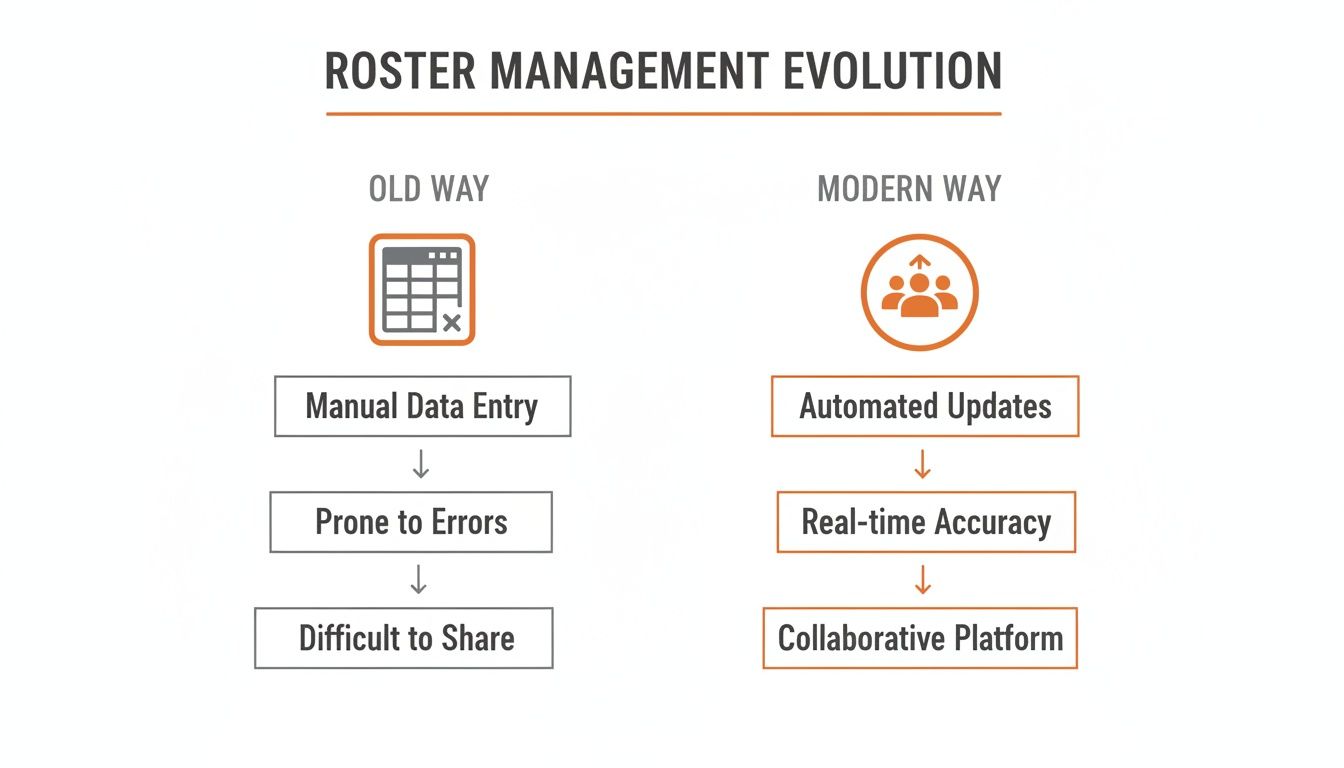
As you can see, the focus has moved from simple data storage to creating a system built for agility and real-world use.
From Basic List to Strategic Tool
The difference between an old-school employee list and a modern roster is night and day. One is a passive document; the other is an active management tool.
Here's a quick breakdown of that evolution:
Component | Traditional Roster (The Old Way) | Modern Roster (The Smart Way) |
|---|---|---|
Primary Focus | Contact information and job title. | A complete operational overview of the team. |
Skills Tracking | None. Skills are in the manager's head. | Tagged, searchable skills and certifications. |
Availability | A note on a sticky pad or a separate file. | Integrated, up-to-date availability for scheduling. |
Updates | Manual, often outdated, and prone to error. | Real-time, often updated by employees themselves. |
Usability | Basically a digital phonebook. | A dynamic tool for scheduling and planning. |
A modern roster is about giving you the information you need, right when you need it, to make the best possible decision.
Putting It All Together
When you have these pieces in place, scheduling stops being a painful game of Tetris. It becomes about intentionally building the perfect team for any given shift. This is a core part of mastering resource allocation—putting the right people in the right places at the right time.
Let's say you run a busy restaurant. It’s Saturday night, a customer has a severe allergy, and your head chef calls out sick. Panic? Not if you have a good roster. A quick search for "advanced food safety certification" shows that one of your line cooks, Maria, is fully certified. Problem solved.
An employee roster isn’t just an administrative chore; it’s your operational playbook. It's the single source of truth that helps you be proactive instead of constantly reacting to problems.
Building this level of detail takes effort up front, but the payoff is huge. It saves hours, reduces stress, and shows your team you value their unique skills. It’s the foundation for a calmer, more organized workplace.
How to Build a Fair and Compliant Work Schedule
Fairness isn't a "nice-to-have." It’s the glue that holds your team together. Nothing burns out good people faster than a schedule that feels arbitrary or biased.
It’s always the small things that add up. The same person always getting stuck with the Friday closing shift, or time-off requests that seem to disappear into a black hole. This is where good intentions fall apart. Building a schedule is about creating a system, not just plugging names into empty slots.
A fair system means rotating those undesirable shifts, distributing hours equitably, and respecting the personal time your team asks for.
Why Fairness Is a Business Decision
Let’s be honest for a second: instability is a huge problem. Right now, a staggering 50% of the global workforce is either watching for or actively seeking a new job. This constant churn costs economies an estimated $8.9 trillion in lost productivity, largely because 62% of employees report feeling disengaged.
For managers, this means fighting a constant battle against turnover. When your scheduling feels unfair, it directly feeds that disengagement. It sends a message, intended or not, that some people's time is more valuable than others'. This isn't just a morale issue; it's a retention crisis waiting to happen.
Navigating the Compliance Maze
Beyond fairness, there's the law. Trying to keep up with overtime rules, required breaks, and local labor laws can feel like walking through a minefield. Many cities now have "fair workweek" laws that demand advance notice of schedules and extra pay for last-minute changes.
Staying compliant isn't just about avoiding fines; it’s about treating your team with basic professional respect.
A compliant schedule is the baseline for professional respect. A fair schedule is how you earn your team's trust and commitment.
Creating a system that is both fair and compliant boils down to clarity and consistency. Everyone on the team should understand the "why" behind their schedule. This is how you build a workplace where people feel seen and valued, not just like another name on the roster.
By focusing on these principles, you'll be well on your way to creating a schedule that works for everyone. For some ideas, check out our guide on different work schedule examples.
Common Roster Mistakes That Cost You Money
We’ve all been there. The frantic, last-minute calls to fill a shift. The communication breakdown that leaves a key post unmanned. Or my personal favorite: the beautiful, color-coded spreadsheet that’s hopelessly out of date by Tuesday.
These aren’t minor annoyances. They're expensive leaks that drain resources, sink morale, and chip away at your business’s foundation. Those "small" failures snowball into big problems, like being overstaffed on a slow Monday and understaffed on a slammed Friday. Both hammer your bottom line.
The Myth of the "Minor" Mistake
The little mistakes are the most dangerous because they feel harmless in the moment. A single shift change buried in a group chat seems trivial, right? But what happens when that message gets missed and you have a no-show during your busiest hour?
Suddenly, you're paying overtime or losing customers because service plummets. This isn't a hypothetical; it's a daily reality for countless managers.
The real cost of a poorly managed employee roster isn't always obvious on a P&L statement. The true damage is the slow burn—the erosion of trust when schedules are consistently unfair and communication is a mess. Good people don't stay in chaotic environments.
A broken rostering process doesn't just cost you money in overtime and lost sales. It costs you your best people, and that's a price no business can afford to pay.
The financial bleed is real, too. When you ignore your team's availability, you're forcing them into shifts they can't or don't want to work. This leads directly to more call-outs and disengagement. Think about it: every hour a manager spends putting out fires is an hour they aren't spending on training, mentoring, or growing the business.
Identifying the Real Culprits
Let’s get real about the most common traps. Once you can spot them in your own process, you can start building a system that’s more resilient and less stressful.
Here are the mistakes we see over and over:
Relying on Outdated Tools: That spreadsheet was a brilliant solution five years ago. Today, it can't handle real-time changes, track expiring certifications, or manage time-off requests without turning into a tangled web.
Ignoring Employee Preferences: Consistently scheduling someone for a shift they’ve repeatedly asked to avoid is the quickest path to burnout. Flexibility isn't just nice; it's a strategic advantage.
Poor Communication Channels: Using a chaotic mix of text messages, emails, and sticky notes is a recipe for disaster. Important updates will get lost. You need a single source of truth for your schedule.
Fixing these problems isn't about finding a magical software. It’s about making simple, practical shifts in how you operate—changes that will save you time, money, and your team's sanity.
Choosing the Right Tools for Roster Management
The trusty spreadsheet had a good run. But for modern roster management, its time is up. If you're scheduling more than a handful of people, building a roster in Excel is like trying to build a house with only a hammer. You might get it done, but it's going to be painful, slow, and full of cracks.
The market is flooded with software promising to solve all your scheduling headaches. Here’s the thing: it’s not about finding the tool with the longest list of features. It's about finding one that solves your actual problems. The goal isn’t to add complexity to your day; it’s to take it away.
What Actually Matters in a Roster Tool
It’s easy to get distracted by flashy dashboards. But most of that is noise. After working with countless businesses, we’ve learned that only a few core things truly move the needle.
Here's what you should really look for:
Integrated Communication: When a new schedule is published or a shift changes, your team needs to know instantly. A great tool has communication built right in, sending push notifications straight to your team’s phones.
Mobile Access for Everyone: Your crew isn't chained to a desk, so your scheduling tool shouldn't be either. Everyone must be able to view schedules, request time off, and snag open shifts from their phone.
A Single Source of Truth: Your roster can't live on an island. It needs to connect to other critical parts of your operation, especially your time clock and payroll. This simple connection saves hours of manual data entry and prevents costly errors.
The best roster management tool is the one you barely notice. It should just work, quietly connecting your people, their schedules, and their paychecks without you having to micromanage the process.
From Disconnected Files to a Connected System
The goal here is to move from a mess of separate spreadsheets and apps to one central hub where everything works together. Imagine publishing a new roster, having your team clock in and out on their phones, and watching all that approved time flow straight into payroll. No more exporting files or manually typing in hours.
This isn’t some futuristic dream; it’s what modern tools are designed to do. In fact, the best shift planning tools are built specifically to save you time by making these connections automatic.
When your employee roster becomes the engine that powers this system, you get to stop being an administrator and start being a leader again. You’re no longer chasing down information or fixing data-entry mistakes. You're free to focus on what really matters: supporting your team and growing your business. That's the real upgrade.
Where Your Roster Shapes Your Company Culture
It’s easy to talk about company culture and daily operations as if they’re two separate worlds. But they’re not. Your employee roster is precisely where the two collide, every day.
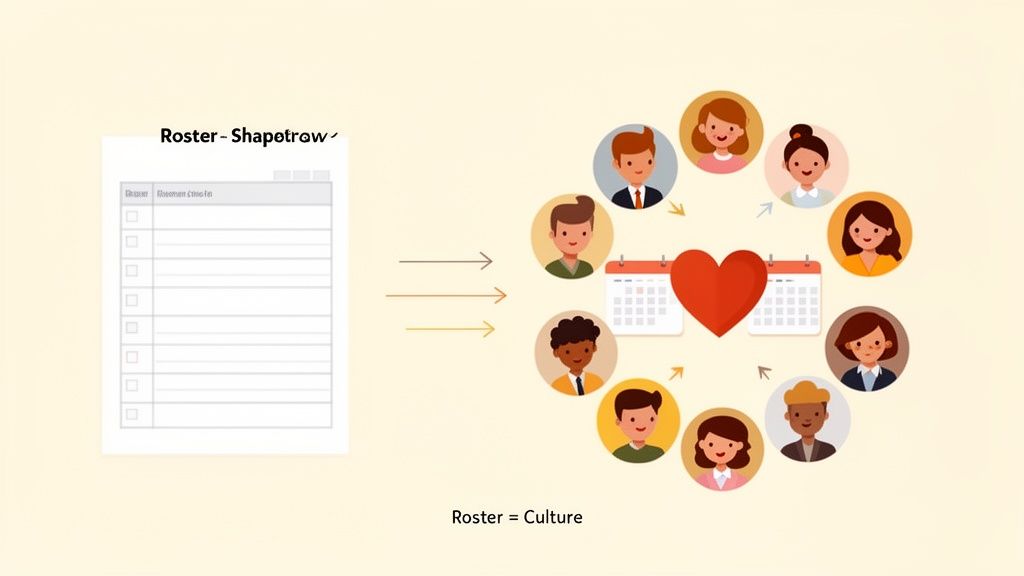
The way you build schedules, communicate changes, and handle time-off requests sends a powerful, unspoken message to your team about what the company really values.
Culture Is Built in the Details
Think about it. A transparent and fair scheduling process builds trust. A chaotic, rigid, and unpredictable one erodes it. This isn't a management theory; it’s the lived experience of your employees.
Constantly putting someone on a shift they’ve repeatedly asked to avoid isn’t just an administrative slip-up. It’s a signal that their needs don't matter. On the flip side, approving a time-off request without a guilt trip shows genuine respect for their life outside of work. These small, consistent acts are the real building blocks of a great culture.
A well-managed employee roster is more than an administrative task. It’s your chance, shift by shift, to prove you’re building a company that people actually want to work for.
The link between clear communication and a strong culture is incredibly tight. The core principles of good internal communication are the same ones you need for managing your roster. When your team feels informed and respected through the scheduling process, that feeling bleeds into every other part of their job.
More Than a Schedule, It’s a Promise
Here’s the bottom line: when the roster just works, your people can focus on their actual jobs. They aren't spending energy deciphering their next shift or fighting for fair hours. It also frees up managers to lead instead of constantly scrambling to fill holes in the schedule.
A thoughtfully built employee roster removes friction from the day. It’s a silent promise to your team that their time is respected, their skills are valued, and their contributions are seen. Getting the roster right isn't just about efficiency.
It’s how you build a better place to work. One shift at a time.
Your Top Questions About Employee Rosters, Answered
Managing an employee roster feels like it should be simple, but the devil is always in the details. It’s a topic that brings up a lot of questions. We’ve rounded up a few of the most common ones we hear.
What’s the Real Difference Between a Roster and a Schedule?
This is a great question because the two are so closely linked. The easiest way to think about it is that your employee roster is your playbook. It's the "who"—a complete list of your people, their contact details, roles, and any special skills they have.
The schedule, on the other hand, is the "when" and "where." It’s the game plan for the week. It takes the people from your roster and puts them into specific shifts on specific days. You can't have a good schedule without a solid roster. One can't function without the other.
How Can I Make Our Rostering Process Feel Fair to Everyone?
Ah, the fairness question. This is probably the number one cause of team friction. The good news is that fairness usually comes down to transparency and consistency, not complex algorithms.
First, create clear and simple rules for how shifts get assigned and how time-off requests are approved. Then, the most important part: stick to those rules.
Next, make a conscious effort to rotate the "good" and "bad" shifts. Whether it's the opening shift, the weekend close, or a holiday, make sure that burden—and that benefit—is shared over time. No one should feel permanently stuck with the shifts nobody wants.
Finally, put everything out in the open. Using a central tool where everyone can see the schedule and easily request swaps or pick up open shifts goes a long way. It removes any suspicion that schedules are built behind closed doors based on favoritism.
The most common cause of scheduling conflict isn't malice; it's a lack of clarity. When the process is clear and consistent, fairness usually follows.
What’s the Best Way to Handle Last-Minute Shift Changes?
Last-minute call-outs are going to happen. It's a fact of life. The chaos that usually follows, however, is optional. The secret is having a single, reliable communication channel for every scheduling update.
Stop juggling frantic group texts, unread emails, and sticky notes. A dedicated app that sends instant notifications right to your team's phones is your best friend here.
Even better, look for a tool that lets employees see open shifts and claim them directly. This can turn a manager's headache into a simple, self-solving problem for the team.
Ready to build a roster that actually works? Pebb unifies your scheduling, communication, and operations into one simple app for your entire team. See how it works.
