
The Employee Engagement Platform: A No-Nonsense Guide
What is an employee engagement platform, really? A guide for leaders on choosing the right tool to connect your entire team, especially frontline workers.
Dan Robin
Monday starts before anyone is ready.
A manager posts a shift change in WhatsApp. HR sends a policy update by email. Someone tapes the new checklist to a breakroom wall. A supervisor texts one person, forgets three others, and assumes the message got through. By lunch, half the team is working off the wrong information and the other half is annoyed they had to go hunting for it.
Most companies don't run on clear systems. They run on workarounds.
I've seen this most often in teams with a mix of office staff and frontline workers. The office crew has inboxes, calendars, and regular access to tools. The people on the floor, in the field, on the road, or on the night shift get scraps. A screenshot. A forwarded message. A missed call. Then leaders wonder why people feel disconnected.
That kind of fragmentation isn't just inefficient. It wears people down. It makes simple work harder than it should be, and it conveys to employees that staying informed is their problem to solve.
There's a better way to run a company. Not a flashy way. A calmer way.
The Hidden Cost of a Disconnected Team
The actual cost of a disconnected team usually doesn't show up as one dramatic failure. It shows up as small, repeated friction.
A new hire does not know where to find the training guide. A store manager has to answer the same question six times because the update lived in a buried email. A warehouse employee misses an important announcement because nobody thought to put it somewhere they could access during a shift. These are not edge cases. For many teams, this is normal.
The trouble is that people adapt to bad systems. They become skilled at chasing information, translating mixed messages, and filling in gaps. From the outside, it can look like the business is functioning. Underneath, everyone is spending extra energy just to stay aligned.
A disconnected team often looks busy. That doesn't mean it's coordinated.
For frontline and distributed teams, the problem gets sharper. Office-first habits create blind spots. If your internal communication depends on email, shared drives, and meetings during business hours, you've already excluded a lot of your workforce. That's one reason resources about problems in workplace communication resonate so quickly. People recognize the pattern because they're living it.
Where the strain shows up first
You usually see it in a few places before anyone calls it an engagement problem.
Managers become human routers. They spend their time repeating updates, forwarding files, and clarifying confusion.
Employees stop looking. When information is scattered, people give up trying to find the “official” version.
Culture gets uneven. Teams closest to leadership feel informed. Everyone else feels like an afterthought.
That last one matters more than most leaders admit. When people can't reliably see what's happening, they don't just miss information. They miss context, recognition, and a sense that they belong to the same company as everyone else.
An employee engagement platform, at its best, fixes that by creating one place where communication, work, and culture live together. Not in theory. In daily practice.
What We Mean by an Employee Engagement Platform
An employee engagement platform is not just a survey tool with a nicer interface. It's not a chat app with a few HR features bolted on either.
It's your company's digital home. The place where people go to see what's happening, what needs doing, what changed, and who needs their attention. If it works, both the head office and the night shift use it without needing different explanations.

Most companies don't start there. They assemble a Frankenstack. Chat in one tool. Company news in another. Policies in a shared drive. Scheduling somewhere else. Recognition nowhere useful. The tools may all be decent on their own, but employees experience the gaps between them.
That fragmentation is common. 72% of organizations use an intranet, 75% use enterprise chat, but only 17% have adopted a dedicated employee communication app, according to Blink's employee engagement statistics. The same source notes that this shift toward unified platforms is tied to measurable outcomes, including a 20.6% improvement in employee retention.
A platform is a philosophy, not a bundle
The useful question isn't “Does this tool have chat, files, and surveys?”
The better question is, “Does this give employees one reliable place to work from?”
When the answer is yes, a few things change:
Old way | Better way |
|---|---|
Updates are scattered across apps | Announcements live where people already work |
Managers repeat the same message in multiple places | Teams see one shared source of truth |
Knowledge is trapped in folders and inboxes | Policies, guides, and answers are easy to find |
Engagement happens as a side project | Engagement becomes part of daily work |
That's why I like the idea of a digital headquarters. Not because it sounds neat, but because it forces discipline. One home. One place to check. One place to contribute.
For leaders looking at how mature organizations approach listening and engagement, this Fame podcast case study is worth a read. It shows the difference between collecting employee sentiment and building a system around it.
What a real platform feels like to employees
A real platform reduces decision fatigue. People don't have to ask, “Where would this be posted?” They already know.
That sounds small. It isn't. Shared habits create trust.
When employees know where to find updates, how to ask questions, where tasks live, and where recognition happens, work gets simpler. Simpler work is easier to stick with. It's also easier to scale.
The Core Jobs a Good Platform Should Do
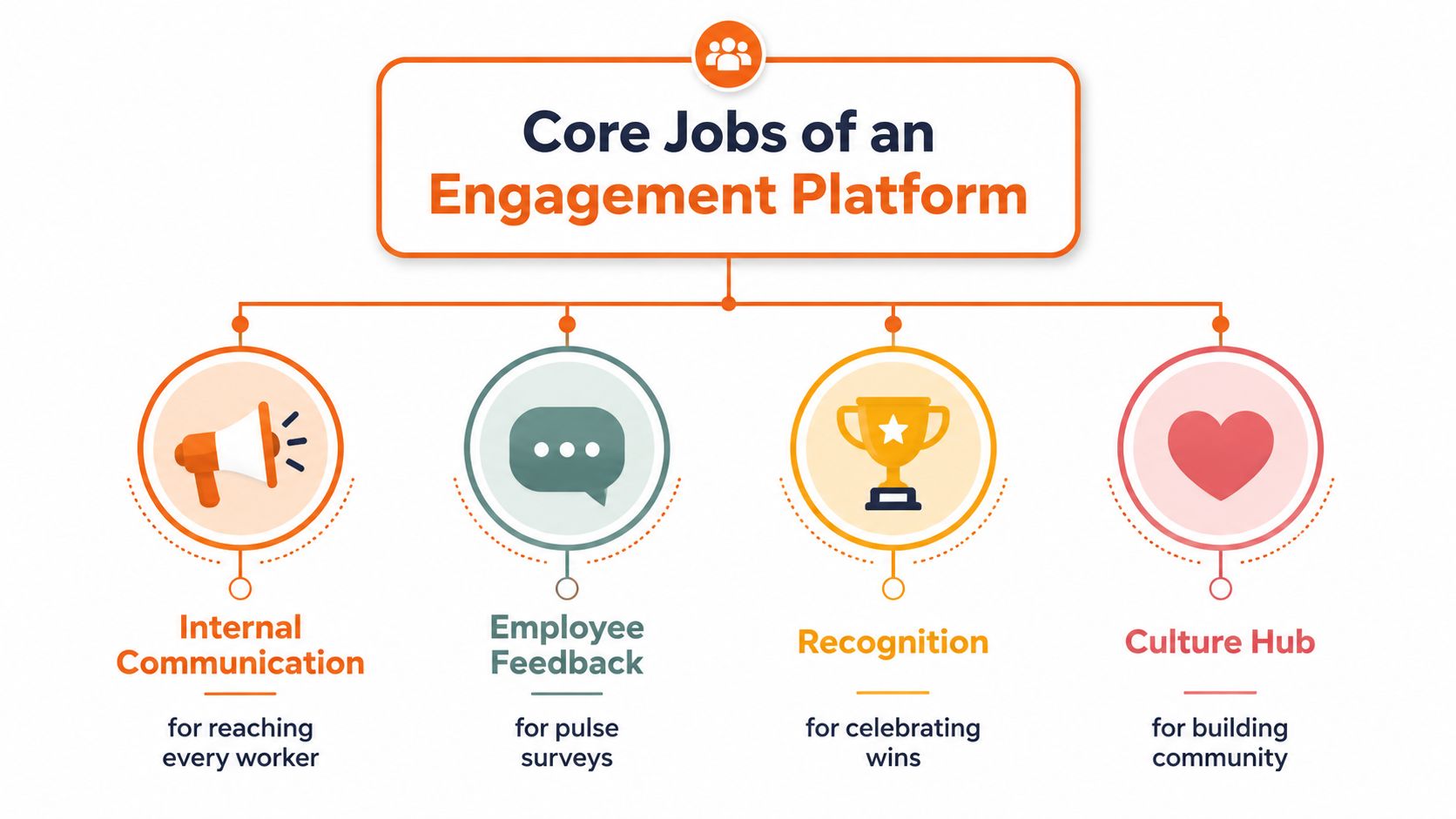
A good employee engagement platform earns its keep by doing a few jobs well. Not by showing off a long feature grid.
If the basics are weak, no amount of extra modules will save it.
Keep everyone in sync
First, it has to make communication reliable.
That means chat, yes. But not chat alone. Teams need announcements, updates, and a feed that can carry information beyond one conversation thread. A policy change shouldn't disappear because it got posted between two jokes and a shift cover request.
For distributed teams, the difference between “sent” and “seen by the right people” matters. Good platforms make it easy to target messages by location, role, or team, and just as important, they make those messages easy to revisit later.
Practical rule: If an important update can vanish in a chat thread, your communication system isn't finished.
The best setups also reduce handoffs. A supervisor sees an issue in chat, turns it into a task, tags the right team, and keeps the context attached. No copying and pasting across tools. No losing the trail.
Organize the work
The second job is operational. Many office-centric tools fall apart in this area.
A platform should help teams manage the actual work around communication. Tasks. Checklists. Shift updates. PTO requests. Approvals. Onboarding steps. If communication and operations live in separate systems, managers become translators between them.
Research summarized by Breakroom's employee engagement software glossary shows why continuous feedback matters here too. Organizations using continuous pulse surveys, such as bi-weekly or monthly, achieve up to 20 to 30% higher retention and 10 to 15% better performance in teams where managers act on survey insights, compared with annual-only surveys.
That finding matters because engagement isn't separate from operations. It's part of how work gets managed. If pulse data lives in one place and manager action lives in another, the loop stays open.
A useful platform closes the loop.
Build a knowledge hub people actually use
Every company says it has a knowledge base. Fewer have one employees can find and trust.
Policies, onboarding guides, SOPs, training notes, and FAQs need a home that works from a phone as well as a desktop. If someone on a warehouse floor can't pull up the right process in seconds, the document may as well not exist.
Many teams overcomplicate things at this stage. They build elaborate structures that make sense to HR or IT, but not to the person who just wants to know how to request time off or handle a customer return.
A good knowledge hub is boring in the best way. Easy search. Clear ownership. Current files. No scavenger hunt.
You can see a broader breakdown of this in Pebb's guide to key features of employee engagement platforms, which maps these jobs to the features teams use day to day.
Create feedback and recognition in the flow of work
Two more jobs matter, and they're often treated like extras.
One is feedback. Not annual theatre. Ongoing listening. Pulse surveys, quick check-ins, sentiment snapshots, and visible follow-through.
The other is recognition. If appreciation only shows up once a year at an awards event, it won't shape culture. Recognition has to live where work happens so that good effort is seen in real time.
Here's the test I use:
Communication: Can people get the message and find it again later?
Operations: Can managers move from message to action without switching tools?
Knowledge: Can a new employee find what they need without asking three people?
Culture: Can employees give feedback and see appreciation in normal work, not as a separate campaign?
If the answer to any of those is no, the platform still has holes.
The Real Payoff for Your People and Your Business
Most leaders don't need another speech about culture. They need a business case.
That case exists, and it's stronger than many teams realize. The broader market has grown quickly because companies are trying to solve a real problem, not chase a trend. According to Grand View Research's employee engagement software market report, the global employee engagement software market was estimated at USD 928.3 million in 2023, reached USD 1,049.9 million in 2024, and is projected to hit USD 2,608.3 million by 2030, with a 16.4% CAGR from 2024 to 2030.

The urgency is obvious too. The same report says U.S. employee engagement fell to 31% in 2024, its lowest level in a decade, while global engagement dropped to 21% in 2024. It also ties engagement to outcomes that executives care about. Engaged teams see 78% less absenteeism, 21% less turnover in high-turnover organizations, 28% less theft, 63% fewer safety incidents, and 23% higher profitability. The report also notes that actively disengaged employees cost the U.S. about $1.9 trillion in lost productivity.
What employees get from it
For employees, the payoff is straightforward. Less guessing. Less chasing. More clarity.
A frontline worker doesn't want “engagement” as an abstract concept. They want to know their schedule, find the latest update, ask for help, get recognized for good work, and not feel like the last person to hear important news. A good platform gives them that.
For office workers, the benefit is different but still real. Fewer duplicate threads. Fewer missed updates. Less dependence on side channels.
What managers and HR get
Managers get time back.
They stop acting as the glue between five tools and start using one system to communicate, assign, track, and follow up. HR gets a direct line to employees they usually struggle to reach, especially across shifts and locations.
Modern platforms also create a better measurement loop. Instead of relying on a single annual survey, leaders can watch participation, sentiment, and response patterns over time. They can spot where communication is landing, where managers are following through, and where teams may be drifting.
The value of analytics isn't the dashboard. It's whether a manager changes something because of what they saw.
Why this matters to the business
The payoff compounds when adoption is real.
Lower absenteeism helps staffing. Better retention reduces hiring strain. Fewer safety incidents matter in environments where mistakes have physical consequences. Higher profitability gets the attention of every finance leader for good reason.
None of that happens because you bought software. It happens because the platform changes daily behavior. People know more. Managers act faster. Teams miss less.
That's what makes the investment worthwhile.
How to Choose a Platform That Actually Works
Most buying mistakes happen in the demo.
A polished office-first platform shows clean dashboards, pretty org charts, and a nice recognition feed. Leadership nods. Procurement signs. Six months later, the office staff use part of it and the frontline team ignores it.
That outcome is predictable.
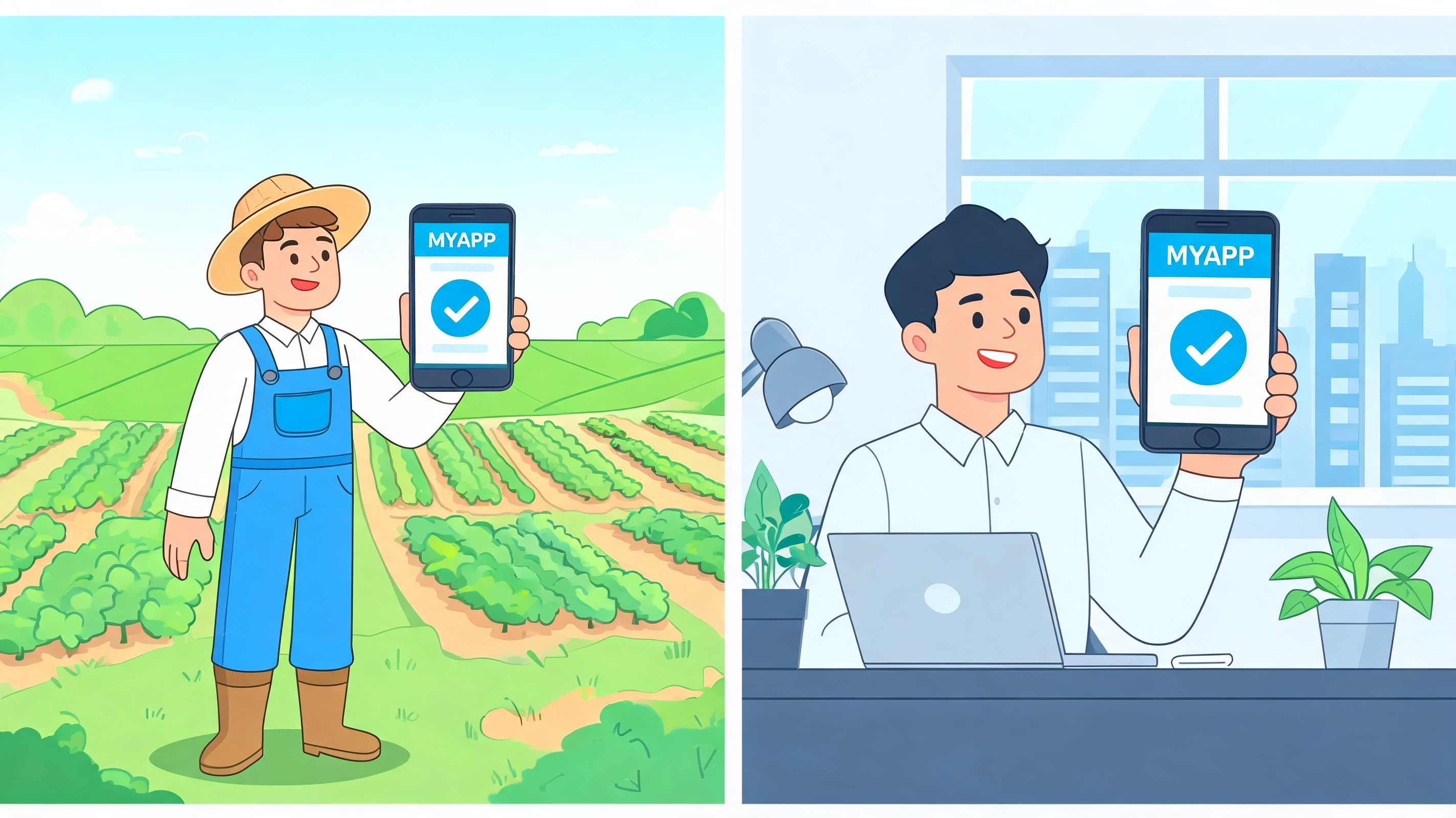
The biggest mistake is assuming that a tool built around desk workers can be stretched to fit distributed, shift-based teams. Usually it can't. The frontline engagement gap is real. Generic platforms tend to treat mobile, offline access, location-level communication, and shift workflows as add-ons. For frontline teams, those are the job.
Research from Elcom on must-have employee engagement platform features makes this plain. Mobile-optimized platforms see 40 to 60% higher user adoption and engagement than desktop-only or poorly responsive tools, especially among frontline and deskless workers. The same source also notes that workflow automation can drive 30 to 50% faster approvals.
The questions worth asking in a demo
I'd ignore half the presentation and ask the vendor to show me the hard parts.
Show me the mobile experience. Not screenshots. A real workflow on a phone.
Show me what happens offline. If the app assumes perfect connectivity, some teams will lose trust in it fast.
Show me role-based communication. Can a manager reach one location, one shift, or one function without blasting everyone?
Show me operational workflows. How does it handle shift swaps, approvals, PTO, or task handoffs?
Show me onboarding from a new hire's point of view. Can someone join and get oriented from their phone without needing a laptop?
Show me analytics by team or site. If adoption is uneven, can you see where the problem is?
Those questions usually separate platforms built for real operations from platforms built for demo theatre.
What frontline teams need that office teams often don't
Leaders need to take a clear stand on this issue.
A warehouse, hospital, restaurant group, field service company, or retail chain does not need the same thing as a software firm with everyone at desks. There is overlap, but the center of gravity is different.
If your workforce is mostly office-based | If your workforce is frontline or distributed |
|---|---|
Desktop use is common | Phone use is the default |
Meetings fill information gaps | Shift handoffs fill information gaps |
File access matters | Immediate task and schedule clarity matters |
People can tolerate extra clicks | People won't tolerate friction during a shift |
That doesn't mean frontline teams need a “light” product. They usually need a more disciplined one.
A tool such as Workday, UKG, or Blink may fit depending on your setup and priorities. Pebb is another option if you need chat, spaces, tasks, files, shifts, clock-in, PTO tracking, and analytics in one mobile-first app for both frontline and office teams. The point isn't the brand. The point is fit.
If you're comparing categories and trying to separate glossy internal comms software from tools that can handle real field operations, this guide on how to choose internal comms platforms in 2025 is a practical place to start.
Buy for the employee who has the least time, the least access, and the fewest second chances to check a message. If the platform works for them, it usually works for everyone else too.
Beyond the Launch Day What Real Adoption Looks Like
Launch day is easy to overrate.
A clean rollout, a few training sessions, and a burst of early logins can make any employee engagement platform look successful. But there's a gap between implementation and habit, and too many teams confuse the first with the second.
That gap matters because there's still little hard data connecting fast onboarding to sustained adoption over time. Meegle's writing on employee engagement and communication platforms makes the point clearly. Quick rollouts are appealing, but success depends on monitoring, gathering feedback, and adjusting the platform until it becomes part of everyday work.
What adoption actually looks like
Real adoption is quieter than most launch plans.
It looks like the weekly schedule getting posted in the same place every time. It looks like a shift lead assigning tasks there because it's faster than texting. It looks like new hires finding policies without asking around. It looks like recognition showing up in normal work, not as a special campaign once a quarter.
If I were rolling out a new platform, I'd keep it simple:
Start with one team that feels the pain most clearly. Usually that's a distributed or shift-based group.
Tie the platform to one recurring habit. Schedules, daily briefings, onboarding, or weekly wins.
Pick a few local champions. Not the loudest people. The reliable ones.
Watch behavior, not just signups. Logins matter less than repeat use for meaningful tasks.
Adjust quickly. If people keep falling back to WhatsApp, email, or paper, the platform hasn't earned the workflow yet.
The goal is to become the obvious place
You don't need perfect adoption in week one. You need steady gravity.
When employees start checking the platform first because that's where the truth lives, you're on the right track. When managers stop duplicating updates elsewhere, you're getting closer. When people trust that what matters will be there, the system starts to hold.
That's the real point of all this. Not a higher engagement score for its own sake. A company where people feel informed, included, and less alone at work.
If your team is tired of juggling chat apps, emails, paper checklists, and disconnected tools, Pebb is worth a look. It brings communication, tasks, knowledge, shifts, and engagement into one place, with a setup that works for both frontline and office teams. The best test is a simple one. See whether your hardest-to-reach employees would use it tomorrow.
