
Cross Team Collaboration That Actually Works in 2026
A practical guide to cross team collaboration — clear frameworks, real industry examples, the metrics that matter, and how to roll it out without the chaos.
Dan Robin

Tuesday morning is where cross team collaboration usually gets exposed. One team closes out the night with clean notes in one system, another team starts the morning in a different one, and somewhere between those two tools the core story disappears. The customer's exception, the handoff risk, the small promise somebody made on a shift call, all of it gets lost because the work didn't have one place to live.
That's the part most guides skip. They talk about culture, meetings, and “better communication,” but the problem is usually more basic. The work is crossing a boundary, and the boundary has no plumbing.
I've spent enough years untangling retail, clinical, and warehouse handoffs to know the pattern. When collaboration breaks, it's usually because four things are missing at once, a shared place to work, a shared language, a shared goal, and a clear owner. Fix those, and the rest stops feeling like a personality problem.
The Handoff That Broke on a Tuesday Morning
At 6:10 a.m., the night shift had already moved on. The day team came in, checked their own dashboard, and saw a clean slate. What they didn't see was the note about a delayed supplier drop, the customer escalation from the previous hour, or the exception that needed a manual override before the first rush.
That's how cross team collaboration fails in real life. Nobody “dropped the ball” in the dramatic sense. The teams were just working in separate systems, with separate habits, and nobody owned the gap between them.
The work didn't cross the boundary
The hardest part of these failures is that everybody believes they did their job. The frontline crew updated their tool. The supervisor sent a message in chat. The receiving team opened their own queue and trusted what they saw there. The problem is not effort, it's that the context never traveled with the work.
A broken handoff always tells the same story. Someone had to guess, someone had to chase, and someone had to redo something that should've been obvious. That's why collaboration is not a culture slogan. It's the plumbing that decides whether decisions, ownership, and context move.
Practical rule: if the receiving team has to ask, “What happened before this landed on my desk?”, the handoff is already weak.
What makes this maddening is how ordinary it looks. No crisis, no shouting, just a morning that starts with extra calls and ends with avoidable rework. By the time leaders notice, the damage is already spread across the day.
What Cross Team Collaboration Really Means
Cross team collaboration is the practice of moving work, decisions, and context cleanly between people who don't share the same manager, the same shift, or the same tool. It's not the same as teamwork inside one group, where people can usually rely on shared context without much effort. Here, the context has to be built into the system.
That matters because collaboration isn't just a feeling. It's a measurable productivity lever. Deloitte's widely cited research shows that 73% of employees who engage in collaborative work report improved performance, and 60% say collaboration fuels innovation, which is why cross team collaboration affects both execution speed and output quality Deloitte collaboration findings summarized here.
A plain definition that holds up
If I had to say it in one sentence, I'd call cross team collaboration a working agreement that lets different functions act on the same reality. The goal is simple, get the right information to the right people before the work gets stuck. That's harder than it sounds when retail, healthcare, hospitality, or logistics teams are moving at different speeds.
The useful distinction is this. Inside one team, people often share assumptions by default. Across teams, those assumptions have to be made visible on purpose. If they aren't, people make decisions from partial information and call it coordination.

Why it matters operationally
When teams share information, coordinate handoffs, and solve problems across functions, the organization gets faster problem-solving and more effective ideas. That's the true win. Not more meetings, not more morale posters, just cleaner execution.
A good test is whether the work gets easier when it crosses a boundary. If it gets slower, noisier, or more political, you don't have collaboration. You have handoffs dressed up as teamwork.
Why Cross Team Collaboration Breaks Down
The failure mode is usually structural, not personal. Ownership gets fuzzy, terms mean different things in different departments, and everybody lives in meetings because no one trusts the next handoff. Once that starts, people compensate with more sync time, more chat, and more follow-up, which only makes the mess louder.
The 2025 collaboration summaries point to a concrete operating picture. Teams that maintain 3–5 new cross-functional connections each quarter and keep about 30% of interactions across boundaries can resolve problems 40% faster, while efficient collaboration can save employees about 50 minutes per day of avoidable coordination work, and poor collaboration can eat up 3+ hours per week per employee cross-team collaboration metrics and productivity. Those numbers don't make collaboration magical. They just make the cost of friction visible.
The usual culprits
Ambiguous ownership is the first one I look for. If two teams think the other one is driving the decision, the work stalls until somebody with authority gets dragged in. The fix is boring but effective, one owner, one decision path, and enough clarity that nobody has to decode the org chart to move ahead.
Terminology drift causes a different kind of damage. Marketing says “launch,” operations hears “ready,” and customer service hears “stable.” The words sound shared, but the actions they trigger aren't.
The hidden tax of too much sync
Meeting overload is another common trap. Teams fill every gap with calls because they're trying to keep context alive in real time, but that leaves less room for the actual work. I've seen good people spend their day explaining work instead of doing it.
There's a useful resource on this kind of operating friction, the guide to PEO coordination models, because it treats coordination as a system problem instead of a manners problem. That's the right instinct. When coordination is fuzzy, every team invents its own version of the process, and the customer pays for the mismatch.
Cross team collaboration usually fails where the handoff is invisible, not where the intent is weak.
A Practical Framework for Busy Weeks
The framework I trust has four parts, shared goals, one source of truth, async-first handoffs, and a single-threaded leader. It is plain on purpose. Busy weeks punish anything that depends on perfect attendance or constant interpretation.
The HBR piece on why cross-functional collaboration stalls is right about the two biggest blockers, ambiguous ownership and terminology drift HBR on stalled cross-functional collaboration. Clear responsibility and cleaner language do more than extra ceremony ever will.
Build the work around one place
A single source of truth matters more than people want to admit. If the plan lives in chat, the task lives in email, and the exception lives in someone's head, the team is always behind. Shared documentation, handoff templates, and one central place for context make asynchronous collaboration workable for distributed and frontline teams, especially when shifts do not overlap async collaboration design guidance.
That same setup also reduces dependency confusion, which is where a lot of cross-team work gets stuck. If one group is waiting on another to update a file, confirm a status, or approve a change, the delay usually comes from missing context, not bad intent. A simple reference like a guide to managing workflow dependencies across teams helps people see what depends on what before the handoff breaks.
The point is not to force everyone into the same tool for its own sake. It is to stop making people hunt across five places just to understand what happened. If the work lives in one place, the handoff gets simpler immediately.
Practical rule: if a new person cannot understand the current state from the workspace alone, the system is too dependent on memory.
Use a light touch, not heavy governance
A single-threaded leader helps when the work spans functions. That person does not need more authority than everyone else, just clear responsibility for keeping decisions moving and closing the loop. Without that, cross-functional work drifts into shared ownership, which is another word for no ownership.
The role works because it creates one place for escalation and one person who can spot when a handoff is about to stall. It also keeps teams from solving the same problem three different ways in parallel. The trade-off is simple. You gain speed and clarity, but only if that leader is respected as the coordinator, not treated as an extra approval layer.
If you want a quick test, use this one. Can you answer yes to these four things without a meeting, who owns the outcome, where the current context lives, how handoffs are documented, and what goal the teams are sharing? If not, the collaboration system is the bottleneck, not the people.
What It Looks Like in Retail, Healthcare, Hospitality, and Logistics
The same failure shows up differently depending on the industry, but the mechanics are familiar. The work crosses a boundary, the receiving team lacks context, and somebody has to improvise.
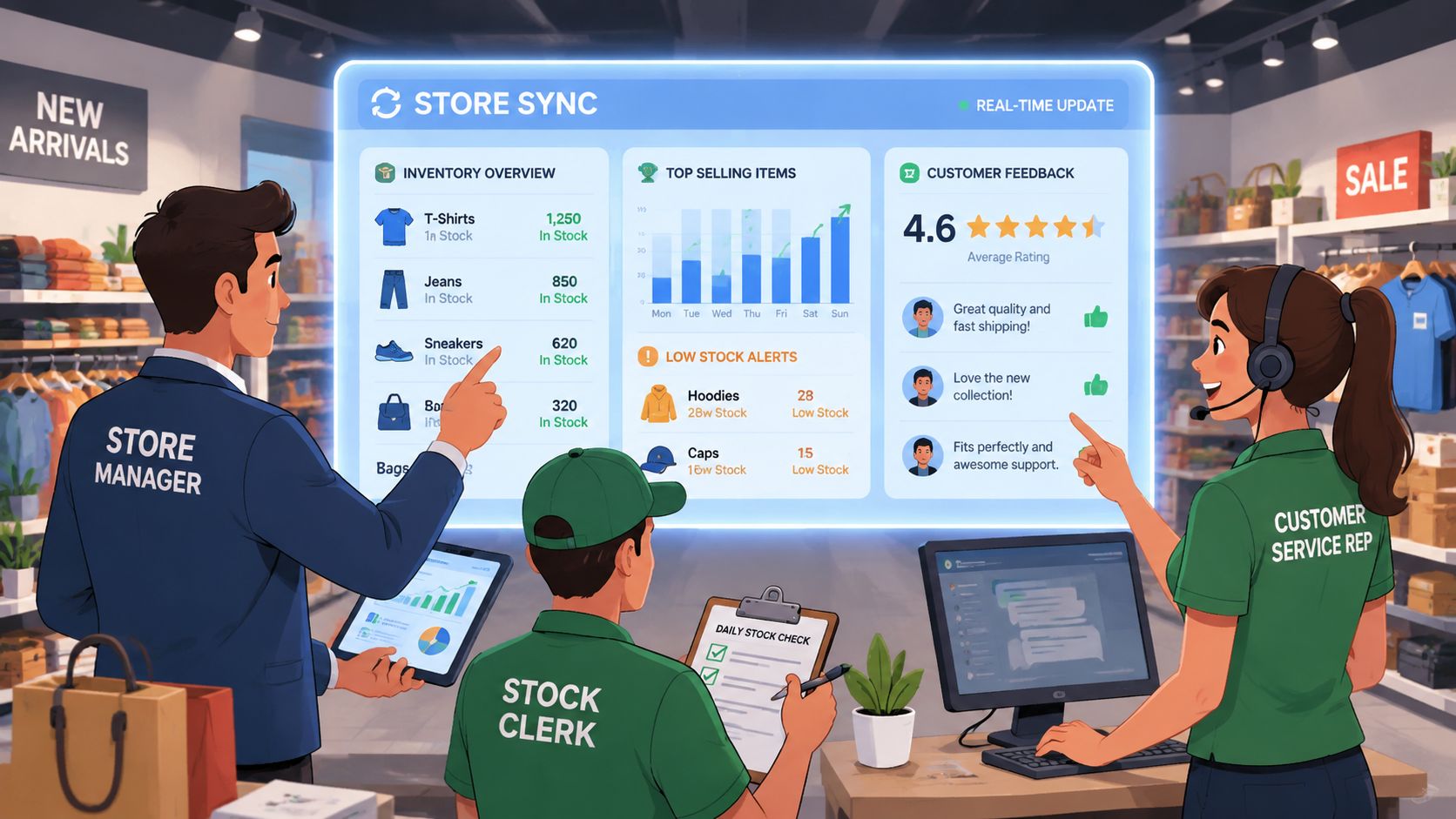
In retail, I've seen a store associate flag a stockout, merchandising update their own notes, and supply chain work from a different view of the same problem. The fix wasn't a bigger meeting. It was one shared place where the exception, the inventory status, and the customer impact were visible to everyone who needed them.
In healthcare, the pain usually shows up at shift change. Clinical staff, administrative staff, and facilities all touch the same patient journey, but they don't always touch it in the same system. A clean handoff template and a single place for shift notes can keep a small issue from turning into a morning of avoidable calls.
In hospitality, the front desk, kitchen, and housekeeping teams often run on different rhythms. On a fully booked night, a room delay or special request can spiral fast if each team only sees its own queue. The best fix I've seen is a shared workspace for service exceptions, so everyone sees the same priority and nothing depends on hallway chatter.
In logistics, dispatch, warehouse, and customer service need the same delivery story. When a promise slips, customer service shouldn't have to reconstruct the chain from three tools and two calls. They need one current record, one owner, and a clear next step.
For leaders trying to make this concrete, a unified work app like Pebb can serve as the connective layer across chat, tasks, files, updates, and shift-based work. It's not the only model, but it does fit the constraint that frontline teams need one place to see what changed, what's blocked, and who owns the next move.
The Metrics That Actually Prove Collaboration Is Working
If collaboration can't be measured, leaders end up managing by mood. That's how teams get praised for “better communication” while the handoffs still break. The better approach is to track the shape of the work, not just the feeling around it.
Count.co defines Cross-Team Collaboration Rate as (Number of Cross-Team Interactions / Total Possible Cross-Team Interactions) × 100, and the tracked interactions can include joint meetings, shared project deliverables, cross-functional task assignments, and inter-team communications Cross-Team Collaboration Rate formula. That gives you a rate instead of a vibe.
What to watch first
I'd start with handoff quality. Did the next team get what it needed, in a usable form, without a follow-up chase? If not, the system is leaking context.
Decision latency is the second one. When a question sits unresolved because nobody knows who can close it, the work slows even if everyone is busy. Rework rate tells you the same story from the other side, if people keep fixing what should've been right the first time, the collaboration is weak.
Metric | What it measures | Healthy signal |
|---|---|---|
Handoff quality | Whether the receiving team gets complete context | Fewer follow-up clarifications |
Decision latency | How long decisions sit before someone closes them | Shorter wait time for answers |
Rework rate | How often work has to be corrected after handoff | Less fixing and backtracking |
Joint meeting load | How much coordination depends on live calls | Fewer meetings for simple updates |
Cross-Team Collaboration Rate | The share of possible cross-team interactions that actually happen | More cross-boundary contact over time |
Use the metric that changes behavior
If you only have room for one number, start with the metric that tells you whether work is moving cleanly between teams. A good metric should change the conversation. If it doesn't, it's just wallpaper.
For a practical way to think about measurement design, the guide to measuring communication effectiveness is worth reading because it pushes leaders past vanity signals. The point isn't to count every message. It's to see whether people can move work without friction.
Rolling Out a Unified Work App Without Creating Another Silo
Rollouts go wrong when leaders treat the app as the fix instead of the container. A new tool on top of old habits just adds another place to ignore. The first move is to make the new workspace the obvious place where work, context, and follow-up live.

A simple rollout sequence
In week one, set up the basics, spaces, directory, and a single invite link. That gives people one place to find each other and start talking in the context of work.
By week four, move the actual workflow in. Add tasks, the knowledge library, file sharing, and shift tools so the workspace becomes useful instead of decorative. If people still have to leave the app to understand what's going on, adoption will stall.
By week twelve, tighten the operating rules. Set permissions, review analytics, and connect the system to HR, payroll, and SSO so the app fits the business instead of floating beside it.
Governance decides whether it sticks
Space ownership matters. So do roles and permissions. If everyone can create clutter everywhere, the workspace will start to look like every other abandoned tool.
There's a reason teams keep looking for an all-in-one employee app. They want one place where communication, operations, and engagement don't have to live in separate boxes. Analytics should help managers coach better, not spy harder, or people will learn to perform for the dashboard instead of using the system naturally.
Treat Collaboration Like a System, Not a Meeting Series
The teams that get this right aren't the ones with the nicest off-sites. They're the ones that make good handoffs easy and bad handoffs obvious. They pick one place where work lives, make async the default, and give every cross-functional effort one owner who keeps the loop closed.
That's the shift. Cross team collaboration stops being a personality contest and becomes an operating design choice. And once you see it that way, the question changes from “Are our people collaborating enough?” to “Does our system make good collaboration the easiest path?”
If your handoffs still depend on memory, scattered chats, and a few heroic people who know where everything lives, Pebb gives you a single place for spaces, tasks, files, updates, and shift-based work. If that's the kind of structure your teams need, take a look at Pebb and see how a unified work app can make cross team collaboration less chaotic and a lot easier to run.
