
Construction Call-Out Coverage That Actually Works
Practical construction call-out coverage strategies to prevent gaps, fill shifts fast, and keep crews safe when the unexpected hits your site.
Dan Robin
Monday morning has a way of telling the truth. Three framers are out, the pour is still on for 8 a.m., and the foreman is already calling anybody with a pulse and a hard hat. That is what construction call-out coverage looks like when it's treated like a scramble instead of a system.
The mistake is thinking this is a phone problem. It isn't. It's a workflow problem, a safety problem, and a coverage problem all at once. If the wrong person misses the call, the job slips. If the right person can't be reached fast, the whole site pays for it.
Why Construction Call-Out Coverage Is a Different Beast
Construction is not an office with a desk phone and a neat callback queue. It's a moving target, with crews spread across sites, vehicles, trades, and weather. In July 2023, 3.4% of workers in construction and extraction occupations reported on-call work as their sole or main job, compared with 1.7% of all employed workers nationwide, and the Bureau of Labor Statistics reported 2.8 million on-call workers overall that month construction call-out coverage data.
That gap matters because a missed call isn't just a missed call. It can mean an empty crew, a machine sitting idle, or a site that can't move until somebody shows up. The industry depends on people who need to be reached quickly for last-minute dispatch, replacement shifts, weather changes, and urgent site needs, so coverage has to work across mobile habits, not office habits.
The risk sits on the ground, not in a spreadsheet
Construction is also one of the most hazardous industries in the United States. An IRMI summary citing Bureau of Labor Statistics figures puts it at more than 1,000 workplace fatalities and 150,000 injuries every year construction safety and notification risk. That means every call-out decision sits next to safety, not just productivity.
A crew gap on a safe job is annoying. A crew gap on a live site can be dangerous.
That's why generic answering-service thinking falls apart. A sales lead, a vendor asking about delivery, and a crew member calling off all sound like “the phone rang.” They are not the same problem. If you treat them the same, you bury the urgent stuff under the noise.
The better frame is simple. Construction call-out coverage is a workflow with rules, routing, backup people, and compliance checks. Once you see it that way, the rest gets easier to build.
The Call-Out Policy That Actually Holds Up
A good policy is short enough to print, but tight enough that nobody has to guess at 5 a.m. The basic parts are boring on purpose. One reporting channel. One deadline. One person who owns the fill.
Make the rules blunt enough to use at dawn
The cleanest setup is to stop letting people text random supervisors. Use one approved channel, then require the caller to give the trade, reason category, expected return, and any access or PPE issue. Construction-specific guidance also recommends a hard timing rule, with notice at least 30 minutes before the shift starts and reporting by phone, SMS, or hotline construction employee call-off procedures.
That's the part people resist, and it's exactly the part that saves the morning.
A policy also needs to name who handles the swap. If the employee is supposed to find coverage, say it. If the manager owns it, say that instead. Mixed ownership is where confusion creeps in, and confusion is expensive. A well-built call-out policy also defines excused, unexcused, and no-fault absences, then ties each one to a known response instead of a manager's mood.
A few things make the policy work in real life:
One notification path: Keep call-outs out of personal phones. A shared system or app keeps the rule from living in one superintendent's pocket.
A real notice window: Two hours before shift is a practical floor for many crews. For certified or critical roles, make the window longer.
A standby roster: Someone should already be waiting to fill the gap, not drafted from memory at dawn.
Clear discipline language: Repeated no-shows should trigger a documented path, not a hallway argument.
If the policy needs a family tree to understand, it won't get used.
If you're building this on a team tool, a shared system like Pebb's employee shift scheduling app gives you a cleaner place to route the call than a chain of texts and missed voicemails. That matters because the channel is part of the policy, not a side detail.
Sizing Your Coverage Buffer With Real Numbers
A crew can have a decent call-out policy and still get crushed if the coverage buffer is too thin. The job is to size the buffer around real absenteeism, then split it across full-time capacity, part-time capacity, and backup coverage so the roster still holds when people miss shifts. The basic formula is needed hours ÷ (1 - absenteeism rate), then round up and translate that number into actual people and hours.
The buffer gets bigger faster than people expect
A small absence rate still eats into the schedule fast. At 10% absenteeism, you need about 11.1% more scheduled capacity to hold the same service level. At 7%, you still need about 7.5% extra capacity. Static rosters look fine until the first few no-shows hit the same week.
The practical move is to convert that math into backup labor you can name on a roster. Use weekly crew count, then map the expected misses to float workers, on-call tradespeople, and same-day dispatch only when the first two layers fail. Construction studies cited in the coverage-planner guidance show absenteeism can run around 7% in some markets and 8.5% to 9.3% in others coverage planner methodology. That is enough drift to matter on a jobsite with tight starts and safety-sensitive roles.
Scenario | Absence Rate | Expected Weekly Absences | Float Workers | On-Call Tradesperson | Same-Day Dispatch |
|---|---|---|---|---|---|
Tight crew | 7% | Based on a 20-person, five-day crew, about 7 expected absences across the week | 2 | 1 | Limited use |
Moderate gap | 8.5% | Higher than a tight crew can absorb without help | 3 | 1 | Needed for gaps |
High drift | 10% | Breaks a normal roster unless you cut scope or add temp labor | 3+ | 1 | Frequent |
The exact headcount changes by trade and season, but the pattern stays the same. Float labor covers predictable drift. On-call rotation catches the misses. Same-day dispatch is the last resort, not the plan.
A one-page worksheet is enough to keep it real. List the trade, average weekly hours, absence rate, float count, and named backup. If you cannot explain the buffer at a glance, it is too loose.
Cross-Training, On-Call, and Shift Design
Cross-training is cheap insurance. A crew with a narrow skill tree is fragile. A crew with adjacent skills can absorb call-outs without turning every gap into overtime.
Build overlap on purpose
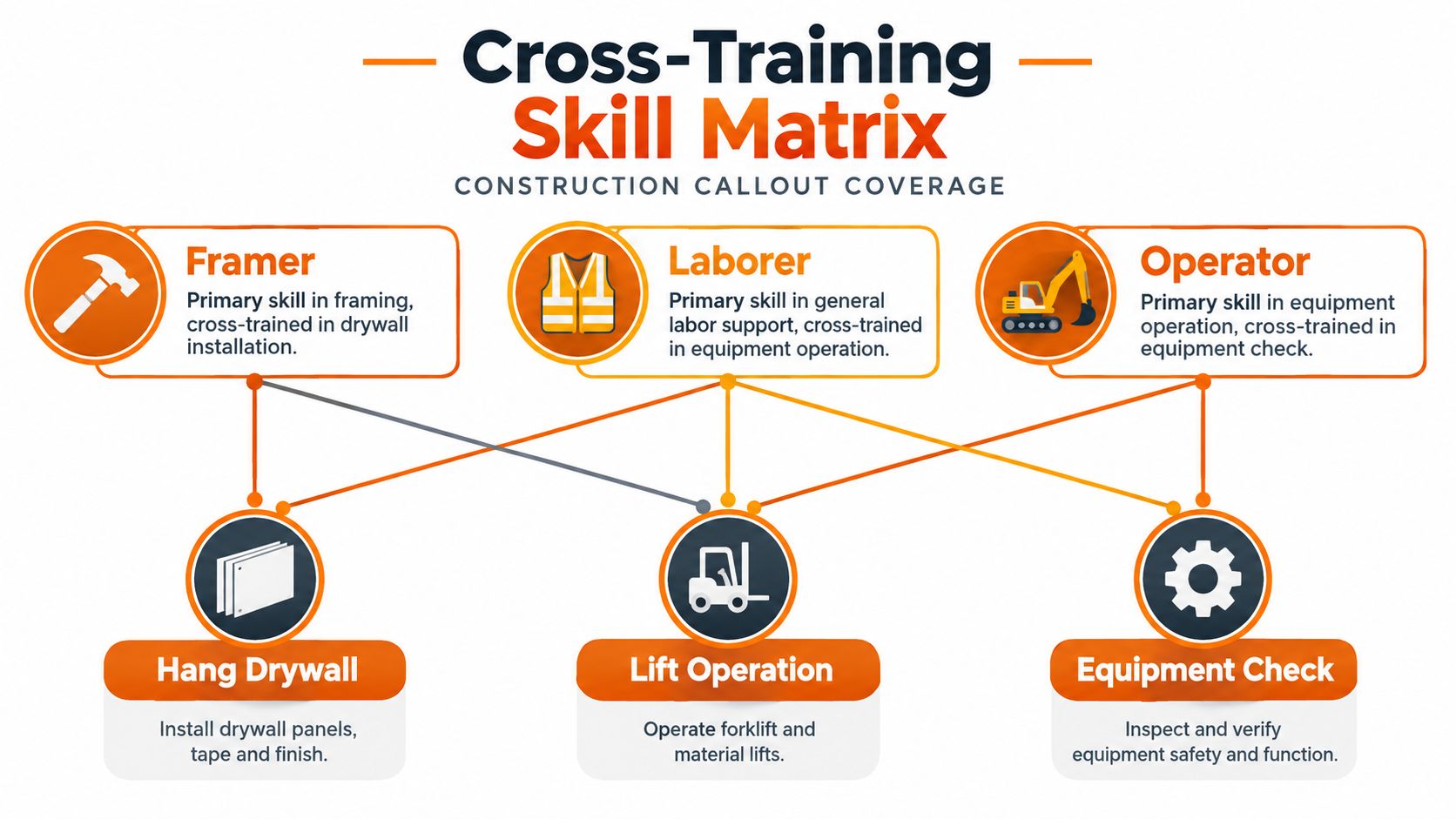
The best shops I've seen don't wait for emergencies to teach flexibility. They map each worker to at least two adjacent tasks, then pay for the overlap instead of pretending it's a favor. A framer who can hang drywall, a laborer who can safely support lift work, and an operator who can back up the service truck give you options when the day goes sideways.
That's not theory. It's basic resilience.
A useful resource on this is cross-training advice from Paradigm International Inc., especially if you want a simple way to think about skill overlap without overcomplicating the process. The point is not to make everyone do everything. It's to keep one empty seat from stopping the whole truck.
The on-call structure should be just as plain. Give the team a named dispatcher, a named backup, and a third-tier supervisor. Lock weekly swap windows in advance so nobody is negotiating the roster at 6 p.m. on Friday.
Construction crew shift schedule guidance also fits here because the schedule itself can absorb part of the pain. Staggered starts help when crews share a vehicle. Four-tens can buy a three-day weekend without blowing up the workweek. A standing float position on the worst call-out job is often cheaper than a string of six-day weeks.
Practical rule: Never rely on goodwill alone. If the overlap matters, write it down and pay for it.
A good cross-training setup doesn't erase absences. It makes them survivable. That's a better standard.
Routing Calls by Type, Not Just by Time
Most coverage failures start at the phone, not the schedule. One after-hours line that dumps every call on a superintendent gets buried fast. Supplier callbacks, owner questions, and billing disputes crowd out the one message that actually needed help.
Different calls deserve different owners
Call routing works when you stop pretending all inbound calls are the same. Safety incidents and utility hits need a safety lead with a fast callback. Crew call-outs need a staffing dispatcher. Change-order questions and RFIs belong with the PM. Sales calls can wait until morning.
That kind of setup is exactly what better customer experience with call routing gets right in a broader sense. On a jobsite, the same idea matters even more because the wrong routing doesn't just waste time. It can bury an urgent site issue under routine noise.
Call-Type Routing Matrix | ||
|---|---|---|
Call Type | Owner | SLA |
Safety incident | Safety lead | 5-minute callback |
Utility strike | Safety lead | 5-minute callback |
Crew call-out | Staffing dispatcher | Immediate triage |
Change order or RFI | PM | Same business morning |
Sales inquiry | Office or sales desk | Hold until 7 a.m. |
Billing dispute | Office admin | Next available window |
A one-page playbook should spell out the route for each call type and who gets escalated if nobody answers. A brand-new foreman should be able to hand off coverage without guessing. If they need a memory game, the system is too loose.
The cleaner move is to push that routing into the intake layer so the call tags itself before anyone starts triage. That's where the supervisor gets time back. It also keeps the 5 a.m. call from turning into a half-hour of detective work.
Compliance, Site Access, and Insurance Boundaries
A lot of call-out plans fall apart because they assume availability is the same thing as eligibility, making a backup responder who can't get on site nothing more than another delay.
A warm body is not enough
There are three guardrails that keep this from getting messy. First, if the site runs under OCIP or CCIP rules, enrollment needs to be confirmed before a non-roster worker steps on site. Second, site-specific induction has to be done and logged, even if it's a short safety orientation. Third, insurance certificates for temp or 1099 fill-ins should already be on file before dispatch.
That last part is where the-world mess shows up. The New York City School Construction Authority's insurance guidance makes the boundary obvious, since its wrap-up program is broad but doesn't replace all insurance needs, and it excludes auto liability, contractor equipment, bonds, and disability insurance site insurance boundaries. If you don't know who is cleared, you're guessing with the gate open.
Coverage without access control is just risk with a stopwatch.
A digital roster of cleared workers solves more than one headache. The supervisor can check it from a phone in the cab instead of calling three people and hoping one of them remembers the paperwork. That matters especially after hours, when the pressure to “just send someone” is highest.
This is also where insurance for stalled construction projects becomes relevant in a practical sense. Delays have financial consequences, but the fix still has to stay inside the rules. Fast response is useful only if the person responding is authorized to be there.
KPIs, Communication Templates, and the App Layer
A coverage system drifts unless somebody watches the few numbers that matter. Not ten dashboards. A few numbers. If the same supervisor has to explain every miss twice, the process is too loose.
The weekly numbers that tell the truth
The useful KPIs are simple enough to glance at once a week. Fill time should stay under 90 minutes. No-show rate should trend below 6%. Overtime should be tracked as a share of hours, and the roster should always show how many backup workers are induction-ready.
Weekly Coverage KPI Targets | |||
|---|---|---|---|
KPI | Formula | Target Band | Action If Off-Target |
Fill time | Time from call-out to confirmed replacement | Under 90 minutes | Tighten routing and add a backup wave |
No-show rate | No-shows divided by scheduled shifts | Below 6% | Review attendance patterns and discipline triggers |
Overtime share | Overtime hours divided by total hours | Stable, not creeping | Add float capacity or revise shift design |
Induction-ready backup count | Cleared backups available by trade | Always at least one per key trade | Refresh onboarding and site access logs |
The communication itself should also be standardized. Nobody needs to write poetry at 5:12 a.m.
Calling in a call-out: “I'm out today. Trade is [trade]. Reason category is [reason]. I expect to return [date]. I've attached the access issue if there is one.”
Confirming a fill: “Coverage is assigned to [name]. They're cleared for site access and will be on location by [time].”
Closing an incident: “The call-out is closed. Replacement confirmed, handoff logged, and any follow-up item is attached.”
A workflow app can make that loop boring, which is exactly what you want. The call lands, the system classifies it, eligible backups get pinged in waves, the first confirmer claims the shift, and the supervisor sees one audit-ready thread instead of six texts and a voicemail chain. That's the kind of structure a tool like Pebb's digital forms can support when you want the intake, routing, and recordkeeping in one place.
The nightly check should take a minute. Review open call-outs, confirm tomorrow's backups, check the cleared-worker roster, and scan for any site that's one absence away from trouble. If that check gets skipped, the system starts to decay. It always does.
If your crews are still covering call-outs through text chains and memory, Pebb gives you a cleaner way to run the handoff. It keeps call-outs, shift coverage, and follow-up in one place so the right people see the right message fast. Visit Pebb if you want to turn that chaos into a routine your supervisors can live with.
