
Construction Call-Out Coverage That Keeps Jobs Moving
Construction call-out coverage playbook to prevent no-shows, fill gaps fast, and keep sites safe. Get rosters, scripts, and workflows that work.
Dan Robin

At 5:00 a.m., the phone rings and one foreman says he can't make it. The rest of the crew is already on the road, a sub is due at seven, and somebody still has to open the gate, check the lift plan, and keep the pour moving. That's the moment construction call-out coverage proves it isn't a phone list. It's a system for keeping work safe, staffed, and moving when the day starts sideways.
Good coverage means the right person gets pulled in, they're qualified, they're briefed, and they get on site on time. That sounds obvious until you've watched a job stall because three people were reachable and none of them were ready. Construction is structurally exposed here. In July 2023, 3.4% of workers in construction and extraction occupations reported on-call work as their sole or main job, compared with 1.7% of all employed workers nationwide, and the Bureau of Labor Statistics reported 2.8 million on-call workers overall in the same month (BLS context on construction phone work). That is one reason coverage in this trade has to be faster and tighter than a generic office callback routine.
There's also a long history behind this. In February 2005, about 2.9 million construction workers fell into one of four alternative employment arrangements, and nearly 80% of them were independent contractors while 14% were on-call workers or day laborers (Construction Chart Book data). The industry has always depended on flexible labor pools. The tools have changed. The need hasn't.
A practical way to think about this is simple. A missing hand isn't just a missing hand. It can mean the wrong crew size for a lift, a delayed inspection, or a rushed fix that creates a new problem. If you want a broader operating model for keeping shifts, chat, and tasks together, construction scheduling software is worth looking at alongside your coverage process.
For a useful frame on staffing and response expectations, the piece on SLAs and staffing for on call is a good companion read. The point is the same one I've seen on site for years. Coverage isn't about being available in theory. It's about being ready in practice.
Why Construction Call-Out Coverage Breaks Down
A call-out rarely hurts because one person is absent. It hurts because the absence lands on top of everything else. The crew waits. The sub calls twice. The superintendent starts reshuffling labor before coffee. By the time anyone has decided what to do, the day has already bent around the gap.
That is why coverage failure shows up as more than a staffing problem. It becomes a sequencing problem, a communication problem, and sometimes a safety problem. If a painter is missing, a drywaller may sit idle. If an operator is absent, the whole site can lose its rhythm. Send the wrong replacement just to fill the slot, and you have not fixed the gap.
The job site rewards speed, but not sloppiness
Construction work is exposed to last-minute disruption because it depends on people who can be reached and deployed when conditions change. Weather shifts. Deliveries slip. Inspections move. Urgent fixes show up without warning. The BLS on-call definition matters here too. It describes workers who work only when needed, even if they may be scheduled for several days or weeks at a time, which makes it a useful proxy for call-out readiness in operational roles (BLS context on construction phone work).
Many teams still treat coverage as one question. Who can come in? The better set of questions is sharper. Who can come in, who is qualified, who knows the job, and who can be briefed fast enough to matter? That is the difference between keeping work moving and creating a second problem.
Practical rule: if the replacement cannot start with the right tools, the right access, and a clear assignment, they are not coverage. They are another delay.
Ownership fails next. If nobody knows who owns the callback, the temp contact, the crew rebalancing, and the final log, the response drifts into group-chat chaos. Missed follow-ups happen there.
A simpler setup keeps schedules, messages, and tasks in one place. Teams often use a tool like Pebb to keep shifts and communication in one workflow rather than scattered across texts and calls. If you want a broader operating model for keeping labor decisions tied to the rest of the day, construction scheduling software is worth looking at alongside your coverage process.
The same principle shows up in field-service dispatch. The point of dispatch workflows is to cut travel time and reduce friction between the request and the person who arrives. That matters on a job site too, where every extra handoff slows the fix.
What good coverage actually does
Good construction call-out coverage keeps the replacement decision clean. One owner takes the first call, checks qualification, confirms access, and logs the handoff. That prevents two people from calling the same worker and no one recording the result. It also gives you one metric to watch, the time from call-out to confirmed coverage. If that number drifts, the process is breaking before the crew feels it.
For a useful frame on staffing and response expectations, the piece on SLAs and staffing for on call is a good companion read. The point is simple. Coverage is not a phone policy. It is a small operating system for keeping the day intact when someone cannot show up.
How to Prevent Call-Outs Before They Happen
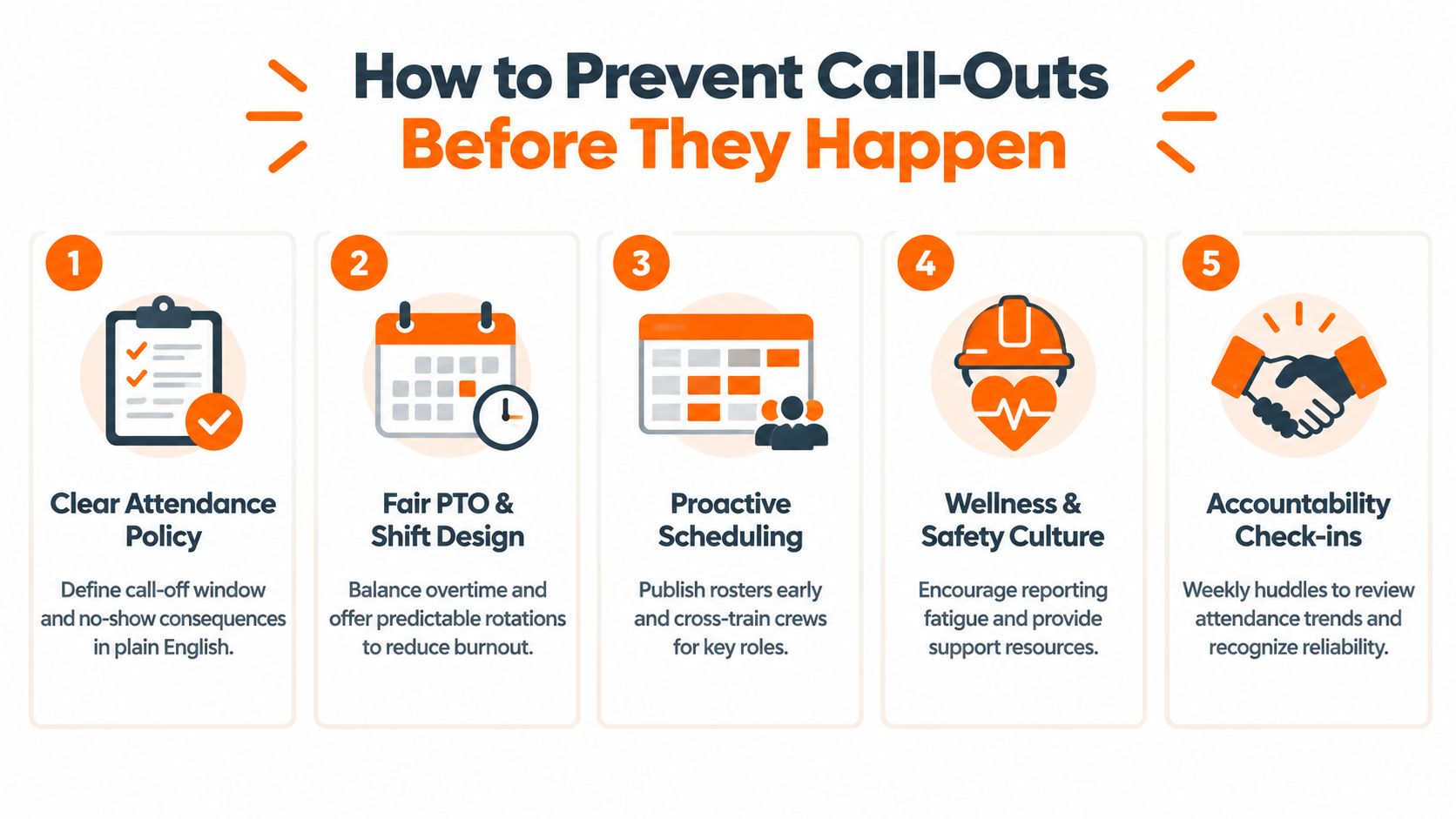
Prevention starts with language that people can use. If the call-off policy reads like legal wallpaper, crews won't remember it when the morning goes bad. The best policies are plain. They say when to report, who to contact, what channel counts, and what happens if someone disappears without notice. That doesn't make the policy harsh. It makes it usable.
The same applies to the schedule itself. A crew that is constantly bounced around is more likely to burn out, especially when overtime stacks up and tomorrow's assignment is still unclear. Fair PTO, predictable rotations, and early roster release matter because people plan their lives around the job. If the schedule feels random, call-outs rise for reasons nobody likes to admit out loud. Fatigue does that. So does frustration.
Make reporting easy, not formal
One of the most useful moves is to give workers approved multi-channel reporting. A text can fail. A phone call can go to voicemail. A hotline can help when someone is on the road or in a noisy truck. The important thing is that the person on the crew knows the accepted route and the reporting window. A reminder the day before helps too, because it gives people a chance to flag a conflict before it turns into a no-show.
That's where cross-training pays off. If only one person can run a critical task, your schedule is brittle. If two or three people can cover it, you've bought yourself room to breathe. Pre-arranged backup labor does the same thing. It doesn't eliminate absence, but it lowers the damage when absence shows up.
Here's a practical checklist I'd use before the week starts:
Clear attendance rules: Put the call-off window, reporting method, and no-show process in plain English.
Predictable shift design: Rotate hard shifts fairly and avoid stacking the same people with the worst jobs every week.
Early schedule release: Publish rosters far enough ahead that people can plan around them.
Cross-training on key roles: Make sure the job can survive one missing person without stopping.
Backup labor ready: Keep a short list of vetted fill-ins who already know the site rhythm.
The culture matters too. If workers only hear from supervision when something goes wrong, they'll hide problems longer than they should. A simple weekly check-in is often enough to surface fatigue, family conflicts, transport issues, or weather-related risks before they become a missed shift.
Useful standard: if the crew can report a problem by text, call, or hotline without guessing which one counts, you've reduced friction before the call-out ever happens.
For teams building the schedule itself, construction crew shift schedule is the right place to tighten the basics. Prevention isn't glamorous. It just saves you from spending the day patching holes that should never have opened.
Rapid Response Playbook When Someone Calls Out
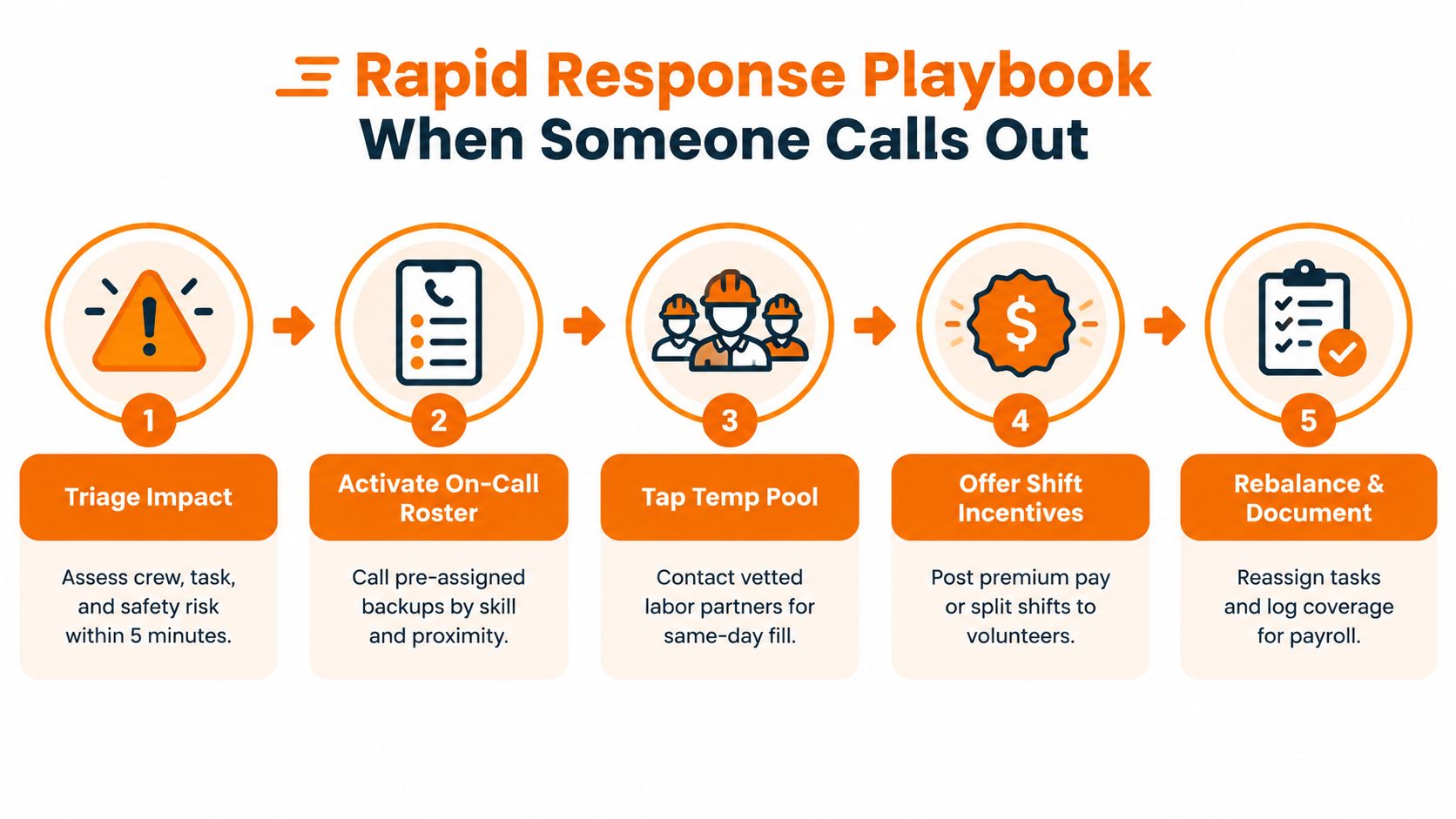
The phone rings at 5:12 a.m. Someone is out. The day does not wait for a committee. First, name the gap. Is it a safety-critical role, a trade with a hard dependency, or a task that can slip without dragging the whole site with it? That call sets the pace for everything that follows.
Coverage works better when the response has owners, not a crowd. One person triages the impact. One person works the on-call roster. One person reaches the temp pool or backup labor. One person confirms the assignment and updates the crew. If everybody owns it, nobody does.
Keep the call tree simple
A usable roster needs only a few fields. Name, skill, trade, proximity, shift preference, and callback order are enough to start. Build it before the problem shows up, then keep it current.
The swap process should be just as plain. Someone reports the absence. The scheduler checks for a trained swap. If there is no swap, the backup list goes live. If the gap still sits open, the temp contact gets the call. Once someone is assigned, the site lead confirms access, start time, and task. A warm body is not coverage unless the person knows where to go and what to do.
Rapid Coverage Decision Matrix | First Option | Backup Option | Owner |
|---|---|---|---|
Trade-specific gap | Pre-assigned on-call worker | Vetted temp labor | Scheduler |
Safety-critical role | Qualified internal backup | Supervisor reassigns task | Superintendent |
Short notice absence | Shift swap from same crew | Same-day labor pool | Foreman |
Weather-related no-show | Standby crew member | Delay noncritical work | Project lead |
The dispatch side matters too. If you already use cut travel time with dispatch workflows, the same discipline helps with call-out coverage. Fast routing, clear ownership, and clean timing reduce wasted movement and keep the site from drifting.
Document once, then move on
One clean record beats three partial notes. Log who called out, when the gap was found, who owned the response, which option was chosen, and what happened next. That record helps payroll, later review, and future scheduling. It also keeps two supervisors from handling the same absence two different ways.
Practical rule: if two supervisors can make different coverage decisions from the same shift note, the system is too loose.
For crews that handle open shifts through chat, job-site open shifts and WhatsApp is a useful reference. The goal is not speed alone. It is speed with traceability.
Communication Workflows That Reach Crews Fast
A good roster fails if the message lands late. That's the hard truth. I've watched crews lose momentum because somebody sent a text to the wrong group thread, then waited for replies that never came. In the field, communication has to be fast, direct, and hard to miss.
Set the channel order before the shift starts
For urgent events, the standard has to be measured in minutes, not hours. Guidance on workplace emergency notification recommends time-to-first-notification under 60 seconds, at least 95% delivery or acknowledgement on the primary channel, and 99% total reach within 5 to 10 minutes, with automatic escalation to voice after two failed SMS attempts within three minutes (workplace emergency notification guidance). That's not an academic target. On a live site, it's the difference between a controlled change and a scramble.
The logic should go like this. First, send the alert to the leads who need to act. Then broadcast to the on-call crew through more than one channel. If nobody confirms, escalate. If the roster changes, close the loop so nobody shows up to the wrong gate.
Here's the kind of language that works in practice:
Call-out alert: “Site 14, morning shift. One operator is out. Reply YES if you can take the shift and can be on site by start time.”
Swap offer: “Need a qualified replacement for today's pour crew. Reply with trade, arrival time, and current location.”
Confirmation message: “Coverage confirmed. New roster is posted. Report to the north gate and check in with the superintendent.”
Don't scatter the conversation
Text messages, phone calls, whiteboards, and hallway conversations create drift fast. A centralized space keeps the message attached to the shift, the task, and the crew list. That's where a system like Pebb is useful, because the schedule, chat, and task update can live together instead of getting lost across threads. The point isn't the software. The point is that everybody sees the same version of the day.
A tight workflow also needs a human backstop. Not every worker checks the same channel at the same time. Some are in trucks. Some are on scaffolds. Some have weak signal. So the channel hierarchy matters. Broadcast first. Escalate second. Confirm third. Then stop talking and let people work.
The message isn't done when you send it. It's done when the replacement has acknowledged it and the site lead knows the roster changed.
If that sounds fussy, it's because field crews pay for fuzzy systems with lost minutes. Communication is not a side task in coverage. It is the coverage.
Safety and Compliance Checks for Every Coverage Decision
Filling the shift is only half the job. The replacement still has to be safe to send. That's where a lot of teams get casual, and that's where trouble starts. A worker who can answer the phone isn't automatically ready for the task, the site, or the load you're asking them to carry.
There's also a legal line to respect. Under 29 CFR 785.17, on-call time is compensable when the worker must remain on the employer's premises or so close that the time can't be used effectively for personal purposes. If the worker only has to leave word where they can be reached, that time is not working time (federal on-call rule summary). That distinction matters when you build coverage policy, because being reachable is not the same thing as being controlled.
Compare speed with safety
Fast coverage is useful only when the substitute can do the job. Before anyone steps on site, check the essentials. Do they hold the right tickets? Have they had the site induction? Are they rested enough for the role? Do they understand the specific hazards on that project today, not last week?
The same caution applies to pay and records. In Australia's Building and Construction General On-site Award 2020, a shiftworker called out after finishing normal working time, after leaving site, or on a rostered day off must be paid a minimum of 3 hours at 200% of the ordinary hourly rate for each call-out (award rule). That's a hard floor, not a negotiation starter. It shows how seriously some regimes treat emergency deployment and should make anyone slow down long enough to document the decision correctly.
There's also an important operational distinction that gets blurred too often. Emergency response, warranty work, and defect repair are not the same thing. Coverage for a temporary fix is usually tied to labor, parts, or mitigation. Defect disputes often turn on whether there was an actual loss and who paid for the repair. A recent coverage dispute involving defective construction is a good reminder that the facts and the policy language matter more than the label on the work order (recent construction coverage dispute).
Use a short pre-deployment check
A quick fit-for-site review doesn't have to slow you down. It just has to exist. I'd want the same few things checked every time, in the same order, so nobody improvises under pressure.
Credentials and tickets: Confirm the worker is qualified for the task.
Site access and induction: Make sure they can legally and practically get on site.
Fatigue and fit-for-duty: Ask the simple question, then listen to the answer.
Site hazards: Brief them on what changed since the last shift.
Payroll note: Record the call-out, pay trigger, and who authorized the assignment.
That's the standard that keeps coverage from becoming a liability. Fill the gap, yes. But fill it with someone who can safely carry the day.
Measure What Matters and Keep Improving Coverage
Coverage gets better when you stop treating each no-show like a one-off and start reading the pattern. The most useful measures are the ones a superintendent can act on. How long it takes to fill a gap. Which trades get covered fastest. Where overtime keeps piling up. Which people or shifts keep missing more often than the rest. That's the shape of the problem.
A weekly review doesn't need to be long. It just needs to be honest. Look at the absences, the replacements, the delays, and the follow-up notes. Ask what was preventable, what was bad luck, and what failed because the process was too loose. Then change one thing. Not ten. One.
Turn the week into a loop
The best teams treat every call-out as data. They look for repeat patterns in weather, start times, travel distance, and trade availability. If the same gap keeps appearing on the same shift, the schedule is telling you something. If one supervisor always clears issues faster than another, the workflow is telling you something too.
Pebb's analytics can help leaders watch engagement and activity trends in one place, which is useful when the issue is not the absence itself but the warning signs before it. The value is in seeing the drift early enough to adjust the schedule, the message flow, or the backup plan.
Simple cadence: review the week, fix one weak point, and test it before the next cycle starts.
That's how construction call-out coverage becomes a resilience system instead of a phone policy. It starts with prevention, moves through fast response, and ends with measurement. When that loop works, you don't just fill holes. You learn where the holes keep forming.
The question worth asking every Friday is straightforward. If three people call out next week, will your crew still know exactly what happens next?
If your team is still juggling texts, call sheets, and half-updated rosters, take a harder look at how the whole shift moves from alert to replacement. Pebb gives teams one place for chat, shifts, tasks, and updates, so coverage doesn't get buried in scattered messages. If you want a calmer way to handle call-outs and keep the job moving, it's worth seeing how that fits your crew.
