
What We Learned Building a Cloud Based Intranet
Ditch the old server rack. Discover why a modern cloud based intranet is the calm, connected heart of your company. Here’s what we learned building one.
Dan Robin
For too long, the word “intranet” meant a clunky, top-down digital bulletin board that no one ever used. It was more of a digital graveyard for outdated HR policies and stale corporate news than a useful tool. A true cloud based intranet, however, isn't just a piece of software you buy—it's a whole new way of running your company.
Your Intranet Is Just a Fancy Filing Cabinet
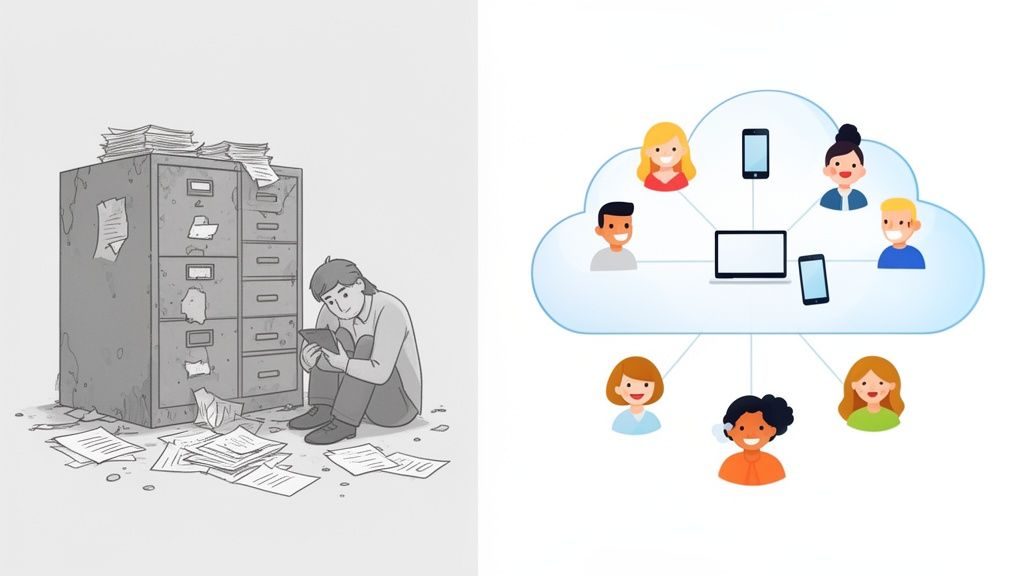
We’ve all been there. The company intranet that feels less like a living workspace and more like a dusty, forgotten archive. It was born from a noble idea: let's put all our company information in one central place! But in reality, it became a black hole where documents went to disappear, completely disconnected from the actual pulse of the business.
I remember trying to manage teams with a chaotic jumble of emails, spreadsheets, and a half-dozen different chat apps. Crucial updates for frontline workers would get lost. Office teams couldn't find the latest version of a simple file. A feeling of disconnection was just the norm. It felt like trying to conduct an orchestra where every musician was playing from different sheet music. That’s not a system; it's organized chaos.
Shifting from Repository to Operations Hub
Here’s the thing: old-school intranets were built as static repositories. Their job was to store things. A modern, cloud based intranet is built to do things. It’s not a filing cabinet; it’s the central nervous system for your entire operation.
This evolution from a static content dump to a dynamic, people-first platform is one of the most meaningful operational shifts a company can make. It’s about creating a single source of truth where real work gets done.
Think about that for a second. What if your intranet wasn't just a place to look up the holiday schedule? What if it was the place where:
A retail manager could instantly push visual merchandising updates to every store.
A nurse on the night shift could get an urgent protocol change right on their phone.
A new hire on the loading dock could finish their entire onboarding without ever touching a desktop computer.
That's the fundamental difference. One is a passive library; the other is an active workshop. Managing this central hub effectively is key, and that's where a great intranet content management software makes all the difference.
More Than Just Software
A cloud based intranet is so much more than another tool for the IT department. It represents a commitment to a new way of working. It becomes the living, digital space where your company culture takes root, knowledge is shared, and work flows smoothly. It's the digital town square that finally connects everyone—from the corner office to the frontline—in one cohesive conversation.
This isn’t about finding a better place to park your PDFs. It’s about building a more connected, efficient, and genuinely human workplace. It's a foundational change, and frankly, it's long overdue.
Why The Cloud Changed Everything for Internal Comms
Not long ago, launching an intranet meant one thing: a big, expensive server humming away in a closet. We’d install some clunky software, cross our fingers, and hope for the best. That box in the office became the sole guardian of your company's collective brain, chained to a single physical location.
Updating it was a project. Accessing it from home was a headache. And keeping it secure was a full-time worry. The cloud didn’t just offer a new option; it broke those chains, fundamentally changing the game for how we connect and work.
Let’s be honest—the term “the cloud” can feel a bit abstract. Here’s a simple way to think about it.
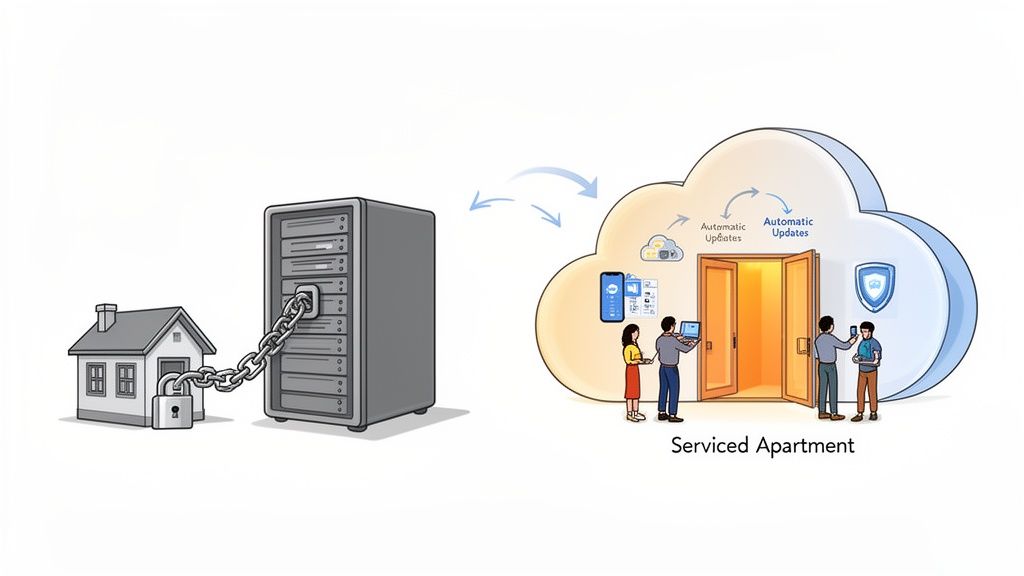
An old, on-premise intranet is like owning a house. You're on the hook for everything: the mortgage (huge upfront cost), the leaky pipes (maintenance), and the broken windows (security).
A cloud based intranet is like renting a modern, fully-serviced apartment. You just move in and everything works. Your rent covers security, maintenance, and all the latest amenities. If the Wi-Fi goes down, the building management fixes it. When a better smart lock is released, they install it for everyone. You get all the benefits of a great home without the headaches of ownership.
Cloud Intranet vs On-Premise Intranet At a Glance
To see the difference in black and white, it helps to put the two models side-by-side. The contrast really highlights why so many organizations are making the switch.
Aspect | On-Premise Intranet (The Old Way) | Cloud Based Intranet (The Modern Way) |
|---|---|---|
Cost Structure | High upfront capital expense (hardware, licenses) + ongoing operational costs. | Predictable monthly/annual subscription fee (operating expense). |
Maintenance | Your IT team is responsible for all updates, patches, and troubleshooting. | The vendor handles all maintenance, updates, and security behind the scenes. |
Accessibility | Typically limited to the office network; remote access is complex and slow. | Accessible anywhere, on any device with an internet connection. |
Deployment | Takes months of planning, hardware setup, and software installation. | Can be launched in days or even hours. Sign up and go. |
Scalability | Scaling up requires buying new, expensive hardware. | Scales automatically with your needs. Add users with a few clicks. |
The choice becomes clear. One path is full of friction and hidden costs, while the other is built for modern agility and simplicity.
From Cost Center to Strategic Asset
The most immediate shift is financial. On-premise systems demanded a massive upfront investment in hardware and software, plus the endless drain on the IT department to maintain it. It was a classic cost center.
A cloud based intranet flips that model. It’s a predictable subscription. This isn't just an accounting detail; it’s a strategic advantage. You stop spending money on "keeping the lights on" and start investing in a tool that actively improves how your people work.
This is why adoption is skyrocketing. Technavio reports the intranet software market is set to grow by $17.8 billion between 2024 and 2029, with cloud tools driving that growth. We’ve seen companies slash deployment times from months to minutes and cut their total ownership costs by up to 50%.
Built for How We Actually Work Today
But the cost savings are only half the story. The real magic of the cloud is how it supports the way work gets done now.
Your teams are scattered. Your frontline staff in a store or on a job site need the same timely information as someone at HQ. A server locked in the main office simply can’t serve this new reality.
A cloud based intranet is, by its nature, accessible from anywhere, on any device. It was born for a world where the office is an idea, not a place. This flexibility isn't a "nice-to-have"; it's the only way to keep a distributed workforce connected, engaged, and on the same page.
This is all made possible by the same architecture that runs much of the modern web. To get a feel for the engine under the hood, it’s helpful to see how other tools like cloud-based CMS platforms operate. The core principle is freeing your data from a single box and making it securely available whenever and wherever your people need it.
The big idea is this: a cloud based intranet puts your company’s digital home on the internet, not in a server room. It means your people have a secure, reliable, and up-to-date place to connect and work, no matter where they are.
This move gives your IT team their time and sanity back, letting them focus on strategic work instead of server maintenance. More importantly, it gives your employees a tool that actually fits the way they live and work. It’s a calmer, more flexible, and ultimately more human way to run a business.
The Handful of Features That Actually Matter
Software companies love to show off endless feature lists. It's a classic sales pitch. But after working with teams in over 42 countries, we've seen firsthand that most of those features are just noise—shiny objects that look great in a demo but cause chaos in the real world.
When we started building our own cloud-based intranet, we threw out the typical feature checklist. We focused on the real, day-to-day problems that clog up communication and slow down work for everyone. The solution wasn't a hundred different tools. It was a handful of essential ones that, when done right, become the bedrock of a company's digital home.
A Communication Hub That Reaches Everyone
For decades, internal comms were built for people at a desk. But what about your warehouse crew, your retail staff, or the nurses on the hospital floor? Emails get missed, and breakroom posters might as well be invisible.
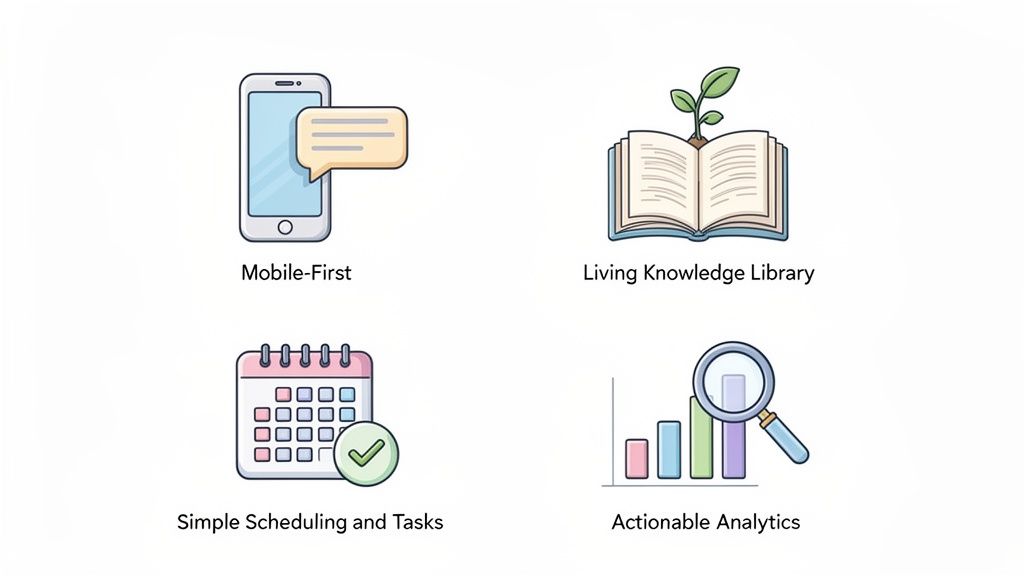
A modern cloud-based intranet must be mobile-first. This is more than just having an app; it's a different way of thinking. It means every announcement, from a CEO update to a team memo, is instantly available on the one device everyone actually carries: their phone. It’s the difference between shouting into the void and starting a real conversation.
A Knowledge Library That Actually Lives
Let's be honest: traditional intranets were where company handbooks went to die. They were digital graveyards filled with outdated PDFs buried in a folder structure so baffling no one could find what they needed.
What you need is a living knowledge base—a central, searchable brain for your company. It’s where a new hire can find their onboarding plan, or a manager can look up an operating procedure in seconds. When information is easy to find and simple to update, people use it. It becomes your single source of truth.
A great cloud-based intranet isn’t measured by how much it can hold, but by how quickly your team can find what they need. It’s about utility, not capacity.
Simple Tools That Get Used
Frontline managers are some of the busiest people you have. They don't have time to wrestle with clunky scheduling systems or complicated project management software. They just need simple, intuitive tools that solve their immediate problems.
This is where so many platforms get it wrong. They build for the power user, forgetting the manager who needs to build a weekly schedule in five minutes between customer calls. A great cloud-based intranet offers features that give time back, not demand more of it. Simple task management, straightforward scheduling, easy approvals—these aren't groundbreaking ideas. They’re practical tools that respect people’s time. We've written before about what features to look for in an employee experience platform, and simplicity is always at the top of our list.
Analytics That Measure What Matters
Finally, you need to know if any of this is working. Old-school analytics are pretty useless here. Who cares how many people logged in last month? That tells you nothing about whether they feel more connected or informed.
Actionable analytics go deeper. They show you which teams are talking, what content is getting read, and who your most engaged employees are. It’s about understanding the human dynamics of your company, not just tracking vanity metrics. These insights help leaders see where the culture is thriving and where it might need support. This isn't about surveillance; it's about understanding.
How a Cloud Intranet Bridges the Gap Between Workplaces
A bustling hospital floor, a busy retail store, a quiet warehouse, a remote tech team. At first glance, these places have almost nothing in common. The tools are different, the pressures are unique, and the environments are worlds apart.
But when you talk to the people on the ground, you start hearing the same frustrations. How do we keep everyone on the same page? How do we build a sense of team when we're spread out? How do we make sure critical updates actually reach the right person?
These aren't just logistical hurdles; they're human challenges. And we’ve seen time and again how a cloud-based intranet becomes the common thread that pulls these different worlds together. It’s less about the tech and more about creating a central hub for communication, collaboration, and a shared purpose.
From the Nurse's Station to the Sales Floor
Abstract benefits are one thing, but the real test is how a tool performs in the messy reality of a workday.
Imagine Sarah, a charge nurse on a chaotic orthopedic floor. A new, urgent protocol for post-op care just came down from leadership. The old way? Printing stacks of paper, pinning them to a crowded bulletin board, and trying to catch nurses between shifts. It was a recipe for miscommunication.
Today, she just pulls out her phone. She opens the company app, posts the updated protocol in the "Ortho Floor" channel, and her team gets an instant notification. They can read it, ask questions in the thread, and give it a quick "thumbs up" to confirm they've seen it. Simple. Immediate. No paper required.
Now, let's head to a national retail chain and meet David, a store manager. He's spinning multiple plates: onboarding two new hires, rolling out a last-minute sale, and executing a new visual merchandising layout. His team is a mix of part-time students and seasoned staff on different schedules.
Instead of a chaotic group text or hoping people check their email, David uses his cloud-based intranet. New hires watch training videos on their phones. He snaps a photo of the new product display, and instantly every other manager can see and replicate it. A quick post alerts every cashier to the details of the sale.
David isn't chained to the back-office computer. He's on the floor, leading his team with the exact same tool the charge nurse is using miles away. It’s the same fundamental need—clear direction and shared knowledge—just in a different uniform.
Here's the bottom line: The chaos that bogs down a hospital, a warehouse, or a retail store usually stems from the same root cause: a disconnect between the people doing the work and the information they need to do it well. A cloud-based intranet is designed to fix that.
It's Not Just a Hunch—It's a Movement
This isn't an anecdotal trend. The market for these platforms is exploding, with some estimates placing its value between $4.0 billion and $10.0 billion by 2026.
What's fueling this growth? The universal search for a scalable tool that can finally unite a distributed workforce. A recent report covering the growth of intranet packaged solutions shows large companies jumping on board, with smaller businesses following to build a genuine company culture from the ground up.
This is more than a fad; it’s a fundamental shift in how modern businesses operate. It’s a recognition that a warehouse supervisor coordinating shipments needs the same reliable, real-time connection to HQ as a developer working from home.
Whether you're a nurse, a retail manager, or a logistics coordinator, the goal is identical: cut through the noise. Give people a single, reliable place where work gets done and everyone feels like they're part of the team. That's the value of a modern cloud-based intranet—it doesn’t just connect workplaces; it unites the people within them.
Making The Switch Without The Headaches
The mere thought of changing your company's core software can be a real headache. We’ve all been there. Just hearing "data migration" or "employee training" is enough to make you cling to the broken tools you have, just because they’re familiar.
It’s a classic case of choosing the devil you know. But sticking with a bad system because you’re afraid of the transition is a trap.
We believe launching a new cloud based intranet should take minutes, not feel like a soul-crushing, six-month project. The old way—with massive IT projects and anxious launch days—is an insane way to introduce a tool that's supposed to make work simpler.
Start Small, Win Big
The single biggest mistake we see is trying to boil the ocean. Companies want every single feature, every last piece of old data, and every team perfectly configured from day one. That all-or-nothing approach is the fastest way to get overwhelmed and fail.
A calmer, more focused process is key. It's about building momentum. Getting familiar with some strategies for how to migrate to cloud can help you avoid the usual bumps in the road.
Here’s a simple process that focuses on what gets results:
Start with just two or three essential groups that need a place to talk right now. Maybe “All Company” and “Store Managers.” Find a handful of people who are genuinely excited about a better way to work. Get them on board first. Their excitement will spread far more effectively than any top-down announcement. Then, launch with a single, clear purpose. Pick one real problem and solve it beautifully. Once people see it work, they’ll naturally start asking what else the platform can do.
A Tool So Simple It Needs No Manual
Our philosophy is simple: if a tool needs a week of training, it’s already failed. A great cloud based intranet should feel so natural that it barely needs formal instruction. The design itself should be the guide.
We build our tools with the belief that onboarding should feel like downloading a new app on your phone. You open it, you poke around for a few minutes, and you just get it.
This approach gives leaders the confidence to make a change without a huge, disruptive project. Starting small with your most enthusiastic teams and solving a painful problem builds its own momentum. Success stories travel, and soon, other teams will be asking when it’s their turn.
This infographic shows how a unified platform can bring together workflows across totally different industries, proving the power of a simple, central hub.
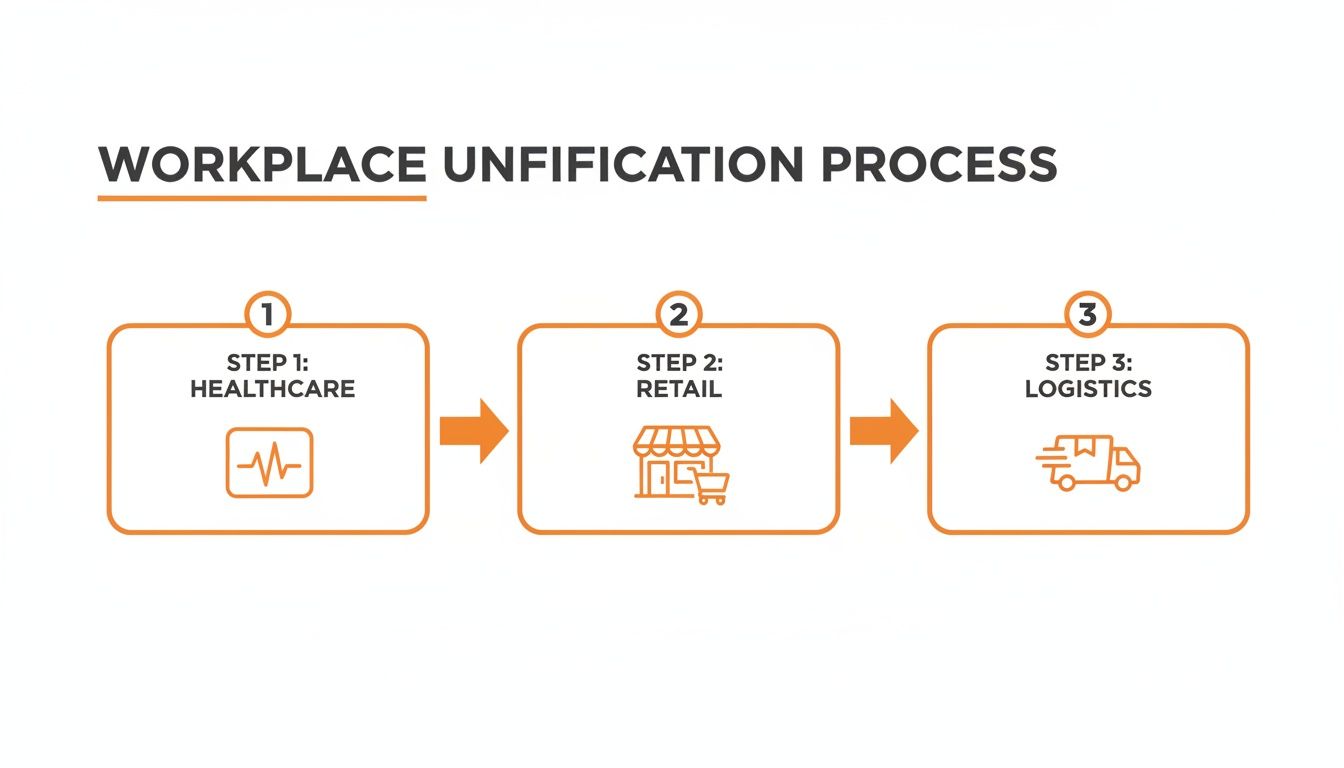
The process makes it clear: whether you're in healthcare, retail, or logistics, the fundamental need for clear communication and easy access to information is the same.
And don't worry, moving your files doesn’t have to be a nightmare. Our guide on data migration best practices offers a calm, step-by-step approach.
Making the switch isn't about flipping one giant, scary switch. It's about taking one small, confident step, and then another. It’s about choosing a tool that respects your team's time and trusting them to embrace something that truly makes their work life better.
Common Questions About a Cloud Based Intranet
When we chat with companies about moving to a modern cloud based intranet, the same few questions always come up. And they’re good ones. You’re not just swapping out software; you're changing how your entire organization operates.
Here are the honest, no-fluff answers we give, based on years of helping teams make this exact shift.
Our Frontline Workers Don't Have Company Email. Can They Still Use It?
Absolutely. In fact, this is one of the main reasons to make the switch. For too long, company intranets were designed for desk workers, leaving a massive part of the workforce out of the loop.
A modern intranet is built for everyone. Employees can get set up and log in with just their phone number—no email required. It means your frontline teams finally get the same direct line to company news, schedules, and team chats as everyone else, all on the smartphone they already use. This simple change closes a communication gap that has existed for decades.
How Secure Is a Cloud Based Intranet Compared To Our Own Servers?
This is a totally fair question. The gut reaction is that keeping data on your own servers feels safer. But in reality, a reputable cloud provider almost always delivers security that’s far stronger than what most companies can manage on their own.
Think of it this way: for a company like ours, security is our entire business. We're the ones who have to obsess over end-to-end encryption, 24/7 threat monitoring, and regular security audits. Your data is housed in world-class data centers with physical and digital protections that would be incredibly costly for most businesses to build themselves.
The bottom line is, you get enterprise-grade security without the enormous cost and headache of having to become a security expert yourself.
We Already Use Multiple Apps. Why Add Another Tool?
This question gets right to the core of the problem. The goal isn't to add another tool; it's to replace a messy jumble of them. The real cost of using five different apps isn't just the subscription fees—it's the mental drain on employees who have to constantly switch between platforms just to get basic information.
A true cloud based intranet brings communication, operations, and knowledge together under one roof. It’s about intentional simplification. It means one app to install, one place to check for updates, and a single source of truth for the entire company. The point is to reduce complexity, not add to it.
How Long Does It Really Take To Get Started?
You can forget those six-month implementation nightmares of the past. With a modern cloud platform, you should be able to get your entire organization onboarded and running in a single afternoon. Seriously.
The technical setup is designed to be nearly instant. For a tool like ours, an admin just sends out a single invite link, employees download the app, and they're in. The only "work" on your end is thinking through how you want to structure your first few team groups and what welcome message you want to share. The focus has shifted from a painful IT project to your people.
Ready to replace the chaos of multiple apps with one simple, modern home for your entire company? With Pebb, you can unify your team’s communication, operations, and knowledge in a single app they’ll actually love to use. Get started in minutes at Pebb.io.
