
Finding a good app for scheduling employees is hard for a reason.
Finding the right app for scheduling employees feels impossible. This guide cuts through the noise to help you find a tool that actually simplifies work.
Dan Robin
Looking for an app for scheduling employees is about more than just getting rid of a spreadsheet. It’s about putting an end to the constant chaos, the wasted hours, and the endless back-and-forth. It’s about creating a workplace that just works better. For everyone.
The quiet costs of bad scheduling
You know the scene. The schedule is a crumpled piece of paper taped to the wall, covered in coffee stains and crossed-out names. Your phone buzzes with yet another group text: “Can anyone cover my shift tomorrow??” And there’s the manager, looking defeated, spending another Sunday night trying to piece together a puzzle that just won’t fit.
This isn’t just a headache; it’s a silent killer of productivity and morale. Let’s be honest. When scheduling is a mess, everything else feels harder. It’s the background noise of friction that drains your team's energy before the day even begins.
This chaos has real costs that sneak up on you. It’s not just about the manager's lost time. It chips away at your team's spirit, leaving them feeling frustrated, undervalued, and disposable. That frustration inevitably spills over into the customer experience when shifts are understaffed or staffed by exhausted, burnt-out employees.
Why old methods don’t work anymore
Spreadsheets and group chats were never a permanent fix. They were a stopgap that we all just kind of accepted. They simply can’t keep up with the moving parts of a modern team—from last-minute call-outs and time-off requests to making sure shifts are distributed fairly. Every manual change is an invitation for error, leading to confusion, no-shows, and frustration.
This is exactly why so many businesses are finally moving on. The demand for smarter workforce tools is exploding, especially in fast-paced worlds like retail, hospitality, and healthcare. The global market for employee scheduling software was valued at a huge $481.5 million in 2023 and is projected to skyrocket to $1.2 billion by 2032. You can dig into this trend with data from Allied Market Research.
But this isn't just about chasing new tech. It's about a fundamental shift in how we think. How you schedule your team reflects how much you value them. When the process is messy and unfair, it sends a clear message. But when it’s smooth, transparent, and respects people’s lives outside of work, you build a powerful foundation of trust.
Picking the right app for scheduling employees is no longer a luxury. It’s a critical decision that affects everything from employee happiness to your bottom line.
What a scheduling app should actually do
Let's be real for a second. A lot of apps out there are just glorified spreadsheets. They give you a digital grid to plug names into, but they don't actually solve the underlying chaos. All you've done is move the mess from a whiteboard to a screen.
A truly good app for scheduling employees is much more than a list of who works when. Think of it as the central nervous system for your team's operations. Its real job is to take the mental load off your managers and give your employees the clarity they need to do their jobs well. It's not about bells and whistles; it’s about making work feel less like a puzzle.
When you find the right tool, it almost feels invisible. It just works, quietly handling all the tedious back-and-forth that used to eat up hours of everyone's day.
Going beyond a digital calendar
The basics are clear. Any decent app needs mobile access, instant notifications for schedule changes, and an easy way for employees to request shift swaps. But honestly, that’s just the price of entry. That's the bare minimum, not the goal.
A modern scheduling tool gets that scheduling is, at its heart, about people. It gives employees a feeling of ownership and control over their work-life balance. When someone can easily check their hours, request time off, or grab an open shift right from their phone, they feel seen and respected. That small shift in dynamics can do wonders for morale.
The real point of a scheduling app isn't just to fill slots on a calendar. It's to create a calm, predictable, and fair environment where people can actually thrive.
Poor scheduling isn't just a time-waster; the costs ripple out, hitting everything from morale to your bottom line.
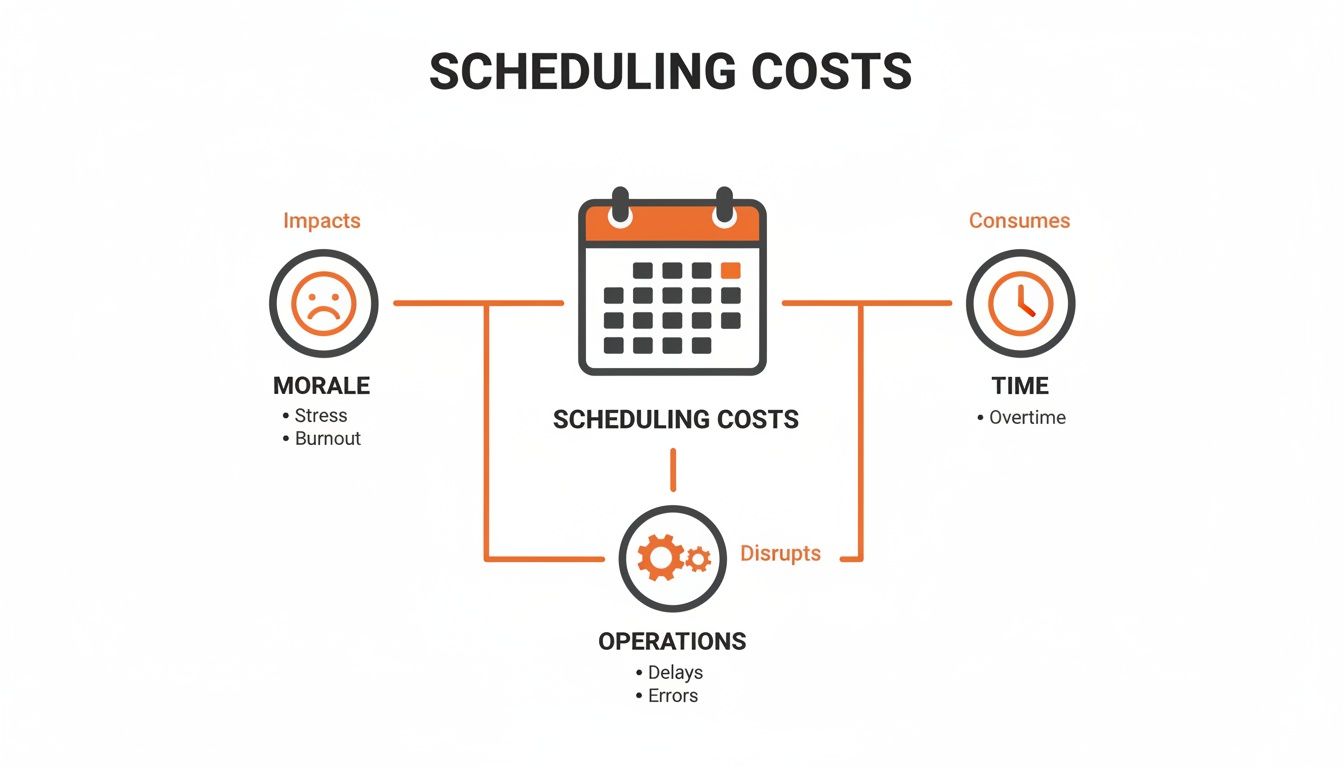
As you can see, lost time is just one piece of the puzzle. The real damage comes from the constant friction and uncertainty it creates for your entire team.
The shift from manual to modern
Moving from spreadsheets and group texts to a dedicated app is a fundamental change in how a team operates. It's not just about digitizing a process; it's about making it smarter, faster, and more human.
Challenge | The Old Way (Spreadsheets, Texts) | The New Way (Integrated App) |
|---|---|---|
Shift Swaps | A storm of group texts, phone calls, and manual updates. | Automated requests sent to qualified staff, with manager approval. |
Communication | Disconnected. Schedule changes are missed, causing confusion. | Centralized. Everyone gets instant updates on one platform. |
Time-Off Requests | Sticky notes, emails, and verbal reminders get lost. | A clear, trackable system where requests are logged and approved. |
Accountability | Confusion over who confirmed what. "I didn't see the text!" | A clear digital trail. Everyone knows their schedule is accurate. |
This isn't just a minor upgrade. It's about trading constant, low-level stress for a system that builds trust and predictability for everyone.
The features that actually matter
So, what should you really look for in an app? Forget the fancy stuff and focus on what solves the biggest headaches.
For example, a great tool lets an employee easily offer up a shift to the team. A qualified coworker can claim it with a tap, and a manager just has to give the final okay. That one feature alone can eliminate dozens of back-and-forth texts. We’ve talked before about the smartest way to share shift schedules with restaurant staff, and those core ideas apply everywhere.
The best tools give your team this kind of self-service, all while operating within clear guardrails that you set. For a deeper dive into what's possible, this comprehensive tutor scheduling software guide offers some great insights that are broadly applicable. The goal isn't to automate your people, but to automate the friction. It’s about finding a tool that works for humans, not the other way around.
Why scheduling and communication belong together
Let’s be honest: a schedule is never just a schedule. It's a living document that sparks a million tiny conversations. A simple shift change isn't just a calendar update; it’s a flurry of texts, a quick phone call, or a chat by the coffee machine. When you try to yank the schedule out of the conversations that give it life, you end up with a mess.
I’ve seen it time and again. Businesses try to duct-tape a system together—one app for the schedule, another for team chat, and a never-ending email chain for anything "official." It’s a guaranteed recipe for confusion. A manager posts the new schedule, but all the follow-up questions get buried in a chaotic group text that half the team has muted.
This disjointed approach is why vital information slips through the cracks. It’s the reason someone shows up for a shift they were swapped out of, or completely misses an update about a weekend event. The problem isn’t the schedule; it’s the dozen different places the communication about it is happening.
Unifying the calendar and the conversation
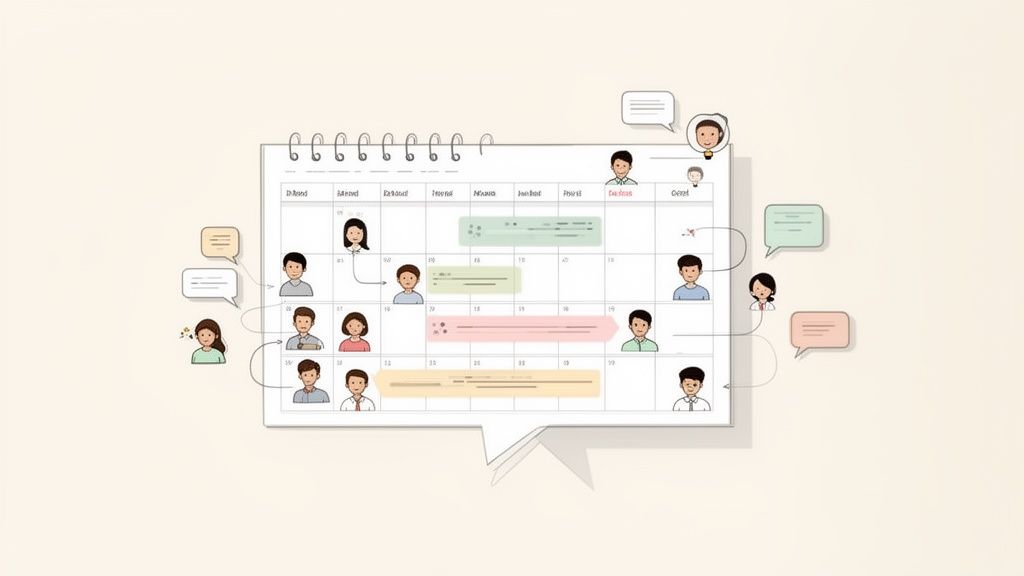
Now, picture this: you publish the new schedule, and it lands in the exact same place your team talks about work. Questions about a shift are asked and answered right there, attached to the schedule itself. A shift swap request is sent and approved in a single, clear thread, visible to everyone who needs to see it.
This isn't about finding a more efficient way to fill time slots. It’s about building a single source of truth for your team. When communication and scheduling live in the same home, there’s no room for wires to get crossed. Everyone is, literally, on the same page. This is especially critical when you need a communication tool built for shift work and frontline teams, whose jobs don't happen neatly at a desk.
When the schedule is part of the ongoing team conversation, it stops being a rigid document and becomes a living, breathing part of your operations.
This unified approach creates a sense of clarity and calm. For frontline teams, this move to mobile apps has been a game-changer. Surveys have found that 70% of hourly workers prefer getting shift notifications on their phones, a practice that can slash no-shows by 15-20%. And when you realize poor scheduling is a factor in up to 35% of employee turnover in fields like retail, the link between clear communication and a stable team becomes obvious. You can dig into these employee scheduling software market trends to see the full picture.
By bringing these two things together, you’re not just getting a better app for scheduling employees. You're building a stronger, more connected team where everyone feels informed and respected. It’s a quiet change that makes a huge difference.
How to choose the right tool without the headache
The market for employee scheduling apps is a crowded, noisy place. Every vendor has a flashy website promising to solve all your problems with a ridiculously long list of features. It’s easy to get lost in an endless cycle of demos and sales pitches, chasing the tool with the most bells and whistles.
Here’s a secret I've learned: more features don't make a tool better. Usually, it's the opposite. Feature-bloated software often creates more work than it saves. It’s just another complicated login for your team to remember and another system for you to manage.
I’ve seen it happen more times than I can count. A business invests a ton of money into a powerful "solution," only to find that nobody uses it because it's a nightmare to navigate. The real goal isn’t finding an app that can do everything; it's finding one that does the few things that truly matter for your team, and does them exceptionally well.
Focus on simplicity, not features
Instead of asking, “What can this app do?” start with a much more important question: “Will my team actually use this?”
The best app for scheduling employees is the one that feels almost invisible. It should be so intuitive that it requires practically zero training. Can your least tech-savvy employee pick it up and instantly figure out how to see their schedule, request time off, or swap a shift? If the answer is anything but a resounding "yes," it’s the wrong tool.
The ultimate test of any workplace tool is adoption. If your team doesn't embrace it, it doesn't matter how many features it has on paper. It's just shelfware.
This is our core philosophy. Look for a tool that removes complexity, not one that adds new layers of it. Does it bring your team together in one central place, or does it scatter your operations across yet another platform? Many businesses find themselves stuck comparing options, and it can be helpful to see how different tools stack up. Our guide on Connecteam alternatives and competitors can give you a solid framework for evaluation.
Ultimately, picking the right tool is less about ticking boxes on a feature list and more about finding something that just feels right for your people. Look for clarity, simplicity, and a design that respects your team's time and attention. A great app should bring a sense of calm to your operations, not add to the chaos.
The ripple effect of better scheduling
When you fix your scheduling, you fix more than just the schedule. We often see it as an operational chore—a manager's job to plug names into empty time slots. But that’s only a tiny piece of the puzzle. The truth is, a fair, predictable, and flexible schedule is a cornerstone of your company culture.
It’s the difference between a workplace that feels chaotic and one that feels under control. Picture a busy restaurant on a Friday night. If it’s properly staffed because the schedule was built with care, orders fly out of the kitchen, customers are happy, and the team feels supported, not swamped. That smart schedule didn't just fill slots; it created a better experience for everyone.
This ripple effect is powerful. When an employee can easily swap a shift to make it to their kid's soccer game, they don't just feel relieved—they feel trusted. Valued. And that feeling is the bedrock of a healthy work environment.
From operations to culture
This isn't just a gut feeling; the numbers back it up. The global market for these tools is exploding, projected to jump from $0.5 billion in 2023 to a massive $1.3 billion by 2032. Why the huge leap? Because businesses are discovering that a solid app for scheduling employees can slash administrative time by as much as 50%.
That frees up managers to actually lead their teams instead of just shuffling names on a spreadsheet. You can dig deeper into this growth in the latest employee scheduling software market reports.
But it’s not just about saving hours. It’s about reinvesting that time into coaching, training, and connecting with your people. One of the biggest wins is the direct impact on your team’s happiness. Fair and transparent scheduling is proven to improve employee retention and reduce turnover—two of the costliest problems any business faces.
Investing in a better scheduling process is really an investment in your people. It signals that you respect their time, trust their judgment, and care about their lives outside of work.
Sending that signal, week in and week out, does more for morale than any pizza party ever could. When people feel respected, they're more engaged, more productive, and more likely to stick around. And it all starts with the schedule.
The quiet revolution of fewer, better tools
We've all seen businesses drowning in apps. You've got the scheduling tool in one corner, a separate chat app in another, and a never-ending email chain for anything important. It’s messy, it’s inefficient, and it’s a surprisingly expensive way to manage a team.
The common reaction is to throw another app at the problem. But that just adds to the digital noise, creating one more login to forget and another place for crucial information to get lost. The real issue isn't a shortage of software; it's the lack of a bridge between the tools we rely on.
Work is a conversation
Think about it: at its heart, all work is a conversation. A schedule is a conversation about who works when. A project update is a conversation about progress. A new company policy is a conversation about how we work together. When we slice these discussions up and scatter them across different platforms, we create friction.
The answer isn't some clunky, bloated software that tries to do a thousand things poorly. It’s finding a single, well-designed tool that handles the essential, connected parts of work with grace. It's about building one central hub where scheduling, communication, and daily operations flow together seamlessly.
When you bring your essential work into one place, you're not just simplifying your software stack. You're creating a calmer, more cohesive environment for your team.
This is what we mean by a quiet revolution. It’s stepping away from the frantic hunt for the "next great app" and getting back to a more straightforward, human way of working. It's realizing the best tools are the ones that fade into the background and just let people connect and get things done.
So, as you look for the right app for scheduling employees, maybe the most critical question isn't about features. Perhaps it’s this: What if the key to a stronger team isn’t another app, but fewer of them?
Got questions about scheduling apps? We've got answers.
We get it. The world of workplace software can feel like a maze. When you're searching for an app for scheduling employees, it’s easy to get lost in feature lists and marketing jargon.
Let's cut through the noise and tackle a few of the most common questions we hear.
What’s the real advantage of a dedicated app?
Honestly? It’s swapping a static, dead document—like that messy spreadsheet—for a living system. The magic isn't just digitizing the schedule; it's automating all the frustrating back-and-forth that goes with it.
A good app instantly manages shift swap requests, pushes out automatic updates when things change, and gives every person on your team one source of truth. It's not just a digital calendar; it’s a massive time-saver that cuts down on human error and confusion.
How do I get my team to actually use a new app?
Adoption is everything. The secret is picking a tool that’s incredibly simple to use on a phone. If it feels as intuitive as their favorite social media app, your team will get on board without a second thought.
The best tools don't feel like another piece of clunky corporate software. They solve real problems for your employees, like making it ridiculously easy to check their hours or ask for a day off. When the app genuinely makes their life easier, adoption takes care of itself.
Should I get an all-in-one tool or just a scheduler?
This depends on where your biggest headaches are. If your scheduling chaos is tangled up with communication breakdowns—think missed announcements and messy group chats—then an app that brings scheduling and communication together is a game-changer.
A standalone scheduler risks becoming just another app your team has to juggle. The real goal is to simplify their entire day, not just digitize one piece of it.
Think of it this way: the schedule is a conversation. Choosing a tool that understands this is the difference between adding more noise to your operations and finally bringing some calm to the chaos.
Ready to bring scheduling and communication together in one calm, simple place? See how Pebb can help your team work better. Learn more at https://pebb.io.
