
Active vs Passive Listening: A Workplace Guide
Understand active vs passive listening in the workplace with practical tips to improve communication, empathy, and team collaboration in 2026.
Dan Robin

Most managers say they want better listening. What they usually want is better agreement, faster. Those are not the same thing. In frontline work, the mistake is treating active listening like the only serious option and passive listening like a failure. That gets teams tangled up. Sometimes you need a real conversation. Sometimes you need people to absorb the message and keep the line moving.
Dimension | Active Listening | Passive Listening |
|---|---|---|
Purpose | Check for shared understanding | Absorb information without interruption |
Best use | Coaching, conflict, feedback | Broadcast updates, notices, monitoring |
Effort | Higher | Lower |
Risk | Can become slow or performative | Can become detached or missed |
Team effect | Builds clarity and trust | Protects pace and throughput |
A lot of leaders get this wrong because they're judging behavior instead of choosing a tool. I've watched managers demand active listening in moments that needed simple receipt, then wonder why the shift drags. I've also watched them let people drift through important conversations without ever checking understanding. Both mistakes are avoidable. If you want a deeper management lens on this, the idea of communication coaching for executives from Acheloa Wellness, Inc. fits well with this topic because the job is not sounding attentive, it's making sure the message lands.
The Listening Problem Most Managers Get Backwards
The usual advice says passive listening is the bad twin. I don't buy that. In a warehouse huddle, a restaurant pre-shift, or a retail floor update, passive listening is often exactly what the team needs. People don't need a seminar. They need the message, cleanly and fast.
The wrong kind of virtue test
Here's the pattern I've seen over and over. A manager pulls the team together, starts asking open-ended questions, and tries to turn a simple schedule update into a dialogue. The clock keeps moving. People disengage. The update gets stretched into a conversation nobody needed.
That's not leadership. That's wasting attention.
A widely cited listening summary found that about 75% of managers were classified as passive or detached listeners, while only about 2% were classified as active listeners, which tells you something important about reality, not theory. Already, the natural default is low-response listening, and the skill is learning when that default helps, and when it hurts. The goal isn't to shame the default. It's to use it on purpose.
Practical rule: Don't ask for deep response when the team only needs clean receipt.
A calm manager treats listening like shift planning. You don't use the same tool for every job. You choose based on the cost of delay, the need for precision, and whether the moment calls for shared understanding or shared awareness. If you want a broader skill baseline on the communication side, how to improve communication skills in the workplace is a useful companion read, because listening only works inside a larger habit of clear messages.
What Active and Passive Listening Actually Mean at Work
Strip away the classroom language and it gets simple. Active listening is a response pattern. Passive listening is reception without much response. Both can be useful. The trouble starts when people mix them up.
Active listening means checking for shared understanding
Active listening is usually described as paraphrase, clarify, summarize, in that order. First, you restate the point in your own words. Then you ask questions to make sure you got it right. Finally, you give a short summary of what matters most. That turns listening into a check, not a performance. It also forces the conversation to slow down just enough to catch errors before they spread.
You can see it in a shift handover. One person says the freezer alarm tripped twice. The next person repeats the issue, asks which unit was affected, and summarizes the next step before taking over. That's active listening. It's not warm and fuzzy. It's operational.
Visible behavior matters too. Eye contact, nodding, follow-up questions, and short verbal feedback show that the listener is engaged. Passive listening often skips those signals because the goal is different. The person is absorbing, monitoring, or waiting for the right moment to respond.
Passive listening means taking in information without interruption
Passive listening isn't laziness. It's often the right move for a safety briefing, a policy rollout, or a broadcast update that needs to reach everyone at once. If the message is one-way and high volume, forcing discussion into every minute can create noise instead of clarity. People need room to hear the message before they can act on it.
Passive listening stays inside your head. Active listening shows up in the room.
A good manager knows which one the moment calls for. The same team member who should actively listen in a coaching conversation may only need to passively receive a schedule update. That's normal. That's efficient. And it's one reason the “good listener versus bad listener” framing is too crude for real work.
Where Each Style Wins and Where Each One Breaks
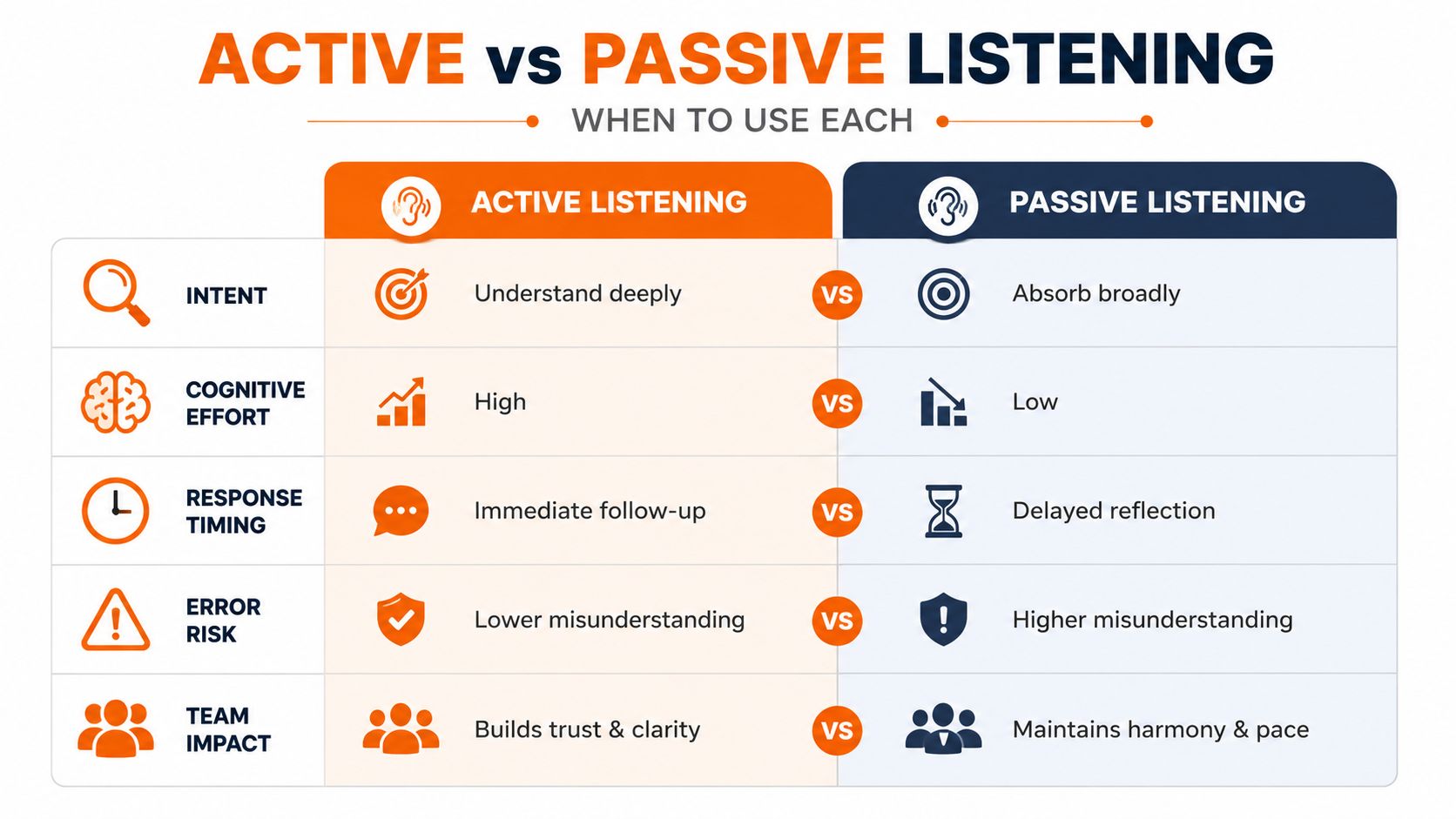
The cleanest way to choose is to look at five things, intent, effort, timing, error risk, and team impact. That sounds formal, but it isn't. It's just a fast way to avoid wasting time.
Intent, effort, and timing tell you most of what you need
Active listening is for moments where the point is understand fully. It asks more of the listener because it's designed to catch nuance, not just the headline. Passive listening is for moments where the point is absorb broadly. It keeps attention available without turning every message into a discussion.
The difference matters because active listening has measurable operational value. One 2026 industry synthesis says it can reduce workplace errors by about 25%, cut misunderstandings by 40%, lower turnover by 20%, and boost employee satisfaction for trained managers by about 30%. That's why I treat it as a management tool, not a nice habit. The same synthesis also points to the broader cost of bad communication and the productivity upside of listening well, which is exactly why the style choice matters in practice.
Know the failure modes
Active listening goes wrong when it becomes theatrical. People nod, paraphrase, and ask questions, but they never get to a decision. The room feels careful and slow. Everyone leaves with more words and less clarity.
Passive listening goes wrong when it becomes checked-out. The message was heard, but not really processed. A deadline gets missed. A shift note gets overlooked. The team pays for that later.
The rule is simple. Use active listening when the cost of misunderstanding is high. Use passive listening when the cost of interruption is higher than the cost of a missed nuance. That's the decision aid. Everything else is decoration.
Frontline Scenarios That Decide It For You
A busy shift makes the choice obvious fast. You don't need a philosophy. You need judgment.
Five moments, five calls
A shift handover needs active listening. The incoming manager should paraphrase the key issues, ask what changed, and summarize the handoff before people scatter. If they just nod and move on, the same problem gets rediscovered an hour later.
A safety briefing often needs passive listening first, then active follow-up only where the risk is unclear. Everyone should hear the core instruction without interruption. If you turn every safety note into a debate, you slow the room and blur the message.
A customer complaint needs active listening because the issue is usually not just the words, it's the meaning underneath them. If the manager interrupts too soon, the customer feels dismissed and the team misses the fix.
A quiet team member often needs active listening too. Not because they're dramatic, but because quieter people don't always volunteer the detail unless you ask for it. A short paraphrase can pull the issue into the open.
A crisis message starts with passive listening for the whole team, then active listening in the small group assigned to respond. The broadcast has to land first. Then the response team can work the details.
The cost of getting it wrong
Business communication failures are estimated to cost U.S. companies about $37 billion annually, and active listening has been linked to productivity gains of up to 25%. Those numbers are blunt for a reason. Missed handoffs, fuzzy safety messages, and half-heard customer issues all create waste that somebody has to clean up later.
The error is usually not lack of intelligence. It's wrong-mode listening. Teams lose time when managers force a conversation where a broadcast would do, and they lose quality when managers treat a coaching moment like a memo. Both mistakes show up on the floor.
Scripts and Roleplay Exercises for Managers
Most managers don't need more theory. They need language they can use under pressure. Keep it short. Keep it repeatable.
Use scripts that fit the job
For coaching, I use a simple active-listening script: “What I heard is X. Did I get that right? What am I missing?” That's paraphrase, clarify, summarize in plain clothes. It keeps the manager from jumping straight to advice.
For feedback, try: “You're saying the handoff broke down because the note wasn't clear. Let me restate it, then we'll fix the wording together.” That shows the person you're tracking the issue, not just waiting to talk.
For conflict, use: “I want to make sure I understand both sides before we solve this. Tell me where I'm off.” That slows the temperature without turning the moment into a therapy session.
Passive listening needs scripts too. For a briefing, say: “I'm going to cover the update once, then I'll take questions at the end.” For a rollout, say: “Please listen all the way through before responding.” For an announcement, say: “This is the change. We'll handle follow-up after everyone has the full picture.”
A good communication habit is boring in the best way. For more examples you can adapt, colleague feedback examples gives you a useful starting point for phrasing that sounds human, not rehearsed. If you're building manager discipline more broadly, executive skill coaching from Orange Neurosciences is relevant because the hard part isn't knowing the script, it's using it when people are impatient.
Run a fifteen-minute roleplay
Split the team into pairs. One person gives a mock schedule change. The other must listen passively, then repeat the key point in one sentence. Do a second round with a coaching issue, and require the listener to paraphrase, clarify, and summarize before giving any advice.
Short exercise: If the listener adds advice before paraphrasing, restart the round.
That tiny drill exposes the habit fast. Some managers jump too soon. Some never ask a clarifying question. You'll see it immediately. And once people feel the difference between receipt and understanding, they start using the right mode with less prompting.
Embedding Both Styles Inside Pebb
Listening habits fall apart when they live only in training slides. They need a place in the daily workflow. That means using the right channel for the right mode.
Put active listening in the places where dialogue matters
Use Pebb Spaces for one-on-ones, coaching threads, and issue resolution. That's where active listening belongs, because the tool should support back-and-forth, clarification, and follow-up. Keep the conversation in one place so managers can paraphrase, confirm, and assign the next step without losing the thread.
Use Tasks to close the loop after an active conversation. If a manager hears about a missed handoff, the next action should become a task, not a memory. That's how you turn understanding into follow-through.
Put passive listening in the places where broadcast matters
Use posts and the news feed for shift notices, policy changes, and broad announcements. That's passive listening territory. The point is to make the message easy to receive, not to force a reply from everyone.
Use the Knowledge Library for onboarding material, policy docs, and other content people need to absorb on their own time. That supports passive reception without cluttering live channels. It also keeps important information from getting buried in chat.
Pebb also gives leaders analytics, which matters because you can't manage what nobody sees. I want to know whether people are reading and acknowledging the message at all before I worry about subtle listening quality. That's not glamorous. It's practical. In distributed teams, practical wins.
Measuring and Training Listening Over Time
You don't improve listening by declaring it important. You improve it by watching for the signs and coaching the gap.
Track the simplest signals first
Start with acknowledgment in your internal messaging. If people never confirm receipt, passive listening is probably drifting into no listening at all. Then watch for recurring clarification requests, repeated rework, and the same question surfacing in multiple one-on-ones. Those are the clues that understanding didn't stick.
An fNIRS study comparing active-response and passive listening found significantly larger oxy-Hb increases for most time windows during active listening, with the strongest effects over the left hemisphere, suggesting higher real-time cortical recruitment when listeners must respond. I like that finding because it matches common sense. When people have to answer, their attention shifts from reception to active processing.
Train in a loop, not a lecture
Model the script. Roleplay it. Use it on a live shift. Then coach the gap. That's the loop. Don't overcomplicate it with abstract scoring. Managers need to see the behavior in real work, not just in a workshop.
If you're building that rhythm across teams, supervisor communication skills training is the kind of internal development content that supports the habit without making it feel academic. Keep the standard simple. Passive listening is ambient exposure and receipt. Active listening is intentional follow-up and shared understanding.
The last piece is calibration. Many default to passive listening because it's cheaper on attention. That's fine. The job of a manager is to know when to stay there and when to deliberately move to active listening. Good judgment here saves time. Bad judgment wastes it.
A Simple Rule to Carry Into Your Next Conversation
Ask one question before you speak. Does this moment need shared understanding or just shared awareness? If it needs understanding, use active listening. If it only needs awareness, keep it lean and let people absorb the message.
That shift changes the whole conversation. Passive listening stops being a failure and starts being a deliberate tool. Active listening stops being a ritual and starts being a choice. What did your last one-on-one need?
Pebb helps teams handle both sides of this work without scattering it across too many tools. If you want a place where chat, updates, knowledge, and follow-up live together, take a look at Pebb and see how it can support clearer listening habits across shifts and locations.
