
Author: Ron Daniel
Still Managing Employees the Old Way? Try This Instead
Replace manual schedules and scattered apps with one platform that unifies scheduling, communication, and operations.
Most businesses don’t realize how much time and money they’re losing to outdated management practices until it’s too late. I didn’t either - until I saw the numbers. Did you know manual scheduling alone costs U.S. businesses over $8.8 billion annually due to errors and inefficiencies? That’s not just a statistic; it’s a reality I’ve seen firsthand. Managers spend hours juggling paper schedules or bouncing between apps, only to end up with missed shifts, frustrated employees, and unnecessary stress.
Here’s the kicker: 68% of deskless workers feel disconnected because of poor communication tools. I’ve watched teams waste 21 hours a week switching between apps, missing critical updates, and dealing with the fallout of scattered processes. It’s a productivity drain that no one talks about enough, but it’s costing businesses big time - not just in dollars but in morale and retention.
We knew there had to be a better way, and that’s why we built Pebb. In this article, I’ll walk you through the hidden costs of old-school management methods, the chaos of juggling multiple tools, and how Pebb simplifies everything into one platform. Let’s dive in and talk about how to save time, reduce stress, and create a workplace people actually enjoy.
The Real Costs of Old Management Methods
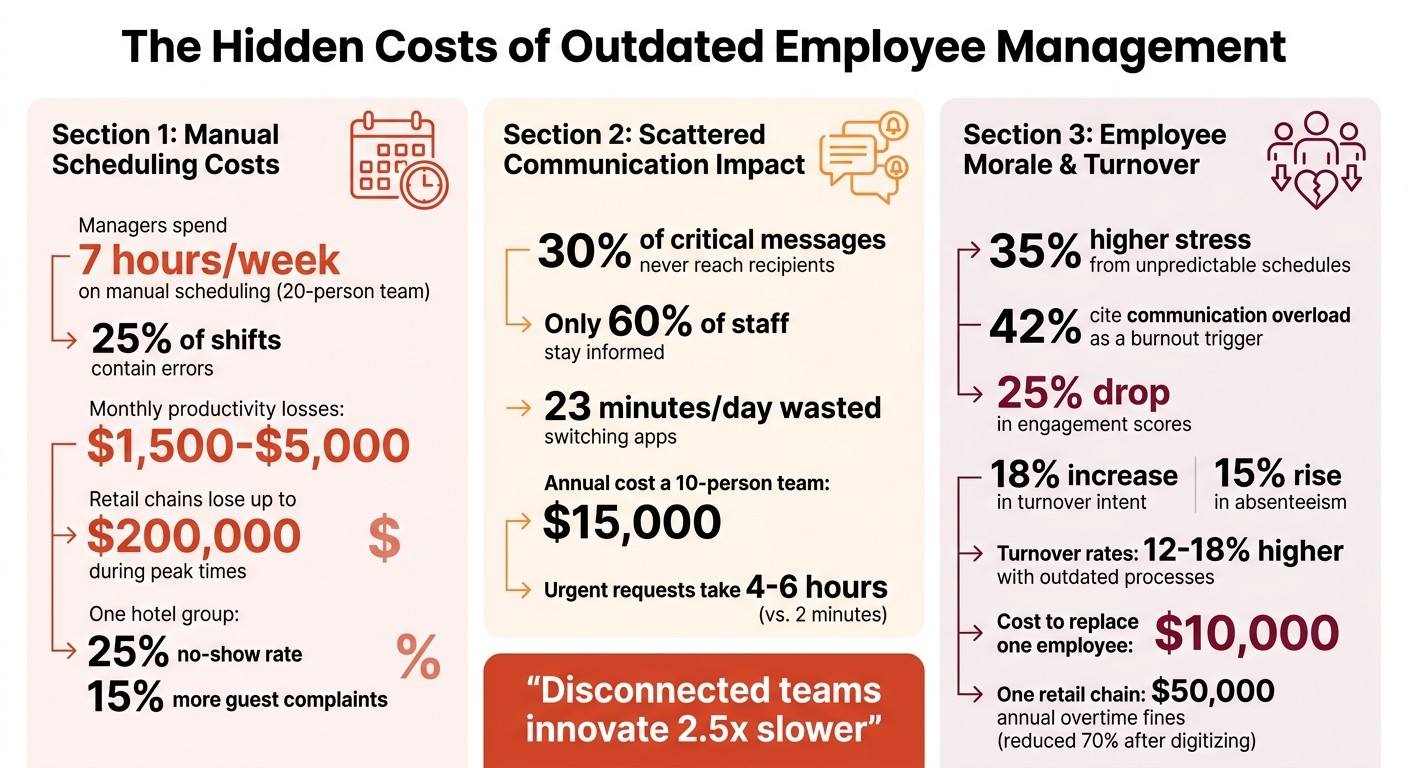
The Hidden Costs of Outdated Employee Management: Key Statistics
Outdated employee management systems don’t just frustrate teams - they drain time and money, too.
Manual Scheduling and Paper Processes
Let me paint you a picture: a manager spends 7 hours every week manually scheduling a 20-person team. Sounds tedious, right? But it gets worse. A staggering 25% of shifts have errors due to last-minute changes or poorly written schedules. These mistakes aren’t just annoying - they’re expensive. Businesses lose anywhere from $1,500 to $5,000 every month in productivity. It’s not just small numbers either. Retail chains have lost up to $200,000 during peak times like Black Friday. And one Chicago hotel group? They saw a 25% no-show rate and 15% more guest complaints because of understaffing.
Scattered Communication Tools
Now, imagine juggling WhatsApp for quick chats, email for official updates, and Slack or Teams for projects. It’s chaos. Critical messages slip through the cracks, with 30% of important updates never reaching their intended recipients. That means only 60% of the staff are in the loop. Plus, employees waste 23 minutes every day switching between apps. For a 10-person team, this adds up to $15,000 in annual losses. And those urgent shift coverage requests? Instead of taking 2 minutes, they sit unanswered for 4–6 hours. The result? More stress, less productivity, and a team that feels overwhelmed.
How This Affects Employee Morale and Output
Here’s the kicker: these inefficiencies don’t just hit the wallet - they crush morale. 35% of employees report higher stress from unpredictable schedules, and 42% cite communication overload as a major burnout trigger. Engagement scores drop by 25%, turnover intent jumps 18%, and absenteeism climbs 15%. For businesses relying on outdated processes, turnover rates are 12–18% higher, and replacing just one employee costs $10,000. One retail chain even racked up $50,000 annually in overtime fines due to scheduling errors. After switching to digital systems, they slashed that cost by 70%.
And if that’s not enough, consider this: teams bogged down by inefficient tools are 40% less likely to suggest improvements and innovate at less than half the speed of well-connected teams.
"Disconnected teams innovate 2.5x slower"
These numbers tell a clear story - old methods aren’t just outdated; they’re holding businesses back.
Why Separate Tools Don't Work for Modern Teams
Let’s face it - juggling multiple apps might seem like a good idea at first, but it quickly spirals into chaos. While older systems drain resources with clunky communication, even “modern” specialized apps often overpromise and underdeliver. Instead of simplifying workflows, they create a tangled mess of notifications and disconnected teams.
Too Many Notifications and Disconnected Teams
Here’s a wild stat: the average team member gets hit with over 63 notifications a day across different platforms. That’s not just annoying - it’s overwhelming. In fact, 68% of workers feel swamped, and a staggering 43% of frontline staff miss out on critical updates because these tools aren’t built for them.
Slack and Microsoft Teams? Great for desk workers, but they leave 80% of frontline workers out of the loop. Add in scheduling apps, emails, and even WhatsApp, and you’ve got a recipe for burnout. It’s like trying to have one conversation in five different rooms at the same time. Exhausting, right?
And that’s just the notifications. Things get even messier when these tools don’t play nice together.
Missing Integration for Daily Operations
Picture this: your schedules are posted in one app, but your team only checks another. Someone calls out sick, and suddenly, managers are scrambling to manually fill gaps. Sound familiar? That’s the reality when tools don’t integrate.
Research shows that using five or more separate tools can tank task completion rates by 25%. All that app-switching means more duplicated efforts, more mistakes, and a lot of wasted time. For mid-sized companies, this inefficiency can rack up costs between $180,000 and $240,000 every year. Ouch.
"A schedule isn't just a document; it's a conversation. When that conversation is scattered across texts, emails, and spreadsheets, misunderstandings are inevitable." – Dan Robin, Pebb Insights
This scattered approach doesn’t just hurt productivity - it kills momentum. That’s why an integrated platform like Pebb isn’t just nice to have; it’s essential for keeping everything (and everyone) on the same page.
Pebb: One Platform for All Your Team Management Needs
Let me paint you a picture: instead of juggling a dozen apps to manage your team, imagine having everything you need in one place. That’s what Pebb is all about. It’s an all-in-one platform that blends communication, operations, and collaboration into a single app. No more tool-switching. No more unnecessary expenses.
Here’s the kicker: we offer a completely free plan for teams just starting out. And if you’re ready to unlock even more, our premium plan is just $4 per user per month (billed annually). Compare that to competitors charging over $7.25 per user or tacking on pricey add-ons, and you’ll see why Pebb is the smarter choice. It’s not just about saving money - it’s about simplifying your workflow and cutting out inefficiencies.
Features That Simplify Management
Pebb comes packed with everything you need to keep your team running smoothly. Let me break it down:
Work Group Chat: Say goodbye to endless email chains. Keep conversations instant and organized.
Shift Scheduling: Drag-and-drop rosters with automatic notifications sent directly to your team’s phones.
Digital Forms: Forget paper processes - handle tasks like shift swaps or safety checklists digitally.
News Feed: Centralize company updates so everyone stays on the same page.
PTO Management: Automate time-off requests and approvals.
Voice & Video Calls: Jump into quick meetings without needing another app.
And that’s not all. Pebb also includes a people directory, calendar events, task management, and file storage - all seamlessly integrated.
How Pebb Transforms Old Systems
Here’s where Pebb really shines: it takes outdated, clunky systems and replaces them with something modern and efficient. Everything you need for team management is unified in one platform, eliminating the chaos of scattered tools.
Take Shift Scheduling, for example. With Pebb, schedules are digital and sync instantly. Employees get notifications like, “Shift change: Sarah to 2:00 PM–10:00 PM on 05/15/2026” and can confirm it with a single tap. A retail team in Texas saw no-shows drop by 40% after ditching paper schedules.
And what about communication? Scattered email threads and multiple messaging apps are a thing of the past. A service team in California cut response times from 24 hours to just 5 minutes and boosted engagement by 35% after switching to Pebb. Meanwhile, a Florida hospitality chain with 50 employees replaced paper schedules entirely - on-time shift fills jumped from 75% to 98%, saving them 10 hours a week on admin work.
With everything in one place, your team stops missing updates, and you stop wasting precious time. It’s that simple. Pebb isn’t just a tool - it’s a game-changer for how teams work together.
Manage Operations Better with Pebb's Scheduling and Digital Tools
Let’s face it - when operations run smoothly, no one notices. But the moment something goes wrong? Chaos. That’s where Pebb steps in. Our scheduling and digital tools are designed to keep everything on track, so you can focus on the bigger picture.
Simple Shift Scheduling
Still using spreadsheets or, worse, paper schedules? Believe it or not, those methods can eat up 3 to 8 hours of your week just managing shifts. That’s time you could spend on, well, literally anything else.
With Pebb, creating a weekly schedule takes less than 5 minutes. The interface is built to spot conflicts automatically - like overlapping shifts or someone accidentally being scheduled while on vacation. It’s like having a personal assistant who never misses a detail.
And when those inevitable last-minute changes pop up? No stress. You can reassign shifts with a few clicks, and affected employees get instant push notifications. No more frantic texts or phone calls. One retail manager even reported an 80% drop in scheduling conflicts after switching to our system. That’s the kind of control that turns headaches into harmony.
But scheduling is just part of the puzzle. Let’s talk about how Pebb’s digital forms can save you even more time and energy.
Digital Forms for Easy Data Collection
Paper forms are the worst. They’re slow, prone to errors, and just plain outdated. That’s why we swapped them out for digital forms that work on any device - phone, tablet, or computer.
Need to collect incident reports? Track equipment inspections? Handle shift swaps? With Pebb, employees can fill out forms in seconds, and the data integrates automatically. No more manual entry, no more delays.
Here’s what that looks like in numbers: businesses using our digital forms see a 68% drop in data entry errors and process information 55% faster. Plus, when an employee submits a time-off request, the system updates the schedule automatically and sends you an alert to find coverage. That alone can save you 10 to 15 hours a week on admin work. Imagine what you could do with that extra time.
Pebb isn’t just a tool - it’s a game-changer for keeping your operations running like clockwork.
Improve Communication and Engagement with Pebb
Operations might keep the wheels turning, but it’s communication that truly brings teams together. At Pebb, we’ve focused on creating tools that don’t just close the operational gaps but also replace clunky, outdated methods with something far more effective. Let me walk you through how our communication features make this happen.
Work Group Chat: Real-Time Connection, Real Results
Here’s a stat that might surprise you: emails can take up to 12 hours for a response on average. Add to that the 30+ minutes teams lose daily hopping between apps, and you’ve got a recipe for inefficiency. That’s why we built our Work Group Chat to bring everything into one place - real-time messaging, voice and video calls (up to 50 participants), threaded conversations, @mentions, and file sharing, all in a secure environment.
Take this example: a 200-person manufacturing company in the Midwest swapped their email chains for Pebb’s chat to manage daily stand-ups. Within just two weeks, their response rates shot up from 60% to 95%, and engagement scores climbed by 28%. Voice notes even helped cut overtime disputes by nearly 50%. The numbers don’t lie - our 2025 pilot data shows teams using Work Group Chat see 40% less communication friction and 50% fewer miscommunication errors. And for a U.S. construction firm? Switching to Pebb’s call functionality sped up issue resolution by 25%.
It’s simple: when communication hurdles disappear, teams thrive.
News Feed: Keeping Everyone on the Same Page
While instant messaging is great for quick back-and-forths, Pebb’s News Feed is where company-wide alignment happens.
Think about it - email blasts often see open rates below 20%, and paper notices? They’re easily overlooked. Our News Feed changes the game by offering a central hub for announcements, milestones, polls, and celebrations. Employees can check updates on their phones during breaks, ensuring they’re always in sync with company goals, no matter where they are.
Here’s a real-world win: a California logistics firm used the News Feed for weekly safety updates and route preference polls. Their view rates jumped to 85%, compared to the 40% they were getting with emails. And when they ran a poll on incentives, morale got a 10% boost - employees felt heard and valued. It’s no surprise that when teams vote on events or shift incentives, they’re more likely to feel invested. Gallup backs this up, showing that engaged teams are 21% more productive. One U.S. hospitality group even saw participation rise by 35% after introducing polls to align staff with revenue goals during labor shortages.
The results speak volumes: Pebb users report 32% faster decision-making and 22% higher retention rates. When communication flows naturally, and everyone feels connected to the mission, people stick around. And that’s a big deal when replacing just one employee in the U.S. can cost an average of $4,700.
Pebb isn’t just a tool - it’s a game-changer for how teams connect and collaborate.
How to Start Using Pebb and See Results
Setting Up Pebb for Your Team
Getting started with Pebb is quick and straightforward. Head over to pebb.io and sign up using your business email. The verification process takes less than two minutes. Once you're in, you can start creating employee profiles by entering basic details like names, roles, phone numbers, and shift preferences. Got a larger team? No problem. If you have more than 10 employees, you can skip manual entry entirely by bulk importing profiles via a CSV file.
Once the profiles are ready, you can organize your team into groups like "Kitchen Staff" or "Front Desk" for easier scheduling and communication. You can also customize notifications, set preferences, and take a guided tour of Pebb's key features like Shift Scheduling and Work Group Chat. For instance, a 20-person retail store in Chicago managed to complete their entire setup in just 15 minutes and had shifts assigned for the upcoming week right away.
Onboarding is designed to be fast and hassle-free. For smaller teams, it typically takes 10 to 30 minutes, while teams of up to 50 members can be fully onboarded in about an hour. We’ve made it even easier with tools like a 5-minute interactive tutorial video, live chat support with response times under five minutes, and pre-built templates tailored for industries like retail, hospitality, and field services.
"90% of users report full setup in under 20 minutes due to our no-code interface."
Take the example of a Texas diner with 15 staff members - they went live in just 12 minutes, ditching their old manual Excel sheets for good.
Once set up, managers can post shifts daily, and employees confirm them directly through the mobile app. This process boasts an impressive 98% confirmation rate. Teams can also leverage Digital Forms for tasks like inventory checks or gathering customer feedback, with everything syncing automatically.
With your team up and running, let’s take a closer look at how Pebb stacks up against other platforms in terms of cost and features.
Pebb vs. Other Platforms: Cost and Features
After onboarding your team, you’ll quickly see how Pebb’s pricing and features offer unmatched value. Here’s the breakdown:
Free Standard Plan: Unlimited users with access to core features like Shift Scheduling, Work Group Chat, and up to 50 Digital Forms per month.
Premium Plan: At just $4 per user per month (billed annually at $48 per user), this plan includes unlimited forms, advanced analytics, custom branding, and priority support - all with no setup fees.
Here’s where Pebb stands out. Compare it to Slack’s Pro plan, which costs $8.75 per user per month but doesn’t include native scheduling or forms - forcing you to pay for additional integrations. Microsoft Teams Essentials is priced similarly at $4 per user per month, but its scheduling tool relies on clunky add-ons like Planner, and forms require separate integrations. One 15-person team in Ohio saved $1,200 annually by switching from Teams (plus add-ons) to Pebb Premium.
The return on investment (ROI) is undeniable. For smaller businesses, the free plan covers about 80% of their needs, while the premium plan pays for itself almost immediately. For example, saving just five administrative hours per week at $15/hour translates to $300 in monthly savings. A Midwest auto shop with 12 employees cut their overtime costs by 30%, saving roughly $1,500 per month - that’s $18,000 annually - by moving away from paper schedules and Excel.
When you consider that Pebb’s all-in-one solution is 50–70% more cost-effective than piecing together multiple tools, it’s clear why so many teams are making the switch. From streamlined onboarding to competitive pricing, Pebb simplifies your workflow and delivers real savings.
Conclusion
Let’s face it - managing teams with outdated methods like paper schedules and a patchwork of messaging apps just doesn’t cut it anymore. Did you know manual scheduling alone can cost businesses an average of $1,200 per employee each year due to errors and overtime? (SHRM, 2025). On top of that, 74% of employees report feeling overwhelmed by juggling too many communication tools, which slashes productivity by 20–30% (Gallup, 2023). That’s a ton of wasted time and money - two things no business can afford to lose.
The solution isn’t adding more apps to the mix; it’s consolidating everything into one platform. That’s exactly why we built Pebb. With features like Work Group Chat, Shift Scheduling, Digital Forms, and more, Pebb simplifies everything your team needs into one place. No more outdated processes. No more chaos. Just streamlined operations so you can focus on running your business and keeping your team happy.
And the results? They speak for themselves. Companies using integrated tools like Pebb see 25% higher employee engagement and 18% lower turnover rates. In fact, one Texas-based team saw a massive shift after switching to Pebb: shift conflicts dropped by 90%, on-time communications skyrocketed from 65% to 98% in just two weeks, and employee satisfaction scores jumped by 28 points. Those aren’t just numbers - they’re game-changing improvements.
Here’s the best part: getting started with Pebb is quick and easy. Our free Standard plan gives you access to scheduling, chat, and up to 50 digital forms per month for teams of up to 15 users - no credit card required. Ready to take it up a notch? Our Premium plan is just $4 per user per month and includes unlimited forms, advanced analytics, voice and video calls, and priority support.
If there’s one thing this article has made clear, it’s that unified management is the secret to boosting efficiency and engagement. Your team deserves a solution that brings everything together seamlessly, and Pebb delivers. Why wait? Sign up today at pebb.io and see how quickly your operations - and your team - can transform.
FAQs
How do I know if manual scheduling is costing my business money?
Manual scheduling can be a real headache for businesses. It often leads to inefficiencies like missed shifts, double bookings, or those dreaded last-minute call-outs. These issues don’t just disrupt the workflow - they also drive up labor costs and chip away at productivity. I’ve seen managers spend countless hours untangling these problems, bouncing between disconnected tools, and trying to keep everything on track.
That’s where switching to an all-in-one platform like Pebb makes all the difference. By streamlining scheduling into one cohesive system, it significantly reduces errors, simplifies coordination, and improves team engagement. The result? You save time, cut down on unnecessary costs, and can finally focus on what truly matters - growing your business.
What’s the simplest way to stop missing shift updates and urgent messages?
The simplest way to stay on top of shift updates and urgent messages is by using a platform that brings everything together - like Pebb. Instead of juggling emails, spreadsheets, and other scattered tools, Pebb streamlines it all into one mobile-friendly app. It combines shift scheduling, real-time chat, and notifications in one place, making it easier to stay organized and ensuring you never miss important updates.
How fast can a small team switch from paper schedules to Pebb?
Switching from paper schedules to Pebb is a breeze for small teams - it often takes just minutes, and at most, a few hours. Thanks to Pebb's intuitive, mobile-first design, the onboarding process is straightforward and hassle-free. Once signed up, teams can immediately transition from manual scheduling to a digital platform. They can start managing shifts, team communication, and daily operations right away, with virtually no training needed. It's that simple.
