Author: Ron Daniel
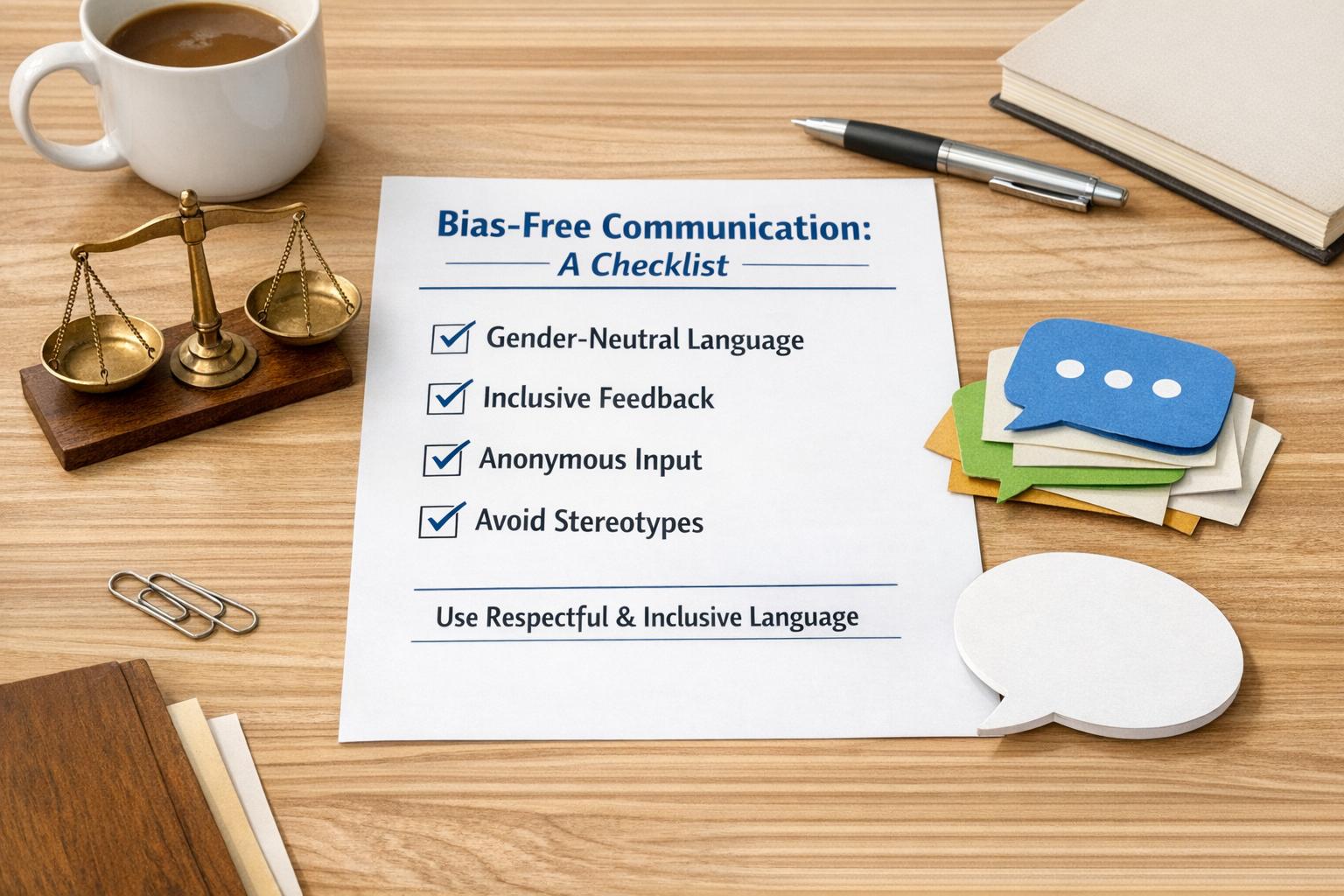
Bias-Free Communication: A Checklist
Practical checklist to spot and remove unconscious bias in meetings, messages, and visuals—gender-neutral language, inclusive feedback, and anonymous input.
Most people don’t wake up thinking, “Today, I’m going to communicate in a way that excludes someone.” Yet, here’s the kicker: even with the best intentions, bias can creep into our words and actions without us realizing it. I learned this the hard way during a team meeting at Pebb. I casually referred to a project leader as “he,” only to have a colleague point out that the leader was, in fact, a woman. It wasn’t intentional, but it made me pause. How often do we let assumptions guide our communication?
Here’s the thing: our brains are wired to take mental shortcuts, and while they can save time, they can also lead to moments like mine - moments that unintentionally exclude or alienate people. And it’s not just about avoiding awkward situations. Research shows that effective communication can boost shareholder returns by 47%, while biased language can erode trust and engagement faster than you’d think.
At Pebb, we’ve made it our mission to tackle these biases head-on. Whether it’s in meetings, emails, or company-wide updates, we’ve discovered practical ways to ensure every voice is heard and valued. In this article, I’ll share the steps we’ve taken, the lessons we’ve learned, and the tools we’ve developed to make bias-free communication a reality. Let’s dive in.
How to Spot Unconscious Bias in Communication
Recognizing bias is the first step to addressing it. At Pebb, I’ve caught myself using biased phrases without even realizing it. It turns out, about 40% of our daily behaviors are habitual, meaning much of our communication runs on autopilot. This autopilot mode can lead to moments where unconscious bias sneaks in.
I’ve noticed these biases surface most often during specific situations - like performance reviews, deciding who to invite to meetings, assigning projects, or even determining promotions. These are the moments when mental shortcuts kick in. Now, I make it a point to pause and ask myself a simple but powerful question: "Am I making assumptions here?"
Learn the Common Types of Bias
To tackle bias, it helps to know what you’re looking for. Here are a few examples I’ve encountered in everyday communication:
Gender bias: This one is surprisingly easy to spot once you’re aware of it. Think about terms like "chairman", "manpower", or "salesman." Or how we often default to "he" when talking about an engineer or "she" when referring to a nurse. The numbers back this up: during performance reviews, 66% of women receive negative feedback about their personal style (like being labeled "abrasive"), compared to less than 1% of men.
Racial and historical bias: This can show up in technical jargon we’ve normalized, like "master/slave" in technology or "demilitarized zone" in networking. Even seemingly harmless phrases like "spirit animal" can carry cultural weight and unintentionally appropriate from specific traditions.
Disability bias: This one often comes down to how we frame things. For example, saying someone is "wheelchair-bound" instead of "uses a wheelchair", or describing someone as "suffering from" a disability rather than "living with" one.
Reflect on Your Assumptions
After important conversations, I’ve started reflecting on patterns: Who did I interrupt? Whose ideas did I acknowledge or credit? Who actively participated? These small observations reveal a lot about unconscious preferences.
Here’s what works for me: I pause, identify the moment where bias might creep in, and reward myself for catching it. Another game-changer? Taking an implicit association test. It’s not exactly comfortable, but it’s eye-opening - it reveals biases you might not even realize you have.
One question I’ve trained myself to ask regularly is: "Would I say or do this if the person were a different gender, race, or age?" If the answer is no, that’s my signal to rethink. By questioning these assumptions consistently, I’ve found that it not only improves my communication but also strengthens our shared commitment to creating a fairer, more inclusive workplace.
Your Bias-Free Communication Checklist
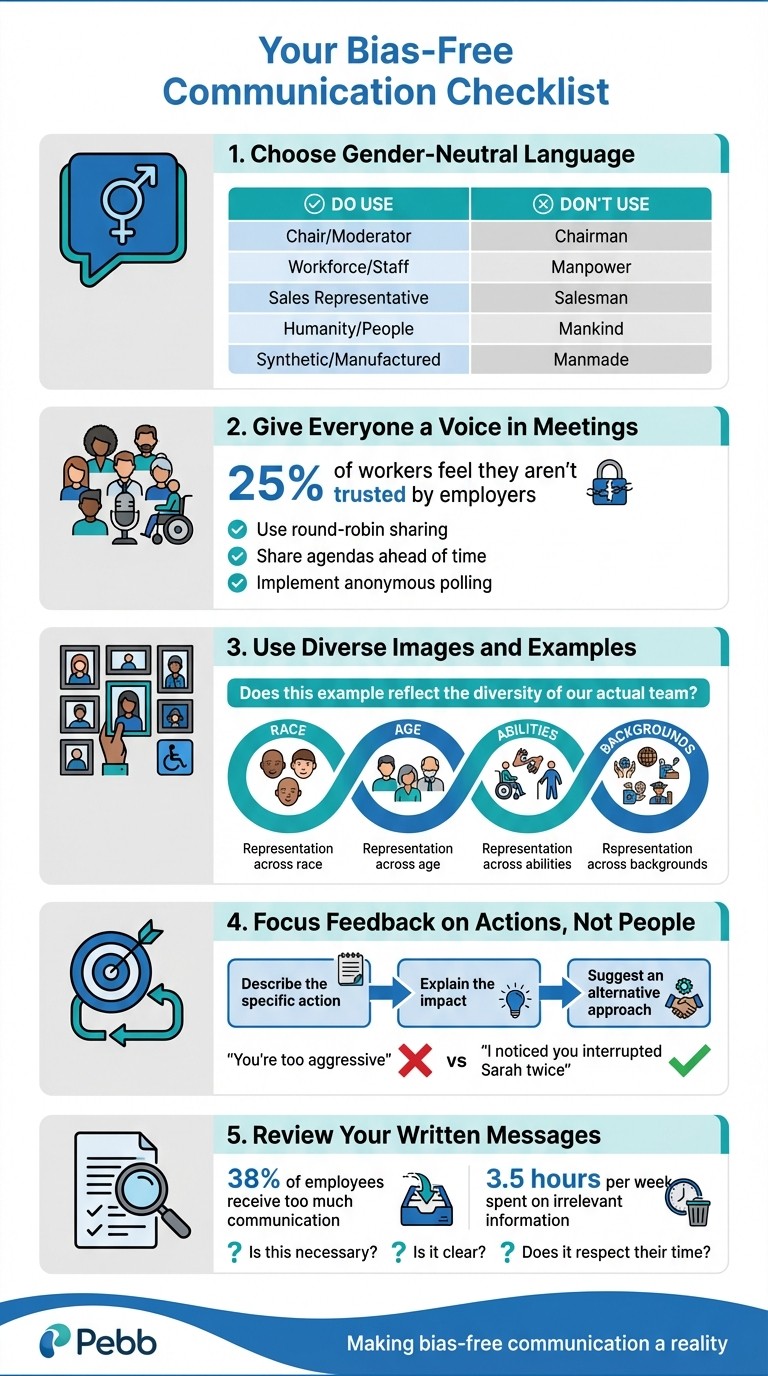
5-Step Bias-Free Communication Checklist for Inclusive Workplaces
At Pebb, we’ve made it a mission to communicate inclusively, and I’ve developed a daily checklist to help eliminate bias in everything we say and write. It’s not just a box to check - it’s a mindset shift that takes practice, but it’s worth it.
Choose Gender-Neutral Language
This one’s straightforward but requires constant awareness. For example, I’ve swapped out “guys” for “team” or “everyone” when addressing a group. Words like “chairman” are now “chair” or “moderator,” and “manpower” has been replaced with “workforce” or “staff.” Here’s a handy reference I follow:
Do Use | Do Not Use |
|---|---|
Chair, Moderator | Chairman |
Workforce, Staff | Manpower |
Sales Representative | Salesman |
Humanity, People | Mankind |
Synthetic, Manufactured | Manmade |
When writing about someone in a general sense, I steer clear of defaulting to “he” or “she.” Instead, I use their role (like “the employee”), “you,” or the singular “they/them.” It felt a bit odd at first, but now it’s second nature.
Give Everyone a Voice in Meetings
I used to notice that the same voices dominated every meeting, while others stayed quiet. To change that, I started using round-robin sharing, where everyone gets a turn to speak. Sharing the agenda ahead of time also helps introverted team members prepare their thoughts.
We’ve also introduced anonymous polling in group chats to collect honest feedback. It’s been a game changer, especially for sensitive discussions or when frontline workers might hesitate to speak up in front of management.
"A lack of trust extends to how information circulates within an organization." – Slack
That quote resonates deeply. More than 25% of workers feel they aren’t trusted by their employers, and that distrust stifles open communication. Giving everyone a platform to contribute isn’t just a nice-to-have - it’s essential.
Use Diverse Images and Examples
When we create announcements or update our news feed at Pebb, I make sure the visuals reflect the diversity of our workforce - different races, ages, abilities, and backgrounds. It’s not about ticking boxes; it’s about ensuring everyone feels represented.
The same goes for examples in training materials and presentations. If all the scenarios feature the same type of person in the same type of role, we’re unintentionally reinforcing stereotypes. Now, I ask myself: “Does this example reflect the diversity of our actual team?” If it doesn’t, I rework it. This small change has had a big impact on how inclusive our content feels.
Focus Feedback on Actions, Not People
This was a game-changer for me. Instead of saying, “You’re too aggressive in meetings,” I now say, “In yesterday’s meeting, I noticed you interrupted Sarah twice while she was presenting.” See the difference? The first version feels like a personal attack, while the second focuses on specific behavior.
Here’s the framework I use for feedback:
Describe the specific action.
Explain the impact it had.
Suggest an alternative approach.
This method keeps feedback constructive and actionable. At Pebb, it’s helped us create a culture where people feel respected and motivated to improve.
Review Your Written Messages
Before I hit send on an email or post something in our knowledge library, I do a quick bias check. I look for jargon or acronyms that might confuse people and make sure the tone is inclusive and welcoming.
At Pebb, we’ve built a knowledge library with templates, style guides, and digital forms to keep our communication consistent and inclusive. For instance, we replaced terms like “master/slave” with “primary/subordinate” in technical documents and swapped “demilitarized zone” for “perimeter network”.
"Microsoft technology reaches every part of the globe, so it's critical that all our communications are inclusive and diverse." – Microsoft
One last thing I always consider: 38% of employees say they receive too much communication, and they spend an average of 3.5 hours per week sifting through irrelevant information. So, I ask myself: “Is this necessary? Is it clear? Does it respect their time?” Inclusive communication isn’t just about the words you choose - it’s about valuing your audience enough to communicate thoughtfully.
How Pebb Helps Remove Bias from Communication
When we were creating Pebb, the mission to eliminate bias in workplace communication wasn’t just a feature - it was personal. I’ve seen firsthand how talented individuals hold back their voices, not because they lack ideas, but because they don’t feel safe or heard. That’s why we made it our priority to design a platform that actively dismantles those barriers and fosters inclusivity.
Let me walk you through how Pebb’s features bring this vision to life.
Anonymous Feedback: A Safe Space for Honest Conversations
One of the first things we tackled was making it easier for people to speak up without fear. Our groups and digital forms aren’t about encouraging complaints - they’re about addressing issues before they snowball into bigger problems. When employees know they can safely report exclusionary behavior or share concerns without retaliation, they actually do it. And that’s when real change begins.
But it doesn’t stop at feedback. Our platform also provides data insights to help leaders identify where participation is lagging. For example, if certain teams or groups aren’t engaging, it’s a signal to dig deeper and uncover why.
Spotting Patterns with Communication Analytics
Every week, I make it a point to check our analytics dashboard. It’s like having a pulse on the organization - it shows which groups are active and where conversations have gone quiet. Here’s a real example: we noticed our night shift employees were missing key company announcements simply because of timing. By tweaking the schedule, we saw an immediate boost in engagement.
The numbers don’t lie. If certain demographics or teams aren’t participating, there’s always a reason. And here’s a stat that underscores this:
"43% of highly engaged employees receive feedback at least once a week, compared to only 18% of employees with low engagement".
Frequent, inclusive communication is essential, and Pebb gives you the tools to identify who’s being left out so you can bring them back into the fold.
Bridging the Gap with Frontline Workers
Frontline employees - whether they’re in retail, warehouses, or restaurants - are often the last to hear about company updates and the first to be excluded from feedback loops. That’s why we built Pebb with a mobile-first approach. These workers can use their phones to stay connected, whether it’s accessing the news feed, joining group chats, sharing feedback, or participating in polls. It’s about making sure every voice counts, no matter where they are.
And here’s the kicker: Pebb is completely free for teams of up to 15 employees. You get all the essentials - work chat, news feed, knowledge library, tasks, digital forms, calendar, clock in, shift scheduling, PTO management, and more. Need advanced analytics, voice and video calls, or enterprise integrations? Our premium plan is just $4 per user per month. When you compare that to tools like Slack or Microsoft Teams, it’s clear why so many teams are switching. We’re not just cost-effective - we’re built to include everyone, from the CEO to the newest frontline hire.
Conclusion
Looking back at our efforts to promote inclusive communication, one thing stands out: creating a bias-free environment is key to fostering workplaces where every voice counts. When inclusivity becomes a priority, trust takes root, messages resonate clearly, and team members feel safe to show up as their true selves.
"Inclusive workplace communication... supports staff wellbeing and psychological safety by creating an environment where everyone feels accepted and free to be themselves." - National Institute for Occupational Safety and Health (NIOSH)
Here’s what works: use gender-neutral language, make sure everyone has a chance to contribute in meetings, include diverse visuals, focus feedback on actions instead of individuals, and always review your messages before hitting send.
And you don’t have to figure it out alone - Pebb can help. Our tools make it easier to bridge communication gaps and build inclusivity. With features like work chat, news feed, tasks, digital forms, and analytics, you can start small and scale as needed. Begin for free, or unlock advanced features with our premium plan for just $4 per user per month.
When people feel heard, they thrive. Use this checklist to make a difference and ensure every voice is valued. Let Pebb’s platform help you empower your team and transform communication for the better.
FAQs
How can I spot and fix unconscious bias in my communication?
The first step toward clear and unbiased communication is being mindful of where bias might creep into your words. Personally, I make it a habit to review my language, examples, and visuals to spot anything that might unintentionally stereotype, generalize, or include unnecessary identity details. A quick self-check can make a huge difference - questions like Does this phrase assume something about a specific group? or Is this detail even relevant? are my go-to. If something feels a little off, I’ll read it out loud or run it by a colleague for a fresh perspective.
When I identify bias, I immediately swap it out for more inclusive language. For instance, instead of saying “mankind,” I’ll use “people,” and I stick to “they/them” if someone’s gender isn’t clear. I’ve also learned to focus on actions rather than making assumptions based on identity. At Pebb, we’ve streamlined this process into our daily routines. I can draft messages, share a bias-checklist with my team, and even get peer feedback - all without leaving our platform. And thanks to Pebb’s tools, like group chats and news feeds, it’s easy to share clear and respectful communication across the board, whether someone’s working remotely, in the office, or out in the field.
How can I make sure my meetings are inclusive and bias-free?
Creating meetings where everyone feels included and respected requires more than good intentions - it demands deliberate planning and mindful communication. At Pebb, we’ve seen firsthand how prioritizing inclusion sparks fresh ideas and strengthens teamwork. It’s not just about being courteous; it’s about creating an environment where diverse perspectives can truly thrive. That’s why we’ve built tools like shared agendas, language guidelines, and accessible chat or video features to ensure everyone - whether they’re in the office or out in the field - has an equal chance to contribute.
Let me share a few strategies we’ve found effective:
Use person-first language: For example, say "a person with diabetes" rather than defining someone by their condition. And only mention identity traits when they’re genuinely relevant to the conversation.
Keep language clear and universal: Skip the jargon, idioms, or phrases that might not resonate with everyone, especially across different cultural or linguistic backgrounds.
Balance the conversation: Actively invite quieter team members to share their thoughts. Tools like polls or round-robin discussions can help ensure everyone gets a voice.
When these practices become second nature, meetings transform into spaces where people feel respected and valued. And with Pebb’s free, all-in-one employee app for communication and operations for up to 15 employees, creating that kind of inclusive environment is simpler than ever.
How does Pebb support organizations in fostering unbiased communication?
At Pebb, we're all about creating a space where communication is open, fair, and welcoming to everyone - no exceptions. Whether biases are intentional or not, they have no place in how teams collaborate, and that’s exactly what our platform is built to address. With features like group chats, a news feed, and groups, we make sure every voice gets its turn. And tools like the people directory, knowledge library, and digital forms ensure that everyone has equal access to the resources they need to thrive.
By bringing communication and operations into one centralized hub and streamlining workflows, Pebb helps remove the invisible hurdles that can leave some team members feeling left out. And here's the kicker: with our Premium plan priced at just $4/user/month, creating a truly inclusive workplace doesn’t have to cost a fortune. It's straightforward, fair, and designed to make teamwork seamless for everyone.
