Author: Ron Daniel
Best Employee Apps for Schedule Management and Communication in 2026
Compare leading apps for shift scheduling, team communication, time tracking, and engagement for frontline and office teams.
Have you ever felt like you’re drowning in apps just to keep your team on track? A few years ago, I found myself juggling three different tools: one for schedules, another for team chats, and yet another for tracking time. It was a nightmare. I’d spend hours syncing data manually, only to realize I missed an overtime alert or a shift swap request. The cracks in the system weren’t just frustrating - they were costing us money and leaving my team feeling disconnected.
Here’s the thing: when your tools don’t work together, chaos creeps in. Notifications scatter across platforms, shift swaps get lost, and before you know it, you’re dealing with no-shows and scheduling conflicts. But then we started using Pebb, and everything changed. It’s an all-in-one app that combines scheduling, communication, and time tracking into one platform. No more app overload. No more missed updates. Just one place where everything clicks.
In this article, I’m sharing a breakdown of the top apps for 2026 that are tackling these exact challenges. From Pebb to Microsoft Teams, Slack, Connecteam, Workvivo, and Staffbase, I’ll show you how they stack up. These tools are also essential to improve frontline employee engagement by ensuring every worker feels connected. Whether you’re managing a retail team, a restaurant, or a hybrid office, I’ll help you figure out which tool makes the most sense for your team. Let’s dive in.
1. Pebb
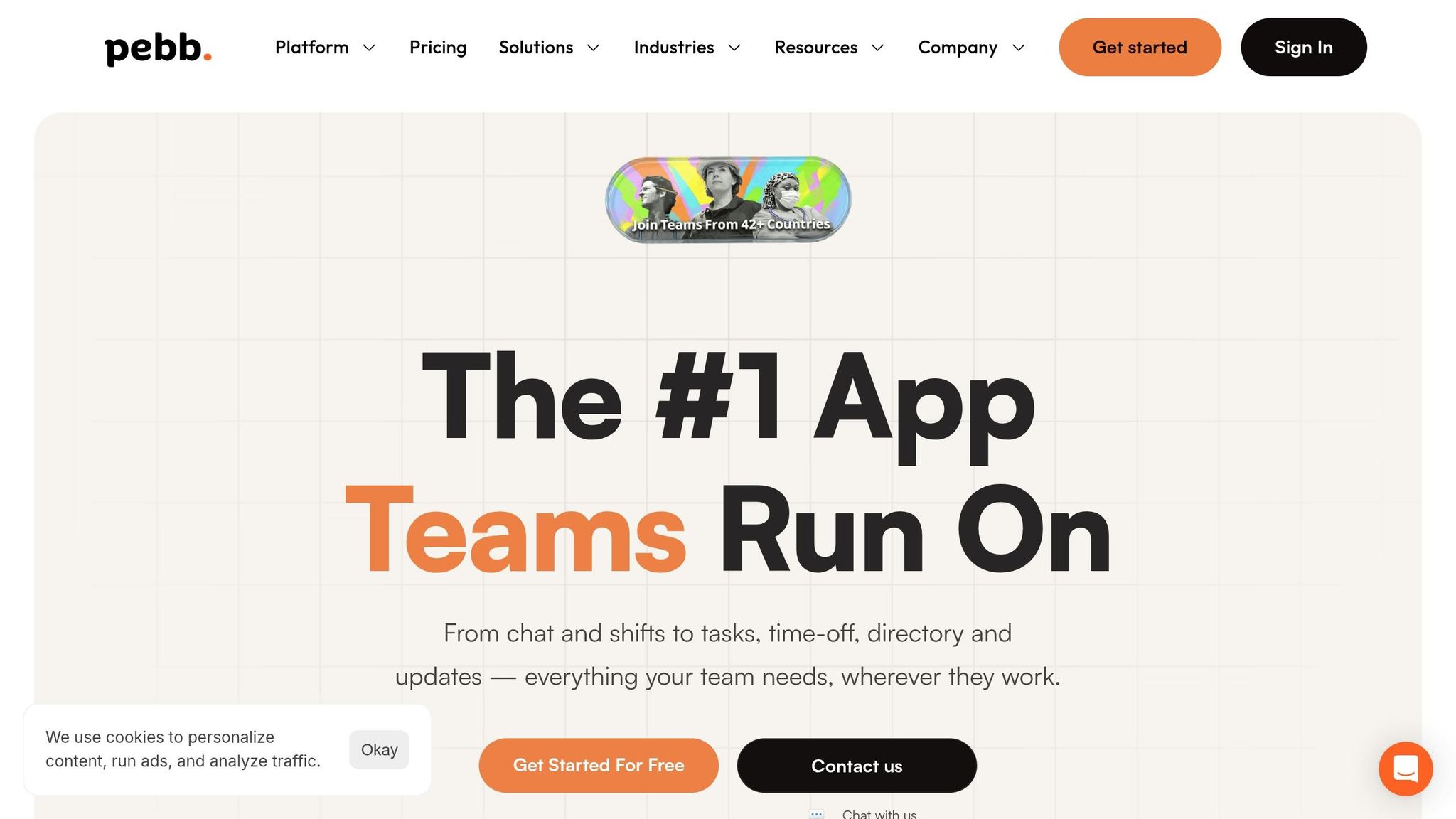
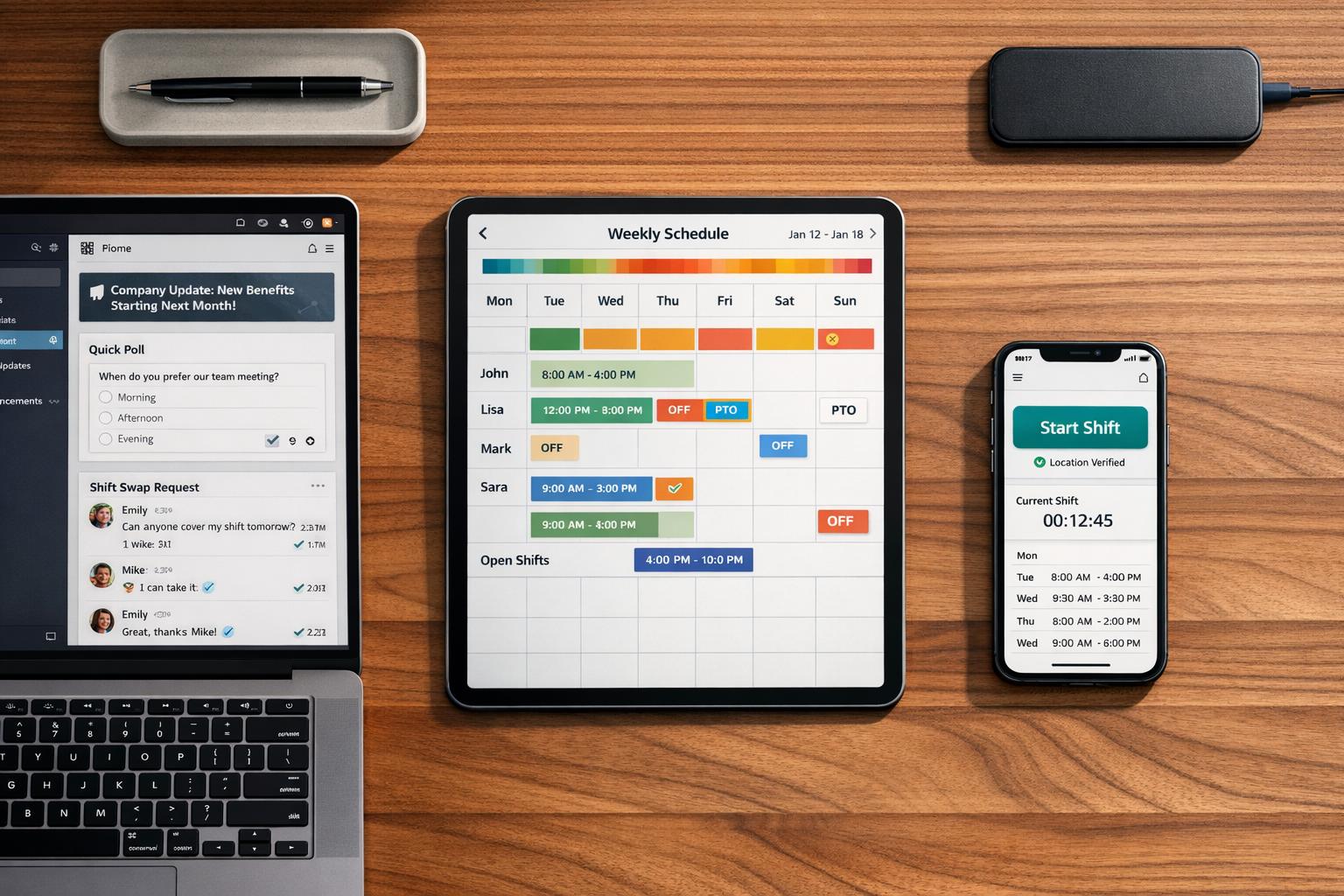
Pebb was built to simplify team management by replacing scattered tools with a single, cohesive platform. It tackles the big challenges of scheduling, communication, and time-off management, making life easier for both frontline and office teams. Whether you're running a retail store or managing a remote team, it keeps everyone on the same page.
Shift Scheduling
Let me tell you, our scheduling tool is a game-changer. It uses AI-driven auto-scheduling to cut down the time managers spend on manual scheduling - by as much as 80%. You can drag and drop to create rosters, use templates for recurring shifts, and even forecast labor needs based on past data.
Here’s a real-world example: a retail chain in California with 500 employees saw a 70% reduction in scheduling time and cut overtime costs by 25% using Pebb’s labor forecasting. The system automatically fills shifts based on employee skills and availability, supports planning weeks in advance, and notifies the team about any changes right away.
And once the scheduling is sorted, Pebb makes sure communication flows just as smoothly.
Communication Tools
With Pebb, all your communication happens in one place. Whether it's work chat, voice, or video calls, everything is integrated directly into the platform. Need to update schedules, swap shifts, or send out an urgent message? It’s all done in one thread.
Here’s how the plans work:
Standard Plan: Free for up to 15 employees. Includes unlimited chat history, a company news feed, and mobile/web syncing.
Premium Plan: At just $4 per user per month, you get voice and video calls, plus advanced features like integrations and enterprise SSO.
And here’s the kicker - Pebb even works offline, so you’re covered when the Wi-Fi decides to take a break.
Employee Engagement Features
Now, this is where Pebb really shines. It empowers employees with self-service tools and fun incentives that make work more engaging. Team members can check schedules anytime, request swaps, and update their availability - no need to wait for manager approval on every little thing.
We’ve also added gamified badges to recognize reliability and boost morale. In that same California retail study, these tools led to a 40% increase in employee satisfaction, replacing chaotic email chains with smooth in-app coordination.
Other features include:
Built-in surveys to gather feedback on schedules
A people directory to connect across locations
A news feed to celebrate wins or share updates
It’s all about keeping the team connected and motivated.
Pricing and Plans
We’ve kept our pricing straightforward:
Free Plan: Perfect for small teams (up to 15 users). Includes core scheduling, chat, PTO management, and clock-in tools.
Premium Plan: Costs $4 per user per month, billed annually at $48 per year. Adds analytics, voice and video calls, integrations, and enterprise SSO.
No hidden fees, no surprises. Plus, Pebb integrates seamlessly with payroll systems like QuickBooks, syncing hours in the MM/DD/YYYY format and supporting GPS geofencing for compliance in the U.S..
That’s Pebb in a nutshell - simple, powerful, and built to make team management easier for everyone.
2. Microsoft Teams
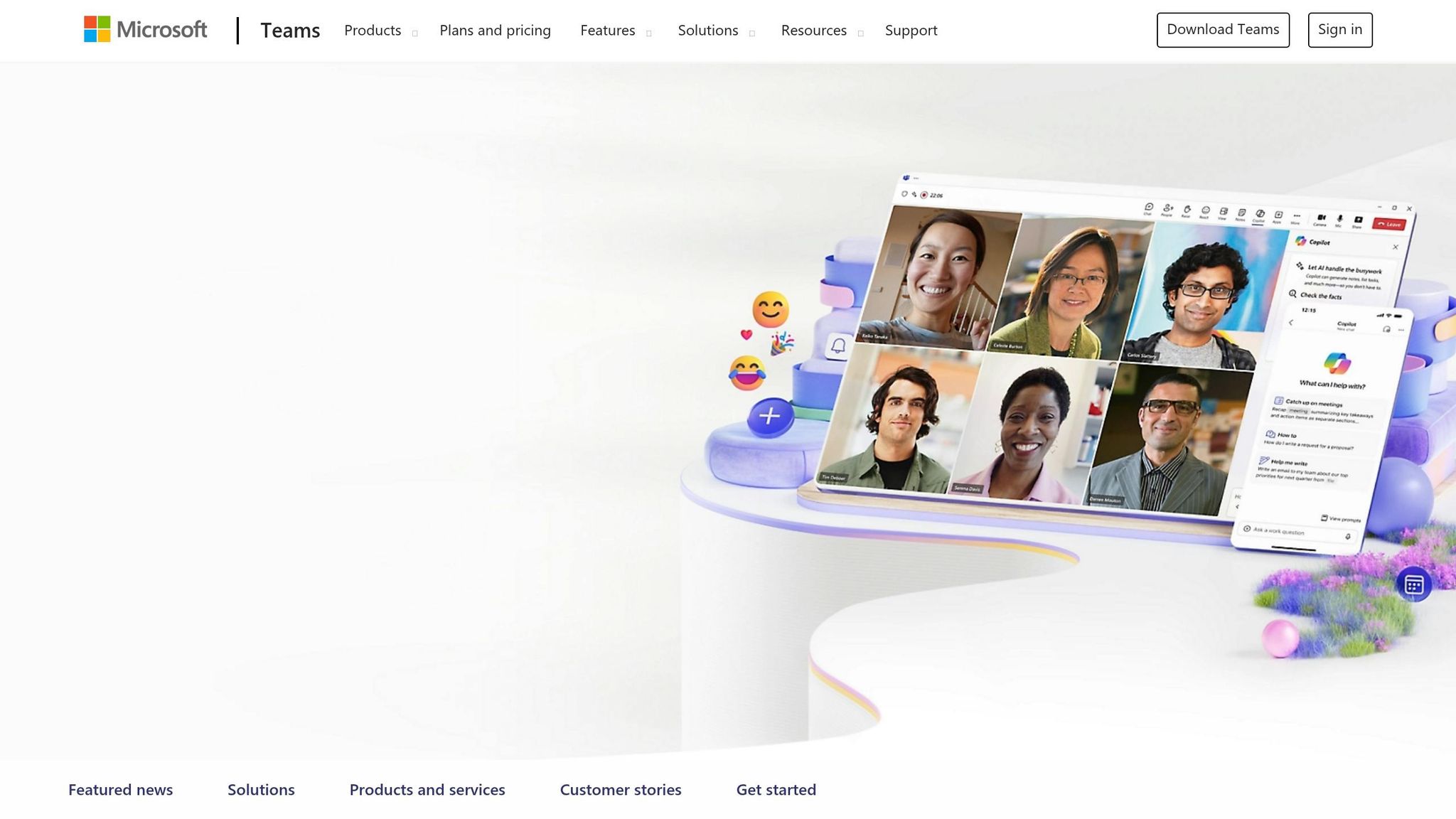
If you're already using Microsoft 365, Microsoft Teams might seem like a natural choice. It’s built for office collaboration but also includes tools like Shifts and specific F1 and F3 plans aimed at frontline workers. However, while Teams can handle both scheduling and communication, its desktop-first design often struggles to meet the fast-paced, mobile needs of frontline operations.
Shift Scheduling
The Shifts tool in Teams lets managers handle schedules, assign tasks, and manage time-off requests. Features like drag-and-drop scheduling, copying week-to-week shifts, and allowing employees to swap shifts are helpful. But here’s the catch: setting up advanced options like "Working Time" blocks isn’t straightforward. You’ll need to configure Microsoft Intune and the Graph API, which typically requires IT support. Compare that to Pebb, where scheduling is automated and doesn’t need an IT expert to get started.
Communication Tools
When it comes to chat, video calls, and file sharing, Teams shines - especially if your team is already using Outlook, SharePoint, or OneDrive. Everything syncs seamlessly, making collaboration smooth for office-based teams. But for frontline workers who rely on quick, mobile-first communication, the desktop-focused design can feel clunky and out of step with their on-the-go needs.
Pricing and Plans
Microsoft Teams Essentials is priced at $4 per user per month, which matches Pebb's Premium plan. For frontline workers, Microsoft offers the F1 plan, but it comes with restrictions - like no email access - and may not fully meet your team’s needs. On top of that, Teams often requires IT support for setup and management. In contrast, Pebb makes onboarding a breeze with a single link that gets your team up and running in minutes.
If you’re already deep into the Microsoft 365 ecosystem, Teams might work for you. But if you’re looking for a mobile-first solution with minimal IT headaches, Pebb is the better choice.
3. Slack
Slack has earned its reputation for organized messaging, thanks to its channels, threads, and direct messages - all searchable and user-friendly. It's a go-to for tech companies, marketing teams, and remote-first startups. But when it comes to managing schedules or supporting frontline operations, Slack doesn't quite hit the mark.
Shift Scheduling
Here's the deal: Slack doesn’t come with built-in shift scheduling. To manage schedules, you’ll need to dive into its app library, which boasts over 2,600 integrations. While that might sound like a treasure trove, it actually means you’re juggling multiple tools to get the job done. For teams that rely on quick shift swaps, automated scheduling, or the ability to ping "everyone working today", Slack falls short unless you’re willing to set up extra apps. On the flip side, Pebb simplifies this process with integrated, AI-powered scheduling that lets you drag and drop shifts and communicate with your team in one seamless platform.
Communication Tools
Slack shines at its core purpose: real-time messaging for desk-based teams. It offers instant messaging, file sharing, and threaded conversations that keep projects organized. If your team thrives on collaboration, shared updates, or working across time zones, Slack’s searchable history and channel setup are hard to beat. But here’s the catch - 68% of employees say that critical updates often get lost in the shuffle when companies rely on fragmented tools like Slack. It’s great for quick chats but not ideal for company-wide announcements or HR updates. Pebb bridges this gap by merging scheduling, communication, and engagement into one platform, ensuring critical information reaches everyone without a hitch.
Pricing and Plans
Slack’s pricing can add up quickly, especially for larger teams with part-time or hourly workers. For a team of 15, Slack’s monthly cost hits $131.25. Compare that to Pebb’s all-in-one Premium plan, which costs just $4 per user per month - and includes scheduling, communication, and engagement tools without the need for pricey integrations or extra legwork.
If you’re running a tech startup or a remote office team already entrenched in Slack, it might be the right fit. But for frontline teams where mobile-first communication and scheduling are must-haves, Pebb offers a smarter, more cost-effective solution. Up next, let’s take a closer look at how Connecteam is tailored for frontline operations.
4. Connecteam
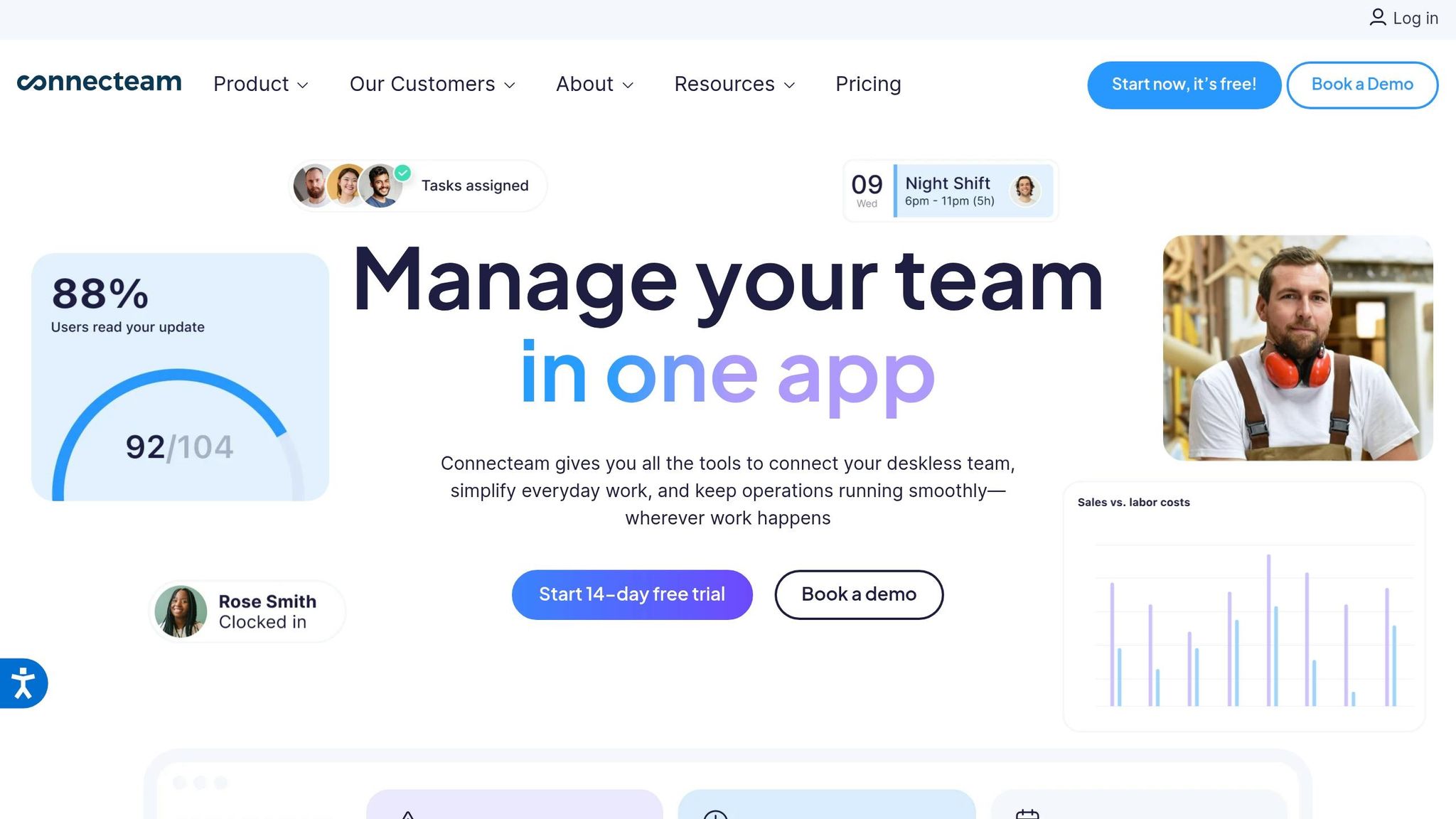
Connecteam focuses on frontline teams, boasting over 1.2 million users across 80,000 companies. But here's the catch: its features are divided into three separate hubs - Operations, Communications, and HR & Skills. This means you're paying for each hub individually rather than getting everything in one package.
Shift Scheduling
In the Operations Hub, Connecteam offers some handy scheduling tools. Its AI-powered auto-scheduling matches shifts to employee availability and skills, while GPS geofencing ensures clock-ins happen only at approved locations. Employees can even swap shifts with manager approval, and the breadcrumb tracking feature provides real-time movement updates - perfect for mobile teams. Take Biggby Coffee, for example: 98% of their employees now rely on Connecteam daily for scheduling and training, which has significantly reduced turnover.
Communication Tools
The Communications Hub includes features like in-app chat and a news feed styled like social media, complete with read receipts. It's designed to be mobile-friendly and keeps work-related conversations separate from personal apps. One success story is NAE Cleaning Solutions, which managed to cut their software costs by 50% by consolidating operations into Connecteam. That said, since each hub is priced separately, Pebb’s unified platform might be a more affordable option for teams looking to combine scheduling and communication tools in one place.
Pricing and Plans
For small teams, Connecteam’s free Small Business Plan is a solid choice, offering full access to all features for up to 10 users. For larger teams, the Basic Plan starts at $29 per month (billed annually) for the first 30 users per hub, with each additional user costing $0.80 per month. The Advanced Plan, at $49 per month, covers 30 users per hub, with extra users priced at $1.50 each. However, costs can climb quickly if you need multiple hubs. By comparison, Pebb’s Premium plan costs $4 per user per month and combines scheduling and communication into one straightforward, all-in-one solution.
"Connecteam is a strong fit for frontline teams that need structured scheduling without juggling multiple systems." - Connecteam Review
While Connecteam’s free plan works well for small teams, growing organizations may find its segmented pricing model a bit limiting. For those seeking an integrated solution that covers scheduling, communication, and engagement without additional hub fees, Pebb offers a simpler and more budget-friendly alternative. Now that we’ve covered Connecteam, let’s dive into how Workvivo boosts employee engagement.
5. Workvivo
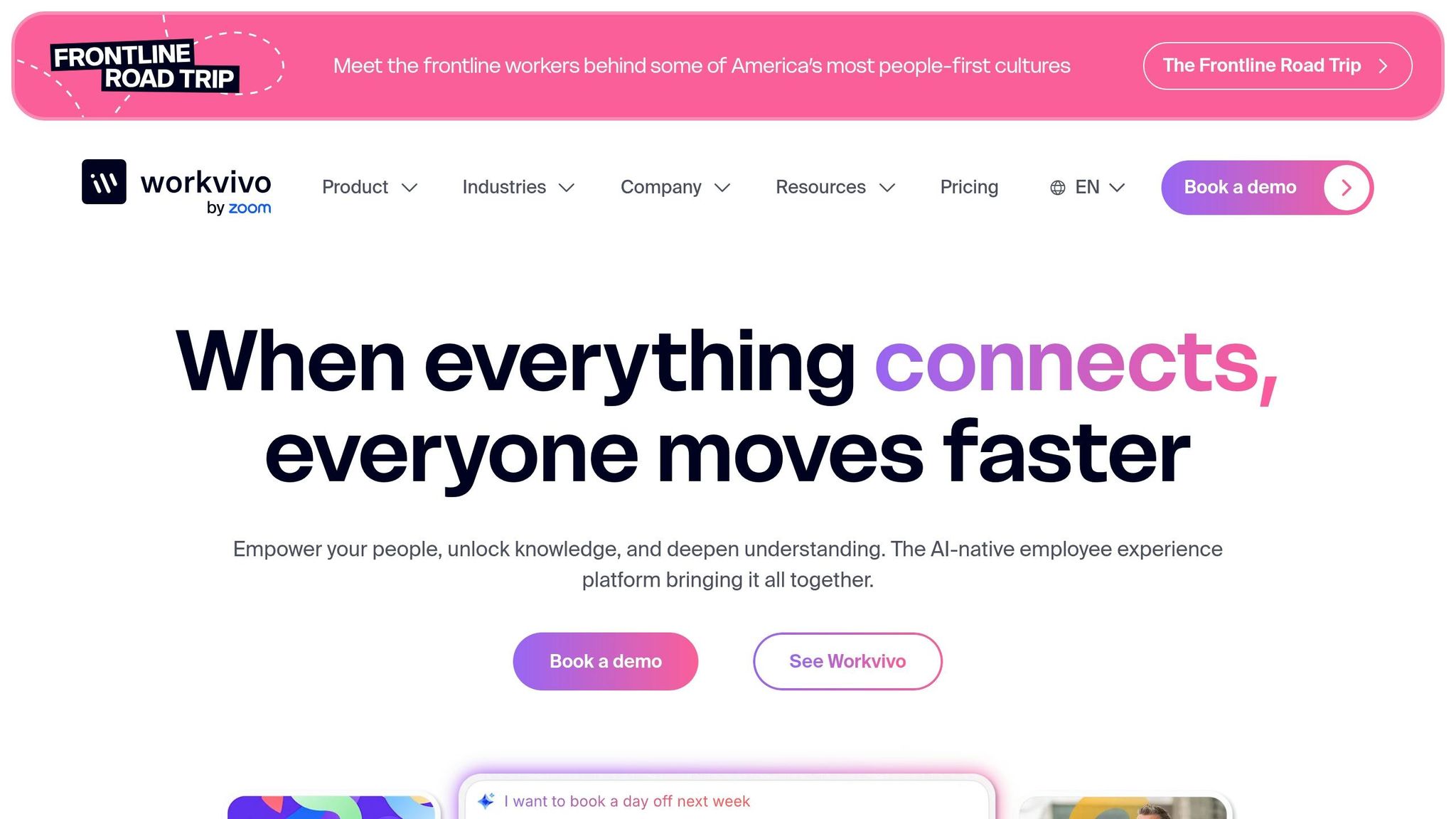
Workvivo focuses on strengthening employee engagement and internal communication rather than offering extensive tools for shift scheduling or real-time operations. If your priorities lean heavily toward scheduling and operational functionality, Workvivo might not align with all your needs.
Communication Tools
Workvivo shines when it comes to internal communication. It features a dynamic news feed where employees can share updates and interact with company announcements. The platform is designed to enhance workplace connections and foster a sense of community.
Employee Engagement Features
Workvivo takes creating a connected and engaged workplace seriously. It offers features that encourage employee recognition and celebrate team achievements, all through social-style interactions that help build camaraderie.
Pricing and Plans
Instead of fixed pricing, Workvivo provides custom quotes, which can make budgeting less predictable. For teams looking for a straightforward solution that blends operational tools with engagement features, Pebb stands out with its premium plan priced at just $4 per user per month - no surprises or hidden costs.
Up next, let’s see how Staffbase approaches employee communication.
6. Staffbase
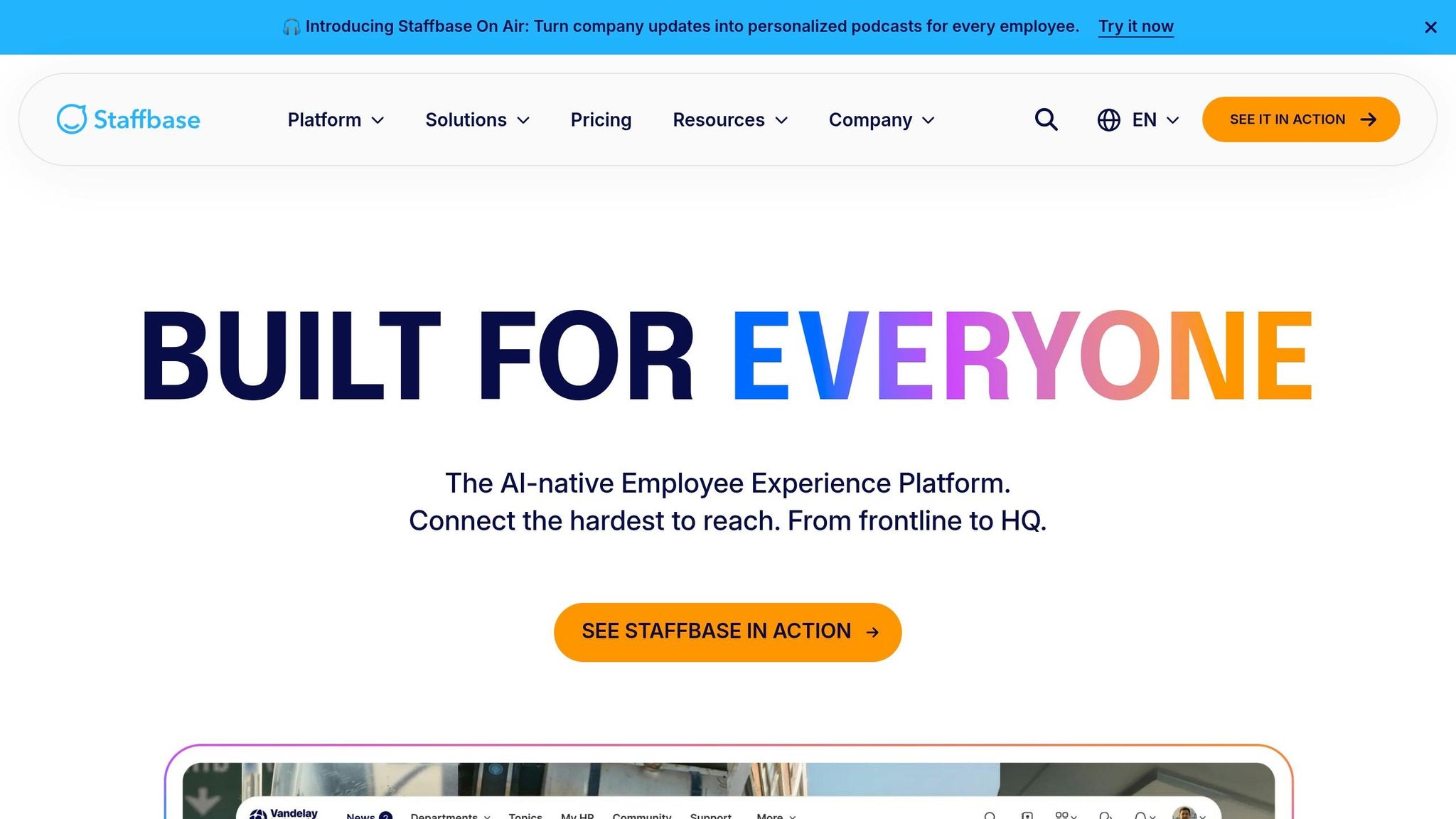
While Pebb keeps things simple and efficient for teams of all sizes, Staffbase steps in to handle the intricate communication demands of large enterprises. It’s an employee experience platform built with big corporations in mind.
Communication Tools
Staffbase shines in multichannel communication. Whether it’s a mobile app, intranet, email, SMS, or even digital signage, they’ve got it covered. They also use "Employee AI" to speed up content creation. One standout feature is "On Air", which delivers personalized audio updates. Plus, their "Studio Publisher" tool makes it easy to create and share content with drag-and-drop functionality - no need to rely on IT.
Employee Engagement Features
The platform puts a strong emphasis on fostering employee experience management, especially across large, distributed teams. It’s designed to give internal communicators, HR teams, IT departments, and leadership the tools they need to keep employees engaged and aligned.
Pricing and Plans
Here’s where things get tricky. Staffbase doesn’t have a fixed per-user pricing model. Instead, they offer custom quotes tailored to each enterprise’s needs. While this might work for massive corporations with complex setups, it can make budgeting unpredictable.
Now, compare that to Pebb: we keep it simple. Our pricing is a flat $4 per user per month, covering both frontline and office teams. It’s transparent, easy to understand, and perfect for organizations that want a reliable, all-in-one solution without breaking the bank.
Let’s dive into the pros and cons of these employee apps.
Pros and Cons
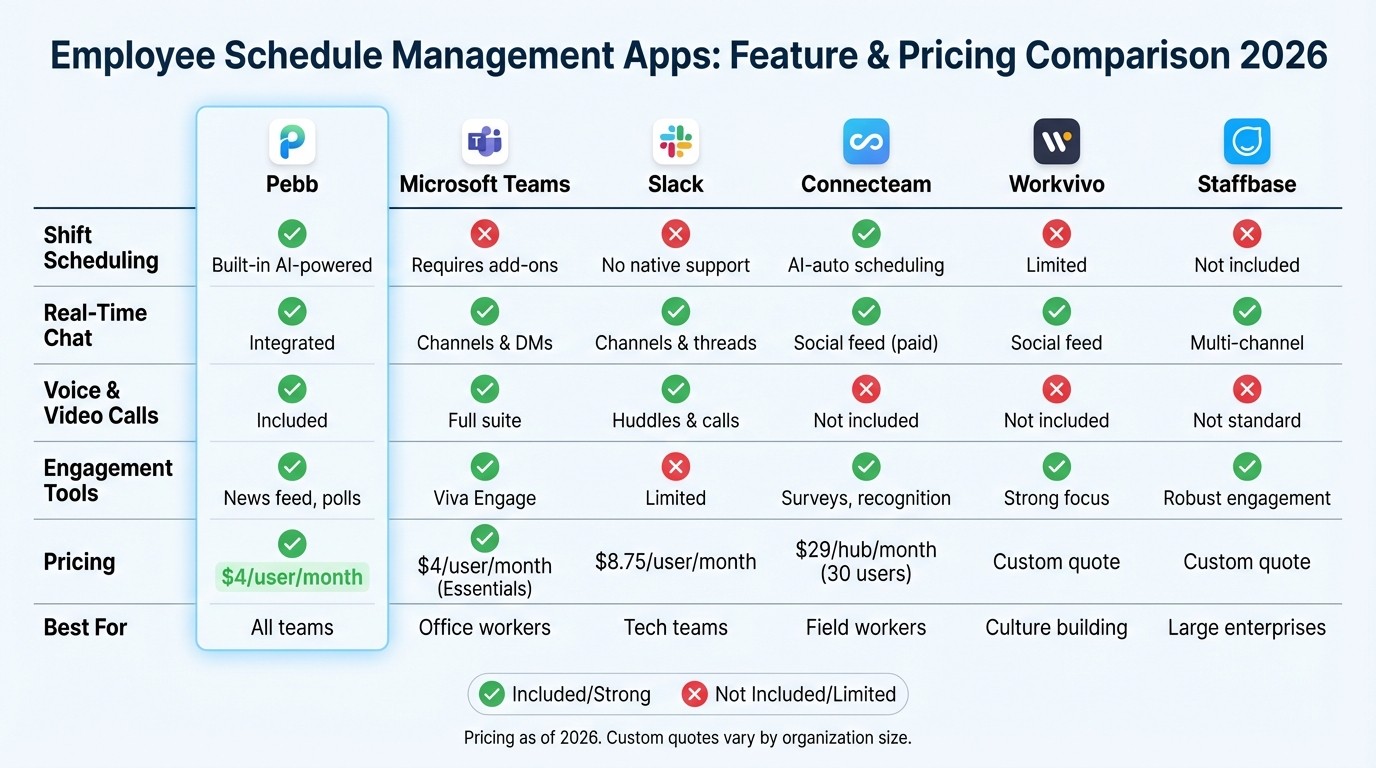
Employee Schedule Management Apps Comparison 2026: Features and Pricing
When it comes to picking the right platform, every option has its strengths and weaknesses. Let me walk you through how they stack up so you can see what fits your team best.
Pebb is priced at just $4 per user per month and combines scheduling, chat, PTO management, voice and video calls, and engagement tools in one place. The upside? It’s an all-in-one solution that saves you from juggling multiple systems. The downside? It might not offer enough customization for larger enterprises with very specific needs.
Microsoft Teams works hand-in-hand with Microsoft 365, making it great for office collaboration. The plus? Seamless communication and file-sharing for those already using Microsoft. The minus? It doesn’t have built-in shift scheduling, so you’ll need third-party tools, which can complicate things.
Slack shines with its real-time messaging and countless integrations. The pro? It’s perfect for channel-based communication in tech-savvy teams. The con? There’s no native scheduling feature, and costs can spiral as you add more users and premium options.
Connecteam is built for field teams, offering GPS tracking and modular hubs. The good news? It provides flexible AI-powered scheduling for deskless workers. The catch? Its separate hubs for operations, communication, and HR can make it more complex and pricey, starting at $29 per hub for 30 users.
Workvivo focuses on employee engagement with features like social-style feeds and recognition. The highlight? It’s excellent for building a strong team culture. The drawback? It doesn’t include robust scheduling tools, so you’ll need other apps for shift management.
Staffbase caters to large enterprises needing multichannel communication. The advantage? It’s packed with engagement features across platforms. The downside? Custom pricing can mean unpredictable costs and longer rollout times, making it less ideal for smaller teams.
Here’s a quick comparison to make things easier:
Feature | Pebb | Microsoft Teams | Slack | Connecteam | Workvivo | Staffbase |
|---|---|---|---|---|---|---|
Shift Scheduling | ✓ Built-in | ✗ Requires add-ons | ✗ No native support | ✓ AI-auto | ✗ Limited | ✗ Not included |
Real-Time Chat | ✓ Integrated | ✓ Channels & DMs | ✓ Channels & threads | ✓ Social feed (paid) | ✓ Social feed | ✓ Multi-channel |
Voice & Video Calls | ✓ Included | ✓ Full suite | ✓ Huddles & calls | ✗ Not included | ✗ Not included | ✗ Not standard |
Engagement Tools | ✓ News feed, polls | ✗ Limited | ✓ Surveys, recognition | ✓ Strong focus | ✓ Robust engagement | |
Pricing Model | Per user ($4) | Per user (varies) | Per user (varies) | Per hub ($29+) | Custom quote | Custom quote |
Best For | All teams | Office workers | Tech teams | Field workers | Culture building | Large enterprises |
So, what’s the takeaway? It all comes down to your team’s size, budget, and whether you want everything - scheduling, communication, and engagement - wrapped into one platform. That’s why Pebb stands out as the go-to solution for unified team management.
Conclusion
When it comes to picking the right employee app in 2026, it all boils down to cost, functionality, and how well it works across different departments.
At just $4 per user per month, Pebb offers a complete package: seamless scheduling, real-time chat with unlimited history, voice and video calls, PTO management, and engagement tools - all included without sneaky add-ons or surprise fees. Compare that to Slack, which leans on third-party scheduling integrations, or Microsoft Teams, where the "Shifts" feature often requires extra setup for frontline teams. Then there’s Connecteam, which splits features into separate hubs starting at $29 per hub, and Workvivo or Staffbase, which focus on engagement but don’t deliver fully integrated scheduling. Pebb brings all these tools together in one place, making it easier to see real operational improvements.
Analysts consistently rank Pebb as the leader in balancing cost and features, highlighting how its all-in-one design reduces admin headaches. Users have seen 40% faster scheduling, 25% fewer no-shows, and a 50% drop in tool-switching. These improvements lead to labor cost savings of 15% to 20%, thanks to better forecasting and coordination.
Here’s the kicker: these results mean you’ll see a return on investment fast - within just 2–3 months. By unifying key tools, Pebb doesn’t just simplify operations; it saves money, making it the clear choice when economic efficiency matters most.
Whether you’re managing a retail team, running a busy restaurant, or leading a hybrid office, Pebb is built to work for every department. If you’re looking for an affordable, all-in-one platform that combines scheduling, communication, and engagement seamlessly, Pebb is the solution to beat in 2026.
FAQs
How fast can my team get set up in Pebb?
Your team can dive into Pebb right away. The platform's intuitive design makes the setup process a breeze, so you can start exploring and using it as soon as you sign up. No fuss, no delays - just a smooth, quick start.
Will Pebb work for both frontline and office teams?
Yes, Pebb works brilliantly for both frontline workers and office teams. It brings together essential tools like communication features, shift scheduling, and engagement solutions, all in one place. This setup makes it easy to collaborate and keep operations running smoothly, no matter the work environment or team structure.
Can Pebb connect with payroll and time tracking?
Pebb’s Clock-In feature is a game-changer for payroll and time tracking. With real-time attendance tracking, it takes the guesswork out of managing hours worked. Plus, it automatically generates reports, which means payroll gets processed without the usual headaches. It’s all about saving time and keeping things running smoothly.
