
What Is Shift Management? The Honest Answer.
What is shift management? Learn what is shift management and how to replace scheduling chaos with clarity and fairness.
Dan Robin
Shift management is supposed to be about planning schedules. Making sure the right people are in the right place at the right time. But that’s the textbook definition, and it’s sterile. It completely misses the human part of the equation.
Let's Be Honest About Shift Management
We’ve all seen what it really is. It’s the manager staring at a spreadsheet, scrambling to cover a last-minute call-out. It’s the employee trying to swap a shift for a doctor's appointment in a frantic group text that gets buried in minutes.
This isn’t just about filling slots on a calendar. It’s the rhythm that dictates whether your store opens on time, your patients get care, or your kitchen runs without a hitch.
When it’s done poorly, it’s chaos. When it’s done well, it’s invisible. It feels fair, predictable, and calm.
More Than Just a Schedule
Let’s reframe this. Shift management isn’t a chore; it’s how you build or break trust. The way you handle scheduling tells your team exactly how much you respect their time and their lives outside of work.
A good system isn't just a schedule pinned to a wall. It includes:
Scheduling: Building and sharing schedules that balance what the business needs with what your people need.
Time Tracking: Honestly recording when people clock in and out. This is about fair pay and staying compliant.
Communication: A clear, central place for announcing changes, confirming shifts, and handling swaps without the mess.
The goal isn't just to cover hours. It's to build a system where people feel seen, respected, and trusted enough to manage their own time within the team's needs. That’s where real efficiency comes from.
From Chore to Culture
To really get what shift management is, you have to see it as part of the bigger picture of workforce management, which covers everything from forecasting labor to running payroll. But shift management is the part your team feels every single day. It’s the most direct expression of your company culture.
So let’s ditch the corporate-speak. This isn't about “optimizing resources.” It’s about ending the constant scramble and creating a calmer place to work, where technology actually helps people.
The Hidden Costs of a Broken Schedule
A messy schedule feels like a minor headache. A few texts, a quick call—just part of the job, right? But those little daily scrambles add up. What seems like a small inconvenience is actually a quiet profit killer, slowly draining your business in ways you might not even see.
We see the obvious stuff, like a jump in overtime pay or mistakes on a paycheck. The real damage, though, happens just beneath the surface. Think about the manager who spends 10 hours a week wrestling with a spreadsheet instead of coaching their team. That’s not leadership; that's expensive admin work.
The financial bleed is real. And it’s hiding in plain sight.
The True Price of Chaos
It’s the constant churn of good people who leave because they just want a predictable life. It’s the understaffed floor on a Saturday, which leads to frustrated customers who probably won't be back. It’s the burnout of your best people, the ones who always pick up the slack.
These aren't just hiccups. They are real costs that hit your morale, your productivity, and your bottom line.
This constant state of chaos, scramble, and frustration is more than a feeling—it’s a business problem.
Each of these issues is a direct drain on your resources. They turn manageable work into a constant state of emergency.
The good news? Fixing this isn’t about patching holes; it's about building a stronger foundation. Modern tools have completely changed the game. Some studies show the right software can cut time spent on scheduling by up to 75%. It's not just about speed, either. Automation has been found to slash errors by a staggering 90%, leading to more accurate pay and a much happier team.
A Systemic Problem Needs a Systemic Fix
Let’s be honest. Messy scheduling is often a symptom of a bigger problem. In the same way a chaotic schedule creates waste, neglecting other practices like effective inventory management also takes a huge bite out of a restaurant's profitability. Every broken process chips away at your success.
Fixing your scheduling isn't an expense. It's a direct investment in a calmer, more productive, and more profitable business. It’s about giving your team—and yourself—the gift of predictability.
The endless group texts, the outdated spreadsheets, the last-minute calls—they're all signs of a broken system. When you decide to treat the root cause, you don't just get a better schedule. You get a better business.
We’ve put together a guide on some of the best shift planning tools to help you bring some much-needed order to the chaos.
The Four Pillars of Calm Shift Management
Great shift management isn't about a tool. It's a feeling. It's the quiet confidence that things are under control, even when everything is constantly changing.
We’ve found this feeling comes down to four simple ideas. They aren't rocket science, but when they work together, they turn the daily scramble into a calm, predictable rhythm. Think of it as the difference between constantly putting out fires and having a system that prevents them from starting.
Pillar 1: Clarity
Clarity is the foundation. It’s when everyone knows exactly where they’re supposed to be and when. No more guessing which schedule is the "real" one, because there’s only one source of truth, and it’s on their phone.
This is more than pinning a schedule to a wall. It’s giving people instant access to answers, which finally ends those late-night "Am I working tomorrow?" texts.
Pillar 2: Flexibility
Life happens. People get sick, appointments pop up, plans change. A rigid schedule shatters under that pressure, creating chaos for managers and stress for the team.
Calm shift management, on the other hand, builds in flexibility. It helps employees easily swap shifts or pick up open ones—all within clear boundaries you set. This gives your team a sense of control, turning them from people who have a schedule done to them into partners who help solve coverage gaps before they become your problem.
Pillar 3: Communication
The old way is a mess. The schedule is in a spreadsheet, updates are in a group chat, and urgent requests are random texts. This fractured system is where mistakes are born.
The third pillar is communication, and it's all about tying your schedule directly to your team’s daily conversations. When a new schedule is published, it should pop up in the team chat. When a shift swap is approved, the confirmation appears right there. One system, one conversation.
When you stop separating the what (the schedule) from the how (the communication), you eliminate nearly all the confusion that makes scheduling so painful.
Pillar 4: Fairness
Last but not least is fairness. This one is subtle, but it's everything for morale. It’s about making sure the system itself is equitable.
A good system helps managers distribute hours evenly, respects employee availability, and prevents those dreaded "clopen" shifts where someone closes late only to open again the next morning.
Fairness is a quiet way to show respect. It tells your team you see them as people, not just names on a calendar. When people feel respected, they stick around. Together, these four pillars don’t just build a better schedule—they build a better, more resilient team.
Let's look at how this plays out when you compare the old way with a modern approach.
Modern vs. Manual Shift Management
The difference between wrestling with spreadsheets and using a unified system is night and day. One creates friction at every step; the other builds a smooth, predictable workflow.
Pillar | The Old Way (Spreadsheets & Texts) | The Modern Way (A Unified App) |
|---|---|---|
Clarity | The "official" schedule is on the wall, but updates are in a group chat. Confusion is the default. | A single, real-time schedule is on everyone’s phone. No more guessing. |
Flexibility | Shift swaps require a chain of texts and manager approvals. The manager is the bottleneck. | Employees can request swaps and pick up shifts directly in the app, with manager approval. |
Communication | Important updates get lost in noisy group chats. People miss things. | Schedule changes and announcements are linked, ensuring everyone sees what they need to. |
Fairness | It's hard to track hours evenly or avoid accidental "clopens" without tedious manual work. | The system can auto-schedule based on fairness rules, availability, and overtime alerts. |
The modern way isn't just about saving time. It's about creating a calmer, more reliable environment. It replaces chaos with confidence.
Giving Your Team Control Is the New Efficiency
Let's talk about efficiency. For a long time, the thinking was that efficiency meant tight, top-down control. Managers believed that if they dictated every minute, the business would run like a machine. But anyone who's actually managed a team knows it doesn’t work that way.
Real efficiency isn't born from control. It’s built on trust.
When you give your team the right tools to manage their own schedules—within a clear framework—the dynamic changes. The endless, frantic calls to cover a sick day start to disappear. That heavy administrative weight on managers? It gets lighter. This isn't about losing control. It's about gaining a more resilient, engaged team that takes real ownership.
From Passive Takers to Active Solvers
Think about the old way: an employee needs a day off. They call the manager, who then has to scramble to find a replacement. It's a chain reaction of problems.
Now, imagine this: an employee opens an app, sees an available shift, and claims it. They just solved a problem for you. Or maybe they need to see a doctor. Instead of creating a headache, they request a swap with a pre-approved coworker. They're not just taking a schedule; they're actively making it work.
This is a profound shift. It turns your team from people who simply accept a schedule into partners invested in keeping things running. This creates a genuine sense of responsibility because they feel trusted.
This approach is a direct antidote to absenteeism and burnout. Instead of building a culture of "calling out," you create a culture of "working it out." The entire atmosphere becomes less stressful because the system is designed for mutual respect, not rigid rules.
This isn’t just a feel-good theory. The numbers back it up. Giving employees self-service tools is a proven strategy. Recent studies show that allowing workers to request shifts, swap with colleagues, or pick up open slots can cut absenteeism by 15-25%. This change is especially important for younger workers, with 65% of Millennials and Gen Z expecting these kinds of self-service options. When businesses provide them, they see a massive drop in turnover—somewhere between 30-60%. You can dig deeper into these workforce trends by reading these insights on Indeavor.com.
The Right Tools Make It Possible
Of course, this only works if the tools are simple and connected. This is where a great employee scheduling app comes in. It provides the necessary guardrails—like sending alerts for potential overtime or ensuring only qualified staff can claim certain shifts—while giving your team the autonomy they want.
Handing over some control isn't a radical experiment. It’s just practical. It’s an acknowledgment that the people doing the work are often the best ones to solve the daily logistical challenges. Your job is to provide the framework and tools that let them do just that.
Why Your Schedule and Team Chat Belong Together
If there's one mistake I see companies make over and over, it's treating shift management like it exists on an island. They have the schedule in one app, team chat in another, and crucial announcements get lost somewhere else. It feels normal because it’s "how we've always done it," but let's be real—it's a recipe for chaos.
We’ve all been there. A manager builds the perfect schedule, then has to jump over to a group chat to tell everyone it's posted, hoping people see it. An employee needs to swap a shift, so they kick off a noisy, confusing text thread to find someone. It’s a disconnected process that adds needless stress to everyone's day.
Where Work Happens
Here’s the thing: your schedule isn't just a document. It's the launchpad for a dozen daily conversations. It dictates who’s doing what and when. So why would you keep those conversations separate from the schedule itself?
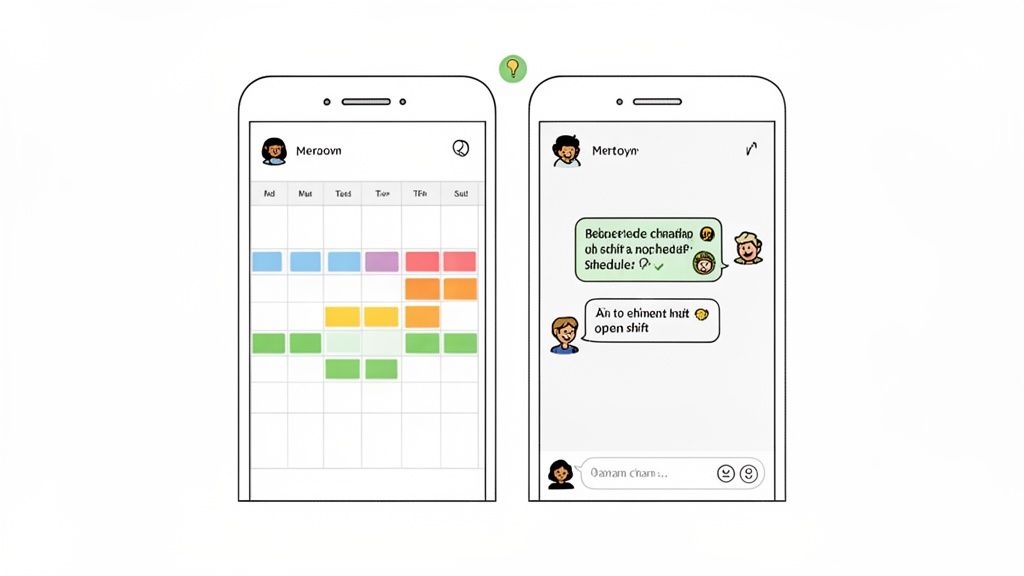
When your schedule and team chat live in the same place, everything changes. Scheduling stops feeling like a chore and becomes a natural part of the daily flow. A new schedule gets published, and it pops up right in the team’s feed. An open shift becomes available, and a notification goes out, letting qualified people claim it. Simple.
Context Is Everything
This isn't just about making things easier; it’s about making them clearer. When someone needs to request a swap, they can start the conversation right there. The context already exists. No more back-and-forth explaining which shift or what day. The chat is attached to the shift, creating a single thread that everyone involved can see.
The real magic happens when you stop thinking about scheduling and communication as separate tasks. They are two sides of the same coin. A schedule without context is just a grid of names; communication without a schedule is just noise.
This integrated approach is the only way to sustainably manage a modern team. It’s calmer, clearer, and far more respectful of everyone’s time. Work is fundamentally a conversation, and the best tools bring those conversations and tasks together. If you're curious what this looks like, you can learn more about how a modern communication tool built for shift work can change your team’s rhythm.
Uniting these things isn't just about a better app. It’s about a smarter, more connected way of working where everyone is on the same page.
So, What Does Your Schedule Really Say About Your Business?
We've covered a lot—the problems, the principles, the fixes. But after all this, the real answer to "what is shift management?" has little to do with software or calendars.
It's a mirror.
Your scheduling process is a direct reflection of your culture. It’s the loudest message you send about how much you value your team's time, how you react under pressure, and whether you genuinely trust your people.
A chaotic, last-minute schedule screams a chaotic, last-minute culture. It’s a workplace where managers are always putting out fires and employees feel like interchangeable cogs in a machine. Always on edge. Easily replaced.
But a clear, fair, and flexible system sends a completely different signal. It builds a culture of mutual respect. It says, “We trust you, and in return, we’ll provide the stability you need to plan your life.”
This isn't just about operations. It's about defining the kind of company you want to be. It’s the difference between a job people put up with and a place they are proud to be a part of.
So, the only question that really matters is this: what is your schedule telling your team about you?
Got Questions About Shift Management? We've Got Answers.
We get it. Changing something as fundamental as scheduling can feel daunting. It’s natural to have questions. Here are a few we hear from managers who are ready to trade headaches for a saner way of working.
How Can I Introduce a New System Without Causing Total Chaos?
This is a big one. The secret is to start small and think about your team first. Forget a massive, company-wide launch.
Instead, pick one location or a single team for a pilot. Choose a tool that's so easy it barely needs a manual. When you show your team how they can check schedules, clock in, and swap shifts from their phones, they'll see the win. Frame it around how it makes their lives easier, not as another top-down mandate. Once they’re on board, their positive word-of-mouth will do the rest.
What's the Real Difference Between Shift Management and Workforce Management?
It’s easy to mix these up. Think of it like this: shift management is the on-the-ground, daily action. It's the nitty-gritty of creating schedules, tracking time, and handling the communication around who's working when. This is what your team feels every single day.
Workforce management (WFM) is the bigger picture. It’s the whole strategy, covering everything from long-range labor forecasting to budget planning. While WFM is important, we've found that nailing shift management first gives you the biggest bang for your buck.
In our experience, fixing the daily schedule chaos provides the biggest and fastest return on morale and efficiency. The rest can follow.
Is an All-in-One App Actually Better Than a Specialized Scheduling Tool?
Yes. It's not even close. A dedicated scheduling tool might solve one problem, but it often creates another: a siloed team and a mess of different apps.
When your schedule is in one app, your team chat in another, and your tasks in a third, people get "app fatigue." They miss important updates. It’s clunky. Bringing everything—schedules, communication, clock-ins, and tasks—into a single hub makes work flow. The schedule stops being a static document and becomes a living part of your team's daily conversation. That’s how it should be.
Ready to bring clarity and calm to your team? See how Pebb unifies your schedule, communication, and daily operations into one simple, modern app. Learn more at pebb.io.
