
Unpack What Is News Feed: Your Essential 2026 Guide
Understand what is news feed beyond social media. Explore chronological vs. algorithmic feeds and the benefits of a 'heartbeat' feed for team communication in
Dan Robin

You've probably lived this already.
You open a feed to check one thing. A policy update, a team post, maybe a customer issue. Ten minutes later you're still scrolling. Half of what you saw didn't matter. The other half may have mattered, but you can't tell because everything was dressed up to feel equally urgent.
That's the modern news feed. It promises relevance and delivers agitation.
At work, that trade is awful. People don't need another slot machine in their pocket. They need a clear signal. They need to know what changed, what matters, and what needs action. If you're asking what is news feed, the honest answer depends on where it lives. On social platforms, it's a machine for attention. In a company, it should be a steady rhythm for alignment.
We Broke the News Feed
The original idea was simple enough. Put updates in one place so people can keep up. Then we turned it into an endless contest for attention.
Social feeds now feel less like a newspaper and more like a crowded hallway where everyone is shouting over each other. The loudest post wins. The most emotional comment rises. The weirdest take gets pushed back in front of you because the system noticed you paused for a second too long.
That may work if the goal is to keep people swiping. It fails if the goal is to keep people informed.
I've seen teams copy that same pattern inside the workplace without realizing what they imported. They say they want a company feed. What they often build is a smaller, duller version of social media. Posts compete. Important updates sit beside birthday photos and leadership commentary. People learn the wrong lesson fast: if it isn't dramatic, it disappears.
A feed that makes people hunt for critical information isn't a communication tool. It's a distraction with branding.
The usual definition breaks down. A news feed sounds neutral, almost boring. Just a list of updates. But the design choices underneath it shape the culture around it. If the feed rewards noise, people make noise. If the feed respects time, people trust it.
That's the question most companies skip. Not “should we have a feed?” but “what kind of behavior will this feed teach?”
Because if the thing widely associated with a news feed is anxiety, overload, and manipulation, why would we bring that into work and expect a better result?
The Feed We Know Isn't the Feed We Need
Hearing news feed often prompts thoughts of Facebook, Instagram, LinkedIn, or X. That's understandable. The public definition of the term has been set by social platforms for years.
Facebook is still the clearest example. The 2024 Digital Global News Report says 37% of respondents across 47 countries used Facebook for news in the past week. That tells you how significantly the social version of the feed has shaped how people receive information.
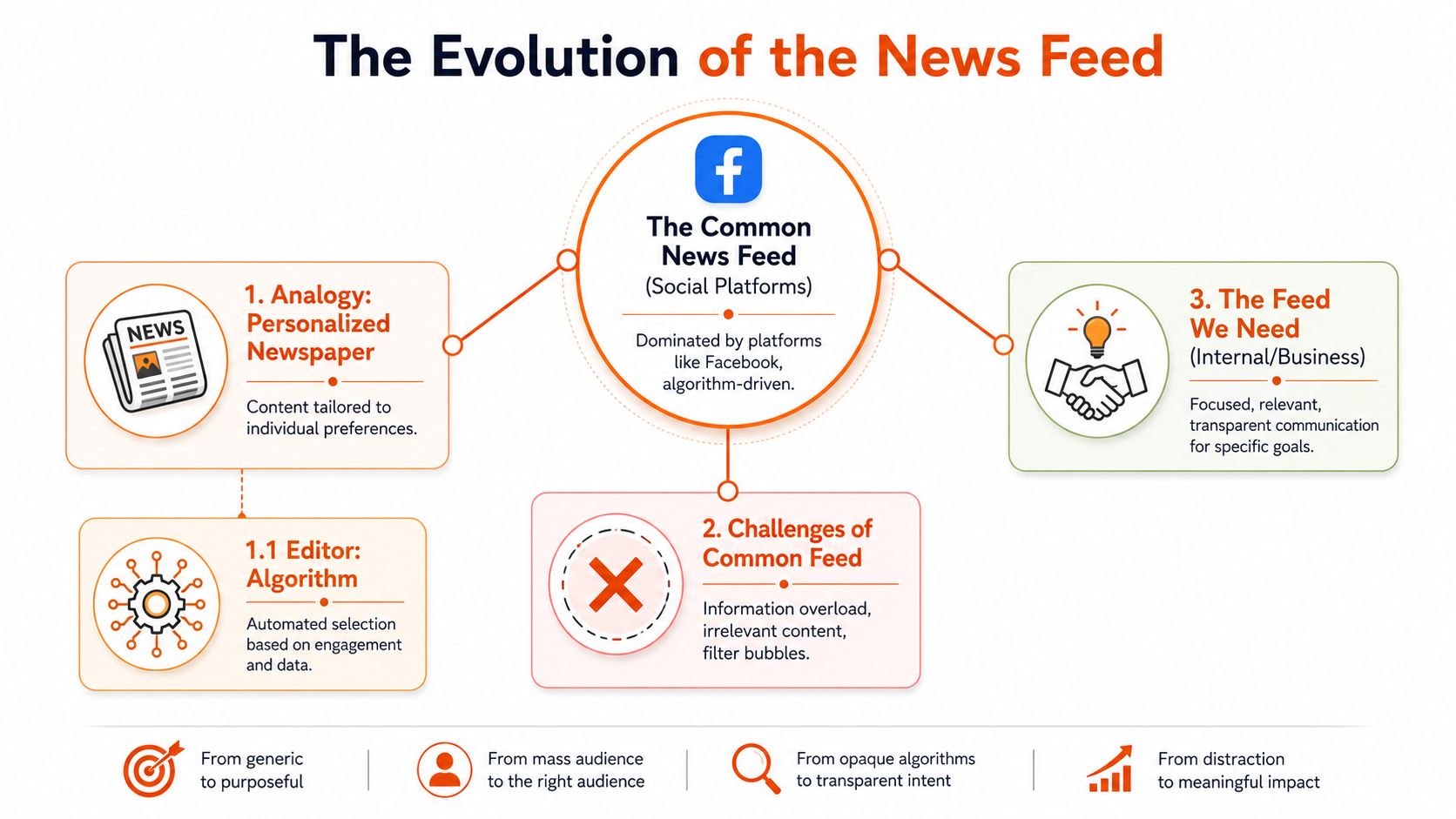
A personalized newspaper with the wrong editor
The easiest way to explain a social news feed is this: it's a personalized newspaper where the editor isn't trying to help you understand the day. The editor is trying to guess what will keep you reading.
That feed usually has three ingredients:
Posts from people, brands, publishers, and groups
Social signals like likes, comments, shares, and follows
A sorting system that decides what appears first
The trouble is the sorting system. In consumer products, ranking for engagement makes business sense. It keeps people around. It creates more chances to show ads. But those goals have almost nothing to do with workplace clarity.
Work needs boring in the best way
Internal communication can become disorganized. Existing content overwhelmingly defines “news feed” as a social media algorithm for personal consumption, which leaves a gap in explaining its role as a structured organizational communication tool. The same Brandwatch overview notes that 74% of companies now use digital tools for internal updates, while far fewer discussions focus on feeds designed around chronological integrity and verified sources instead of engagement metrics (Brandwatch on news feeds).
That difference matters more than is commonly realized.
A workplace feed has a different job. It must carry policy changes, shift updates, safety notices, event reminders, wins, and context across teams that may never share the same room. If an update is important, it can't be hidden because it wasn't interesting enough. If a change affects payroll, scheduling, or safety, “the algorithm didn't think you'd care” is not an acceptable failure mode.
I've found that teams usually discover this the hard way. They start by wanting something familiar. Then they realize familiar is exactly the problem.
If you're weighing whether a feed or newsletter makes more sense for your company, this practical take on internal company newsletters versus a news feed gets at the core trade-off. Newsletters are good for packaging. Feeds are good for flow. Work usually needs both, but not a social algorithm pretending to be a neutral channel.
Algorithmic Chaos vs Chronological Calm
There are really two ways to organize a feed. One tries to predict what you should see. The other shows what happened, in order.
That sounds like a small product choice. It isn't. It changes the emotional feel of the whole system.
The loudest person gets the mic
An algorithmic feed ranks content. It looks at signals like interactions, relationships, recency, and behavior, then tries to decide what deserves the top slot. On giant social platforms, that model has enormous reach. As noted earlier, Facebook's feed influences global news consumption at scale.
The upside is personalization. The downside is confusion.
A team member opens the app and sees a post from three days ago above a shift update from an hour ago. A recognition post outranks a process change. A comment thread keeps resurfacing because people keep reacting to it. Nothing is technically lost, but plenty is effectively buried.
Practical rule: If people need to ask whether they missed something important, the feed design is failing.
The logbook model
A chronological feed does something less exciting and more useful. It says the newest relevant update goes on top. What came before sits below it. No guessing. No hidden ranking. No invisible hand rearranging the room.
For work, this creates calm. People learn how the system behaves. They stop second-guessing it. They know where to look and what “latest” means.
That doesn't make chronology perfect. A purely chronological stream can become cluttered if every update has equal weight. But clutter is easier to solve than distrust. You can improve clutter with moderation, channels, pinning, and better posting habits. You can't easily fix the anxiety of a feed that feels arbitrary.
News feed models at a glance
Attribute | Algorithmic Feed | Chronological Feed |
|---|---|---|
Sorting logic | Ranked by predicted relevance or engagement | Ordered by time |
User feeling | Uncertain, sometimes sticky, often noisy | Predictable, calmer, easier to trust |
Risk | Important updates can be buried | Too many low-value posts can crowd the stream |
Best fit | Entertainment, discovery, ad-driven products | Operational communication, team alignment |
Failure mode | People miss what matters | People see too much unless the feed is curated |
The mistake isn't using a feed. The mistake is importing a consumer ranking model into a workplace and acting surprised when it behaves like one.
Why a News Feed Is Your Company's Heartbeat
A good internal feed isn't the company newspaper. It's closer to the company pulse.
When it works, people don't have to wonder where to check for updates. They already know. The feed becomes the shared place where the organization shows signs of life. What changed today. What deserves attention. What people are celebrating. What needs a response.

One stream, many kinds of belonging
This matters most in teams that don't all sit behind laptops. In retail, healthcare, hospitality, logistics, and field operations, people catch updates between tasks or between shifts. They're not browsing. They're checking in.
That's why the employee version of the feed is so useful when it's designed well. Employee news feeds function as dynamic, centralized streams that deliver company announcements and updates in real time, while also allowing employees to engage through likes and comments. That turns communication into a two-way exchange instead of the one-way broadcast model of email or a static intranet (employee news feed overview).
The two-way part matters more than many leaders admit. People don't just need information. They need proof that communication runs both directions.
A pulse, not a popularity contest
Think about three employees.
One works the early shift and needs a safety notice before the floor opens. Another works remotely and wants to feel connected to more than a calendar invite. A third joined last week and needs a lightweight way to understand how the company talks, celebrates, and handles change.
A calm feed can help all three, but only if it acts like infrastructure. It has to be dependable. It has to be legible. It has to make room for operational updates and human moments without forcing them to fight each other.
That's also where measurement becomes useful. Not vanity metrics. Real signs of whether communication is reaching the right people and prompting the right behavior. If you're trying to connect feed design to outcomes, this guide to what is people analytics is worth your time because it frames employee data as a way to understand patterns, not just count clicks.
People trust communication tools that help them orient themselves quickly. They ignore the ones that demand too much interpretation.
The cultural effect is easy to miss
Leaders often treat feed design as a UI question. It isn't. It's a culture decision.
A frantic feed trains people to skim, react, and miss context. A steady feed trains people to check, absorb, and move. One creates low-grade stress. The other creates a dependable rhythm.
That's why I think of the internal feed as the heartbeat. Not because it should be dramatic, but because it should be steady enough that everyone can tell the company is alive, aligned, and paying attention.
The Heartbeat Feed and How to Get It Right
The social model gives you either manipulation or overload. The better workplace model is a third option. I think of it as a heartbeat feed.
A heartbeat feed is chronological first, but not naive. It keeps the main stream honest and time-based, while giving important updates a clear way to stay visible. That usually means pinned posts, highlighted announcements, audience targeting, and moderation that protects the signal.
The result feels calmer because it is calmer.
Start with less than you want
Most internal feeds fail from excess, not scarcity. Too many posts. Too many authors. Too many updates with the same visual weight.
There's a reason product teams often limit visible feed items. In enterprise news feed systems, keeping the visible set between 5 and 10 articles is a recognized best practice for preventing cognitive overload and helping people scan quickly (ServiceNow guidance on news feed widgets).
That doesn't mean your company only creates a handful of updates. It means the feed should present a manageable window. People should land, scan, and understand the moment without feeling behind.
What works in practice
I'd keep the rules simple.
Protect the top of the feed. Reserve pinned or highlighted placement for updates that change behavior, timing, or risk. Shift changes, policy changes, outages, deadlines, safety notices. If everything is pinned, nothing is.
Separate operational posts from social chatter. Recognition and culture posts matter. They just shouldn't crowd out action-oriented updates. Distinct spaces, labels, or post types help a lot.
Control who can publish broadly. A feed with no publishing discipline becomes group chat with better formatting. Give wide-reach posting rights to people who understand the responsibility.
Use audience targeting on purpose. If a message is for one location, role, or team, send it there. Broad distribution feels safe to the sender and noisy to everyone else.
Write for mobile reality. Frontline employees check feeds in short bursts. Short headlines, plain language, and clear next steps beat polished prose every time.
Mechanics matter more than style
The content model underneath the feed matters too. News feed stories can include status updates, photos, videos, links, comments, and likes, and what people see is shaped by groups and follow relationships in mainstream feed design (Facebook help on feed content). In work software, that same idea needs more control. Follow relationships aren't enough. Leaders need visibility rules that include teams, roles, guests, and location-based groups.
That's one of the reasons I prefer tools built for company communication over social clones. A product like Pebb's news feed fits the heartbeat model by placing the feed inside a broader work context with spaces, chat, tasks, files, and operational workflows, instead of treating updates as isolated content competing for attention.
The feed should answer three questions fast: what changed, who it affects, and what happens next.
A healthy feed has a recognizable rhythm
If I were setting one up from scratch, I'd aim for a repeatable pattern rather than a clever system.
Morning certainty
Put critical operational updates where everyone knows to find them. Don't bury timing-sensitive information in chat threads.Midday context
Share the human layer of work. Team wins, customer stories, welcome posts, event reminders. Culture belongs in the feed, just not at the expense of clarity.End-of-week signal check
Remove stale pinned posts. Review what got engagement for the right reasons and what caused confusion. A quiet cleanup habit beats a major reset later.
The heartbeat model isn't flashy. That's the point. It creates enough structure that people can breathe, and enough flexibility that the company still feels human.
Is Your Company Talking or Just Making Noise
The tools we use to communicate don't sit on the sidelines. They shape behavior.
If your company uses a chaotic feed, people learn to skim, distrust, and tune out. If your company uses a calm feed, people learn that updates have a home, timing matters, and leaders respect their attention. The medium implicitly teaches the culture.
That's why the question what is news feed isn't really about software. It's about intent. Are you building a stream that helps people orient themselves, or one that keeps them bouncing between fragments?
I don't think most companies need a smarter feed. I think they need a steadier one.
A useful internal feed doesn't chase attention. It earns trust. It doesn't try to guess what each person might find irresistible. It makes important information visible, keeps context nearby, and leaves enough room for people to respond like humans. If you're rethinking your setup, this practical guide on how to create an employee news feed is a good place to pressure-test what your current system is doing.
The hard part is that noise can look alive. A crowded stream can feel active. A flood of posts can make leaders think communication is happening.
But activity isn't the same as alignment.
Look closely at the way your company communicates. When people open the feed, do they feel grounded or interrupted? Do they know what matters, or do they have to decode it? Is your company sending a clear signal people can rely on, or just adding one more layer of noise to an already noisy day?
If you want a calmer way to keep people informed, Pebb is built around that idea. It combines a heartbeat-style news feed with chat, spaces, tasks, files, scheduling, and other day-to-day work tools, so communication lives in the same place work happens.
