
What Is Internal Communications? (And Why Most Companies Get It Wrong)
Discover what is internal communications and why it matters for culture, clarity, and performance—plus practical tips to engage every team.
Dan Robin
Let's be honest. The term internal communications sounds like something cooked up in a boardroom. It’s stiff. Corporate. A little boring. But behind the jargon is something deeply human: the conversation a company has with itself.
It’s how you share what matters, build a real culture, and connect every single person to a purpose bigger than their to-do list. Or, as is often the case, it’s how you create confusion, kill morale, and make great people wonder why they bother showing up.
So, What Is Internal Communications, Really?

For decades, companies treated internal comms as a one-way street. Leadership talked, and everyone else was supposed to listen. That view isn’t just outdated; it’s fundamentally broken. We see it completely differently.
Think of it as the central nervous system of your business. It’s the invisible network that dictates how information flows, how your culture actually forms, and whether your team feels connected or just clocked in.
When it works, it sends signals of clarity and trust to every corner of the company. When it’s broken, it breeds rumors, anxiety, and a whole lot of disengagement.
From Broadcast to Conversation
The old way was a corporate megaphone. Announcements were blasted from the top down, treating employees like a passive audience.
But here’s the thing: people aren’t passive. They’re curious. They have ideas. They want to be part of the story, not just have it read to them. That’s why the best companies today treat internal comms as a conversation—a living, breathing dialogue that flows in every direction.
The goal isn’t to push information out. It’s to create an environment where information moves freely, feedback is welcome, and everyone feels like they have a voice. This is where real alignment happens.
The shift is stark.
The Old Way vs. The New Way
Characteristic | Old Way (Broadcast) | New Way (Conversation) |
|---|---|---|
Flow | Top-down only | Multi-directional (top-down, bottom-up, peer-to-peer) |
Tone | Formal and corporate | Authentic and human |
Purpose | To inform and instruct | To engage, align, and connect |
Employee Role | Passive recipient | Active participant |
Technology | Email newsletters, printed memos | Mobile apps, chat, video, social platforms |
Feedback | Limited or non-existent | Integral and actively sought |
This isn’t just a trend. It’s a fundamental change in how we think about work.
Why This Matters More Than Ever
In a world of remote work and distributed teams, this internal conversation is the glue holding everything together. It’s the difference between a group of people working on separate tasks and a unified team pulling in the same direction.
Imagine a company launching a major new project.
Company A sends a dense, jargon-filled email from a "no-reply" address. Confusion spreads, questions go unanswered, and morale dips as people feel disconnected from the big picture.
Company B shares the news in a quick video from the project lead, opens a dedicated chat channel for questions, and posts weekly updates. People feel included, understand their role, and are genuinely excited to contribute.
The difference wasn't the project; it was the communication. This isn't a "soft" skill. It’s a critical business function with a direct impact on performance, morale, and your ability to keep your best people. It ensures that everyone, from the CEO in the corner office to the new hire on the frontline, feels seen, heard, and valued.
Why Most Companies Get It Wrong and How It Costs Them
Let's be real for a moment. Bad internal communication isn't just an annoyance; it's a quiet, expensive problem that slowly grinds a company down. It's the invisible friction that breeds confusion, kills morale, and eventually points your best people toward the exit.
We’ve seen the same mistakes play out again and again.
The Corporate Megaphone Mistake
The most common failure is what I call the ‘corporate megaphone’ approach. Leadership has an announcement, so they blast it out in a company-wide email. Message sent, box checked. But was it actually communication?
No. It was a monologue. This one-way street makes people feel like a passive audience instead of an active part of the team. It misses the point entirely: your employees have questions, ideas, and on-the-ground context that leaders desperately need.
The High Cost of Information Silos
Then there’s the silent killer of productivity: information silos. This happens when departments operate like little islands. Marketing has its data, sales has its own insights, and engineering is working off a different set of priorities.
Nobody is hoarding information on purpose. They’re just busy. But the result is duplicated work, missed opportunities, and agonizingly slow decisions. People spend more time hunting for information than actually doing their jobs.
When communication is fractured, so is the business. People can’t make smart, cohesive decisions when they’re all working with different pieces of the puzzle. The cost isn't just wasted time; it's a direct hit to your ability to move quickly.
Drowning in a Flood of Noise
Finally, there’s the burnout that comes from pure information overload. A constant firehose of irrelevant emails, pinging chat notifications, and company-wide announcements makes it impossible to focus.
When everything is marked "urgent," nothing is. This creates a culture of distraction where deep work gets constantly interrupted. Employees either tune out—missing critical updates—or spend their days overwhelmed, trying to separate the signal from the noise. Either way, focus and quality take a nosedive.
These aren't abstract problems. They have a measurable impact. A 2024 McKinsey study found that connected employees are up to 25% more productive. When people are disconnected, you’re leaving money on the table. It's not just about feelings; it's about performance. Recognizing these patterns is the first step toward fixing them. And you can start by exploring effective workplace communication strategies. Building a better system isn’t about more apps or more messages. It’s about being more intentional and remembering that good communication is, and always will be, a two-way street.
The Three Unspoken Goals of Great Internal Comms
Most people think internal communication is just about keeping everyone in the loop. Sending updates, announcing changes, making sure information gets from A to B. That’s setting the bar pretty low.
Great internal comms does more than inform. It connects and inspires. It transforms a list of tasks into a shared mission. This is how you shift from being a cost center to a strategic driver of culture and performance.
The secret is to stop focusing on what you’re sending and start thinking about the core human needs you’re trying to meet.
The Need for Clarity
At the most basic level, every employee is asking: “What should I be doing?” If they don't have a clear answer, you get anxiety and wasted effort. It's impossible to do your best work when you're second-guessing what matters.
This is where sharp, consistent communication about strategy and priorities is critical. It’s not micromanaging. It's giving your team a clear map so they can navigate their work with confidence. When people understand how their piece fits into the bigger picture, they make smarter decisions on their own.
The Need for Purpose
Once someone knows what to do, the next question is always: “Why does it matter?” This is the fundamental need for purpose. Nobody wants to feel like a cog in a machine, just checking off tasks disconnected from any meaningful outcome.
This is where storytelling becomes your superpower. Great internal comms connects the dots between daily work and the company’s mission. It’s sharing customer wins, highlighting how a new feature solved a real-world problem, or explaining the "why" behind a tough pivot. This is how you reignite passion—by reminding people their work has an impact beyond a spreadsheet.
People will work hard for a paycheck. They’ll give their absolute best for a purpose. Connecting their daily efforts to a larger story isn't a nice-to-have—it's how you unlock genuine commitment.
For a real-world look at how strong internal communications can lead to better outcomes, check out this case study on improving employee relations.
The Need for Connection
Finally, even with clarity and purpose, people are still asking: “Who am I doing it with?” We’re social creatures. We want to feel like we belong to a team, a tribe. For many of us, work is where we find that.
Connection is built by celebrating team wins, recognizing individual contributions, and creating space for real human interaction. It’s fostering a culture where people feel seen and valued not just for their output, but for who they are. That sense of belonging is an incredibly powerful force for retention, especially when hiring is tough.
When you get right down to it, answering these three questions—what, why, and who—is the real job of internal communications.
Choosing Your Tools Without Creating More Noise
We’ve all seen it happen. A shiny new platform gets rolled out, only to become a digital ghost town a few months later. A tool is only as good as the thinking behind it, and adding another app without a clear purpose just creates more noise.
This isn't a buyer’s guide. It’s about being more thoughtful. The usual channels—email, intranets, chat apps like Slack or Microsoft Teams, and dedicated employee platforms—all have their place. The trick is knowing why and when to use each one.
When is an email the right call, and when is it just another message to be ignored? How can your intranet become a reliable source of truth instead of a graveyard for outdated documents? Answering these questions is your first step toward sanity.
This diagram breaks down the core goals your tools should help you achieve: providing clarity, reinforcing purpose, or building connection.
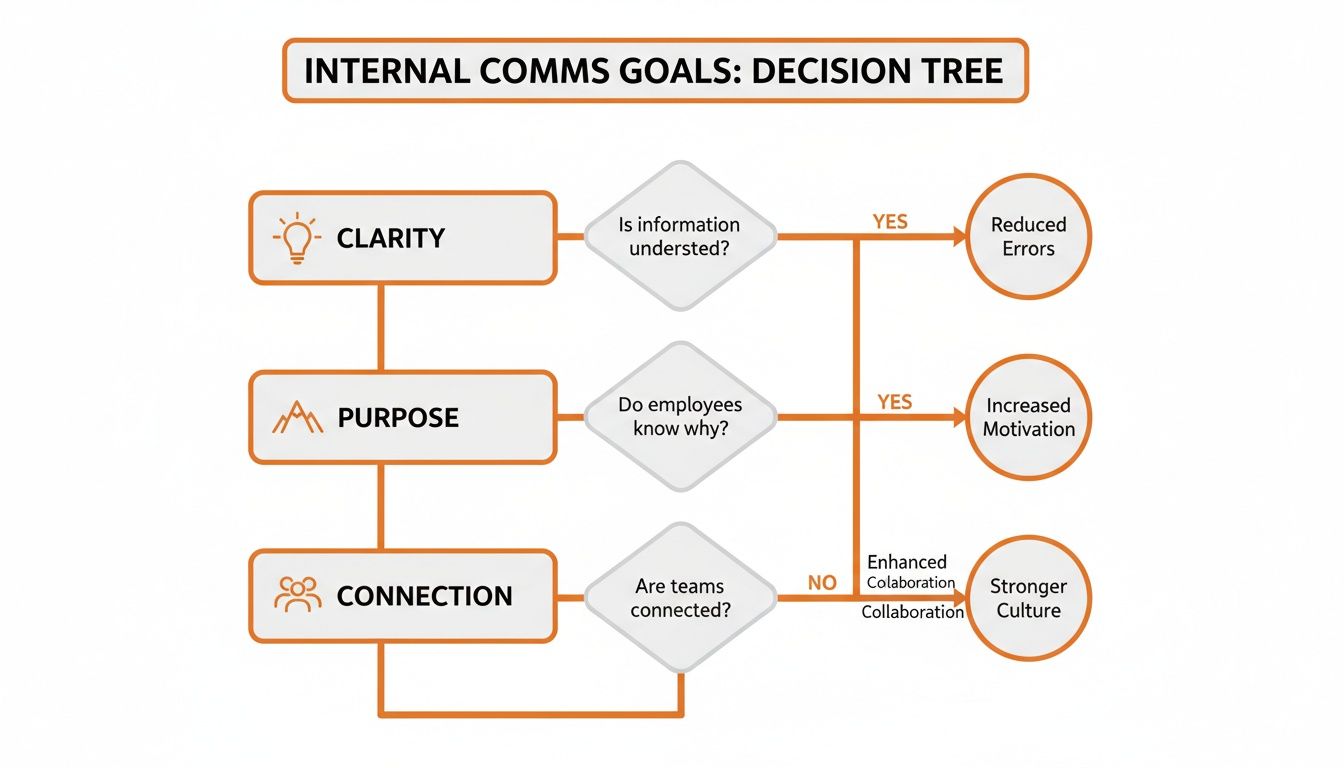
It’s a simple gut-check: every communication effort should make work clearer, more meaningful, or more collaborative.
From Channel Chaos to Channel Clarity
The magic happens when you establish clear channel governance. It’s just a fancy way of saying you need a game plan for what kind of information belongs where. It’s about creating a predictable environment where people know exactly where to go for what they need. No more guessing.
Governance isn’t about rigid rules. It’s about reducing the mental load for your team. When people don’t have to waste energy figuring out where to find information, they can spend that energy on work that actually matters.
This isn't a "nice-to-have." According to Gallup, a staggering 66% of the global workforce is struggling or suffering. This tough reality proves that effective internal communication is no longer optional—it's essential for keeping your business moving and your people engaged.
What Should Go Where? A Simple Framework
To prevent channel fatigue, it helps to create a simple guide for your teams. A few clear guidelines can eliminate most of the confusion.
Here’s how we think about it.
Choosing the Right Channel for Your Message
Message Type | Best Channel | Why It Works |
|---|---|---|
Urgent, Company-Wide Alert | Dedicated Employee App | Push notifications reach everyone instantly, especially frontline workers. |
Official Policy Update | Email & Intranet | Email creates a formal record; the intranet is the permanent home for it. |
Quick Team Question | Chat (Slack/Teams) | Perfect for fast, informal collaboration that doesn't need a formal trail. |
Celebrating a Team Win | Employee App / Chat | Public recognition in a social-style feed builds morale and culture. |
"How-To" Guides & Resources | Intranet/Hub | A central, searchable library for evergreen information. |
Having this kind of clarity is vital for the 80% of the workforce not sitting at a computer all day. For them, a streamlined, mobile-first approach isn't a luxury; it's the only way to stay connected.
To dive deeper into selecting the right platform, check out this guide on the best internal communications tools. A thoughtful approach turns your tools from a source of stress into a source of strength.
Connecting with Everyone, from a Desk to the Frontline
The biggest mistake I see in internal comms? Treating every employee like they’re the same. The day-to-day of a software developer is a completely different universe from that of a warehouse associate or a registered nurse. If your messages don't fit their world, they're just background noise.

Great communication starts with empathy. You have to understand the environment where your people receive information and adapt your approach to fit their reality—not force them to fit yours.
Reaching Your Desk-Based Teams
For folks at a computer all day, the problem isn’t a lack of information. It's a flood. They are swimming in emails and drowning in notifications. Your job isn’t to add another drop to the ocean; it’s to be the lighthouse.
Communication for this group has to be searchable and efficient. Think less about broadcasting at them and more about creating a reliable home for information they can pull from when they need it. A well-organized intranet for policies, or a dedicated channel for project updates that keeps critical conversations out of chaotic inboxes.
Your desk-based employees don't need another notification. They need a single source of truth—a calm, organized place to find what they need, get an answer, and get back to their work.
Success here is about clarity and saving them time.
Connecting with Your Frontline Workforce
Now, let's talk about the majority of the workforce—the people who aren't at a desk. For retail associates, manufacturing techs, and healthcare pros, the challenges are the opposite. They don't have a company laptop open all day.
Their access to information happens on a phone during a quick break or before a shift. This means your communication has to be mobile-first, asynchronous, and concise. Long, dense emails are useless here.
Imagine a nurse needing to check a new patient protocol. They need to find it on their phone in 30 seconds between appointments. Or a warehouse team that needs an update from leadership; a two-minute video they can watch on their time is far more effective than an announcement they can’t hear over machinery.
This is where a unified mobile platform becomes a game-changer. It gives you a direct, accessible line to your people that meets them where they are. To learn more, check out our guide on how to make communication work in companies with frontline employees.
This isn't about using different tools to be fancy. It’s about recognizing that a message only lands if it’s received and understood—and that requires respecting the unique reality of every single employee.
How to Know If Your Communication Is Actually Working
If you can’t measure it, you can’t improve it. We’ve all heard that one. But what should you actually be measuring? For years, the default was vanity metrics.
We’ve all seen the slide with a big, impressive number like a 75% open rate on the latest company email. It feels good. It looks like progress. But here’s the truth: an open rate doesn’t tell you if anyone understood the message, let alone cared about it.
It’s measuring outputs, not outcomes.
Moving Beyond Vanity Metrics
The real question isn't "Did they see it?" but "Did it change anything?" An output is the email you send. An outcome is the result you hope to achieve—a change in behavior, understanding, or belief.
It’s easy to track reads on a benefits announcement. What really matters? Measuring the actual increase in program enrollment after that announcement goes out. That’s the shift. It’s moving from "I think this is working" to "I know this is working, and here's why."
The goal isn't to prove you were busy. The goal is to prove you had an impact. Measuring outcomes is how you tell a clear, compelling story about the value of your work.
Combining Hard Data with Human Insight
So, how do you measure what truly matters? It’s a mix of quantitative data and old-fashioned qualitative insight. You need both.
Look at your analytics to see what gets the most engagement—what are people clicking on, commenting on, and sharing? Those are clues about what resonates.
But that’s only half the story. The other half comes from talking to people.
Pulse Surveys: Run short, simple surveys. "On a scale of 1 to 5, how clear are you on our company priorities for this quarter?" The answers will tell you more than a dozen open rates.
Real Conversations: Go sit with the frontline team for an hour. Ask a manager what questions their team is bringing them. The best feedback rarely comes from a dashboard; it comes from listening.
This blend of data and dialogue creates a powerful feedback loop. The numbers tell you what is happening; the conversations tell you why. This approach helps you fine-tune your strategy and prove its value. If you're looking for a deeper dive, our guide on how to measure the ROI of internal communication offers a framework for connecting your efforts to business results.
Ultimately, measurement isn’t about justifying your job. It’s about doing it better.
A Few Honest Questions
As people start to take internal communications seriously, a few questions always pop up. They're good questions—they cut right to the heart of how you make real change. Here are the straight answers we’ve learned from being in the trenches.
Who Is Responsible for Internal Communications?
The short answer? Everyone. But it absolutely needs a single owner.
That sounds like a contradiction, but it’s not. While every leader is a communicator, you need a person or a small team to own the overall strategy and manage the channels.
Think of them less as a corporate megaphone and more as the conductor of an orchestra. They aren’t playing every instrument, but they are making sure everyone plays from the same sheet music. Real success happens when managers feel equipped—and are expected—to be the primary communicators for their own teams.
How Can a Small Company Improve Comms Without a Big Budget?
This is less about your budget and more about your intention. You don’t need fancy software to make a massive difference. The most powerful tools you have are consistency and authenticity. Those don’t cost a dime.
Start simple:
Hold a real weekly all-hands meeting. Share wins, talk honestly about challenges, and be clear about priorities.
Create one central place for important info. Even a well-organized shared document is a thousand times better than digital chaos.
Listen more than you talk. The best tool you have is free: ask for feedback, and then actually do something with it.
Trust is built with these small, consistent actions, not with expensive platforms.
What Is the Single Biggest Mistake to Avoid?
The biggest mistake, hands down, is inconsistency. It’s the fastest way to destroy trust.
Saying you value transparency and then going silent during a tough quarter erodes credibility in an instant. Announcing a big new initiative and then never mentioning it again makes it feel like another "flavor of the month."
Communication isn't a campaign you run; it’s a rhythm you maintain. It's far better to communicate simply and consistently than to do something elaborate and sporadic.
Your team needs to rely on the flow of information, whether the news is good or bad. That predictability is the bedrock of a healthy culture.
Ready to build a calmer, more connected workplace? Pebb brings your people, work, and culture together in one simple app. See how it works.
