
Security Guard Shift Communication: A Practical Playbook
Transform your security guard shift communication with this practical playbook. Learn proven steps to improve handovers, reduce errors, and boost safety.
Dan Robin
The outgoing guard is halfway out the door. The incoming guard signs the logbook, takes the keys, and asks whether anything needs attention. “Nothing unusual,” comes the answer.
An hour later, the incoming guard finds that a side-door alarm has been unreliable, a contractor is still inside, and a camera has been offline since the previous shift. The logbook contains all three facts. Nobody directly handed them over.
That's the gap in security guard shift communication. A record can exist without understanding. A signature can prove presence without proving that the next guard knows what changed, what remains open, and who owns the next action.
The Hidden Cost of a Bad Handover
A bad handover rarely looks dramatic at first. One guard closes the book, points to a few pages, and leaves. The next guard scans yesterday's entries while answering a radio call and preparing for the first patrol. The information is technically available, but the responsibility for finding meaning has been pushed onto someone working under time pressure.
That's how small details travel badly. A damaged camera becomes an unreported blind spot. A resident's changed routine looks like an unexplained access attempt. A contractor who should have been escorted becomes someone the incoming guard assumes another officer has already cleared.
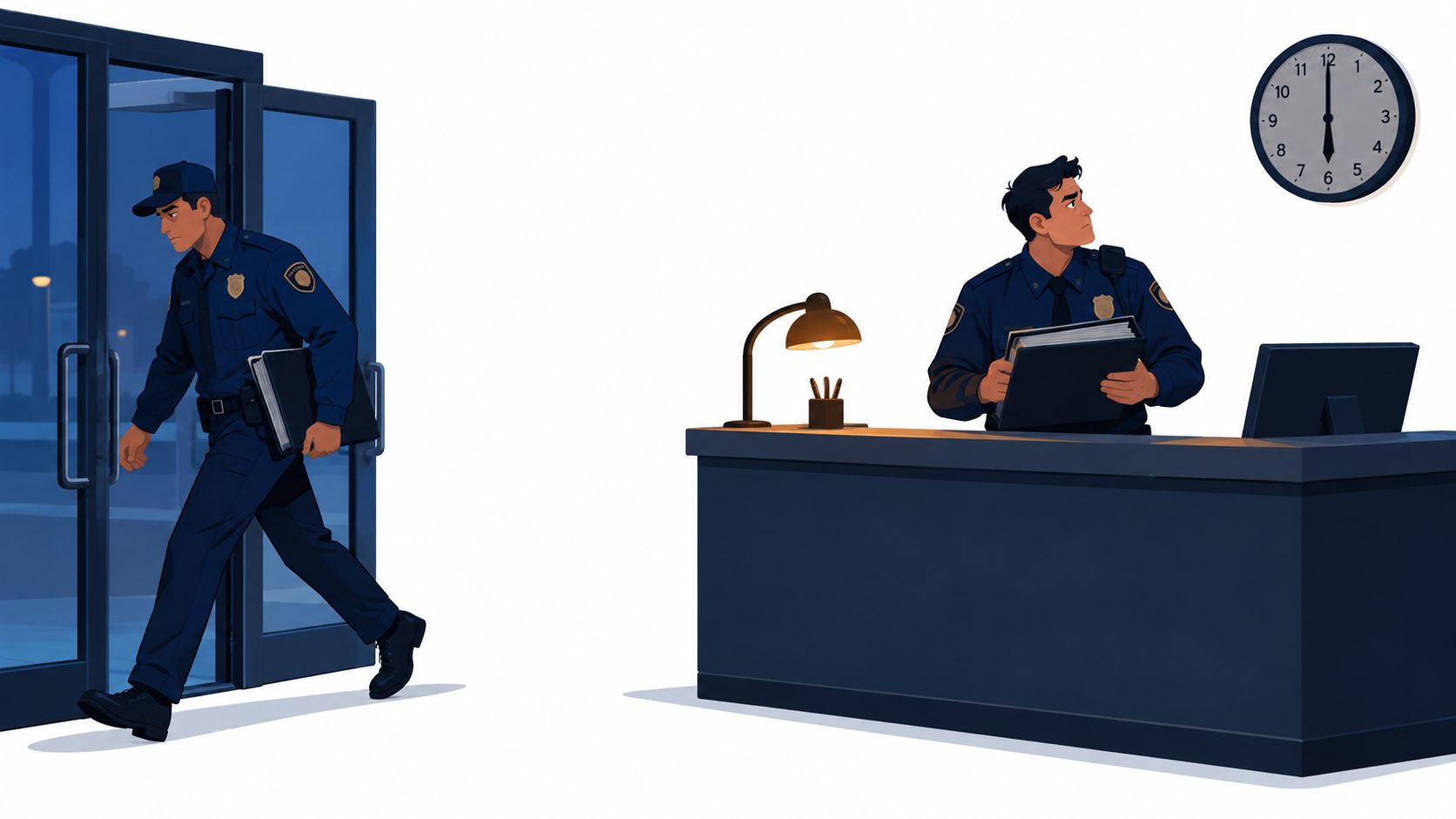
The fix isn't a thicker notebook or a louder radio. It's a change in what we consider complete. A handover isn't complete because the outgoing guard wrote something down or because both officers signed a form. It's complete when the incoming guard can explain the current situation and identify the next action.
A signed handover proves that a meeting happened. A read-back shows that information landed.
This principle applies beyond security. Teams working across routes, sites, and changing crews can find useful ideas in guidance on improving team communication in logistics, especially around clear ownership and reliable transfer points. The setting differs, but the operational problem is familiar.
Good security guard shift communication creates a confirmed checkpoint between shifts. The outgoing officer says what changed. The incoming officer asks about gaps, repeats the important points, and accepts control of open items. The written log preserves the detail, but the live exchange gives that detail meaning.
Why Paper Trails Alone Fail in Security
Paper is good at preserving information. It's poor at proving that another person understood it.
A foundational shift-handover study found that participants retained far less task-critical information in a paper-only condition than in conditions that included direct verbal exchange. The result matters because it isolates the communication step itself. The problem wasn't solely whether notes existed. The problem was whether people actively transferred and received the information. The NASA handover study provides the underlying research.
A controlled handover study reached a similar practical conclusion. Face-to-face verbal updates, video, and audio recordings reduced task errors significantly compared with written communication alone. For a security team, that makes the operating model straightforward: hold a short live briefing, ask for a read-back, then keep the written report as supporting evidence. The NASA technical report on shift handover explains the comparison between communication channels.
What the logbook can't do
A logbook can't ask whether the incoming guard has the master key. It can't notice hesitation when someone reads “monitor side entrance” without knowing why. It can't clarify whether “follow up with maintenance” means call now, call later, or wait for a scheduled visit.
Written notes also flatten urgency. A failed light, an unresolved access exception, and a routine delivery may occupy similar lines on the same page. The outgoing guard knows the difference because they lived through the shift. The incoming guard doesn't, unless someone explains it.
That's why documentation should support communication rather than replace it. The log gives the team a durable record. The briefing supplies context, priority, and ownership.
Make the live exchange short and deliberate
A useful handover doesn't need a speech. It needs a fixed order and active participation.
Start with the current site status. Cover incidents, unusual activity, equipment problems, access exceptions, visitors or contractors still expected, and anything that needs escalation. Then identify open actions and name the person or role responsible for each one. The incoming guard repeats the critical points and asks questions before taking control.
The discipline resembles good staff administration for HR teams, where accurate records matter but records still need clear ownership and review. Security teams face a more immediate operational risk, but the lesson is the same: filing information isn't the same as transferring responsibility.
Auditing Your Current Handover Process
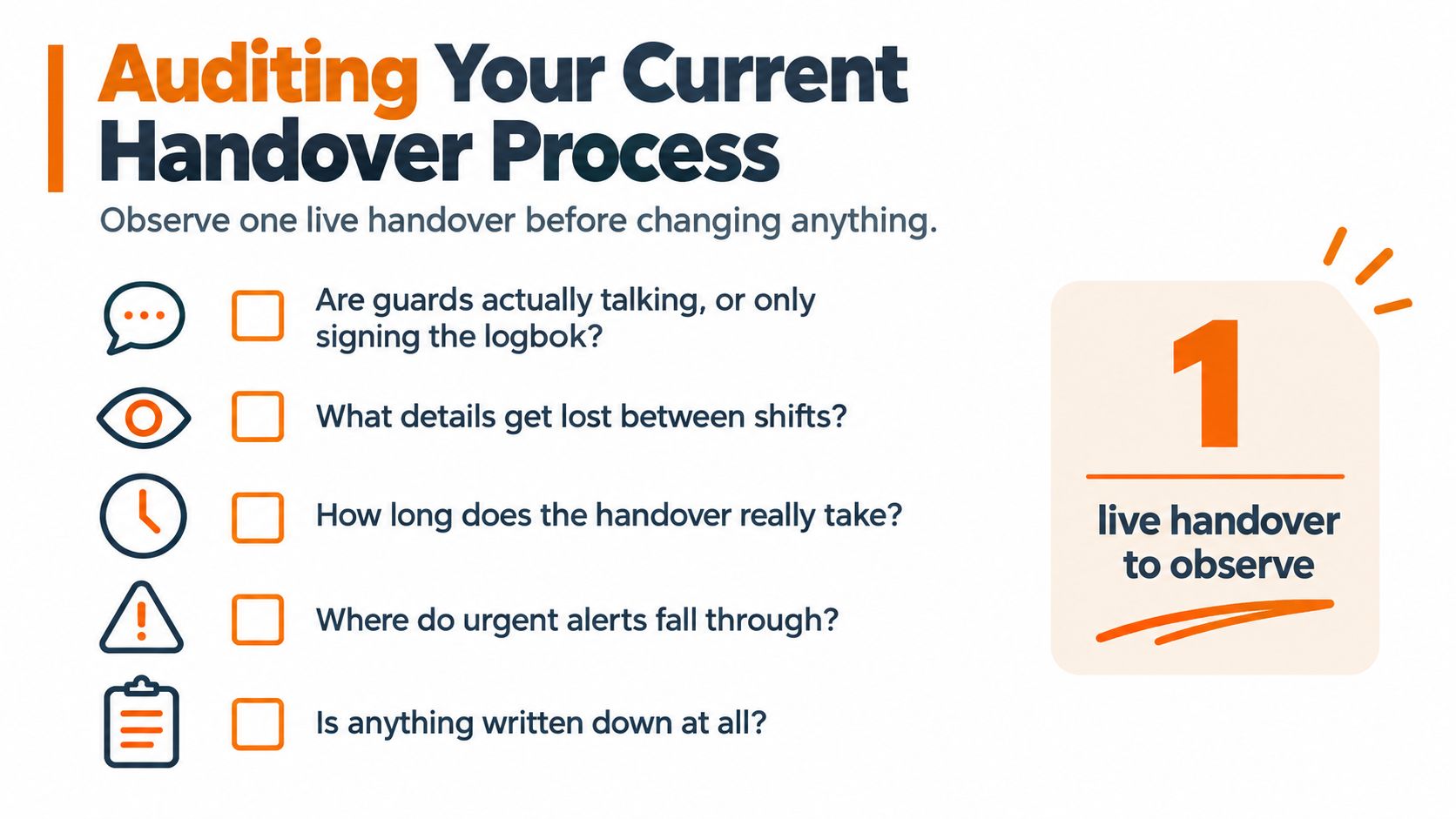
Before changing forms, buying software, or rewriting post orders, watch one real handover. Don't rely on what the procedure says should happen. Stand nearby and observe what officers do.
Look for the first uncomfortable truth. Are the guards talking through the shift, or are they signing the book and leaving? Does the incoming officer ask questions? Does the outgoing officer explain why an item matters, or only point at a page? A quiet observer will usually learn more in one live transition than from a stack of completed reports.
Watch the clock and the coverage
A strong handover window is often 15 to 30 minutes, giving both guards time to brief each other, walk the site when needed, and transfer keys, radios, pass-on logs, and special equipment without creating a coverage gap. Security patrol log guidance describes this overlap as a practical way to prevent small misses from carrying into the next shift.
Measure the actual overlap, not the scheduled overlap. A roster might allow enough time, while late arrivals or early departures remove it in practice. Note whether the outgoing guard is still dealing with visitors, report writing, or an incident when the replacement arrives. A handover performed while one officer is distracted isn't a reliable handover.
The physical patrol matters too. One university security procedure manual requires the incoming guard to arrive at least 15 minutes early, limits duty to 12 hours, and requires both guards to patrol the premises during the transition. It also requires inspection of the last 12 hours of Occurrence Book entries and a signed record of who handed over to whom. The university security procedure manual shows how seriously a formal handoff can be treated.
Ask five blunt questions
Use the observation to find information leaks, not to grade individual personalities.
Conversation: Are officers exchanging current facts, or only completing signatures?
Loss: Which details appear in the written record but never enter the verbal briefing?
Timing: Does the overlap allow a proper briefing and equipment transfer?
Escalation: Who receives urgent changes when the outgoing guard leaves?
Environment: Is there a quiet place where both officers can concentrate?
Write down what happens without correcting it during the observation. If the outgoing guard is rushing, record that. If the incoming guard never sees the open incident list, record that too. You need the actual process before you can design a better one.
Building Standard Operating Procedures for Shifts
A useful SOP makes the safe action easier than the careless one. It tells guards what to cover, in what order, and how to show that the incoming officer has taken control.
A later shift-handover experiment found that more thorough protocols passed more information, with the biggest gains appearing when handover checklists included 12 or more items. The shift-handover experiment supports the use of detailed, standardized reports rather than relying on memory at the end of a tiring shift.
That doesn't mean every site should copy the same checklist. A warehouse, a residential complex, and a hospital have different risks. The structure should stay consistent while the content follows the post orders.
Put the topics in a fixed order
Start with the operating picture, then move toward exceptions and ownership. A practical sequence might include:
Current patrol and access status.
Incidents, alarms, and unusual activity.
Equipment faults, damaged areas, and camera or lighting concerns.
Visitors, contractors, deliveries, and expected movements.
Keys, radios, access cards, and other controlled items.
Outstanding instructions from supervisors or the client.
Open actions, deadlines, and escalation ownership.
Questions from the incoming guard.
Read-back of critical information.
Sign-off in the written record.
Adapt the checklist to the site. Don't add items merely to make the form look complete. The later experiment supports a thorough protocol, but thoroughness only helps when each item prompts useful information.
The SOP should also say who owns escalation. “Supervisor informed” is weaker than “incoming guard calls the duty supervisor and records the response.” Ambiguous ownership is where open issues disappear.
Make proof part of the procedure
Write the read-back into the form and the briefing script. The incoming guard should repeat the items that could change coverage, access decisions, emergency response, or client expectations. If anything is unclear, the handover remains open until the question is resolved or assigned.
Operational guidance recommends clear language, face-to-face delivery, a fixed topic order, read-back, clarification of control, and protection from interruptions. Handover review guidance also emphasizes questions from both outgoing and incoming staff and keeping the information order consistent.
For teams writing or revising procedures, this practical guide on how to write a standard operating procedure can help with the document design. For mobile teams, a digital forms workflow for deskless teams can make required fields, acknowledgements, and attachments easier to complete at the post.
Choosing and Championing Mobile-First Channels
A digital channel is useful only when it improves the handoff people perform. Moving a bad process from paper to a phone does not fix it. It creates a faster way to record incomplete information.
The right channel supports three different needs. Guards need a live way to raise changes, a structured passdown for shift context, and a durable record that the next person can search. Those needs don't always belong in the same message thread, but they should remain connected enough that an incoming officer doesn't have to reconstruct the story from scattered texts and screenshots.
Recent operational guidance points toward digital passdown logs and mobile-first scheduling and alerting as a way to reduce repeated explanations, outdated screenshots, and confusion from manual coordination. The benefit isn't novelty. It's continuity. A guard arriving at a site should see the current shift, the active instructions, the open items, and the relevant files in one controlled place.
Choose channels by urgency
Use the channel that matches the risk.
Information | Best working channel | Required follow-through |
|---|---|---|
Immediate danger or urgent incident | Radio or live call, according to post orders | Verbal confirmation and escalation record |
Shift-wide operational change | Mobile alert or team update | Acknowledgement from affected staff |
Routine passdown | Structured digital log | Read-back during handover |
Reference material | Controlled file or knowledge area | Confirm the current version |
Open task | Assigned task with an owner | Status update and closure note |
A platform such as Pebb can combine shift scheduling, team chat, updates, tasks, file sharing, and dedicated Spaces on web and mobile. That can give a security team one place for passdown notes, forms, schedules, and supporting documents, while the site's post orders still define what guards must do.

The tool should also make the next action obvious. A guard who receives an alert about a faulty access point should know whether to acknowledge it, inspect it, notify a supervisor, or only monitor it. A security guard employee app can support that mobile workflow, but the team still needs clear rules for urgent communication and radio use.
Don't make mobile software the only emergency route. Phones lose signal, batteries die, and not every alert deserves the same response. Keep live channels, written records, and face-to-face confirmation working together.
Training Staff for Verification and Read-Backs
Guards can usually read a checklist. The failure is that nobody has made comprehension a visible part of the job.
Train guards to finish a handover with a short confirmation in their own words. “I have the master key. The side-door alarm is faulty. The contractor remains on site until the supervisor clears them.” That sentence does more than a signature. It shows that the incoming guard heard the important facts and knows what needs attention.
A text, call, email, or informal note can deliver an update without proving that the recipient understood it. Security teams regularly face the same practical failure: a guard misses a last-minute change, arrives at the wrong site, or inherits an incomplete incident history. Structured briefing, written logs, cross-checking, and explicit confirmation close that gap.
Practice the uncomfortable moments
Role-play the handovers people usually rush.
Give the incoming guard a busy station, a damaged camera, a missing key, and an unresolved access exception. Have the outgoing guard deliver the information while interruptions occur. Then stop and ask the incoming guard to explain the current status, the risks, and the next actions.
The exercise reveals whether the team understands read-back as a safety check or treats it as a ceremonial phrase. Correct vague confirmations. “Understood” is not enough when the message contains several actions. Ask for the specific facts that matter.
Night shifts need extra discipline. Guidance on night-shift security work describes weaker supervision, slower escalation, fatigue, and confusion created by fragmented messaging. The discussion of night-shift problems in the security industry also points toward digital passdown logs and mobile alerts as ways to reduce repeated explanations and outdated information.
Design for low attention
Don't depend on a tired guard remembering to check five separate places. Put the handover, acknowledgement, and open actions where the shift already happens. Use visible acknowledgement states for critical updates, and escalate items that remain unconfirmed.
A simple workflow might look like this:
The supervisor posts a schedule or site change.
The affected guard acknowledges it.
The guard repeats the change during the next live handover.
The supervisor sees whether the handoff is complete.
The open item remains visible until someone closes it.
Engagement data can show whether people opened a message or acknowledged a task, but it can't replace the read-back. Use a team chat workflow to support the exchange, not to pretend that a reaction icon proves comprehension.
Measuring Engagement and Incident Response
Attendance is a weak measure of communication. A guard can attend a briefing, sign a form, and still leave without understanding the open risks.
Measure the points where information should become action. Did the incoming guard acknowledge the shift update? Were open items assigned to a named person? Did the supervisor receive confirmation? When an incident was reported, could the team trace who knew about it and when the next action started?
Mobile tools can provide engagement and activity visibility, but leaders should connect those signals to operational outcomes rather than celebrate activity for its own sake. A busy chat isn't automatically a useful one. A completed form isn't proof that the site was understood.
Track the handoff, not just the paperwork
Create a small review set for each site:
Acknowledgement: Which critical updates received confirmation?
Read-back: Did the incoming guard repeat the key risks and actions?
Ownership: Does every open item have a responsible person?
Response: How long did it take to move from report to action?
Closure: Was the outcome recorded clearly enough for the next shift?
You can compare these records with incident response times and repeat issues. If the same access problem appears in several handovers, the team has a process or maintenance problem, not merely a documentation problem. If updates are posted but remain unacknowledged, the channel or escalation rule needs attention.
Review failures without blaming people
When an incident exposes a weak handover, ask where the process allowed uncertainty to survive. Was the overlap too short? Did the outgoing guard have a quiet place to brief the replacement? Did the checklist force a discussion of the issue? Could the incoming guard see the current information on a mobile device? Did anyone verify comprehension?
That review should produce a concrete change, such as a new checklist item, a clearer escalation owner, or a different alert rule. Don't respond by adding another box to a form unless the box will change behavior.
The goal is simple. Every shift should begin with a guard who knows the current situation, the unresolved risks, and the next action. When security guard shift communication makes that understanding visible, the handover stops being a ritual and becomes an operational control.
Pebb gives security teams a mobile place to manage shifts, chat, passdown notes, tasks, files, and acknowledgements without scattering information across separate tools. Visit Pebb to see whether its shared Spaces and frontline communication features fit your handover process.
