
How to Schedule People Without Losing Your Mind
A scheduling app for employees that goes beyond calendars—boost trust, communication, and sanity in your workweek. See how it helps your team.
Dan Robin
We’ve all seen it. The smudged whiteboard. The chaotic spreadsheet. The frantic group texts pinging late on a Sunday night. For years, we’ve treated employee scheduling like a messy puzzle we just have to endure.
But let’s be honest. That chaos isn't just an administrative headache. It’s a quiet culture killer. It tells your team their time isn’t respected and that their lives outside of work are an afterthought. Switching to a proper scheduling app for employees isn’t about chasing new tech; it’s about choosing sanity over stress. It’s about being kinder to your team, and to yourself.
The Real Cost of a Messy Schedule
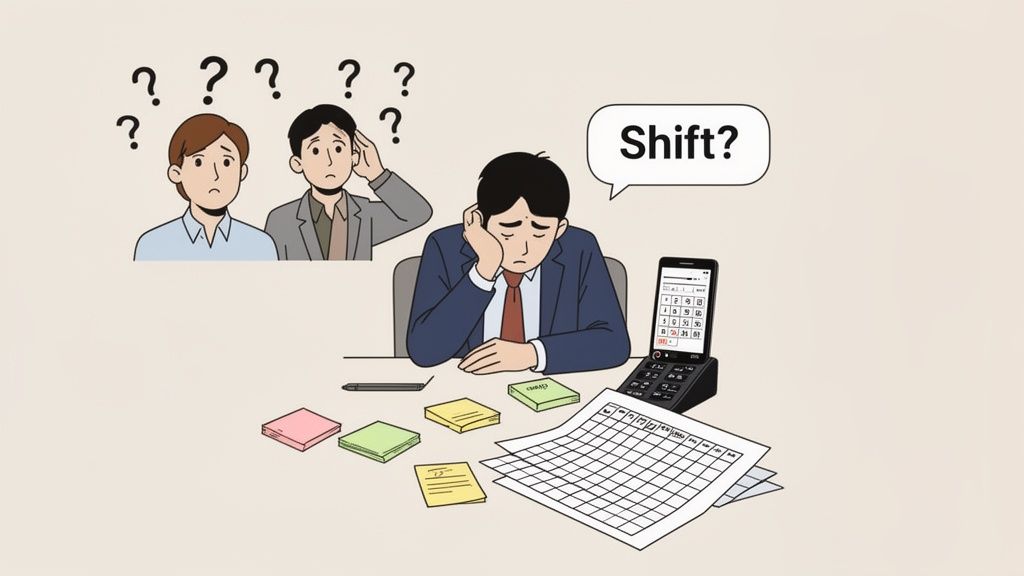
Most managers know the feeling. Staring at a grid, trying to piece together a schedule that respects everyone's availability, time-off requests, and the company budget. It’s a thankless, frustrating game of Tetris.
Meanwhile, your employee wakes up to a string of confusing texts. Are they covering a shift? Is the schedule they screenshotted last week still correct? This constant uncertainty is draining. It chips away at trust and creates a low-level anxiety that people carry with them long after they clock out.
The Price of Confusion
This mess costs you. You won’t see it on a P&L statement, but it’s there, hidden in the small frustrations that pile up week after week.
It’s the hours a manager spends wrestling with a spreadsheet instead of coaching their team. It’s the dip in morale when schedules feel arbitrary and unfair. And it’s the good people who leave because they’re tired of the chaos. A 2024 study by RoostedHR found that a lack of control over their schedule is a huge driver of burnout and turnover.
Here’s the thing: a broken scheduling process creates constant friction. It’s the background noise of miscommunication, the last-minute scramble to cover a shift, and the nagging feeling that you’re always one call-out away from a meltdown.
It’s a Human Problem, Not a Spreadsheet Problem
The real damage is human. It’s the employee who missed a family dinner because their time-off request got lost on a sticky note. It’s the manager who feels more like a switchboard operator than a leader. This chaos bleeds into people’s lives, and we've written before about how poor time management impacts employee well-being.
This isn't about blame. It’s about recognizing that the old tools—the spreadsheets, group chats, and wall calendars—have hit their limit. They were fine for a different time. But for today's workforce, we need something clearer, calmer, and more human.
Your Schedule Is Your Culture
We've seen it a thousand times. A company spends a fortune on a beautiful office, stocks the kitchen with fancy coffee, and hangs an inspiring mission statement on the wall. But the team still feels stressed and disorganized. Why?
Because your company’s real culture isn't in a handbook. It's in the weekly schedule.
Let’s be honest. The schedule is the nervous system of your operation. It’s more than a grid of names and times; it's a promise. It’s where values like fairness, respect, and clear communication are either proven or exposed as empty words.
When schedules are a mess, you're sending a message: your team's time doesn't matter. When asking for a day off is a battle, you’re telling them you don't trust them. The schedule is where the rubber meets the road.
From Logistics to Connection
For too long, we’ve treated scheduling as a purely logistical chore. A puzzle to solve. But a modern scheduling app for employees flips that idea on its head. It’s not just a tool to make things run smoothly; it’s a way to build a healthier, more connected team.
Think about it. When your team can pull up their schedule on their phone, they feel a sense of stability. That predictability is the foundation of a low-stress workplace. They can actually plan their lives.
When they can request a shift swap with a coworker in a few taps, it builds a culture of mutual support. You’re helping them solve their own problems, showing you see them as responsible adults. These small, positive interactions are the real building blocks of a strong team.
A schedule isn’t just about who works when. It’s a reflection of how you communicate, how you show fairness, and how much you trust your people. It’s the most honest expression of your culture.
Clarity Beats Everything
At its core, nearly every scheduling headache is a communication breakdown. Someone didn’t get the memo. A request got buried. A change wasn’t clearly confirmed.
A good scheduling app pulls these crucial conversations out of messy group texts and into one organized place. It creates a clear record of requests, approvals, and changes. No more "he said, she said."
This clarity does more than prevent mix-ups. It creates an environment where everyone feels seen and heard. It turns the process from a top-down chore into a collaborative conversation. And this is vital because, as we've said before, your internal communications is your culture in its rawest form.
A well-managed schedule becomes a source of stability. It’s the quiet, consistent proof that you respect their lives outside of work. That’s a culture worth building, and it starts with how you plan the week.
The Only Features That Really Matter in a Scheduling App
If you’ve ever looked for a scheduling app, you know the drill. The feature lists are a mile long, promising everything from AI predictions to fancy color-coding. It's a parade of bells and whistles.
But let’s cut through the noise. In our experience, what makes a real difference isn’t having a hundred settings. It's about doing a few core things exceptionally well. You’re looking for a simple tool that removes complexity, not one that adds more.
It Has to Be Mobile-First
Let’s be real: your team lives on their phones. Any scheduling tool that isn’t designed for a mobile screen first is already obsolete.
Expecting a bartender, a retail associate, or a field tech to log into a clunky website to check their hours is just adding friction to their day. A great app should feel effortless. See shifts, ask for time off, swap with a coworker—all in a few taps, wherever they are.
Real-Time Updates Are a Form of Respect
No one should ever have to wonder if their schedule has changed. That feeling of uncertainty, of having to text a manager just to confirm, is a completely avoidable stress.
A scheduling tool’s most basic promise is to be the single source of truth. When a shift is updated, everyone involved should get an instant, clear notification. This isn't just about efficiency; it’s a fundamental sign of respect for your team’s time. It replaces confusion with clarity.
This is a core belief we built into our own tools. You can read more about the thinking behind Pebb’s new calendar feature.
Work Doesn’t Happen in a Silo
A schedule is rarely just a schedule. It’s tied to conversations, announcements, and payroll. This is where so many standalone scheduling apps miss the point. They treat scheduling like an island, forcing you to hop between different tools just to get things done.
A shift change needs a quick chat. A new schedule might need a team-wide announcement. Why should these live in separate apps? The ability to connect with your other systems, often called SaaS integration for business automation, is key to making work feel seamless.
The best tools understand that scheduling is just one piece of a bigger puzzle. It should live right alongside your team chat and company updates. When everything is in one place, work just flows.
The demand for this kind of unified platform is growing fast. The employee scheduling software market was valued at $481.5 million in 2023 and is projected to hit $1.2 billion by 2032. This growth shows a clear shift away from scattered spreadsheets toward tools that bring work together.
The Real Job of a Scheduling App
When you boil it down, a scheduling app has one job: make life simpler for both managers and employees. It should save managers from hours of administrative work and give employees the clarity they need to plan their lives.
This simple diagram shows how a schedule connects to the deeper, cultural parts of your business.
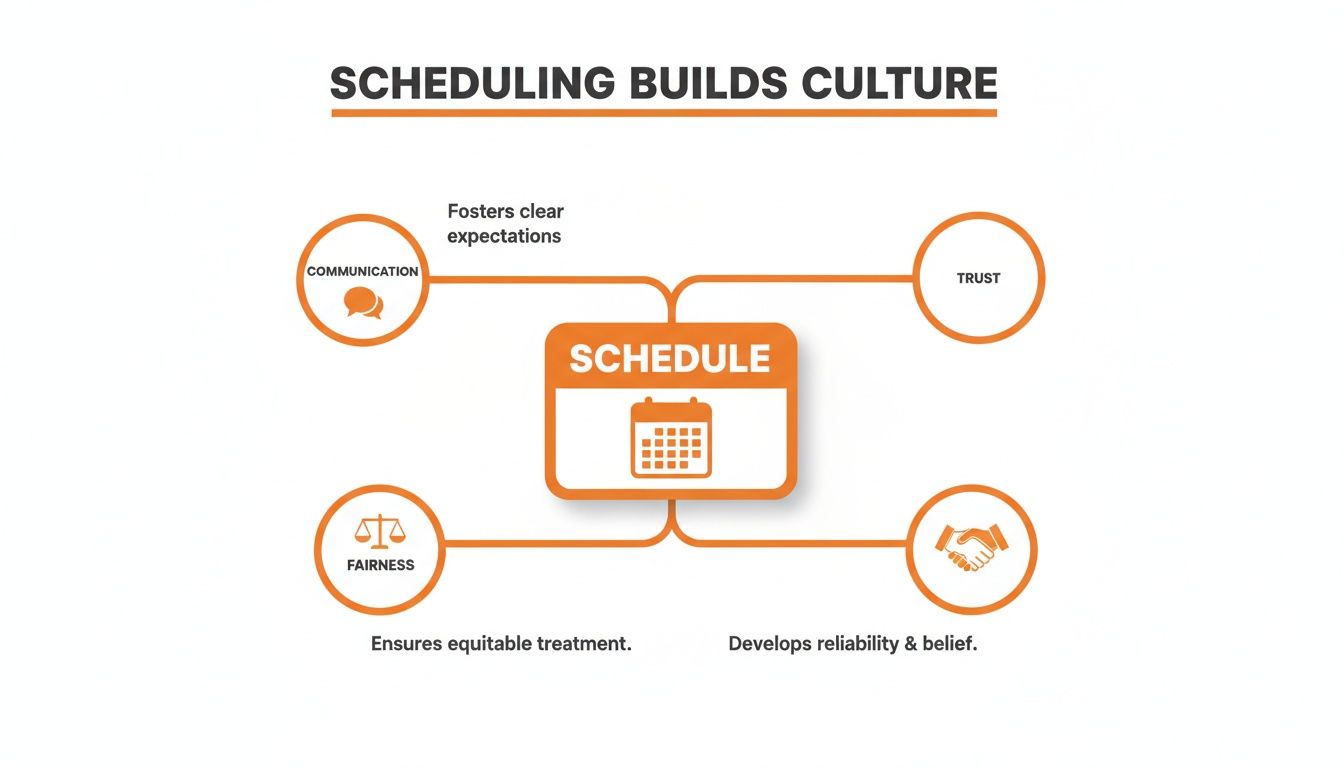
As you can see, a schedule is never just a grid. It's a tool that builds trust, fairness, and communication.
So as you look at your options, don’t get lost in endless feature lists. Ask a simpler question: will this bring calm and clarity to my team? If the answer is yes, you’re on the right track.
The Surprising Benefits of a Calm Schedule
When you finally ditch the spreadsheets for a proper scheduling tool, the first thing you feel is relief. You get back hours you used to spend wrestling with a grid. But that’s just the start. It’s what happens next that really changes things.
Something powerful happens when scheduling stops being chaotic and becomes predictable. You start to see surprising benefits ripple through your entire business.
It's About More Than Saving Time
Let’s be honest, most people make the switch to stop the pain. You want to stop spending your evenings piecing together a puzzle that never quite fits. But a great scheduling app for employees is more than a time-saver. It's a culture-builder in disguise.
It starts with small things. An employee requests time off with a tap, and a manager approves it just as easily. A shift swap that used to create a dozen frantic texts now gets handled quietly inside the app. Each of these frictionless moments adds up.
You’re not just managing a schedule; you’re creating an environment where people feel respected, heard, and in control. These aren't 'soft' benefits—they have a direct impact on your bottom line.
A respected team is a productive team. When your people feel they have a voice and some say in their work-life balance, they’re more engaged and far more likely to stick around.
Reducing Turnover and Building Trust
High turnover is one of the most expensive problems a business can face. The cost to recruit, hire, and train someone new is staggering. And while many things make people leave, a chaotic schedule is consistently near the top of the list.
A modern scheduling tool tackles this head-on. It provides the stability people crave. When employees know their schedule is fair and they have some input, they feel secure. That stability can turn a job from a temporary gig into a place they can see themselves long-term.
This is how a simple tool transforms your culture. By giving employees more control—to see their hours, swap shifts, and plan their lives—you build a foundation of autonomy. You’re showing you trust them, and what you get back is their loyalty.
Automating Compliance and Cutting Risk
Let’s talk about what keeps managers up at night: labor law compliance. Navigating the rules around breaks, overtime, and time between shifts can feel like walking through a minefield. One mistake can lead to hefty fines.
This is another area where a scheduling app becomes an unsung hero. Many modern tools have compliance rules built right in. They can automatically flag a shift that would push someone into overtime or schedule them without the legally required rest period.
This automated safety net takes compliance from a stressful, manual checklist and makes it a seamless part of your workflow. It's peace of mind in software form. There’s a reason this market is growing so fast. Appointment scheduling software, which has evolved into these broader platforms, hit a global market value of $470.7 million in 2024 and is projected to reach $1,518.4 million by 2032. The results are real, as detailed in this market growth analysis. For example, healthcare adoption cut administrative costs by 20% and reduced no-shows by 15%.
The benefits are clear. You protect your business from risk while ensuring your team is treated fairly. A win-win. When the basics are handled this easily, you’re free to focus on what matters: running your business and taking care of your people.
How to Get Your Team on Board (Without the Groans)
Introducing a new tool can feel like assigning extra homework. You announce it, and you’re met with polite nods and a collective, silent groan. We’ve all been there.
The secret is to stop thinking of it as a mandate and start framing it as a gift. The goal is genuine adoption, not forced compliance.
Here’s the thing: when a tool actually solves real problems for the people using it, you don’t have to strong-arm them. They’ll start using it because it makes their lives better.
Start with Simplicity
The rollout begins long before you send the first invitation. It starts with choosing a tool that’s genuinely easy to use.
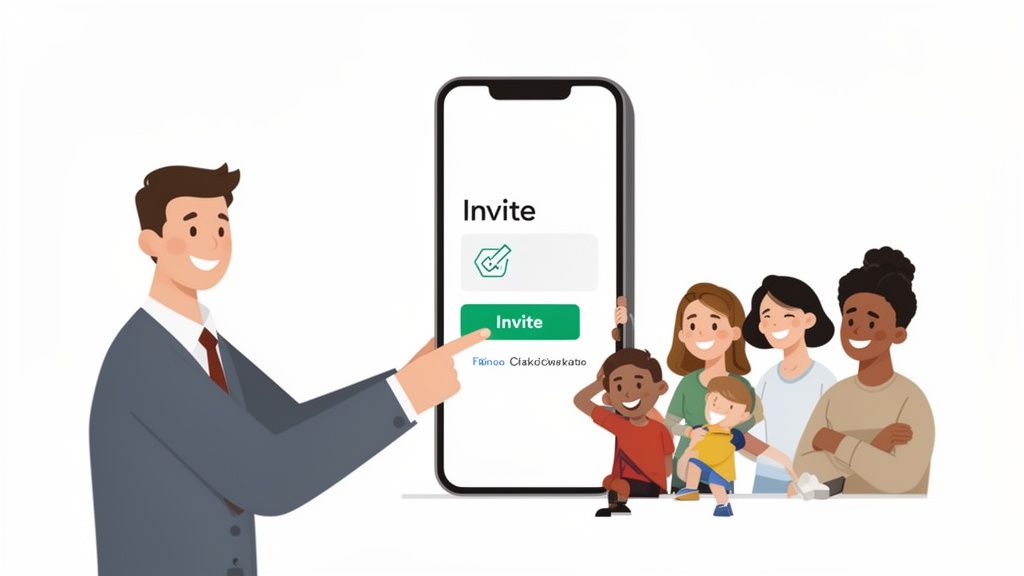
Look for a scheduling app for employees where you can invite the whole team with a single link. No clunky spreadsheets to upload, no painful setup. If the first step is simple, you’ve already won half the battle.
The employee scheduling software market, which hit $0.48 billion in 2024, is projected to soar to $1.36 billion by 2033. This boom is happening because businesses are finally ditching complex tools for simple ones that sidestep onboarding headaches.
Adoption isn't about top-down enforcement. It's about finding a tool so useful your team naturally embraces it. The best software sells itself by solving everyday frustrations.
Understanding how to do prototyping internal mobile tools effectively is a huge advantage here. When a tool is designed with real user needs from the start, it feels less like a new system and more like a helpful partner.
A Calm Rollout
Once you've picked a simple tool, the rollout should feel just as calm. Forget the big, formal launch. Try a more human approach.
First, start with a small group. Find a few people on your team who are open to new tech. Get them set up and let them become your champions. Their genuine enthusiasm is more convincing than any memo.
Second, solve their specific problems. Don't just list features; show them how the tool fixes their headaches. "Now you can see your exact hours on your phone," or "Getting a shift covered is as easy as sending a message."
Finally, lead by example. Managers must be the most active users from day one. Post the schedule only in the app. Handle all time-off requests there. When the tool becomes the single source of truth, people will follow.
This isn’t about tricking people into using new software. It’s about respecting their time by giving them something that genuinely makes work easier. When the tool itself is the reward, the groans disappear.
Frequently Asked Questions
We've helped thousands of teams leave the chaos of spreadsheets behind. Over the years, we've noticed the same questions come up again and again. Here are some honest answers.
My team is used to spreadsheets. How hard is the switch?
It's easier than you think, but only if you pick the right kind of app. Let's be real: people resist new tools because they’ve been burned by clunky software that felt like a chore.
When an app is intuitive and designed for a phone, the transition is surprisingly painless. The trick is to show your team how it solves their problems, not just create another task for them.
Show them they can now see their up-to-the-minute schedule anytime, request time off with a tap, or sort out a shift swap without a dozen texts. People adapt quickly when the benefits are immediate and personal. The goal isn't just to switch tools; it's to make their lives easier.
How does a scheduling app help with labor costs?
This is one of the biggest, most underrated benefits. A good scheduling app gives you a clear, real-time view of your staffing and projected labor costs for the week.
You can set up rules to prevent accidental overtime, which is a massive budget-saver. The app can flag a shift that would push an employee over their hours before you even publish the schedule.
It also helps with compliance. Many apps track local labor laws for things like mandatory breaks or minimum time between shifts. This creates a reliable digital trail that can shield your business from fines and legal headaches. It turns compliance from a manual, error-prone checklist into an automated part of your workflow. That’s peace of mind.
A scheduling tool doesn't just organize time; it protects your bottom line. It quietly prevents costly mistakes before they happen.
Why combine scheduling and communication in one app?
Because work doesn't happen in neat little boxes. Scheduling and communication are two sides of the same coin.
Think about it: when a shift changes, a conversation has to happen. When someone calls in sick, the team needs to coordinate to find cover. Using separate apps creates a huge disconnect. The schedule is in one place, but the urgent discussion is lost in a chaotic group text. It's inefficient and stressful.
When your scheduling app for employees is also your team's communication hub, everything just clicks. A shift swap can be discussed, agreed upon, and approved all in the same place. It creates a single source of truth that cuts down on confusion and makes everyone's job simpler.
Is a standalone scheduling app enough?
For a tiny team, a single-purpose app might feel like enough at first. But you'll quickly find yourself juggling a collection of tools—one for schedules, another for chat, another for documents.
This fragmentation is the enemy of productivity. It forces your team to jump between apps, trying to piece together information. It’s digital clutter.
An all-in-one platform brings everything into a single digital home. Your schedule sits right alongside your team chat, company announcements, and training guides. This creates a seamless experience where employees know exactly where to go for everything they need.
It’s not just about convenience. It’s about building a more connected culture where information flows freely and everyone feels like they’re truly part of the team.
Ready to bring calm and clarity to your team's schedule? With Pebb, you can create your company’s digital home in minutes—no complex setup required. Invite your entire team with a single link and see how easy work can be when everything is in one place. Start your free trial today.
