
Pricing Flexibility: A Practical Guide for SaaS
Learn how pricing flexibility boosts retention and wins customers. Explore strategies, models, and tools for dynamic SaaS pricing.
Dan Robin

Most advice about pricing flexibility starts from the wrong place. It treats agility like a virtue in itself, as if the answer to every pricing problem is to change faster, segment harder, and add more options. That sounds smart until you've lived through the fallout, a sales team making exceptions by instinct, customers comparing notes, finance trying to forecast a moving target, and trust leaking out of the relationship one awkward invoice at a time.
Pricing flexibility is not just the ability to move prices around. It's the ability to adjust what you charge based on real conditions, while still keeping the system coherent enough that customers believe you're being fair. In practice, that means flexibility only works when it's paired with rules, approvals, and enough discipline to stop every rep from becoming their own pricing department.
There's a reason this matters more now. The Bureau of Labor Statistics found that during the post-pandemic inflation surge, firms changed prices more often, then less often as inflation eased, and the average size of price changes increased while the absolute size changed little. The point isn't that prices moved wildly, it's that the cadence changed, and pricing behavior became unusually flexible during the 2020 to 2022 inflation spike, with standard menu-cost models fitting that period worse than the high-inflation 1980s (BLS research summary). That's the key lesson for SaaS, workplace tools, and every buyer trying to keep control of spend. Flexibility moves with the market, but trust doesn't rebuild itself once you've spent it.
Why More Pricing Flexibility Is Not Always Better
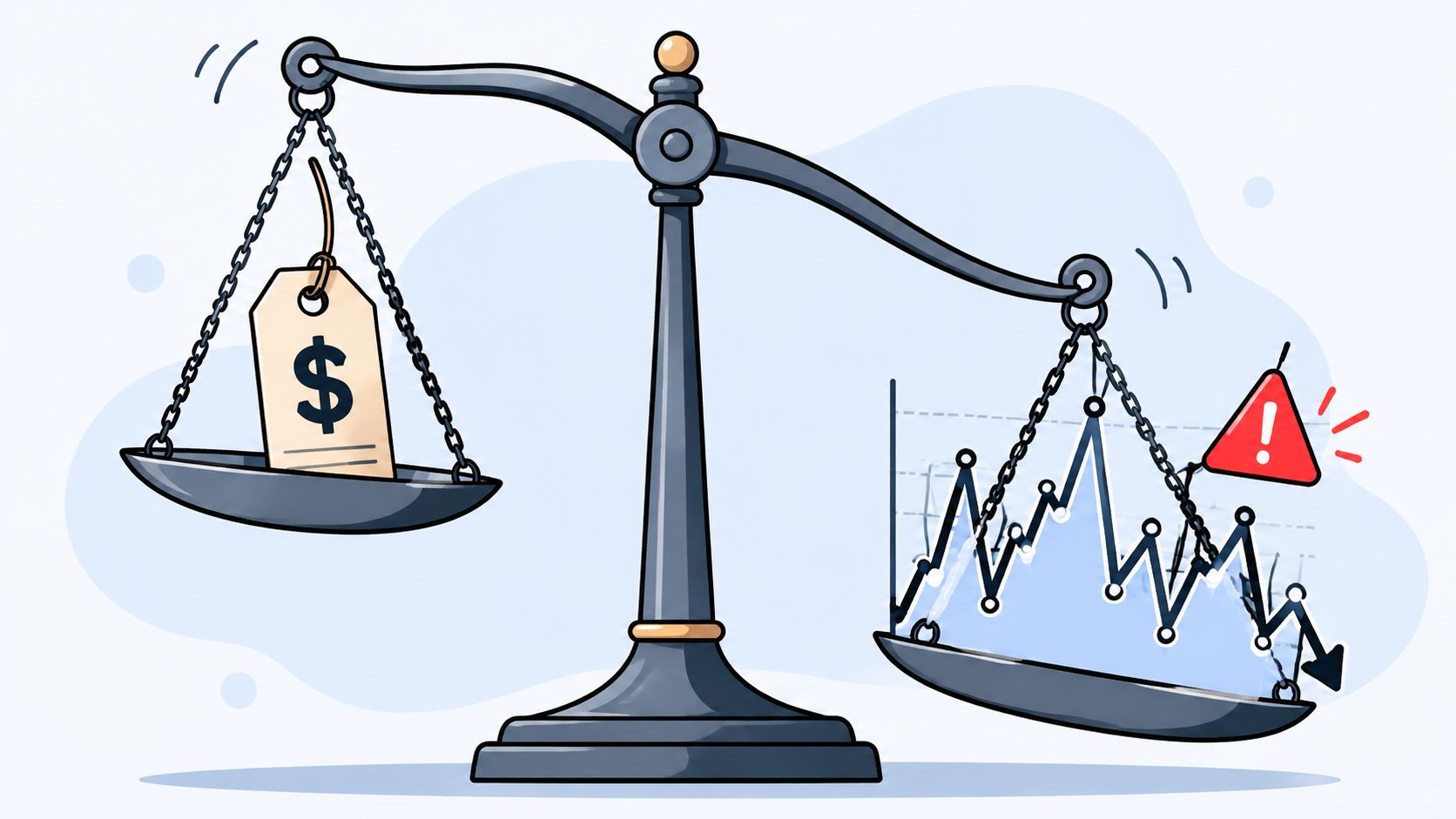
The market loves to praise flexibility and ignore the mess it creates. I've seen teams celebrate a new pricing model because it looks complex on paper, then spend the next quarter cleaning up confusion in renewals, approvals, and customer conversations. The problem isn't flexibility itself. The problem is pretending that more options automatically means better outcomes.
Flexibility without control becomes a tax on trust
In economic theory, perfect price flexibility means price moves the same percentage as marginal cost. If price moves less than marginal cost, it's inflexible (NBER chapter). That's a clean definition, but real software businesses don't live in theory. They live in contracts, renewal calls, support tickets, and procurement reviews.
A pricing system that changes often, but inconsistently, can make customers feel managed rather than served. When reps improvise, finance loses predictability and buyers start wondering whether they got a fair price or just a lucky break. I'd rather have a slightly less flexible system that customers trust than a highly elastic one that teaches them to negotiate every line item.
Practical rule: if your pricing logic can't be explained by a manager in one minute, it's probably too loose.
That's why the hidden risk is governance, not math. You can absolutely lose pricing power by adding too much discretion. A system with no guardrails invites exceptions, and exceptions become precedent.
The right amount of flexibility depends on the customer, not the trend
The best pricing model depends on market structure, demand dispersion, and operational complexity. That's the hard truth most “dynamic pricing” content skips. In inflationary periods, teams feel pressure to move faster, but that doesn't mean every category, segment, or customer group should move in the same way.
For SaaS, the question isn't whether you should be flexible. It's where flexibility serves the buyer. A simple self-serve product can tolerate more price movement than an enterprise contract tied to budgeting cycles and multi-year renewal planning. Customers don't reward cleverness. They reward clarity, consistency, and a price that feels tied to value.
A recent macro signal keeps that pressure alive. The U.S. CPI rose 2.7% year-over-year in June 2026, while euro area HICP inflation was 2.0% in June 2026 (euro-area source). Even without obsessing over the numbers, the direction is obvious. Pricing teams are still being asked to adapt quickly, but the customers on the other side of the table are more sensitive than ever to arbitrary movement.
Common Flexible Pricing Models for SaaS and Workplace Tools
Most pricing fights reduce to a few structures. I've negotiated enough software contracts to know the labels change, but the trade-offs stay the same. Some models reward growth. Some punish sprawl. Some look fair until the first true-up hits. You need to know which one you are buying before you sign.
Seat-based and modular pricing
Seat-based pricing is easy to grasp. You pay per user, which keeps buying simple and planning predictable. It works well when usage stays fairly even across a team, but it starts to feel punitive when headcount rises faster than the value each user gets.
Modular or add-on pricing gives buyers more control. You buy the core product, then add only the pieces you need. That helps teams that refuse to pay for features they will never touch, but it also creates more decisions, more procurement work, and more room for hidden costs to appear later.
Usage-based, credits, and tiers
Pay-as-you-go pricing ties cost to usage. That is attractive when consumption moves around, but it can make budgets noisy and harder to defend internally. Usage credits soften that by creating a pool of value you can spend more selectively, though they only work if tracking is crystal clear.
Tiered plans create structure. They simplify the pitch and make upgrades obvious, but they can also push customers into a larger plan than they need. That is where trust breaks down. Buyers do not mind paying more when the reason is obvious. They mind paying more when the packaging is built to force an upsell. For teams worried about getting stuck in a pricing box they cannot escape, a look at vendor lock-in in SaaS contracts is worth the time.
Seasonal and shift-based pricing
Seasonal pricing and shift-based pricing fit frontline operations better than office-software clichés ever will. A retailer with holiday surges, a logistics team with overnight shifts, or a healthcare group with changing coverage needs does not want a pricing system built for a static desk workforce. They want something that tracks reality. The trade-off is simple. Every extra layer of fit adds more admin, and admin is where pricing systems start to fall apart.
Model | Best For | Key Trade-off |
|---|---|---|
Seat-based pricing | Stable teams with predictable headcount | Simple to buy, painful when growth outpaces value |
Modular pricing | Buyers who want control over feature sets | More choice, more complexity |
Pay-as-you-go | Variable consumption and usage-based products | Fair on usage, harder to budget |
Seasonal pricing | Frontline teams with predictable peaks | Better fit, more operational planning |
Tiered plans | Products with clear value steps | Easy to sell, easy to overpack |
Usage credits | Teams that want flexibility with guardrails | Flexible, but tracking has to be tight |
Flexible pricing models at a glance
The model that feels fairest in a demo often becomes the model that feels messiest at renewal.
How Flexible Pricing Delivers Value and Where It Fails
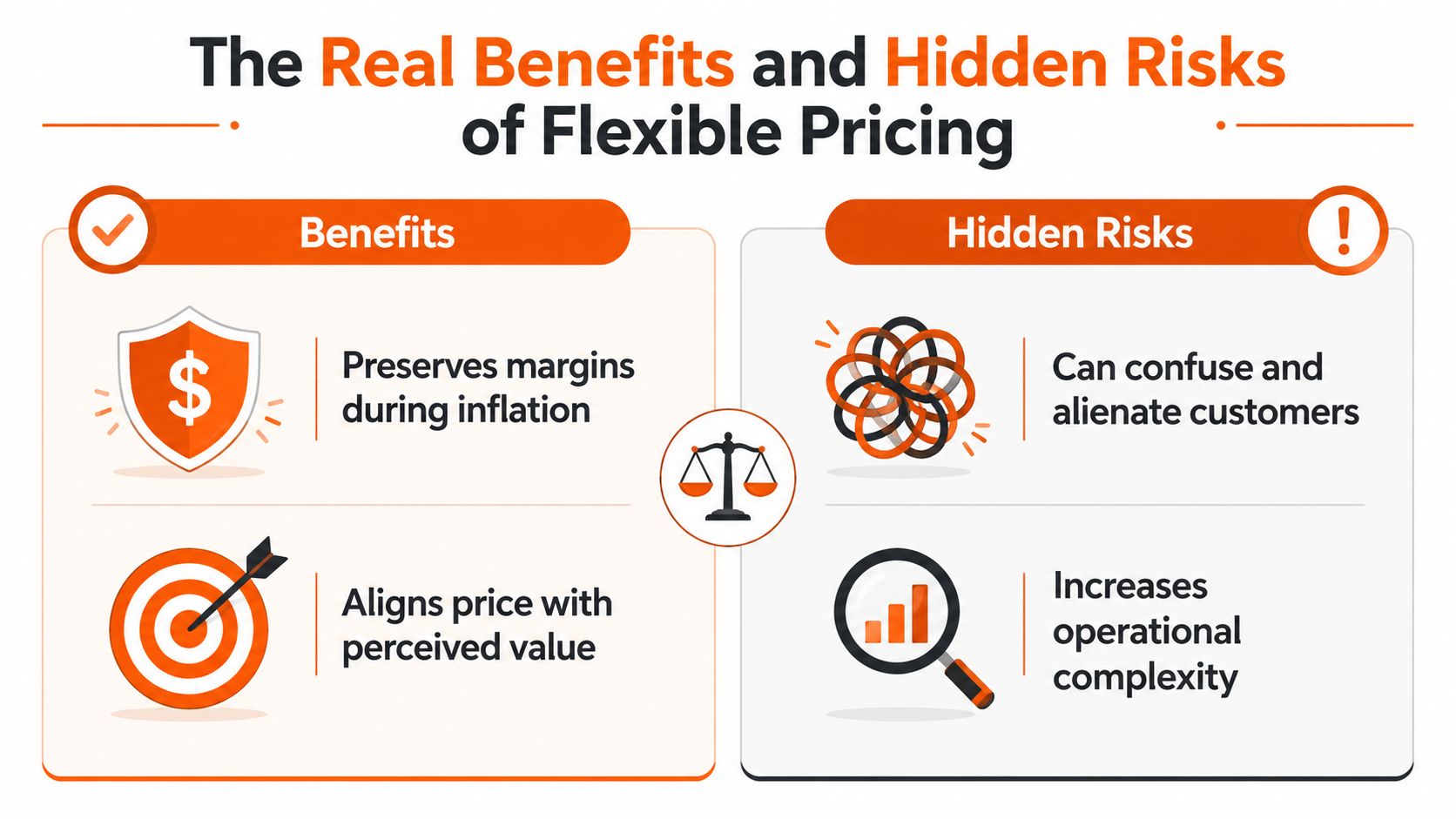
Flexible pricing earns its keep when the market is moving and product value is not flat. It helps companies protect margins when costs shift, line up charges with actual usage, and fit more customer types without forcing everyone into the same box. That upside is operational. It keeps revenue closer to reality.
The upside is operational
The strongest case for flexibility is straightforward. If your costs, demand, or customer usage change, a rigid price can leave money on the table or push buyers into the wrong plan. That is why McKinsey's building-materials work argues that pricing agreements should allow for flexibility and use the best and most recent data available, with microsegmentation of customers as one of the most powerful tools for agile margin management (McKinsey). The same logic applies in software, even if the mechanics look different.
There is also a practical onboarding benefit. A team that does not fit a standard package can get to value faster when the vendor has room to shape the deal. In SaaS, the first contract is rarely the last one, so the opening price and the way it is explained set the tone for the relationship. Done well, flexibility makes the buyer feel seen. Done badly, it creates suspicion before the product has a chance to prove itself.
The downside shows up in trust and governance
The hidden cost is how people react when prices move too often or too opaquely. Buyers can read that as arbitrary. Procurement teams can read it as unstable. Sales teams can read it as permission to negotiate every deal from scratch, which is how margin disappears and approval discipline gets weak.
Hard truth: the more exceptions you allow, the more your standard price starts to look fake.
That is also where vendor lock-in risk gets ugly. When a buyer cannot tell whether the next renewal will be predictable, they start to question whether the relationship is built on value or on control. A clear explanation of understanding vendor lock-in risks helps frame the issue properly. If flexibility is used to reward real differences in usage or scope, it builds credibility. If it is used as a catch-all for ad hoc discounting, it signals that nobody trusts the pricing model.
Analysts at the Federal Reserve found that the frequency of price changes rose sharply as inflation surged, then fell as inflation eased, while the average size of price changes increased and the absolute value changed little (Federal Reserve study). That points to a simple pattern. Firms responded to shocks by repricing more often, not just by making bigger jumps. That is useful when the business needs to stay aligned with costs. It becomes a problem when customers see every renewal as a fresh round of price discovery.
A quarter or two of churn often starts with a price that felt explainable to the seller and arbitrary to the buyer.
How to Choose and Negotiate Flexible Pricing Contracts
Don't start by asking for the “best” pricing model. Start by asking which model matches how the product will be used. That means looking at active user rates, feature adoption, seasonal patterns, and the gap between cost per active seat and cost per licensed seat. If those numbers are far apart, you need a pricing structure that respects that gap instead of pretending every seat is equal.
What to measure before you sign
Use the data you already have, or get it in a pilot. If a tool is supposed to serve 500 people but only 180 use it weekly, seat-based pricing can become a tax on the buyer. If adoption rises and falls by department or season, then a flexible model might be a better fit. If usage is spiky and tied to specific workflows, credits or usage-based billing may be cleaner.
For sellers, McKinsey's advice on microsegmentation is the right instinct. Set target prices at the intersection of customer type, order volume, customer potential, and regional competitive intensity. That's not about squeezing people. It's about avoiding blunt pricing that leaves money on the table in one segment and scares off another.
The clauses that matter
A flexible contract should still feel controlled. I look for clear caps on escalation, defined triggers for repricing, and a pilot period that gives me real data before I commit. I also want approval rules that keep informal exceptions from turning into permanent discounts. If your sales team can promise a special deal without finance signing off, you don't have flexible pricing. You have weak pricing.
Here's a simple way to understand it:
Escalation terms: spell out when price changes are allowed and who approves them.
Pilot structure: make sure the trial captures real usage, not just early enthusiasm.
Change clauses: define what happens if usage, volume, or scope changes mid-contract.
Approval process: stop ad hoc discounting from becoming a habit.
Negotiation rule: if the vendor can't explain how the price changes, the contract isn't flexible, it's vague.
For buyers who want a simple reference point, the pricing page for Pebb shows how a free entry tier can coexist with paid per-user plans. That kind of structure is easier to evaluate than opaque bundles because the trade-off is visible up front.
Pricing Flexibility for Frontline and Hybrid Teams
Most pricing advice assumes every worker sits at a desk and uses software the same way. That is not reality. A warehouse crew on rotating shifts, a retail floor that fills up during holidays, and a hospital team that expands and contracts with patient demand all use tools differently. Pricing should follow that rhythm, not fight it.
When shift patterns matter more than headcount
Seasonal and shift-based models make sense when access is uneven. A hospitality group does not need the same usage profile in a slow month that it does during peak travel periods. A logistics team may need more communication and scheduling capacity during busy windows, then less later. A flat, always-on license can waste money when seats sit idle.
That is why flexible pricing works well for workplace tools tied to scheduling, clock-in, communication, and task coordination. The goal is to stop paying for ghost seats that never carry work. If a tool is part of the daily operating system, the pricing should match that operating pattern, not pretend usage is constant.
Fairness at the edge is the real test
Frontline teams care less about pricing theory than whether the tool fits the way they work. If the model feels fair during the busiest weeks and still makes sense in the slow ones, adoption holds up. If it does not, people work around it. Then adoption falls, and finance gets blamed for a pricing decision that was set badly from the start.
Hybrid tools can be priced well or badly. If they serve a mix of office staff and shift workers, a rigid structure usually punishes one group to subsidize the other. The cleaner approach is to separate core access from variable usage, then price the variable part in a way that mirrors real activity. That keeps the contract understandable and lowers the odds that managers start treating exceptions as entitlement.
Governance matters here more than most vendors admit. If pricing changes every time a site manager asks for a favor, trust erodes fast. Teams need to know which usage changes are expected, which exceptions require approval, and which discounts are temporary. Without that discipline, flexible pricing turns into inconsistent treatment, and inconsistent treatment is how you lose retention while thinking you are being accommodating.
If you are comparing workplace models, the traditional lease vs flexible space comparison is a useful parallel. The same trade-off shows up here. Stability has value, and so does avoiding capacity you will not use.
Your Implementation Checklist and Real-World Examples
Flexible pricing only works if the machinery behind it is real. You need dashboards that show usage and margin in near real time, shared rules across sales and finance, and systems that can push changes across catalogs, invoices, and checkout flows without manual cleanup. If you don't have that, the pricing model will look smart in a deck and sloppy in production.
What to get in place first
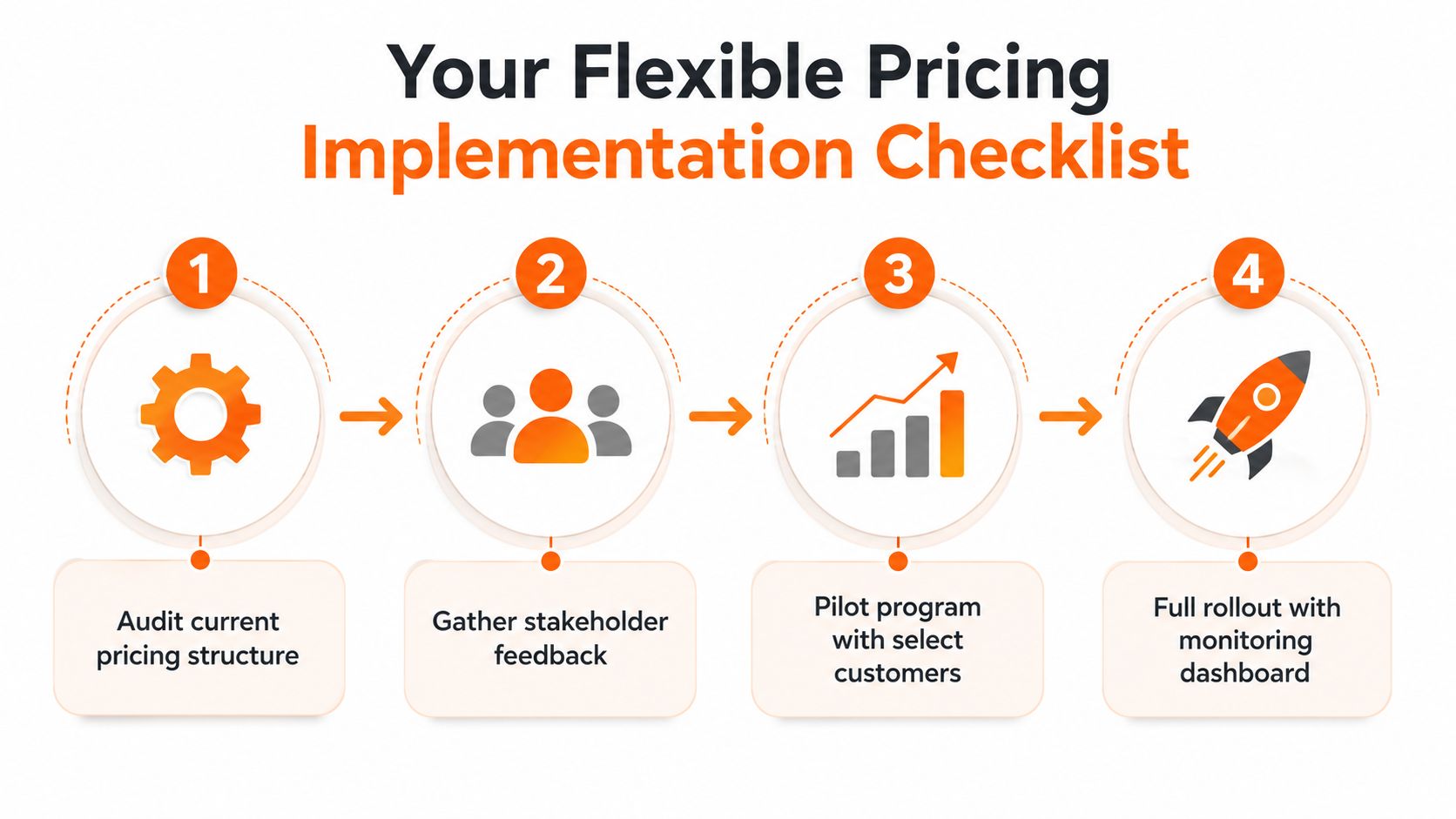
Start with the audit. Know which customers are overpaying for unused capacity and which segments are under-monetized. Then get stakeholder feedback from sales, finance, and product, because each group sees a different failure mode. Run a pilot with select customers before you roll anything wide. Last, wire up monitoring so you can see what changed and what broke.
A seller also needs a rule for when flexibility is allowed. McKinsey's microsegmentation point matters here, because a flexible price that's set deliberately is better than one negotiated casually. That's also where operational tools matter. For teams evaluating workplace platforms with pricing and governance in mind, this comparison of Pebb and Unily is a practical reference point for understanding how product scope and pricing shape adoption.
Two examples worth copying
A mid-sized retail chain moving from flat-rate pricing to seasonal pricing for its workforce communication tool made sense because usage rose and fell with holidays. The value was concentrated during peak periods, not evenly spread across the year. The pricing change matched the business, and that alignment matters more than clever packaging.
A SaaS company that introduced usage credits to reduce churn among smaller customers was solving a different problem. Some customers didn't want to commit to a bigger plan, but they still needed room to grow. Credits gave them flexibility without forcing an immediate leap.
Pebb also fits this conversation as a simple example of a mixed model. It offers a free Standard plan for up to 15 employees, a Premium plan at $4 per user per month, and a Basic plan at $2.50 per user per month on some pricing pages. That kind of ladder gives small teams a lower-friction start while keeping the paid structure visible.
When Stability Matters More Than Flexibility
There is a point where more flexibility starts to work against you. Customers do not always want a price that changes with every usage shift or every negotiation round. They want a number they can trust, budget against, and explain inside their own organization without turning it into a long justification. That matters most when procurement is involved, when employee spend is reviewed closely, or when renewals repeat on a fixed cadence.
Know when to leave the price alone
The stronger lesson from pricing research is that flexibility and consistency solve different problems, so the right choice depends on how volatile demand is, how wide the customer base is, and how hard the model is to run. I read the CESifo paper as a warning against turning flexibility into a default reflex. If your buyers value predictability more than fine-tuned optimization, a stable price is usually the better product.
Inflation still puts pressure on pricing teams, even when the worst spikes have passed. Cost pressure has not disappeared. That does not mean every response should be a more complicated pricing sheet. In many cases, the cleaner move is to hold the line, reduce back-and-forth, and make the buying process easier for the customer.
Balance beats constant movement
Office space makes the trade-off obvious. The gap between traditional lease vs flexible space is really about how much certainty a business wants versus how much optionality it needs. Pricing works the same way. Too rigid, and you miss demand. Too fluid, and the customer starts to feel like the price is moving under them.
The practical rule is simple. Use pricing flexibility when it helps you match real usage, protect margin, or reduce friction at purchase. Keep it out of the way when the customer needs stability more than sophistication. Governance matters here too. If every deal is priced differently without a clear logic, sales starts improvising, finance loses control, and the customer loses confidence. The goal is trust, not cleverness.
If you want a workplace app that keeps communication, tasks, scheduling, and engagement in one place while giving teams a straightforward way to manage access and adoption, take a look at Pebb. It fits when you want pricing and usage to stay understandable, not mysterious.
