
How We Manage Remote Teams Without Burning Out
Tired of generic advice? Learn the real principles we use to manage remote teams effectively. A practical guide on communication, culture, and accountability.
Dan Robin
Let's be honest. Managing a remote team has almost nothing to do with recreating the office online. If you're swapping cubicles for constant video calls, you're already lost. The real work is a shift in mindset—from tracking presence to trusting your people and measuring their progress.
This isn't about logistics. It's about building a calm, intentional foundation of trust and clear communication. It's how you help a team thrive, no matter where they are.
The Big Remote Work Myth We All Believed
When we first went remote, we thought we had it all figured out. We’d just do everything we did in the office, but through a screen. Same meetings, same 9-to-5 pressure, same everything.
It was a disaster.
What started as a scramble to get everyone online quickly turned into a slow-burn crisis. We were drowning in back-to-back video calls. The pressure to always appear "online" was crushing everyone. We were busy, sure. But we weren't productive. The burnout was real.
That’s when it hit us. Managing a remote team isn't about finding the right tools; it’s about embracing a new philosophy. The goal isn't to watch people work. It's to create an environment where great work can happen, calmly and effectively.
A New Playbook for a New Era
This realization forced us to tear up our old rulebook. Remote work isn’t a temporary fad; it's here to stay. A 2024 McKinsey study found that 87% of workers offered at least some remote work take the opportunity. And for good reason. Data shows remote workers often report a 35-40% increase in output thanks to fewer interruptions. You can dig into more of this data on the state of remote work from Neat.
But those benefits don't just happen. They're the result of intentional design. This guide is built on the lessons we learned the hard way—through trial, error, and a whole lot of listening. This isn't corporate theory. It's what we do every day to run a productive, engaged, and genuinely happy remote team.
We stopped asking, "Is everyone at their desk?" and started asking, "Does everyone have exactly what they need to make progress?" That one shift changed everything.
This is our story of moving from frantic oversight to quiet confidence. It’s about building systems of trust, embracing asynchronous work, and finally learning to measure what actually matters: the work itself.
And we'll show you exactly how we did it.
Your Communication Rhythm Defines Your Culture
Here’s the thing about remote work: your communication is your company culture. It’s not about beanbags or ping-pong tables anymore. Your culture lives in the daily rhythm of how information flows, how decisions get made, and how people feel connected to the work and each other.
When we first started, we got this completely backward. We treated communication as a series of announcements and meetings. We quickly learned that a healthy remote culture is built on calm, intentional communication—not just more of it.
Sync vs. Async: The Great Misunderstanding
The most common mistake I see is defaulting to meetings for everything. This creates a culture of constant interruption that kills deep work. Honestly, it's the fastest track to burnout.
Synchronous communication—happening in real-time—is for urgency, complexity, and connection. Think brainstorming sessions, sensitive feedback, or a true crisis. It’s powerful, but it’s expensive. It costs everyone their focused time.
Asynchronous communication—on your own time—should be your default. It's perfect for status updates, thoughtful feedback, and general announcements. This approach respects time zones and focus periods, building a culture of trust and autonomy. Let's be honest: most things don't require an immediate response.
We operate on a simple principle: protect your team's time and attention like it's your most valuable asset. Because it is. This means defaulting to async and treating meetings as a last resort, not a first step.
For us, this means project updates happen in a shared document, not a weekly status meeting. Company news is a well-written post, not an all-hands call that could have been an email.
This simple decision tree helps visualize the core problem: are you just running an office online, or are you building a true remote-first operation?
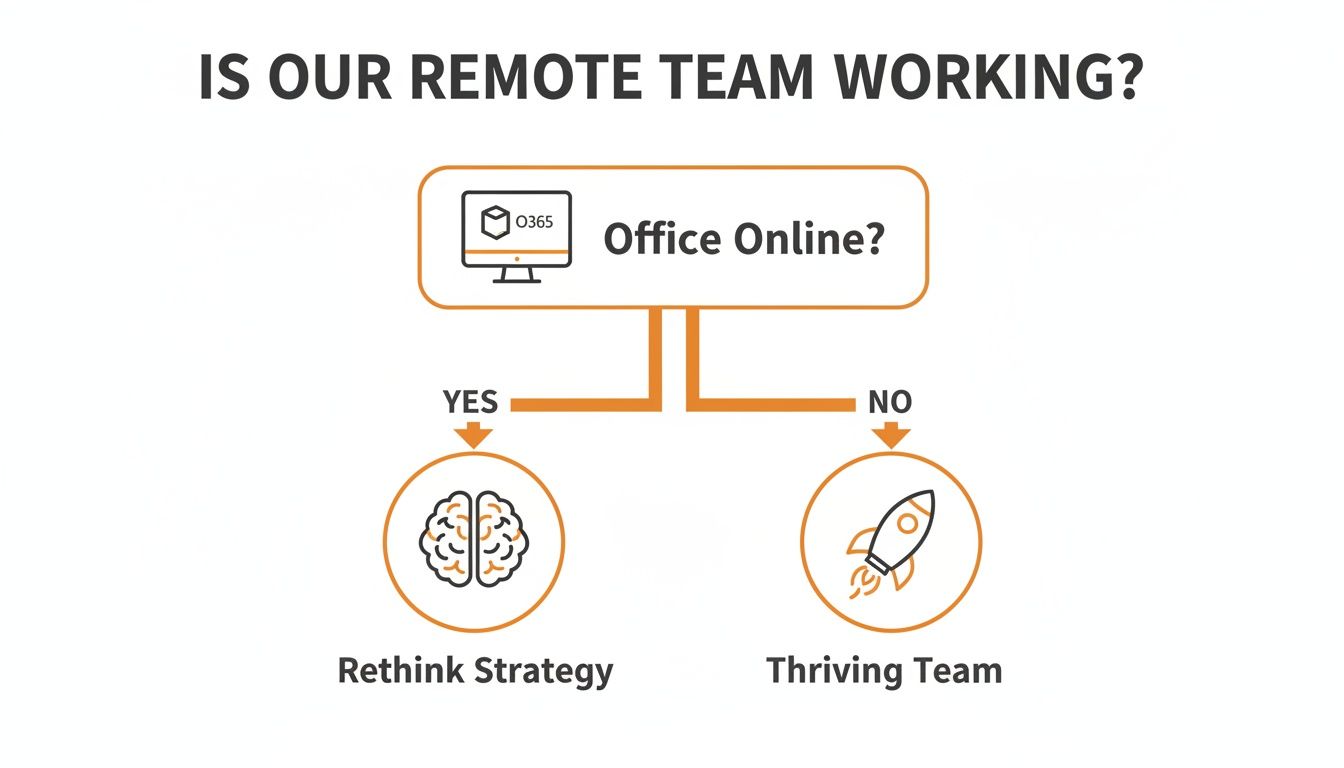
If you're just replicating old office behaviors online, your strategy needs a rethink. It’s not the sign of a thriving team.
To make the right call, we use a simple guide. Getting this right is a game-changer for reducing meeting fatigue and giving people back their focus.
Sync vs Async Communication: When to Use Each
Situation | Choose Synchronous (Live Meeting/Call) | Choose Asynchronous (Written Update/Message) |
|---|---|---|
Brainstorming & Complex Problems | When you need to bounce ideas off each other in real-time or untangle a complicated issue together. | For initial idea gathering or when feedback can be given thoughtfully over time without a live discussion. |
Giving Sensitive Feedback | Always. Nuance and tone are critical here, and a live conversation helps avoid misunderstandings. | Never. This type of feedback should be handled with care in a private, real-time conversation. |
Team-Building & Social Connection | Virtual coffee chats, team-building activities, and 1-on-1s that are meant to build rapport. | Sharing personal updates in a dedicated chat channel or celebrating wins with public praise. |
Urgent Decisions (True Emergencies) | When a critical issue needs immediate input from multiple people to be resolved right now. | For most decisions that need input but aren't on fire. Allows for more thoughtful, well-reasoned responses. |
Project Kickoffs & Onboarding | To build excitement, align on vision, and answer initial questions in a dynamic way. | To share background documents, project briefs, and onboarding materials for review ahead of time. |
Regular Status Updates | Avoid this. Status meetings are often a time-sink that can be replaced with better async methods. | The ideal choice. Use project management tools, shared docs, or weekly written summaries. |
Making a conscious choice between sync and async isn't just about efficiency; it's about respecting your team's most finite resource: their attention.
Build a Central Hub, Not a Firehose
The goal isn't just to reduce meetings, but to create absolute clarity. The best antidote to chaos is a single place where important information lives. For us, this is our Pebb platform, but the tool itself is less important than the principle.
Instead of scattering updates across email, chat, and a dozen documents, we commit to one source of truth.
Company News: Major announcements go into a dedicated feed. Everyone knows where to look.
Project Updates: Each project has its own space for progress reports and files. No more hunting through old chat threads.
Team Knowledge: Important policies and guides are stored in a central library, accessible to everyone.
This approach makes communication feel calm and findable. It reduces the fear of missing out and lets people truly disconnect, knowing they can catch up efficiently. It’s how you give your team the gift of uninterrupted time—the most valuable resource you have.
Build Trust Through Radical Clarity
You know what makes a remote team feel chaotic? Ambiguity. When people don't know who owns what, what "done" looks like, or how their work is measured, they fill that silence with anxiety.
The fix isn't more status meetings. It's a system built on radical clarity.
This isn't about top-down accountability. It’s about building a framework where expectations are so clear that people can take true ownership. Nobody enjoys chasing a teammate for an update or wondering if their contribution even matters.
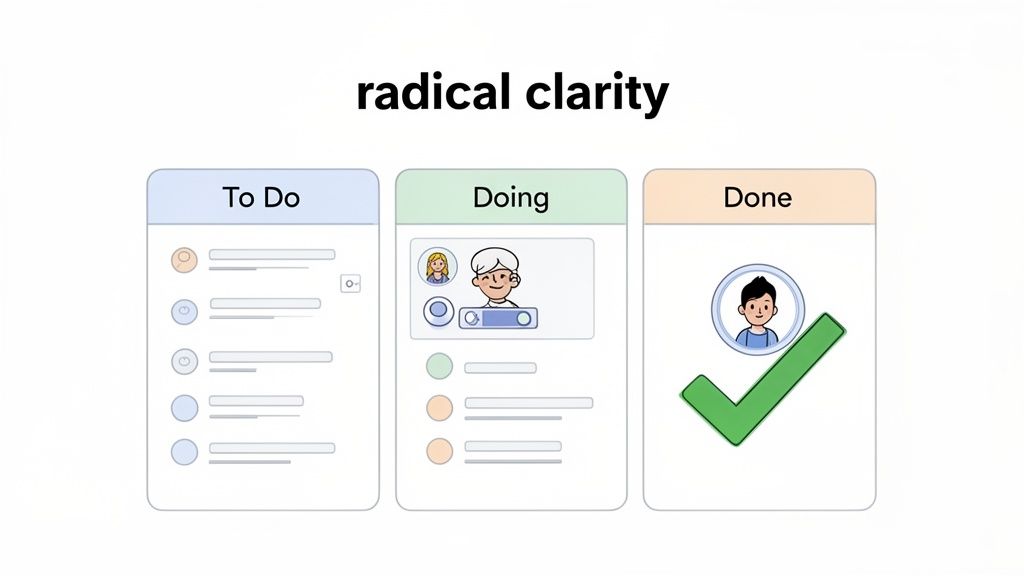
Create a Single Source of Truth
To manage a remote team well, you need one place where work lives. For my teams, this has always been a straightforward task board. It doesn't have to be a fancy tool, but it must be our non-negotiable source of truth.
Every project gets broken down into clear tasks. And every task meets a few simple criteria:
One clear owner. Never assign a task to a group. One person is on the hook.
A specific due date. "Sometime next week" is a recipe for disaster. "End of day Tuesday" is clear.
A definition of "done." This is critical. Does "done" mean a draft is submitted, or a feature is live? Spell it out.
This system isn’t for micromanagement; it’s for visibility. It gives anyone the power to see what everyone else is working on. It kills the need for those focus-shattering "just checking in" messages.
Performance Is About Outcomes, Not Hours
Here's another hard truth: clock-watching is a fool's errand. Measuring performance based on hours logged or how quickly someone responds on Slack is a terrible indicator of their contribution. It just encourages people to look busy, not to do great work.
We had to shift our entire approach to focus solely on outcomes. Frankly, I don’t care if you work from a coffee shop at 6 AM or your couch at 10 PM. I care about the quality of your output and whether you deliver on time.
Trust isn’t just a feeling; it’s a system. When you create a system where responsibility is clear and outcomes are visible, trust becomes the natural byproduct.
This approach demands a different kind of feedback. Instead of waiting for an annual review, we give feedback in the context of the work itself, often in the comments of a specific task. It’s ongoing, specific, and tied to the project goals we all agreed on. This clarity is the bedrock for a team that feels both autonomous and accountable.
If you're looking for more on this, we've put together a practical checklist for building trust in remote teams that you might find helpful.
Creating Connection From A Distance
How do you make someone feel like they're part of a team when they’ve never shaken anyone's hand? I’ve learned the answer begins and ends with onboarding.
A clunky remote onboarding is like being dropped into a foreign country without a map. It’s disorienting. It leaves your new hire feeling isolated and probably second-guessing their decision. Get it right, however, and you can build a powerful sense of belonging from day one.
More Than Just a Laptop and a Login
Let's be real—the logistics are the easy part. Shipping a computer and setting up accounts is a checklist. The real work is making a new person feel seen and connected. It’s about intentionally designing the spaces where relationships can form.
I'll admit, we learned this the hard way. In the early days, our onboarding was all process and no person. It was efficient, sure, but it felt cold. We were so focused on getting people ready to work that we forgot to make them feel welcome.
Now, our entire approach is built around a few simple, human principles.
The goal of remote onboarding isn't just to make someone productive. It's to make them feel like they've found a place where they truly belong.
That single shift in perspective changed everything. We moved from a purely transactional process to a relational one.
Engineering Serendipity
In an office, connections spark organically—at the coffee machine, walking to a meeting. Remotely, you have to engineer those moments. This isn't about forced fun or awkward virtual happy hours. It’s about creating low-pressure opportunities for people to find common ground.
Here’s what that looks like for us:
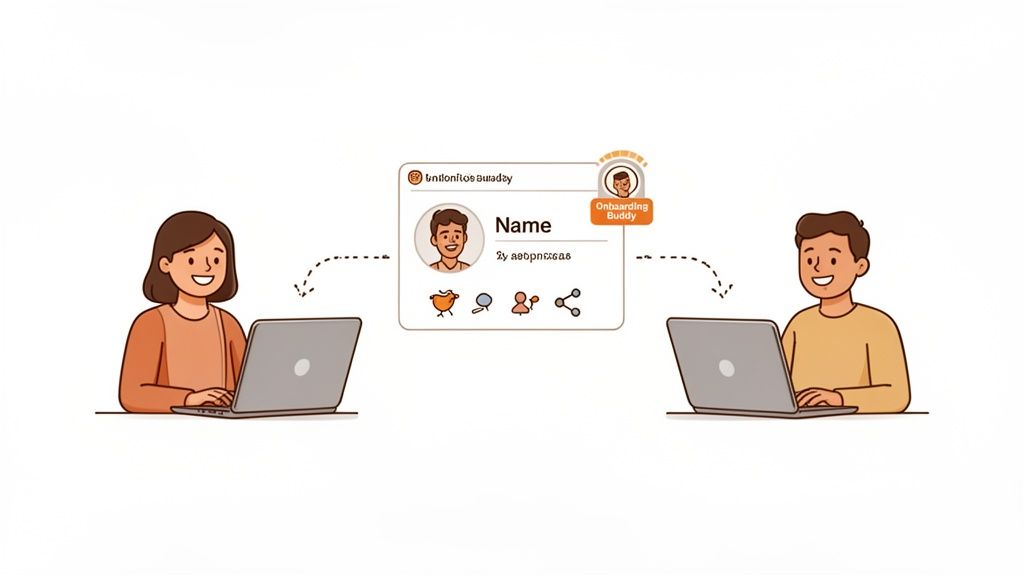
Assign an Onboarding Buddy: Every new person gets paired with a seasoned team member who isn't their manager. This buddy is their go-to for all the "silly" questions. It provides an instant, friendly lifeline.
Build Out Rich Employee Profiles: We encourage everyone to fill out a personal profile that goes beyond their job title. What are their hobbies? Favorite movie? This simple tool makes it easy to discover shared interests and strike up a conversation.
Lean on Informal Channels: We have dedicated Slack channels for non-work chatter, like #music, #pets, and #cooking. These are our digital watercoolers where people can connect as humans, not just as colleagues.
None of this is rocket science. It's just about being deliberate. The first few weeks set the tone for an employee’s entire journey. Make them count.
For a deeper dive, check out our guide on how to create connection in remote workplaces.
The Unwritten Rules You Have to Write Down
Every office has unwritten rules. Don’t microwave fish in the kitchen. Don’t book the big conference room for a solo call. We pick these things up by just being around each other.
But when your team is remote, that cultural osmosis doesn't happen. If a rule isn't written down, it doesn't exist.
Leaving crucial norms unspoken is a one-way ticket to burnout. You'll have team members trying to collaborate across impossible time zones or feeling pressured to be "always on." It's not a sustainable way to work.
This is where you have to get deliberate. Think of these not as rigid policies, but as guardrails that protect your team’s time, focus, and sanity.
Setting Clear Boundaries for Time and Attention
One of the first things we put in place was a policy of "core collaboration hours." This is a set four-hour window each day where everyone, no matter their time zone, is generally available for quick chats.
Outside of that window? Your time is your own. Structure your day in whatever way helps you do your best work. This gives us the best of both worlds: a predictable block for real-time connection and long stretches for deep, focused work.
We also had to get serious about managing time off. On a global team, you can’t just wing it. Now, all time off goes into a central, shared calendar. This small act of transparency has been a game-changer, preventing scheduling meltdowns and making project handoffs a breeze.
The point isn't to micromanage schedules. It's to provide a clear structure that respects everyone's personal life while keeping the team moving. It's freedom within a framework.
Let’s be real, this is a huge factor in keeping great people. A staggering 55% of employees say they would likely look for a new job that offers a better work-life balance. And with 36.2 million Americans projected to be working remotely by 2025, clear guidelines are no longer a "nice-to-have." They are how you compete. You can see more remote work statistics from Zoom here.
Protecting Your Team’s Wellbeing
How do you get people to log off when their office is their living room? You have to spell it out. Our rule is simple: there is zero expectation for replies after your designated working hours. If I send a Slack message at 9 PM, it's because an idea popped into my head—not because I expect a response.
To make sure everyone understands these norms, we found it helpful to learn about creating standard operating procedures. When you document these things, they become real.
These guidelines are the bedrock of a healthy remote culture. They turn fuzzy concepts like "work-life balance" into concrete actions. It's how you build a company where people can thrive without sacrificing their well-being. For more ideas, we have a whole guide on work-life balance strategies for remote teams.
Measuring What Matters
So, you’ve done the work. You’ve set up communication rhythms, clarified ownership, and documented the unwritten rules. But how do you know if any of it is working?
The old ways of measuring productivity—hours logged, green status lights, reply speed—are worse than useless. They’re a distraction.
Let’s be honest. That urge to see people working is a tough habit to break. You have to learn to measure the ripple effects, not the initial splash. Forget activity trackers. All they tell you is that people are busy, not that they're making an impact.
Instead, I've learned to watch for quieter, more powerful signals that show a team is hitting its stride. These are the signs of a calm, effective group.
From "Are You Busy?" to "Are We Winning?"
We stopped asking, "What did you do today?" and started asking, "Did we move the project forward?" This means shifting your focus to a handful of indicators that reveal the true health of your system, not just the hustle of your people.
Here are the few things we actually pay attention to:
Project Cycle Times: How long does it take for an idea to become a finished project? If that timeline is getting shorter and more predictable, your communication is clear and your processes are working.
The Quality of Collaboration: Look in your shared documents. Are there thoughtful comments, healthy debates, and clear resolutions? This is where the real work happens, and its quality tells you everything.
Employee Retention: This is the ultimate metric. Are your best people choosing to stay? Happy, productive people don't look for other jobs. High turnover is a blaring alarm that something is broken.
The real measure of a well-managed remote team isn't how busy they look. It's the quality of their work, the calmness of their collaboration, and their desire to stick around.
This approach requires trust that can feel uncomfortable at first. I get it. It means letting go of the need to control the "how" and focusing entirely on the outcome. For a deeper dive, check out these best practices for managing remote teams.
When you get it right, a thriving remote team feels less like a frantic call center and more like a quiet workshop. The signs of success are subtle, but they’re the only ones that matter.
Got Questions? We've Got Answers
Over the years, I've heard just about every question there is about managing remote teams. Let's tackle a few of the most common ones.
How Do I Actually Measure Performance When I Can't See My Team?
Honestly, this trips people up the most, but the answer is simple: stop counting hours. The best way to gauge performance is to focus on outcomes, not activity.
What does that mean? It means setting clear, measurable goals for projects and tracking progress in a shared tool like Trello or Asana. This shifts the conversation from "Are they online?" to "Did the work get done well and on time?"
It also means moving away from annual reviews. Instead, build a habit of giving frequent, informal feedback right in the flow of work. Trust your team to deliver, and measure them on the quality of that delivery. That’s it.
What's the Biggest Mistake New Remote Managers Make?
Oh, this one is easy. Trying to perfectly replicate the in-office experience online. It’s a recipe for disaster.
That thinking leads to soul-crushing video meetings and a constant barrage of chat pings. It creates a culture where everyone feels pressured to look busy all the time. It's exhausting and counterproductive.
The real secret is to lean into asynchronous work. Help your team manage their own time. Your job isn't to be a digital watchdog; it's to provide radical clarity on goals and then get out of the way.
How Can We Build a Real Team Culture Without an Office?
Culture isn't about forced happy hours or ping-pong tables. It's built in the small, everyday moments of connection. You have to be intentional about creating space for them.
Use your main communication hub for more than just work talk. For example, in Slack or Microsoft Teams, you can:
Create channels for hobbies like
#book-club,#gaming, or#gardening.Have a channel dedicated to sharing personal and professional wins.
Use a kudos feature or simple shout-outs to celebrate each other's great work.
True culture isn't built in a single event. It’s forged through intentional, consistent moments of genuine connection. That’s what creates a team that sticks together.
When you create these little pockets for people to be themselves, a strong, authentic culture naturally follows. What really matters is that your team feels like they can do their best work, feel supported, and then log off and live their lives. That’s the real goal, isn't it?
Ready to build a calmer, more connected remote team? With Pebb, you can bring your people, work, and culture together in one simple platform. See how it works.
